https://www.tf1.fr/arte/arte-journal/videos/arte-journal-54331361.html
Archive
A vendre d’occasion une machine d’assistance à la récolte d’asperges blanches et vertes Baggioni par le Bon Coin
La récolte des asperges blanches a commencé dans les Landes par Landes Info
A vendre d’occasion plastique thermique pour asperge blanche ou verte par le bon coin
https://www.leboncoin.fr/ad/materiel_agricole/2942505394
Agrivaloire vous propose son catalogue de variétés si vous avez l’intention de planter des asperges à l’avenir
GA-OGV and VSSE on the marketing of German asparagus: “The food retail customer wants German green asparagus” by FreshPlaza
GA-OGV and VSSE on the marketing of German asparagus:
“The food retail customer wants German green asparagus”

Simon Schumacher added that, at the beginning of the barbecue season, there is a large buffer of old white asparagus plants for the green asparagus production. “I agree with Mr. Meinhardt. It’s better to plan for green asparagus and then sell the planned green asparagus,” Vielhauer pointed out.
Aldi advertises the fact that from a certain point in time, it will only sell German asparagus, Schumacher continued, asking whether this trend will continue. “I think that the trend is definitely there.” The question is whether the food retail industry is willing to pay for German asparagus. “This is always my fear. Aldi had German green asparagus for one year, and then it was suddenly too expensive for them. Then they sold Spanish asparagus again because that was the cheaper product available.”
Last year, the industry campaigned for an extension to 24 cm, Schumacher pointed out. This would have led to a theoretical 10 percent increase in the volume of white asparagus. “Of course, the increase in volume was not quite as high as calculated because the spears were already 23 cm long. This was secretly allowed. For me, the clear realization from 2024 is: please no longer than 24 cm. 24 becomes 25 – it no longer looks nice, and then we really have woody asparagus,” says Vielhauer.

Day of the German asparagus
Since 2023, there has been the Tag des Deutschen Spargels (en.: Day of German Asparagus), which this year again takes place on May 5. In the first year, retailers adopted the idea into their advertising leaflets, which was significantly less last year, Schumacher noted, and asked for further ideas to involve retailers without turning this promotional campaign into a junk day. “Personally, I think the Tag des Deutschen Spargels is great,” replied Vielhauer. “It gets people talking about asparagus. Some great marketing tools have been developed that retailers can use. But everyone knows that the food retail industry has of course already planned everything – including their own flyers. It is up to all of us to bring this topic to the attention of the retail industry again. The day itself falls perfectly between Easter and Mother’s Day because there is plenty of asparagus then.”
In this context, Schumacher also mentioned the new Herkunftskennzeichen Deutschland, a German origin label. The hope is that consumers will be more likely to buy asparagus with this label, especially green asparagus. “If you ask me personally, it’s just one more label. This label is not as distinctive as I would like it to be. In principle, you need one that immediately catches the consumer’s eye. I have the impression that the label is not that eye-catching.”
The stars are aligned quite well
Finally, Schumacher asked for an outlook. “We’ll keep fighting,” said Vielhauer. “I think the stars are aligned quite well: the film is on, Easter is ideally placed this year. But if it’s 30 degrees again from April 25 to May 30, the world will look quite different. What the consumer is in the mood for is also still something to consider,” he concluded.
Photo credit: VSSE
For more information:
Karl-Martin Vielhauer
OGA / OGV Nordbaden eG
Industriestr. 1-3
76646 Bruchsal
Tel +49 7251 8002-0
Mail: mail@oga-bruchsal.de
Web: https://www.oga-bruchsal.de
Abundant asparagus supply from Caborca, Mexico expected by FreshPlaza
Abundant asparagus supply from Caborca, Mexico expected
With volume from Caborca, Mexico ramping up, the industry is working on rolling out promotions for late February and early March. “We are anticipating an abundant supply of high-quality asparagus from Caborca during that time,” said Fortune.
 Adriana Fortune pictured in asparagus field.
Strong demand ahead
The market for green asparagus has been strong recently as less volume is typically available in December and January. As a result, retail prices have risen slightly. “However, they have remained well below last year’s peak when some stores were selling asparagus for $7.99+ per bunch.” A combination of retail promotions and a late Easter holiday are expected to result in strong demand in the months ahead. “Easter has traditionally been a strong holiday for asparagus sales, and we expect robust consumer demand, which is a great sign for the market,” Fortune commented. She recommends retailers to explore promotional opportunities in order to maximize sales volume.

 For more information:
Adriana Fortune
Gourmet Trading Co.
adrianaf@gourmettrading.com
www.gourmettrading.net
Indalecio Cáceres, de San Isidro de Loxa : « Nous espérons obtenir un bon prix avant que la production d’asperges nationale ne commence » par FreshPlaza
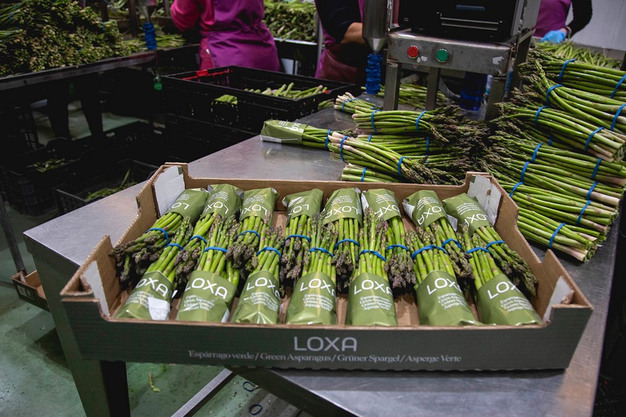
Indalecio Cáceres, de San Isidro de Loxa :
« Nous espérons obtenir un bon prix avant que la production d’asperges nationale ne commence »

« Les prix sont bons en ce moment car il n’y a pas encore de gros volumes d’asperges au niveau national. Il arrive toujours un moment où, soit en raison de l’encombrement de la récolte, soit à cause des fêtes de printemps, la fermeture des marchés est plus longue que d’habitude lors des pics de production de la saison, lorsque les prix chutent et qu’il est très difficile de les faire remonter. C’est pourquoi nous espérons que les niveaux du début de la saison se maintiendront le plus longtemps possible. »
« Le point positif est que cette année, il y a eu plus de pluie que les années précédentes. L’année dernière, la récolte a été très courte en raison de la sécheresse, et l’année précédente, elle a été encore plus courte ; et bien que nous ne nous approchions pas encore des 3,2 millions de kilos d’il y a trois saisons, cette année, nous dépasserons de loin la production de 2024. Maintenant, nous sommes à la merci du gel, car dans une saison qui commence en février, c’est un risque qui nous accompagne même au printemps. »

« Les températures sont de plus en plus douces en hiver ; en fait, les amandiers sont déjà en fleurs dans cette zone de Loja. Mais cela ne veut pas dire que des gelées tardives ne peuvent pas se produire et anéantir toutes les fleurs des arbres qui avancent de plus en plus dans leur production, ou les asperges qui ont déjà poussé. »
Concrètement, à Grenade, le mois de novembre a été qualifié d’extrêmement chaud avec des températures qui ont établi de nouveaux records historiques et le mois de janvier a été à nouveau plus chaud que la normale, mais heureusement avec les précipitations nécessaires pour la saison de l’asperge verte à Loja, où ce légume est principalement cultivé sur des terres non irriguées.

« Pour l’instant, nous sommes très satisfaits du début de la récolte et nous espérons atteindre une bonne moyenne avant que la production d’asperges nationale ne commence. Le Pérou ou le Mexique, qui exportent encore des asperges, ont un impact sur nos prix, mais lorsqu’ils commenceront à produire leurs propres asperges vertes, l’Italie, vers laquelle nous exportons un volume important cette saison, ou l’Allemagne, directement, ne nous achèteront plus. »
 Pour plus d’informations :
San Isidro de Loxa S.C.A.
Polígono Manzanil II, Avenida José Velasco, S/N
18300, Loja (Granada) – Espagne
https://www.loxa.es/
“The acceptance of white asparagus of 24 cm has proven to be just a decision on paper” Delta Star by FreshPlaza
“The acceptance of white asparagus of 24 cm has proven to be just a decision on paper”

As for the weather conditions, they are favorable for the asparagus crops. “We have already covered the farms, and the weather is chilly and dry so far. This is good for the growth of the plants. We hope this benevolent weather remains. Personally, I have invested in early cultivars, such as Vitalim and Maralim, so I expect to begin harvesting soon,” says the Greek entrepreneur.
Delta Spar, like all agricultural companies in Kavala, is simultaneously engaged in the kiwifruit business. Mr. Papargyriou describes the declining asparagus crop in favor of green kiwifruit: “Greek consumers have never shown any interest in asparagus. Meanwhile, asparagus exports 20 years ago were reaching 25.000-30.000 tons, but now they have been limited to about 4.000-5.000 tons. This is not because there is no demand from abroad. On the contrary, we see good demand. However, asparagus is far more difficult to cultivate. It is a labor-intensive crop, and workers are missing. At the same time, production costs rise, while prices paid to producers remain stable. On the other hand, kiwifruit is easier to cultivate and commands far better prices, so producers put emphasis on Hayward crops.”

The Greek exporter remains skeptical about optimistic expectations concerning the approval of marketing white and purple asparagus of 24 cm. He saw no demand for such products last season, which was the first in which this measure took effect. As he comments: “Theoretically, someone should say that this is good. However, it has proven to be just a decision on paper. Speaking from my own experience, I see no difference and do not expect to see any. It doesn’t matter what the new regulations say, as long as supermarkets and consumers do not adopt them.”
For more information:
Tasos Papargyriou
Delta Spar
Tel: +30 259 106 1414
Mob: +30 697 445 4114