
“High strawberry prices ahead of Whitsun weekend due to supply gap”
After a strong start to the season, strawberry supply at Coöperatie Hoogstraten is currently temporarily tighter. Dark and wet weather conditions in recent weeks have slowed the ripening of outdoor crops, while early crops advanced faster than expected due to sunny weather. “As a result, we had really good weeks of almost 2 million kilos per week,” says Shannen Dienn of Coöperatie Hoogstraten.
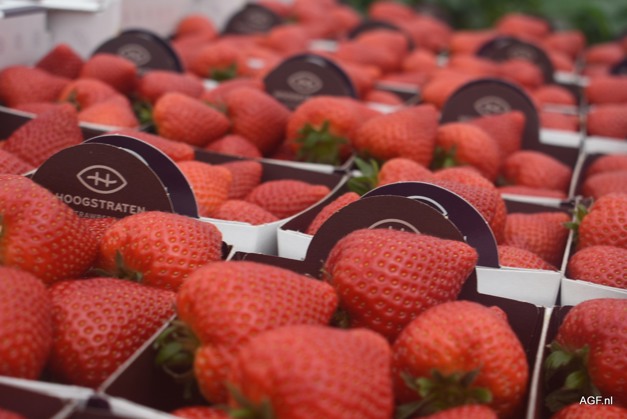
“However, because of the beautiful spring, those productions developed a bit faster than expected, and the next crops from the cold cultivation systems are not yet in full production,” she continues. “The strawberries are not yet ripe. As a result, we are currently dealing with somewhat lower volumes. This is actually a combination of the first productions moving too quickly and the later crops being delayed, which has also caused prices to rise considerably this week.”
Strong demand, but quick recovery from shortage
This is partly because demand remains firm. “Especially with an extended Whitsun weekend and summer temperatures approaching, we notice that consumers are once again turning en masse to soft fruit. The past two weeks of grey and wet weather were not exactly strawberry weather, but consumption continued to perform well. Now that the weather is cooperating again, we have really seen a strong increase in demand in recent days. That remains the strength of the strawberry after all. As soon as the weather improves, people flock to it.”
This is causing high prices for the time being, but Shannen does not expect the shortage to last long. “From the weekend onwards, we will have good weather again, and by the middle of next week, we expect sufficient production again. Fortunately, strawberries can recover quite quickly once the sun returns.”
Stable market
Regarding price levels this season, Shannen expresses satisfaction. “We certainly cannot complain about the prices over the past period. The market has actually remained very stable during the spring. Prices are slightly higher than in previous years, partly because we have slightly lower production. The volumes are spread more evenly throughout the season, so we have fewer extreme peaks than in the past. Only in recent weeks have prices increased somewhat due to limited supply.”

This more stable production is linked to the growth of everbearing varieties among the growers of Coöperatie Hoogstraten. “This year, about 40 per cent of our total production will consist of everbearers, compared to around 31 per cent last year. So there is clear growth, which spreads production better throughout the season.” Whether this also poses a threat to the future of June-bearers, Shannen doubts. “June-bearers remain important, because they still account for our main volumes. And we also have absolutely no ambition to switch completely with our growers. Besides, we never impose varieties on anyone. They always decide that for themselves. We only advise them, but for now, these varieties within our range still complement each other well.”
Limited impact from Spain
At the beginning of the season, there were brief concerns that a larger Spanish supply would disrupt the market in early April. In the end, that impact proved limited, Shannen points out. “In weeks 14 and 15, some more Spanish products did come onto the market as the weather recovered there, but we did not really suffer much from that. And even now, we actually see little competition from other origins on the market. There seems to be enough room for a good summer season. June and July also traditionally remain busy months. We are heading towards good temperatures, which is beneficial for both strawberries and consumption. We are looking forward to it.”
More interest in specialties
The cooperative is also seeing growing interest in specialties such as raspberry, pineapple, peach, or white strawberries, in addition to classic strawberries. “Especially from retail, demand for distinctive products within the soft fruit segment is increasing. Of course, you have to put that into perspective, as they remain true niche products, but even so, there have already been several requests from retailers for next year to include those products in their assortment.”
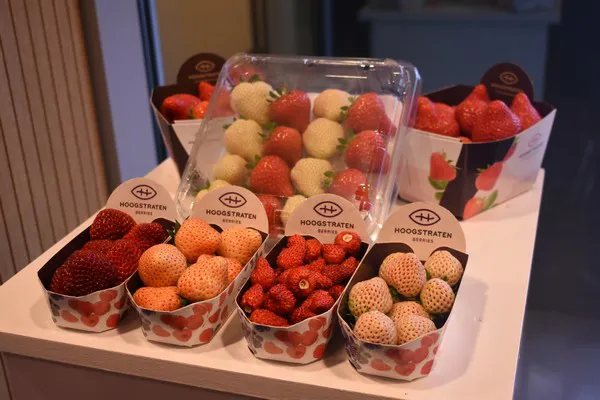
According to Shannen, the specialties mainly respond to the need for exclusivity on shop shelves. “It remains an exclusive product that retailers want to offer for a certain period of time. It will never become a standard product, but it is nice that they want to market it.”
However, this interest is not immediately driving expansion. “Currently, we only have one producer growing the specialties, so volumes remain limited. If demand continues to grow, the producer will surely be open to expanding slightly. However, of course, there are limits to how much you can expand with such exclusive products.”
For more information:
Shannen Dienn
Coöperatie Hoogstraten
Loenhoutseweg 59
2320 Hoogstraten, Belgium
+32 33 40 02 11
info@hoogstraten.eu
www.hoogstraten.eu