
Hannes Badenhop on the recent German blueberry season:
“Advertising was quite intense right up until the last week of sales”
The German blueberry season has now largely come to an end. “After a somewhat early end to the season in the last few years, we were able to wrap up our marketing season as planned in week 34,” reports Hannes Badenhop, managing director of Blaubeergarten GmbH, based in Grethem, Lower Saxony, when asked. Despite the lingering heat, the blueberry grower can look back on a fairly successful campaign.
The first loads of the tried-and-true Duke variety were already harvested and shipped in mid-June. Later in the season, Badenhop offered his customers—primarily grocery retailers—varieties such as Draper, Topshelf, Liberty, and Bluecrop, among others. “The drought itself wasn’t really that much of a problem, since we can irrigate our fields as needed. What is challenging, however, especially in blueberry cultivation, is the falling groundwater level. Nevertheless, we are quite satisfied with this year’s yields and quality across all varieties,” he sums up. The hailstorms in July also did not affect the company in the Lüneburg Heath.
 Up to 60% of the total yield is ultimately sold as organic produce. In addition to food retailers, Blaubeergarten GmbH’s customers include a few large farmers’ market vendors as well as export clients in Denmark and Switzerland.
Mechanization and the two-shift system
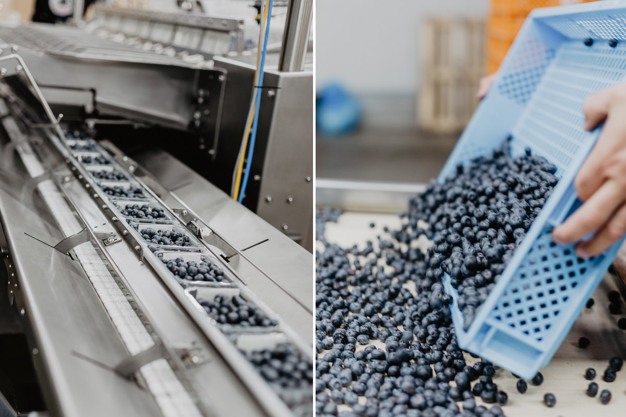
Badenhop also points to the investments in mechanization (as reported by FreshPlaza.de), which are paying off, especially during this year’s heatwave. “90% of our total yield is now harvested by machine. Furthermore, we’ve been operating a two-shift system with day and night shifts for several years now. If it’s too hot during the day, we ramp up the night shift accordingly, and vice versa. This has worked particularly well this year.”
Meanwhile, marketing the local berries proved challenging. Badenhop: “There were abundant quantities everywhere. In mid- to late July, for example, Romanian imports were still widely available in local stores, whereas Polish products were not as heavily represented this year. At the same time, we received an extremely high number of promotional inquiries from food retailers right up until the last week of sales, although we did eventually hold back a bit. Thanks to good quality and shelf life, we were able to store our Draper variety harvest in particular. In the end, some of this produce was also used in the frozen food sector.”
 Blueberries on the bush
Plans to expand Draper acreage
Despite the challenging conditions, the team at Blaubeergarten GmbH is looking to the future with confidence. “Regarding the PPWR Packaging Ordinance, our operation is already well-prepared. We invested in packaging and processing technology several years ago (as reported by FreshPlaza.de), so today we can supply any type of packaging—whether cardboard or plastic trays, open or top-sealed—as required.”
According to Badenhop, the biggest challenge lies primarily in staying on top of cultivation techniques. “The past year has once again shown how important climate- and heat-resistant varieties are. Based on the key parameters of fruit size, firmness, and shelf life, we’ve determined that the Draper variety, in particular, performs very well under prolonged heat. Accordingly, we plan to expand our cultivation capacity somewhat with an eye toward the coming season,” he concluded.
For more information:
Hannes Badenhop
Blaubeergarten GmbH
Grethemer Hauptstraße 35
29690 Grethem
Tel: +49 (0) 5164 8323
kontakt@blaubeergarten.de
www.blaubeergarten.de
https://www.blaubeerland.de/