📅 7–10 October 2025 · Bordeaux, France 🎟️ Private event – pre-registration required
A double international meeting
The 5th edition of International Asparagus Days (IAD) will be held in Bordeaux, alongside the 1st edition of International Berries Days (IBD). Organized by Macfrut, Befve&Co. and Interco Nouvelle-Aquitaine, this trade fair brings together the entire asparagus and berries industries.
👉 An obvious complementarity:
Many asparagus growers are also berry producers.
Many suppliers offer solutions for both sectors.
Several marketers work across both industries.
🔗 A synergy that broadens the offer for the benefit of all.
Technical Tours
Tuesday, October 7 – Asparagus Tour (Gironde, 33)
Vignobles Bouillac: 100 ha of vineyards, 20 ha of nurseries, 15 ha of asparagus under Blayais PGI. With Jean-Pierre Bouillac and Danielle Chambaraud. 👉 Lunch on site & wine tasting.
Lebourg Farm: 900 ha including 49 ha of white asparagus, 80 ha of turf grass, maize, carrots, potatoes.
Tuesday, October 7 – Berries Tour (Lot-et-Garonne, 47)
St Armand Nurseries & Fruits Rouges du Confluent: 12 ha of strawberries under glass (900–1,000 T/year), 20 ha of strawberry nurseries (7 M tray-plants), 40 ha of kiwis.
Aquisol: 60 ha of greenhouses including strawberries, raspberries, blueberries + vegetables (organic & conventional).
Soft fruit in the spotlight for the first time, alongside asparagus
From October 7th to 10th, 2025, the 5th edition of the International Asparagus Days (IAD) will be held in Bordeaux. This is a key event for professionals in the sector from all over the world who want to keep up to date with the latest technologies, production techniques, and market developments. But this year marks the start of a new chapter with the launch of the first edition of the International Berries Days (IBD). The asparagus will be sharing the limelight with these small soft fruits: two families of products that at first glance seem very different, yet complement each other in many ways.
Asparagus and soft fruit: Technical crops for the same market “In terms of production, these are two crops that require a certain precision and a high level of technical expertise,” explains Christian Befve, founder of the two international days and partner of Macfrut and Interco Nouvelle Aquitaine. “Many asparagus producers also grow soft fruit. In terms of timing, the complementarity is also interesting, since the asparagus harvest takes place before the soft fruit harvest (except for the strawberry, which is at the junction between the two crops). All asparagus growers can start growing soft fruit, whether in the ground or above ground. There are no prerequisites in terms of soil composition. On the other hand, soft fruit growers can diversify into asparagus if they wish.”
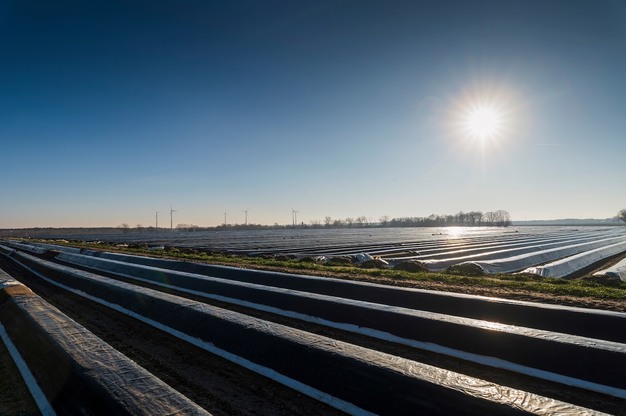
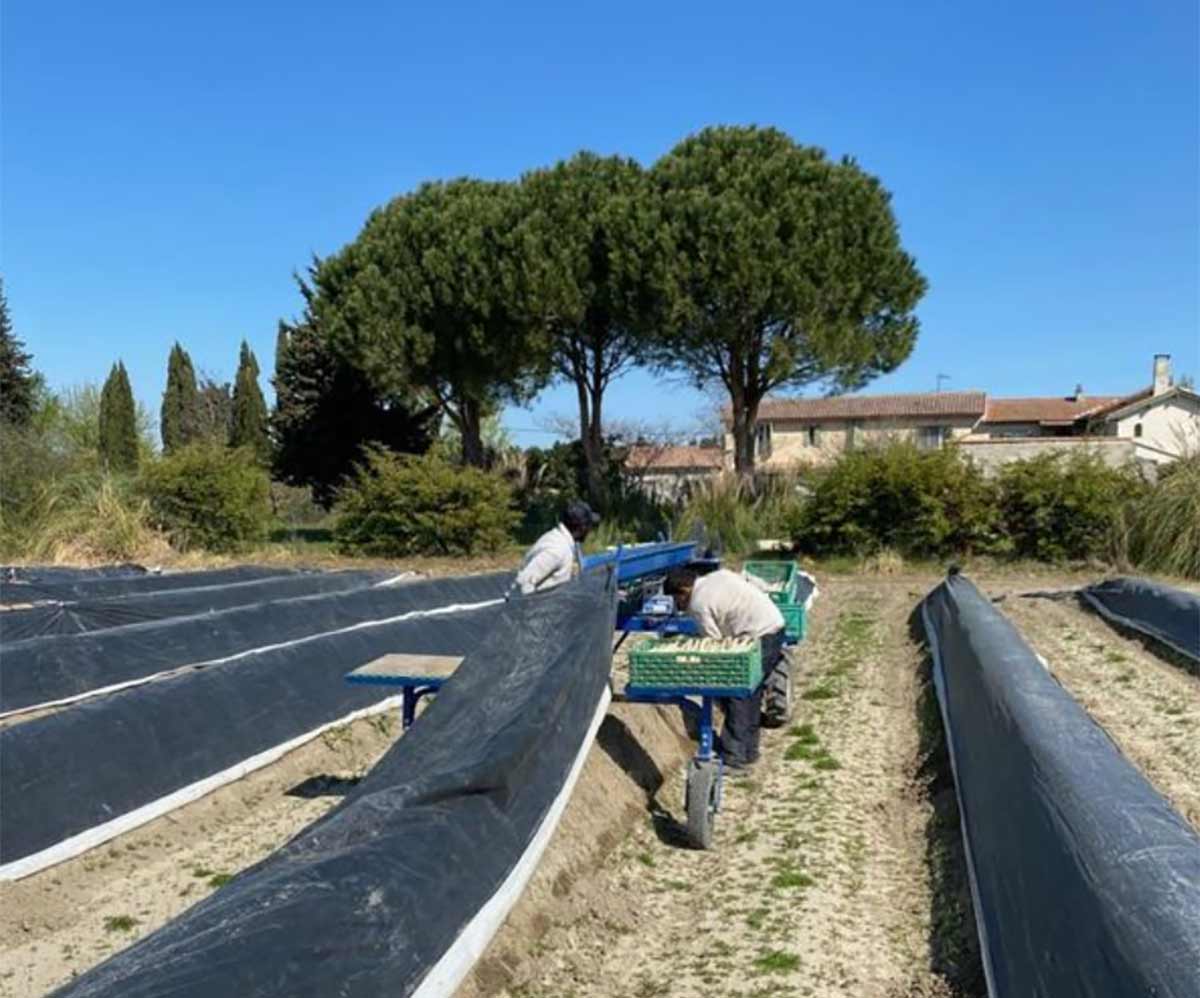
Even in conditions of heavy soil and rocky terrain, it is possible to produce asparagus using a technique that consists of ‘growing without soil in the soil’. “All you have to do is prepare the soil to a width of 1.5 m and a depth of 80 cm, which allows it to be completely corrected. With mulching, we can then protect the mound and preserve the structure we have created.” A technique devised by Christian Befve that is proving highly effective and also has the advantage of being cheaper than growing in the ground.
Another interesting similarity is the market for both product families. “Asparagus and soft fruits are luxury products. The consumers who eat asparagus have the same purchasing power as those who eat soft fruit. Over 50% of suppliers and marketers work with both asparagus and berries. These are two highly profitable markets (which together generate US$96 billion worldwide), with consumption mainly of blueberries soaring in many countries and demand for organic produce rising sharply, especially in Europe.”
Soft fruit: A sector rich in opportunities Although soft fruit is now only grown on 600,000 hectares around the world, the area under production continues to increase. “The development of consumption is an obvious driver of this growth, but it is also driven by varietal innovation and producers who are investing in new varieties that are more resistant and better adapted to climate change. Developing production in consumer countries is also particularly interesting, given that soft fruit is very fragile and has difficulty withstanding transport, not to mention the trend towards consumption of local products. We should not stop as long as there is a market.”
Asparagus: A market in full recovery The same applies to berry producers who would like to start growing asparagus. “The market is currently in full recovery, and we even have a shortage of asparagus plants. History has shown us that the balance between supply and demand was reached at 250,000 hectares. Today, we have planted around 190,000 hectares, so we are 60,000 hectares short of achieving this balance. Given the shortage of asparagus, the crisis is now behind us, and we need to plant now, because we can be sure of a reasonable market for the next 10 years. This is a great opportunity for berry growers to diversify into another lucrative crop. IAD is typically the kind of event that can respond to the needs and questions of growers who want to get started.
As proof of this, I recently gave a talk on asparagus in Spain to producers who pointed out the difficulties they were having in expanding their crops because of water restrictions and labor problems. But some techniques can save water if you know how to apply them at the right time. Establishing a greater distance between rows can also significantly reduce labor requirements. At the end of the conference, the growers were aiming to plant a total of 400 hectares over the next two years. When we respond to growers’ needs by providing practical solutions and good technical support, limiting thoughts give way to the desire to embark on production with greater peace of mind. This is also one of the aims of these two international days.”
The 4-day program will include technical visits focusing on asparagus and soft fruit, as well as conferences, workshops, demonstrations, and a trade fair.
Tuesday, October 7th – Asparagus Tour (Gironde): In the morning, participants will visit Vignobles Bouillac, a farm covering 100 ha of vineyards and 20 ha of vine nurseries, which markets 15 ha of asparagus under the PGI Asperges du Blayais label. Jean-Pierre Bouillac, the farmer, and Danielle Chambaraud, president of the Association of Asperges du Blayais producers, will be on hand for the visit. Lunch and wine tasting will be held on site. In the afternoon, participants will visit the Lebourg farm, which covers 900 hectares, including 80 hectares of turf and 49 hectares of white asparagus, as well as corn (grain and popcorn), carrots, and potatoes.
Tuesday October 7th – Soft Fruit Tour (Lot-et-Garonne): The tour will begin with a morning visit to Pépinières Saint-Armand and Fruits Rouges du Confluent, which grow 12 ha of strawberries in greenhouses (producing 900/1000 tons of strawberries a year), 20 ha of strawberry nurseries (producing 7 million tray-plants), and 40 ha of kiwis. The morning will end with lunch, before heading off to Aquisol, a farm with 60 ha of greenhouses, including 13 ha of strawberries (800T/year), 8 ha of raspberries (230T/year), and 8 ha of blueberries (160T/year). Various technical itineraries will be presented: conventional, organic, soilless, and open-field cultivation. Alongside soft fruit, the farm also produces vegetables such as aubergines, cucumbers, peppers, lettuce, kohlrabi, spinach, and kiwis.
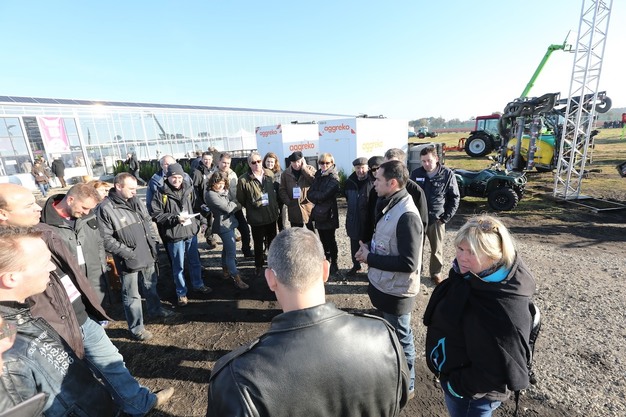
Wednesday and Thursday, October 8-9: A trade fair will be held over the two days, with booths selling plant material, equipment, nurseries, services, marketing, research, and training. Technical visits and outdoor demonstrations (preparation, planting, maintenance, and harvesting equipment) will be organized during the event, with the possibility of on-site catering. Pitch sessions and technical workshops will also be run by exhibitors and sponsors in a central agora. The opening ceremony will take place at 11 am on Wednesday, and will close with a Cocktail and Show evening at the Cabaret Music-Hall “Le Grain d’Folie” at 7 pm in Artigues-près-Bordeaux.
Over the two days, participants will be able to visit Planasa: at 10 am, a presentation on strawberry research will be given, alongside a presentation on the different varieties of asparagus. At 3 pm, participants will have the opportunity to visit blueberry fields, and at 4 pm, they will discover “replanting asparagus on asparagus.”
From 3 pm to 5 pm on Thursday, there will be a conference on “Soft fruit: What innovations for tomorrow’s markets?”
Friday 10 October – Soft Fruit Tour (Dordogne): In the morning, a visit to the Interprofessionnel Technical Center for Fruit and Vegetables in Lanxade will be organized. On this occasion, participants will discover the 190-hectare technology hall, where 52 species of fruit and vegetables are tested. Participants will also have the opportunity to visit the Invenio experimental station in the fruit and vegetable sector at Douville. Invenio is an association of fruit and vegetable growers who wish to combine their efforts in experimentation, varietal research, and technological innovation. A visit to the Douville site will provide an overview of the latest French research into strawberry and raspberry planting material and cultivation.
The afternoon will be devoted to a visit to the farm run by the Teychenné family, members of the Socave cooperative. This is an opportunity to discover traditional production in soil with the “PGI Périgord Strawberry” label, and unheated hydroponic production of remontant strawberries.
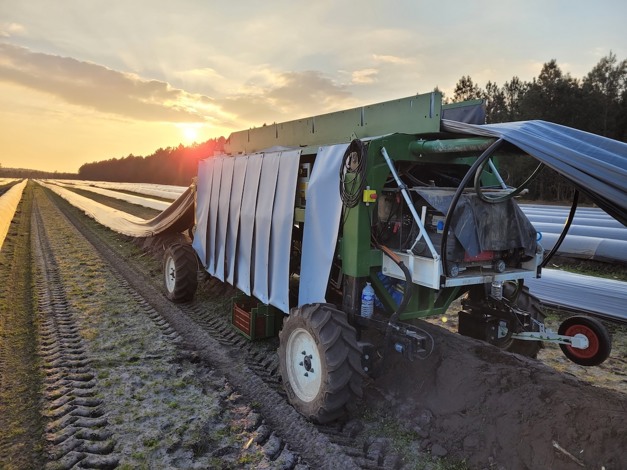
Innovations such as the Aspercut, France’s first harvesting robot, will be on display at IAD and IBD. In all, there are around ten harvesting robots in the world, which are said to have “greatly improved in performance and efficiency in recent years.” These robots “tend to be profitable,” which will inevitably have an impact on the market over the next few years.
Four days of sharing, visits, conferences, and meetings with a common objective for both events: To position ourselves as the true crossroads between research, production, technology, and marketing. The date is strategically chosen, after Fruit Attraction was held the previous week in Madrid. “This will make it easier for professionals from far away to travel to Bordeaux,” explains Christian Befve. “It is a unique opportunity to put growers in touch with marketers and suppliers, and to discover the latest technologies (bio-control, artificial intelligence, robotization…) that are gradually reorganizing the sector. Taking part in IAD and IBD is also an opportunity to understand how to adapt the corresponding cultivation techniques to the soil and climate conditions of each production site without distortion. Compliance with health and social regulations, respect for the environment, and anticipation of climate change are also key issues that will be addressed during this 4-day meeting. This really is a key event for any professional interested in growing asparagus or soft fruit.”
Wilfried Garrigue, Sylektis: “A reliable, robust, and accessible tool built on a low-tech approach.”
AsperCut: A breakthrough innovation giving asparagus farmers back their independence?
The asparagus sector could be on the verge of a major transformation with the upcoming release of AsperCut, France’s first robotic asparagus harvester, expected next season. This project was born out of a stark realization: the shortage of agricultural labor poses one of the greatest threats to French—and more broadly, European—farming. This was particularly evident during the COVID years, when the asparagus harvest in France was seriously jeopardized. It was from this challenge that Sylektis emerged, founded by Wilfried Garrigue and Stéphane Abraham.
A low-tech philosophy for greater reliability “Our background isn’t in agriculture but in industry, and we firmly believe that industrial robotics solutions can be adapted to agriculture,” explains Wilfried Garrigue. “We launched the project in 2020 and are now on the third version of the AsperCut prototype, which is becoming highly operational and productive.”
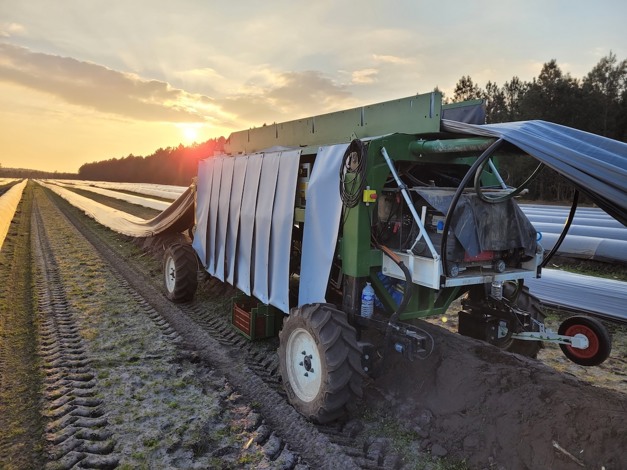
While AsperCut isn’t the first robot developed to automate asparagus harvesting, it marks a real technological shift compared to existing models. “Rather than reinventing everything from scratch, we focused on proven, widely used technologies from both the industrial and agricultural sectors. The machine is composed of three main elements: a custom-designed straddle tool carrier, the harvesting robot, and an AI module that detects the asparagus. This pragmatic, low-tech approach makes the machine more affordable and significantly more reliable for farmers.”
A focus on harvest quality over speed What sets AsperCut apart is its simplicity and durability, qualities the founders prioritized to win over skeptical growers. “Farmers are often wary of robotics, which can feel overly complex, fragile, and hard to use or maintain. That’s why we avoid calling it a ‘robot’; we prefer ‘harvesting machine’. Compared to existing machines, we wanted to develop something smaller, more cost-effective, and focused on harvesting quality rather than speed,” Garrigue explains. “Our machine measures 4 meters long, 2.5 meters wide and high, and weighs 3.5 tons. We’ve deliberately chosen to stop the machine when harvesting rather than moving continuously—this would require much more complex and less reliable robotics. By stopping, we ensure a cleaner, more efficient harvest. The machine can cut the asparagus in a single motion—something that’s not easily achieved by hand—and avoids pinching or damaging the spears, thereby preserving quality. We’ve also developed and patented a tool that can harvest even slightly twisted asparagus, greatly reducing harvest variability.”
Designed for moderate production areas of 2 to 4 hectares, the strategy is to sell several small machines rather than a single large one. This approach adapts easily to various farm sizes and ensures that farmers aren’t left stuck if one machine fails.
Autonomous operation powered by smart AI detection The AsperCut operates autonomously along asparagus beds using a 3D AI-based detection system that pinpoints the exact position of each spear. “We’re at a turning point in terms of available technology,” Garrigue notes. “Cameras and computers have become far more accessible, which has allowed us to integrate this tech into our machines. Going fully electric would have been a step too far for now, but our priority is solving the harvesting challenge. The machine navigates rows on its own, detects asparagus, stops to harvest, and places the spears in a crate. Once a row is complete, it halts for an operator to collect the crates and reposition them to the next row. This process ensures asparagus isn’t left in the crates too long post-harvest. It’s a hybrid machine powered by electricity with an onboard generator for full autonomy.”
Designed for both white and green asparagus Though the original focus was on white asparagus, Sylektis is pushing further, developing a solution for green asparagus as well. “Our vision is a modular harvesting platform that can accommodate up to two robots—one for white asparagus at the front and one for green at the back. Or even two of each for larger operations. We’re collaborating with Fanuc, the world leader in industrial robotics, to develop the green asparagus harvesting module.”
Tackling the labor crisis with a competitive edge “The core issue today in agriculture is labor. Unlike tilling or weeding, harvesting remains a manual task, but we simply don’t have the workforce anymore. These jobs are tough and increasingly unattractive. Since harvesting is also the phase that adds the most value to the crop, AsperCut has strong potential for return on investment. With Maxime Pallin, a farmer in France’s Médoc region who has helped test our prototype for the past three years, we’ve identified the performance goals needed to meet both technical and economic demands. The 2025 season will be key to confirming those targets and launching commercial sales.”
Boosting local capacity and reducing imports through autonomy Although harvesting costs are important, the main goal isn’t necessarily to be cheaper than seasonal labor. “The real aim is to address the labor shortage and ensure that farmers can harvest their crops. Today, 50% of asparagus is imported, and many farmers tell us they would plant and harvest more if only they had the manpower. With AsperCut, we want to empower growers to expand local production, reduce dependence on imports, and make asparagus farming more sustainable. It’s a long-term investment with environmental and economic benefits. With a plantation lasting ten years, AsperCut removes the uncertainty around labor availability for the entire lifespan of the crop. In that sense, it’s a true breakthrough innovation.”
A commitment to supporting farmers in France and beyond As AsperCut nears industrial production, Garrigue and Abraham are approaching the next phase of their journey with confidence and ambition. “We’re proud to be the first to design and build a French-made harvesting machine. France Relance 2030 has supported us from the beginning, and we’re currently fundraising to support industrialization.
We plan to start selling the first units this year, with pre-production delivery set for 2026. Our machines will be distributed through local tractor dealers to ensure ongoing support and maintenance. Labor challenges aren’t unique to France, and we aim to bring AsperCut to farmers across Europe—and possibly further.
We’re also exploring adaptations for other crops facing the same issues, like grape harvesting. Agriculture is at risk: if we can’t harvest, we’re handing over our food sovereignty. We believe AsperCut offers a real solution, and we’re fully committed to helping farmers make this transition.”
Limgroup’s Stefan Pohl about the asparagus sector developments:
“Late segment asparagus varieties are on the rise”
Rising costs and tough sales: Many know the European asparagus sector has had a difficult few years. Things, however, seem to be looking up for this queen among vegetables. Sales still peak in the first half of the season, but the period between Pentecost and the traditional end of the season on June 24 appears to be doing better. Late-segment varieties, though, are few and far between. Limgroup, a breeding company, wants to change that with its new Mosalim variety, reports Product Manager Stefan Pohl.Stefan Pohl at expoSE 2023, where he officially introduced the new late variety, Mosalim
It took about 12 years from this late segment variety’s initial crossbreeding to its actual market introduction. The main goal was to develop a modern alternative to the long-recognized Backlim variety for the last phase of the asparagus season. “Mosalim retains its great tip closure even at higher temperatures,” begins Stefan. “It’s also excellently suited for mechanized harvesting and a longer harvesting program.”
“From the grower’s perspective, the variety has overall good foliage health and yields throughout harvesting. These parameters all benefit the variety. Mosalim should, thus, make a name for itself in various cultivation areas in the coming years,” the product manager says. “It should also gain a good market position. Backlim can, however, remain the standard variety in asparagus cultivation.”
Mosalim is grown in almost all the major asparagus-growing regions in Germany and some in the Netherlands. Last year saw the first plantings in that country, but it has been planted on a particularly large scale this year. “We realized there are many medium-late asparagus varieties, but only a few very late ones. That means there’s demand for good, high-yield late varieties everywhere, not just in Germany and the Netherlands,” says Stefan.
This year, the first of these asparagus will be planted in Austria and Switzerland, too
The early segment is not necessarily more lucrative, sales-wise either. “The season has been increasingly brought forward over the years, pushing up early asparagus cultivation costs. That’s mainly due to high labor and plastic costs. Because of rising minimum wages, this problem will only grow. And on the sales side, there’s a certain threshold regarding prices we cannot exceed. That makes it harder and harder for many growers to make any decent money for early crops.”
“But, that increases the interest in the late segment as many growers recognize that achieving good yields in the season’s last three to four weeks is worthwhile. Demand is admittedly relatively low during that time compared to the first part of the season, but so is supply. Available products are, thus, generally easier to sell. We want to offer growers a good variety with Mosalim, so they have high-quality products available until the very last day of the season,” Stefan continues.
Asparagus sector confident about the future According to Pohl, the mood in the sector is currently quite positive. “In many areas, older fields are being rejuvenated to meet current standards. That’s true for the plant market, too, which is completely sold out. That’s, no doubt, a good sign.” However, the latest figures show that the number of asparagus farms is decreasing in certain regions. “We think the decisive factor is the sales structure. I’m sure those with a good, stable sales structure will keep prospering in the future,” he says.
“Others who don’t have that will have to give up, sooner or later. The rising minimum wage remains a constant challenge, though. Labor costs make up around 60% of asparagus cultivation costs. Still, I doubt we can say the entire sector is suffering. Innovative companies look for solutions, while others see problems. If we consider the acreage throughout Germany, it’s still one of the fastest-growing countries in Europe, even the world. In that respect, I don’t believe the current change is alarming for the sector at this point,” Stefan reckons.
Green asparagus keeps gaining ground Alongside the still dominant white asparagus, its green cousin is undeniably gaining ground. “It currently has a market share of roughly 10-12%, and its upward trend continues. On the one hand, some companies specialize in green asparagus; on the other, some are still skeptical about this crop. Basically, however, green asparagus has become a staple for most cultivation companies.”
The Limgroup has been offering the Xenolim variety specifically for the green asparagus sector for several years now. “This variety’s main advantage is that it’s an anthocyanin-free plant, which means it doesn’t discolor. Growers can use that to stand out from imported trade, which gives them a clear competitive advantage regarding sales. Xenolim is a medium-late variety. Looking ahead, we aim to breed a late green asparagus to offer the entire spectrum,” Stefan concludes.
This article was previously published in Primeur May 2025. Click here for the link to the entire edition
For more information:
Stefan Pohl Limgroup Asparagus Product Manager
Tel: +49 (0)15 225 667 125 spohl@limgroup.eu www.limgroup.eu
To provide the best experiences, we use technologies such as cookies to store and/or access device information. Consenting to these technologies will allow us to process data such as browsing behavior or unique IDs on this site. Failure to consent or withdrawing consent may adversely affect certain features and functions.
Functional
Always active
Technical access or storage is strictly necessary for the legitimate interest purpose of enabling the use of a specific service explicitly requested by the subscriber or user, or for the sole purpose of carrying out the transmission of a communication over an electronic communications network.
Preferences
Technical access or storage is necessary for the legitimate interest purpose of storing preferences that are not requested by the subscriber or Internet user.
Statistics
Technical storage or access that is used exclusively for statistical purposes.Technical storage or access that is used exclusively for anonymous statistical purposes. Absent a subpoena, voluntary compliance from your internet service provider, or additional records from a third party, information stored or retrieved for this sole purpose generally cannot be used to identify you.
Marketing
Technical access or storage is necessary to create user profiles in order to send advertisements, or to track the user on a website or across websites with similar marketing purposes.

 Even in conditions of heavy soil and rocky terrain, it is possible to produce asparagus using a technique that consists of ‘growing without soil in the soil’. “All you have to do is prepare the soil to a width of 1.5 m and a depth of 80 cm, which allows it to be completely corrected. With mulching, we can then protect the mound and preserve the structure we have created.” A technique devised by Christian Befve that is proving highly effective and also has the advantage of being cheaper than growing in the ground.






 For more information: