
https://valenciafruits.com/gallombares-celebra-30-anyos-liderazgo-esparrago-verde/
Archive
Renewed leadership team at berry propagator Genson Group As of January 1st, Dutch berry propagation company Genson Group has implemented a renewed leadership structure. by FreshPlaza
Renewed leadership team at berry propagator Genson Group
 Frans and Li-Ang
Complementary expertise
Frans, as CEO I COO, will primarily focus on Operations & Cultivation, while Li, as CEO I CFO, will oversee Finance and other disciplines. “This new structure enables us to leverage our knowledge, experience, and leadership to the fullest. With complementary expertise, the leadership team is well-positioned to make swift and decisive decisions.”
“With this strengthened leadership, we are more prepared than ever to achieve our growth ambitions. This step allows us to further focus on innovation, sustainability, and expanding our position as an international supplier of soft fruit plants, strawberries, raspberries, and leeks. The leadership team has established a clear new strategy, which will be implemented over the coming years”, Frans shares. “We look to the future with confidence and remain committed to delivering the highest quality to our customers and partners worldwide.”
For more information:
Genson Group
info@genson.nl
www.genson.nl
“Strawberry prices are lower than expected” The strawberry harvest in Greece is not going as well as expected. Mr. Nikos Kaplanis, owner of the Greek strawberry grower and packer Kaplanis Fruits, says: “The harvest has been delayed by about one month by FreshPlaza
“Strawberry prices are lower than expected”

Such circumstances generate implications for the sales to international markets. “There is a loss of turnover so far. Fortunately, the loss concerns only sales and not clients,” says Mr. Kaplanis. As he adds: “We hope that what we have lost at the beginning of our season, we will gain it back at the end of the season. This requires the German and Polish crops to reach the market late, in order to have time to extend our sales to the latest point possible, the first ten days of June.”
As for the current market state, Mr. Kaplanis stresses that it is quite demanding: “Egyptian imported strawberries are still creating tough conditions for the European ones. German supermarkets want to source cheap strawberries, maybe in order to boost their own low sales, so they buy them from Egypt. Despite their air delivery, Egyptian strawberries remain price competitive. So currently, we end up with a price level that does not correspond to our volume level.”

Greek strawberries debuted with EXW prices at 10 euros/kg, and expectations for the actual period were at 6-7 euros/kg. However, things are different. “Despite the good start, this was just a good snapshot. The rest of the season has been marked by prices lower than last year’s average and lower than initially expected,” the Greek exporter narrates.
The Greek crop will reach high volumes around February 20. Greek Victory still has a weak presence, but it is gradually increasing. What stands out in the current season so far is the increase in Arwen’s cultivation, at the expense of Fortuna. Kaplanis Fruits is one such case. “We have substituted Arwen for Fortuna. We are finally disappointed with this variety, which suffers from Tetranychus and is more susceptible after harvest. On the contrary, Arwen remains firm in the late part of the season, after March 15.”

Mr. Kaplanis is excited with Arwen: “We have also replaced many of our Victory plantations with Arwen. Currently, 70% of our plantations are planted with Arwen. It is earlier than Victory, it can also be planted in pots, and it is more productive. It can reach 50 tons/hectare.”
For more information:
Nikos Kaplanis
Kaplanis Fruits
Tel: +30 26230 71846
Email: kaplanisfruits1@gmail.com
Los Angeles fires and frigid temperatures impact strawberry movement by FreshPlaza
Los Angeles fires and frigid temperatures impact strawberry movement

Slower than usual demand
That said, while the supply of strawberries isn’t a problem right now, the demand for them is. “The country is an icebox except for southern California and southern Florida. It’s influencing business,” says Johnston, adding that those fires have also impacted demand given cold temperatures often keep consumers more at home than out shopping. “There is just a lot of disruption affecting demand.”
While pricing in Florida is stable (where this week’s colder temperatures are slowing down production), they’re softer on product from central Mexico. This week they’re starting between $12-$14 though that price may not be able to hold given the continued cold temperatures.
Looking ahead, demand for strawberries is expected to strengthen again once the frigid temperatures have passed for the plentiful supply ahead. “Then Valentine’s Day, a popular strawberry holiday, is coming up and that generally has good promotions which will help demand,” Johnston says, adding that pricing is expected to be similar to last year.
 For more information:
Steve Johnston
G.W. Palmer & Co., Inc.
Tel: +1 (831) 753-6578
sjohnston@gwpalmer.net
http://www.gwpalmer.net/
A vendre d’occasion une butteuse Hermeler pour asperges blanches ou vertes chez le Bon Coin
https://www.leboncoin.fr/ad/materiel_agricole/2910893459
Difficult campaign for Egyptian fresh strawberries by FreshPlaza
Difficult campaign for Egyptian fresh strawberries

Amr Kadah, Export Manager at Fruit. Farm points out that “prices have fallen very quickly, two weeks into the season, due to abundant volumes in the face of insufficient demand for fresh strawberries. Prices have fallen by almost 70% compared with the start of the season. The damage is severe for growers, who suffered significant cost increases this season”.
According to Kadah, this situation has prompted many growers to turn away from the fresh produce sector and turn to freezing. He adds: “Freezing started as early as November 30, which is very odd. Usually, we don’t start freezing until January or February, after the end of the fresh strawberry campaign.”

On the other hand, the supply of frozen strawberries in Egypt is steadily increasing. According to Kadah, the area under strawberry cultivation has reached 55 thousand feddan this season (23100 ha), making Egypt the world’s leading exporter of frozen strawberries with 300 thousand tons by 2024. He continued, “Forecasts for exports in 2025 are up to 350 thousand tonnes, dominated by the Festival, Fortuna, Florida and Sweet Sensation varieties.”
“Despite stable volumes, growers are facing serious challenges such as climate change and rising production costs. We hope to see a pick-up in demand and a regularity in exports to avoid acute price fluctuations,” Kadah concludes.
For more information:
Amr Kadah
Fruit.Farm
Tel: +20 100 928 8377
Email: amr.kadah@mail.ru
www.linkedin.com/in/amr-kadah
www.facebook.com/fruitfarm.egypt
Sonora lidera producción nacional de espárrago con más del 60% del total por Expreso La producción de espárrago en Sonora se traduce a más del 60% de la producción total en México; Caborca es líder.
A vendre d’occasion une calibreuse rotative Besnard pour les asperges blanches ou vertes par Le Bon Coin
https://www.leboncoin.fr/ad/materiel_agricole/2905834509
Asparagus prices rise to $35.75-$38.75 as imports increase for the holiday pull by FreshPlaza
United States holiday produce update:
Asparagus prices rise to $35.75-$38.75 as imports increase for the holiday pull
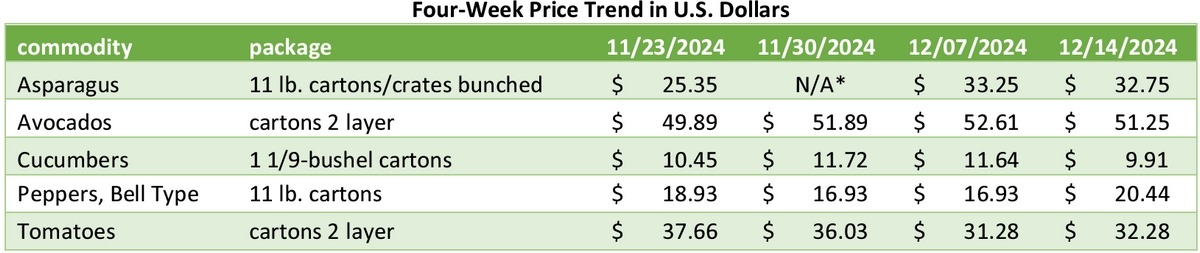
Click to enlarge
Asparagus
Movement of Peru imports through South Florida ports of entry is expected to increase this week in preparation for the holiday pull, then decrease next week due to holiday harvest schedules. Trading is fairly active. Prices are slightly higher. 11-pound cartons of bunched green jumbo are mostly 35.75-38.75, extra-large are mostly 34.7534.95, large are mostly 30.95-32.75, standard are mostly 28.75-30.00, small are 26.00. White large re 38.75-41.00. Supplies jumbo and extra-large are very light, others are light due to vessel delays. Shippers expect heavy loading through December 20.
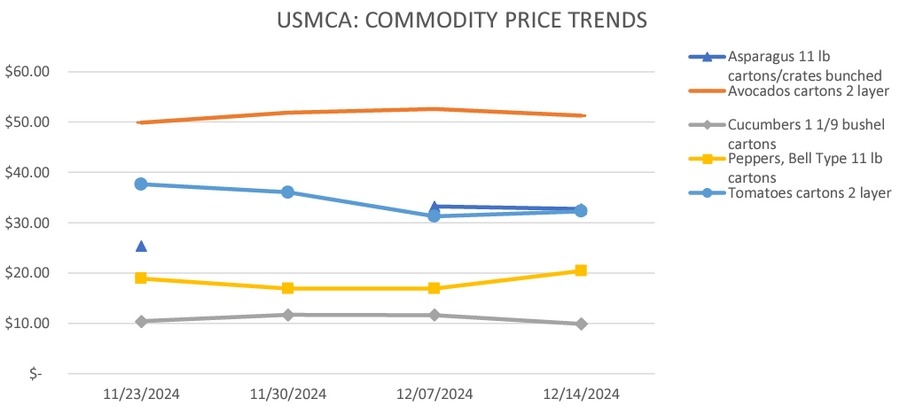
Quality is generally good. Movement from Mexico crossings through Arizona, California, and Texas is expected to decrease seasonally. Trading is moderate. Prices are generally unchanged. 11-pound cartons/crates of bunched large are 34.75-36.75, standard are mostly 32.75. Extra services are included. Prices represent few spot market sales.
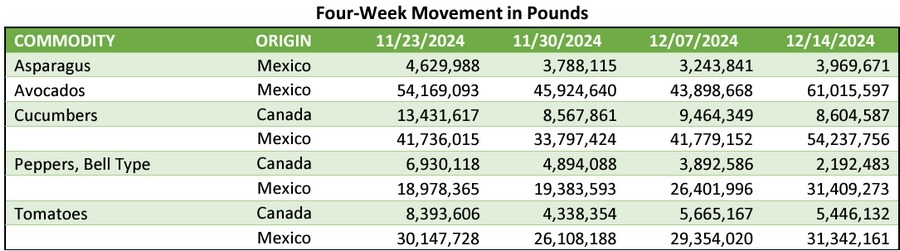
Avocado
Movement from Mexico crossings through Texas is expected to decrease due to holiday harvest schedules. Trading early was moderate, late was fairly active. Prices of conventional 36s and organic 60-70s are generally unchanged, while others are lower. Cartons of 2-layer Hass 32s are mostly 76.25-78.25, 36s are mostly 72.25-74.25, 40s are mostly 66.2568.25, 48s are mostly 49.25-51.25, 60s are mostly 38.25-40.25, 70s are mostly 21.25-23.25, and 84s are mostly 17.2519.25; organic 48s are mostly 65.25-67.25, 60s are mostly 42.25-45.25, and 70s are mostly 36.25-38.25. Extra services are included. Cucumber movement from Mexico crossings through Nogales, Arizona is expected about the same.
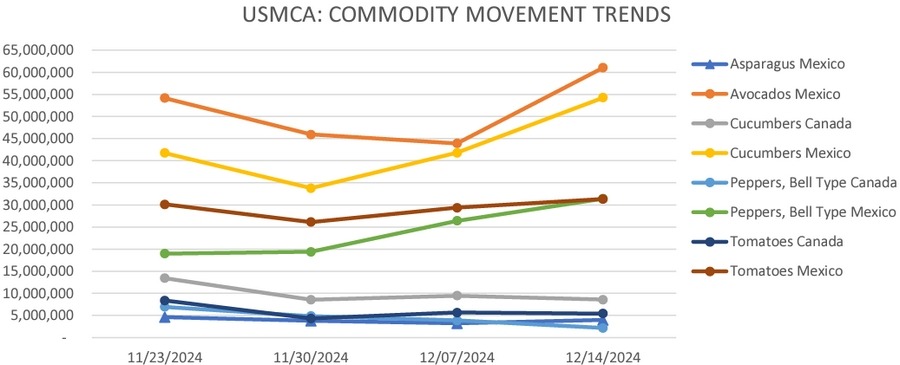
Supplies of large are light. Trading is slow. Prices of medium and large are much lower, small and 36s are slightly lower. 1 1/9-bushel cartons medium are mostly 6.95-8.95, fair quality are mostly 5.95-6.95, ordinary quality are mostly 3.95- 5.95; small are mostly 5.95-6.95, large are mostly 6.95-8.95. Cartons 24s are mostly 3.95-4.95 and 36s are mostly 5.95-6.95. Movement from Mexico’s crossings through Texas is expected to increase. Trading of large is moderate, while others are slow. Prices of large are higher, medium are slightly lower. 1 1/9-bushel cartons medium are mostly 10.95-11.95, fair quality is mostly 7.95-8.95, ordinary quality is mostly 6.95; large are mostly 14.95-16.95.
To view the full report, click here.
 For more information:
USDA
Tel: +1 (202) 720-2791
Email: press@usda.gov
www.usda.gov
A vendre d’occasion une butteuse pour asperge Charpail par le Bon Coin
https://www.leboncoin.fr/ad/materiel_agricole/2905464893