Archive

Global Market: Strawberries By FreshPlaza

The global strawberry market displays contrasting dynamics depending on the main production regions. While some countries benefit from massive production combined with stable demand, others must contend with climatic disruptions, growing competition, or changes in consumption habits. As the season progresses, producers adapt to these evolving conditions to maintain supply and meet market expectations.

In Italy, the market is lively in early May, driven by rising temperatures, while Sicily ensures constant supply thanks to staggered planting. In France, the campaign is in full swing, with sustained production and sales despite competitive pressure from Spanish strawberries.

In Germany, demand was slowed by cool weather and holidays, although local, Belgian, and Dutch strawberries retain a strong market presence. In Spain, Huelva’s production has declined, though prices have risen due to reduced availability.

In Switzerland, the season is intensifying, although recent cold weather has slowed fruit ripening. In Austria, a hailstorm in Burgenland heavily damaged crops, raising serious concerns among growers.

In the Netherlands, prices are surprisingly low ahead of Mother’s Day, despite steady production from Dutch and German suppliers. In the UK, favorable weather supports optimism, with consistently high fruit quality.

In Scotland, growers also approach the season with confidence, thanks to adequate sunshine promoting fruit quality. In North America, supply is expected to be abundant for summer holidays, with large volumes from Santa Maria, Baja, and Salinas.

In South Africa, the season is shifting from the Southern Cape to central regions, with stable demand despite high prices. In Egypt, weak fresh fruit prices have pushed many exporters toward frozen products, deemed more profitable.

Finally, Morocco’s strawberry industry is declining, as growers turn to blueberries and avocados due to falling prices and market challenges.

Italy: A dynamic market despite regional disparities in supply
The Italian strawberry market is particularly lively in early May, stimulated by rising temperatures. According to a major northern trader, another key factor is the current decline in Spanish exports to Italy, combined with reduced supplies from the south. Production is now concentrated in the north, notably in Veneto and Emilia-Romagna. While volumes in Emilia-Romagna are smaller, fruit quality remains excellent. In early May, prices were around €1.80 for a 500-gram tray in Verona, compared to €2.10 in Romagna.

A Sicilian grower states that the season began in November and will continue until the end of May. Production has been steady, with no major issues, especially regarding plant disease. Thanks to staggered planting of early and late varieties, the farm ensures a constant supply over seven months. The marketing schedule is set each February. The farm produces organic strawberries exported to Germany, Switzerland, and Austria. The average price for the season was €3.50/kg, though it recently dropped to €2.50/kg. Fruits are packed in 30×40 cm cardboard boxes containing 250-gram R-Pet trays. Main varieties: Fortuna, Savana, Marimbella.

In Basilicata, the season is 70-80% complete, depending on the varieties grown. Harvest will continue through the end of May, despite some scheduling delays. Prices remain favorable for premium varieties with good firmness, while others are at acceptable levels. This campaign has been marked by low yields and unfavorable weather conditions. Although supply remains below demand, improvement is expected around May 20 with climate stabilization. Overall, prices have remained stable in May, partly due to the gradual decline in strawberry imports, which did not reach significant volumes this year.

France: The campaign peaks with sustained volumes
In early May, France’s strawberry campaign is in full swing, having passed its production peak. Main growing regions are actively harvesting. Sunny weather and high temperatures from the previous week triggered a strong influx of round strawberries, and volumes are expected to remain substantial. Although the production peak for round and Gariguette strawberries occurred in week 15, large quantities are still expected, with some regions still ramping up.

Despite the end of the most intense weeks, market absorption has remained smooth. This regularity is attributed to the effective organization of the French sector, relying on efficient commercial operators and well-targeted promotional campaigns. Even the May 1 holiday did not hinder sales.

Typically, the French season begins in the shadow of Spanish strawberries, which reach full production in March-April. However, this year, competition was softened by Spanish production difficulties due to weather, allowing French strawberries to gain shelf space more quickly. In May, national production covers around 70% of domestic demand. Prices have remained generally high, especially for elongated varieties. With the arrival of field-grown crops, quality has become more variable, leading to greater price fluctuations. Nonetheless, the season has started positively in terms of yields, consumption, pricing, and quality.

France is expected to produce about 60,000 tonnes of strawberries this year, roughly matching last year’s figure, to meet an estimated domestic demand of 120,000 tonnes.

Germany: Falling demand after Easter despite rising supply
Colder temperatures and school holidays significantly dampened strawberry demand in the week following Easter, even as supply increased. Local strawberries gained market presence but showed uneven quality—some were overly large or too pale, reducing their appeal. Dutch strawberries, by contrast, dominated the market with consistently high quality. According to BLE, supply from the Netherlands remained somewhat limited, which helped maintain high prices, although these varied by variety and fruit coloration. In addition to strawberries from Germany, Belgium, and the Netherlands, imports from Greece, Italy, and Spain remained available. Aldi Süd launched the second season of its exclusive local variety ALDIna in week 20.

Spain remains Germany’s top strawberry supplier, followed by Greece and the Netherlands. However, Spanish imports declined by about 13,000 tonnes between 2021 and 2024, while Greek imports rose by 6,000 tonnes. Domestic production also fell, with around 120,000 tonnes harvested in 2024. Roughly one-third of this volume comes from covered cultivation, a steadily growing technique. Over the past ten years, protected cultivation areas have more than tripled.

Regionally, Lower Saxony remains Germany’s leading production area with 2,852 hectares, followed by North Rhine-Westphalia (2,457 ha) and Baden-Württemberg (2,381 ha). These three regions continue to play a key role in national supply.

Spain: Huelva strawberry production declines despite April peak
Until March, strawberry volumes sold from Huelva were below the same period the previous year. However, after the rains ended, harvests surged in the first half of April as the plants hit their production peak.

From the third week of April onward, sales dropped sharply—by an estimated 35% week-on-week. Since then, production has continued to decline, according to the Andalusian regional government. Officials stated, “In the past week, marketed volumes decreased significantly again. After three consecutive seasons of declining output, all indicators suggest this year will mark a fourth drop.”

Meanwhile, farmgate prices are on the rise due to shrinking supply. In week 16, prices increased by around 5.6% from the previous week, and were 24% higher than the five-year average.

Switzerland: Season gaining momentum despite temporary slowdown
The Swiss strawberry season is gaining traction, with 22 tonnes harvested during the week after Easter. Peak harvest is expected between May 19 and June 14, during which up to 1,000 tonnes could be harvested weekly. The Swiss Fruit Association anticipates a total crop of around 7,500 tonnes, with quality currently rated as excellent.

However, recent weather has slowed progress. Week 19 saw a cold, wet spell with maximum temperatures around 10°C, temporarily stalling fruit ripening. A spokesperson from Tobi Seeobst AG, one of the country’s leading fruit cooperatives, stated, “This cold snap severely disrupts the ripening process, which will only fully resume with the return of warmer weather, likely later this week.”

Despite this setback, prospects remain strong. “We generally expect a bountiful harvest—provided the weather improves in the coming weeks. The peak is forecast for weeks 21 and 22,” the spokesperson added.

Austria: Hailstorm damages early harvests in Burgenland
A violent hailstorm in week 18 severely affected parts of Burgenland, causing major crop damage. Producer Adolf Nikles, based in Kukmirn, voiced his dismay: “Open-field cultivation is becoming increasingly difficult, especially with hailstorms this early, like those on May 3–4.” His early strawberry varieties were particularly hard hit, with 80–90% destroyed. The first fruits, initially expected the following week, will likely not be marketable.

As a result, local strawberries are scarce on the market, especially in Vienna, where supply is dominated by imports from Belgium and Spain. Italian strawberries are also well represented in supermarkets, offering an alternative for consumers.

Netherlands: Surprisingly low prices before Mother’s Day
In the Netherlands, strawberry prices usually rise ahead of Mother’s Day. This year is an exception, with surprisingly low prices, according to industry players. “Auction prices this week have ranged between €1.70 and €1.80 per kilo. Despite retail programs being in place, prices remain low due to abundant supply,” traders report.

Warm weather has sped up fruit development, leading to an earlier harvest than usual. Even tunnel-grown strawberries, typically later in the season, have already reached the market. Meanwhile, German production has kicked off strongly, further boosting supply and putting additional pressure on prices.

England: Promising strawberry season thanks to mild weather
Favorable weather conditions—sunny days and cool nights—are contributing to excellent strawberry quality. Producers are optimistic, supported by a mild winter and spring. While volumes are expected to be high, some concerns remain about a potential glut in July. However, the industry hopes to avoid the sudden production peaks seen last year.

Increased winter demand for imported strawberries has set the stage for a strong start to domestic production. Growers are counting on consistent quality and stable weather to ensure steady sales throughout the season.

Scotland: Good early signs for the season
In Scotland, where the season starts later than in England, the first fruits are just being harvested. Growers are cautiously optimistic. Sunlight levels have been favorable, and plants show an abundance of flowers and fruits, suggesting good yields ahead.

North America: Abundant supply expected for summer holidays
In California, strawberry supply remains high, particularly in Santa Maria, where production increased significantly last week. The region is expected to maintain high-quality output for at least eight more weeks. The harvest schedule is similar to last year, though slight delays may occur due to moderate temperatures.

Beyond Santa Maria, northern Baja is also producing good volumes, while Oxnard continues harvesting. However, Oxnard’s output is expected to decrease over the next four to eight weeks. Salinas is just starting its season, with production peaks expected from mid-May through July. Overall, prospects remain positive for Santa Maria, Baja, and Salinas.

Strawberry demand was strong, especially around Easter—which came later this year—allowing markets to benefit from higher volumes. Mother’s Day also drives significant demand, expected to continue through Memorial Day weekend and into early summer.

Overall, the North American market appears well-prepared for a successful summer season, with steady production and sustained consumer demand.

South Africa: Production shifts from Southern Cape to central regions
South Africa’s strawberry season is shifting from the Southern Cape to the central regions of Brits and Bela-Bela. A Johannesburg market agent noted that the last deliveries from George and the first from the new areas have arrived.

“Prices remain relatively high, so customers are only buying what they absolutely need,” he said, noting that demand remains steady from caterers, restaurants, hotels, retailers, and households, all of whom are fond of strawberries.

Currently, 250-gram punnets sell for between €1.45 and €1.90 at market, and up to €3.00 at premium outlets. Available volumes are expected to increase in June and July as the season progresses.

Strawberry acreage continues to expand in South Africa, driven by growing domestic demand and increasing export interest, particularly to the Middle East, where strawberry demand is described as “insatiable.”

Egypt: Tough season for fresh strawberries, frozen segment gains ground
In Egypt, the fresh strawberry season (November to March) saw massive demand, but prices did not meet exporters’ expectations. As a result, many turned to freezing earlier than usual—starting in late November instead of January or February. Exporters initially set high prices to offset rising production costs, with opening prices sometimes double those of the previous season.

Despite this strategy, prices plummeted in the first week, dropping nearly 70%. This sharp decline was due to weak demand and market resistance to high pricing. Demand peaked between November and January, mainly in Europe, Arab countries, and parts of Asia. Outside this window, Egypt’s fresh strawberry market remained extremely limited.

As such, the 2024–2025 season has been difficult for Egypt’s fresh strawberry sector, weighed down by low prices and rising production costs. Many exporters have shifted to frozen strawberries, seen as a more profitable alternative. This segment has become a lifeline, with export volumes estimated at 350,000 tonnes.

Morocco: Strawberry industry declines in favor of other crops
In Morocco, the strawberry industry is in sharp decline, as many growers switch to more profitable crops like blueberries and avocados. Strawberry acreage has dropped significantly, from 3,700 hectares in 2022 to just 2,300 hectares in 2025. This shift is largely due to intensifying competition, which has put downward pressure on prices. Moroccan strawberries remain 10–15% more expensive than their Egyptian counterparts.

Traditionally, Morocco’s fresh strawberry season ends in late March, when EU import tariffs kick in, prompting a shift to frozen processing. However, this year, most exporters ended their fresh campaigns early—in the first week of March. Heavy rainfall in Larache damaged crops and disrupted exports, worsening the sector’s difficulties.

Producers also face other challenges: declining plant quality, rising disease pressure, and labor shortages during peak harvest. These issues compound a general climate of uncertainty. One grower representative shared his concern: “I’m particularly pessimistic about the future of Morocco’s strawberry industry.”

Demand strong for Michigan asparagus as imports drop by FreshPlaza

Demand strong for Michigan asparagus as imports drop

Harvesting of asparagus in Michigan began on May 1–a normal start time for the vegetable in the state. “The crop is looking great. We may start a little slow, but the colder nights should enhance quality,” says Ken Korson, apple and asparagus category manager for North Bay Produce.
The harvesting of asparagus in Michigan began on May 1.

In Michigan, the growing conditions generally have been a little cooler than normal but overall, good. The weather is one of the biggest challenges for growing asparagus in the state given it’s best if extreme temperatures are avoided to maintain quality. While southern Michigan has started its production, northern Michigan will start around May 10-12.

Generally, the supply looks similar to last year in Michigan with the southern region picking up around May 12. “So there will be great volume for promotions,” says Korson, adding that it will be promoting 28 and 11 lb. conventional and organic asparagus and 11 lb. purple asparagus all season. “Fresh asparagus is a sign that spring is here and summer is right around the corner.”

Korson says North Bay Produce will promote 28 and 11 lb. conventional and organic asparagus and 11 lb. purple asparagus all season.

Healthy continued demand anticipated
How about the demand for asparagus? “This year, so far early in the season, we are experiencing stronger-than-average demand for asparagus, coinciding with a decline in imports. We remain optimistic that demand will continue to be robust, ensuring a successful sales season,” says Korson.

After all, the consumption of asparagus tends to be high during this time of year, especially with spring and summer cookouts approaching. North Bay Produce has promotions planned to help further inspire consumers to get grilling and incorporate this key state crop into their meals during this short growing season which lasts until mid to late June.

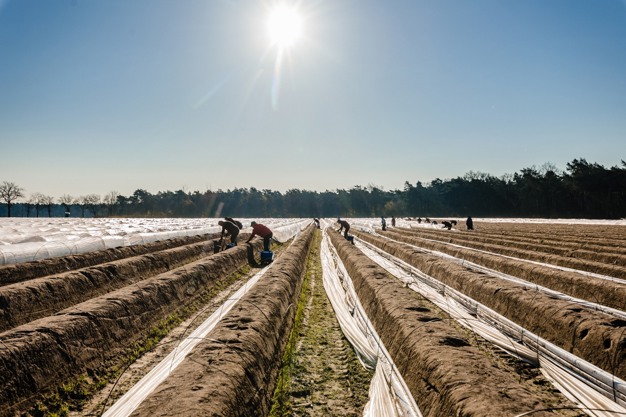
Ron Richter from Richter Farms in Michigan’s asparagus fields.

Pricing is very similar to the last five years at this point in the season. “Looking ahead, I expect us to warm up by the second week of May in Michigan, which will increase the picks and offer consistent sizing,” says Korson.

For more information:
Sharon Robb
North Bay Produce, Inc.
Tel: +1 (231) 946-1941
srobb@northbayproduce.com
www.northbayproduce.com


Chris Chinn – Cobrey Farms English asparagus in peak season this week by FreshPlaza

Chris Chinn – Cobrey Farms

English asparagus in peak season this week

The English asparagus season is now at its peak; the official start of the season was 23rd April, St George’s Day.

“The start of the tunnel crop season was very average with dull weather in January and February,” said Chris Chinn from Cobrey Farms. “In March, however, we had bright, cool days and a very nice spring all round. The warmth meant that the asparagus was just waiting under the surface, and this week has certainly seen the volumes come on.”

Next week sees another bank holiday in England and although this may encourage sales, Chris said that it causes challenges for sales and also harvesting. “We have to double up, but that doesn’t really work with asparagus.”

Chris expects the season to peak through May and then tail off in June.

Cobrey has mostly green asparagus, some purple, and a small amount of white.

For more information:
Chris Chinn
Cobrey Farms
Tel: +44 1989 562 770
Email: chris@cobrey.co.uk
www.cobrey.co.uk


Asparagus grower Leo Henckens (Belgium): “Thankfully, Easter only lasts one weekend!”by FreshPlaza

Easter went well at Hoeve ‘t Bommesaarke, where Leo Henckens and his wife Carine Snijkers grow asparagus.

“We were incredibly busy. We’re glad it’s over—if it had lasted all week, I don’t know if we could have managed!” says the grower from Kinrooi.

“On Friday, demand was already very strong. I thought maybe people were trying to avoid the Saturday rush, so I expected things to calm down. But that wasn’t the case—Saturday was even more hectic. We also saw many new faces. Of course, our regular customers came, but we noticed a lot of newcomers this year. I don’t know if it’s because some colleagues have stopped, but since we didn’t do much advertising, it’s nice to see people still know how to find us.”

Henckens has been harvesting asparagus for a little over two weeks now. “We started on the 7th, which is much earlier than last year. We had to begin sooner than planned because we were caught off guard by the weather. It had been relatively cool, so we thought we still had time. Then suddenly it hit 25°C and everything took off. It was hectic since we didn’t have staff yet. They arrived several days late, so we had to handle things on our own for a while. Luckily, that’s sorted now and we’re back to full operation.”

Henckens is pleased with the quality.
“Last year we had many thin asparagus, especially toward the end of the season. But this year the quality is very good. After last season’s heavy rain, I expected worse, but the soil recovered well. We had a good growing summer, which gave us nice thick spears. That’s why the prices were good right from the start.”

“There was a slight dip last week. We thought prices would fall after Easter Monday, but they were actually higher than the Friday before. I wonder if some of my colleagues took Easter off? It felt like supply was lower, so prices held. As a result, we were able to keep up good sales and deliver decent volumes at solid prices. Today the market is softening a bit, but orders are still coming in, so things are going well.”

For more information:
Leo Henckens
Hoeve ‘t Bommesaarke
+32 494871791
carinesnijkers@telenet.be
www.aspergeskinrooi.be