Archive

Varois-et-Chaignot. Ferme Dubois : 7 000 fourchettes à planter à la fête des Asperges vertes samedi Le Bien Public « Le marqueur de cette nouvelle fête des Asperges vertes sera la création d’une œuvre artistique composée de 7 000 fourchettes », explique Armelle Dubois

https://www.bienpublic.com/culture-loisirs/2024/05/30/ferme-dubois-7-000-fourchettes-a-planter-a-la-fete-des-asperges-vertes-samedi

les conserves d’asperges en Italie par FreshPlaza

Macara® (Italie)

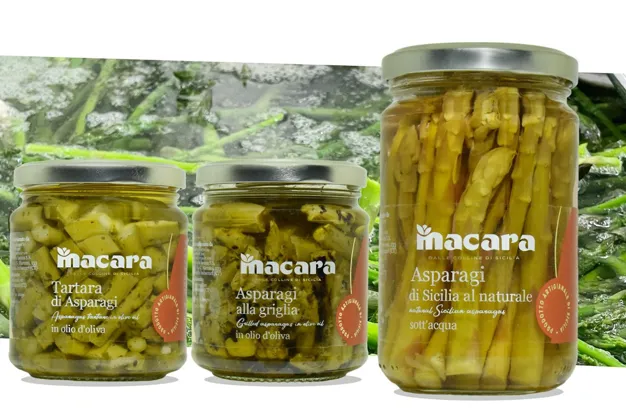
Conserves artisanales d’asperges

La prise en charge de l’ensemble de la chaîne, de la culture à la récolte et à la transformation, permet de garantir l’authenticité et la traçabilité, qui sont essentielles pour une alimentation saine et sûre. Telle est la philosophie de Macara®, la marque de l’Azienda agricola Iacona SS, une entreprise spécialisée dans les arômes séchés et les conserves d’asperges située à Mirabella Imbaccari (CT), en Sicile.
Avec l’obtention des certifications ISO 22005:2008 et FDA en 2023, l’entreprise peut désormais intervenir en toute sécurité et avec professionnalisme sur les marchés nationaux et étrangers. La commercialisation se fait par le biais des canaux de vente au détail, de gros et dans la restauration sur le territoire national et européen. L’entreprise a récemment commencé à vendre aux États-Unis. Le processus de production est axé sur le maintien d’un niveau de qualité élevé afin de garantir des matières premières contrôlées et transformées avec une qualité artisanale. Chaque produit est traité selon les méthodes typiques de l’identité artisanale sicilienne, avec le soutien de machines modernes et innovantes.


Conserves d’asperges vertes

Asperges vertes transformées
La transformation des asperges, basée sur un cycle saisonnier et sur l’utilisation de produits frais, est effectuée en préservant les qualités organoleptiques du produit et en les valorisant grâce à des processus de cuisson non invasifs typiques de la tradition sicilienne. Il s’écoule au maximum 24 heures entre l’arrivée dans l’entreprise et le conditionnement complet, de sorte que toutes les saveurs fraîches et naturelles du légume de saison restent emprisonnées dans les bocaux. La période de pointe se situe au mois de mai, lorsque les températures élevées, particulièrement accentuées en Sicile, confèrent une couleur verte particulière et une saveur profonde. On obtient différents types de produits polyvalents, à consommer directement ou à utiliser dans divers plats.


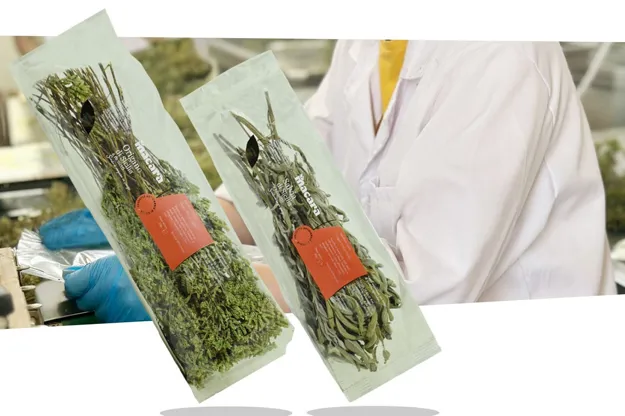
Sachets d’herbes aromatiques

Herbes aromatiques
Une partie du processus de production de l’entreprise est axée sur la production et la transformation d’herbes aromatiques. Le produit phare est une variété locale d’origan séché. La gestion des champs se fait manuellement. Quelques heures après le séchage complet en juin, le produit est transformé dans les différents formats destinés aux différentes utilisations. Une ligne de sels aromatiques fait également partie de la production, où la saveur du sel sicilien est combinée aux arômes profonds des herbes.

Tous les produits sont transformés directement dans les installations de l’entreprise. Les volumes pour 2023 ont atteint environ 95.000 tiges et 30.000 pots. Une augmentation est attendue pour cette année. Les herbes séchées sont disponibles dans plusieurs formats : bocaux en verre et en plastique, et sachets. Les feuilles sont également disponibles en gros pour des industries autre la consommation. Les conserves sont disponibles dans les formats 212, 314 et jusqu’à 3100 ml, en huile d’olive et en eau. »

Pour plus d’informations :
Azienda Agricola Iacona – S.S.
Tél. : +39 388 5662319 / +39 320 9429283
commerciale@aziendamacara.com
www.aziendamacara.com


Autonomous robot harvester makes the cut with asparagus by Fresh Plaza

Autonomous robot harvester makes the cut with asparagus

Cambridge-based autopickr is developing ‘Gus’, a robotic precision agriculture and harvesting platform that currently specializes in cutting and collecting asparagus spears. Weighting approximately 45kg, the four-wheeled, battery powered platform can pick 100 percent of all harvestable asparagus autonomously on an eight-to-10-hour shift.

autopickr.

This differs from its Cartesian competitors that can experience lateral drift and occasionally miss or drop the asparagus spears they were meant to harvest.

Several innovations are key Gus’ success so far, including its arm and end effector.

“The way the robotic arm works is…really similar to the human hand, so for handpicked crops it makes way more sense,” said Kyle-James Keen, COO of autopickr, a spin-out from robot arm specialists ST Robotics.

“Most of us worked there [ST Robotics] for years before and we’ll keep using the arm we have the license for,” said Keen. “It’s not complicated at all, it’s belts and pulleys with motors driving them.”

Keen continued: “When we go on to make our own arm, we will stick by that same ethos and same kind of design.”

Keen explained that the arm’s passive end effector cuts and captures the asparagus without gripping it, thereby avoiding damage to the crop. In use, Gus’ onboard containers can hold 20kg of asparagus spears.

“[Gus] uses robotic motion to cut through and it closes a door around it to be able to make sure it falls in,” said Keen.

More from robotics & UAVs
To get to the cutting stage, Gus uses ultra-wide band (UWB) to triangulate its position, so it knows where it is and within its world frame, Keen explained, adding that GPS would have been unsuitable as Gus has to work in greenhouses as well as fields.

The platform’s AI-enabled computer vision is made possible with an Intel RealSense camera (for depth and tracking) working with a Nvidia Jeston Orin Nano developed for entry level edge-AI and robotics.

One challenge for Gus is determining whether asparagus is growing in clusters.

“Essentially, we detect the spear’s coordinates by using feature detection and…creating a bounding box around that to be able to also detect where clusters are so we can determine [Gus’] optimal path,” said Keen. “The vision system then tells the robot arm the coordinates for the optimal kicking point for the first spear and so on.”

Keen added: “Where we’ve got clusters, it also tells us the angle of the where the end effector needs to orientate itself around to be able to cut.”

Company co-founder and CEO Robyn Sands added that a minimum viable product will be ready by the end of 2024, after which Gus will be ready for alpha trials. Sands added that Gus’ modularity makes it suitable for a range of agricultural and horticultural applications, including daffodil harvesting and vineyard management.

For more information: autopickr.com


For Asparagus, the PGI label really makes a difference during campaigns like this one! by FreshPlaza

Danielle Chambaraud, Asperges du Blayais

“The PGI label really makes a difference during campaigns like this one!”

North of the Gironde, the current asparagus campaign is similar to the situation in the south of France. The campaign is described as early and homogeneous, with reasonable volumes and no great variation in production. The market is balanced and prices are firm. “The campaign began at the end of February. The few days of warm weather stimulated the growth of the asparagus, which came out very early this year. However, this was followed by a long period of rain and colder temperatures, which slowed down production again. As a result, the harvest is rather limited and I doubt there will be any large shoots this year,” explains Danielle Chambaraud, president of the Asparagus du Blayais association.

Prices struggle to hold up
The demand for asparagus increased at Easter, but there was a noticeable drop in the volumes sold compared to previous years. “There was no particular pressure at Easter time. Volumes were not very high, so supply adapted to the demand, and it was difficult to maintain prices. Sales were lower at Easter than in previous years, maybe due to the higher prices. Easter also came early this year, while it is usually celebrated at the heart of the asparagus season, so we were not able to offer the same prices as if Easter fell a couple weeks later.”

Consumers want the PGI label
It is precisely in this rather limited context of production that the PGI can make the difference. “In the past, with or without PGI, we have had to lower our prices when the market was saturated and volumes were considerable in all basins. But in the current context, the PGI can make all the difference. It reassures consumers and helps maintain prices. People are willing to pay the price as long as they get a quality product. Asparagus are now produced almost everywhere in France, so the PGI label is fundamental to the trade and to the promotion of asparagus. It is a guarantee of a particular identity and an asparagus with very little bitterness and a slightly sweeter taste.”

Expansion in line with the market
The asparagus from the Blayais region appeals to consumers thanks to its taste qualities, but it is also attracting growing interest from producers. “Our region is a wine-growing area. It is the region’s core business. Today, the wine industry is in crisis, especially in the Bordeaux region. And with over 70% of sand in the soil, asparagus has become the crop of choice for diversification in northern Gironde. As a result, over the last 3-4 years, we have been integrating more and more producers, although the volumes produced have not increased significantly, given the fragmented nature of our geographical area.”

Production growth must nevertheless be in line with the market situation. “We must not fall into the same trap as the wine industry. In other words, we must not over-plant and over-produce without taking into account the market’s capacity to absorb these volumes. We need to be reasonable and consistent with marketing. It is imperative that we respect all the rules of production and quality, to pay attention to the distribution circuit, to pricing and, of course, we must work together and stay united.”

For more information:
Danielle Chambaraud
Association IGP Asperges du Blayais
Danielle.chambaraud@asperges-blandine.fr


Publication date:

Il Rustico : l’asperge au goût sauvage par FreshPlaza

roduit d’Ortofrutta Castello (Italie), à partir des variétés de Lamboseeds

Il Rustico : l’asperge au goût sauvage

Commercialisée exclusivement par Ortofrutta Castello sous la marque ‘Il Rustico’, l’asperge correspondant au cultivar Saent du semencier Lamboseeds, est présente depuis quelques jours dans les rayons de certaines grandes surfaces.

Il s’agit d’une asperge vert-violet, de taille moyenne, explique l’expert Luciano Trentini, à la saveur amère, qui rappelle beaucoup l’asperge sauvage. Elle est le fruit de la recherche italienne et résulte d’un croisement entre Asparagus officinalis et Asparagus amarus, qui a permis à Lamboseeds d’obtenir un hybride capable de produire des turions au goût particulièrement fort, apprécié par les consommateurs habituels d’asperges sauvages, actuellement récoltées sur les dunes sablonneuses des zones côtières du nord et du sud de l’Italie.

Il y a quelques années seulement que cette variété a été mise sur le marché, après plusieurs tests culinaires visant à faire connaître et apprécier ses caractéristiques qualitatives. Selon une note publiée par les promoteurs de la variété : « Aujourd’hui, les résultats commerciaux permettent d’affirmer que la Saent est un produit différent de l’asperge verte ou violette classique que l’on trouve habituellement sur le marché. Avec cette variété, Lamboseeds, qui s’est toujours concentrée sur des lignes de ‘légumes bien-être’, souhaite couvrir une niche de marché particulière, notamment pour les amateurs d’asperges sauvages. En plein air, la Saent a jusqu’à présent montré une excellente tenue au champ, un rendement élevé et une faible sensibilité aux maladies les plus courantes de l’asperge (rouille, stemfiliose et même fusariose). Ces caractéristiques intrinsèques en font un produit attractif tant pour le producteur que pour le consommateur. »

En 2024, la production a été avancée d’environ deux semaines. Pendant la période des fêtes de Pâques, la variété a subi, comme toutes les autres asperges, une baisse de production due à une réduction de calibre suite au retour du froid. Jusqu’à présent, elle a été cultivée principalement dans le nord de l’Italie, mais on la trouve également dans d’autres régions de notre pays. Il est évident que sa caractérisation génétique ne lui permet pas d’avoir toujours une tête parfaitement fermée, ce qui rappelle ainsi son origine par une certaine similitude avec le type d’asperge sauvage.

Ortofrutta Castello, une entreprise de la Vénétie également spécialisée dans la commercialisation des asperges, a voulu introduire cette référence unique comme élément de diversification dans sa ligne commerciale d’asperges classiques vertes, blanches et violettes.

Lamboseeds expérimente de nouveaux cultivars d’asperges vertes à côté du cultivar Saent. Ceux-ci se caractérisent par une grande précocité, une pousse entièrement verte, une longueur de 23 à 28 cm et une saveur particulièrement douce. Ces nouvelles lignées ne seront proposées que lorsqu’elles auront passé avec succès les tests agronomiques et qu’elles pourront être introduites dans le circuit commercial, après inscription au registre des variétés.

Après un déclin mondial des superficies, la culture est aujourd’hui en plein essor et de nouveaux potentiels de développement se font sentir. D’un point de vue commercial, l’asperge dispose encore d’un gros potentiel : en effet, son taux de pénétration parmi les ménages italiens est encore faible. Seuls 45 % en consomment au moins une fois par an. L’analyse de certains de ces éléments a conduit Lamboseeds et Ortofrutta Castello à essayer de se diversifier afin d’intercepter de nouveaux consommateurs potentiels. L’expert Luciano Trentini le sait bien, lui qui a suivi l’évolution des techniques de culture de l’asperge et notamment le développement de cette variété. Trentini est l’un des huit experts techniques du groupe Befve&Co qui travaillent en coopération dans le monde entier.

Pour plus d’informations :
Ortofrutta Castello srl
Tél. : +39 425 958750
www.ortofruttacastello.com
info@ortofruttacastello.com

Date de publication: