
Archive
“Strawberry season looks better than asparagus season” by FreshPlaza
Olivier Thomas, La Ferme du Pont d’Achelles
“Strawberry season looks better than asparagus season”
 Appoline and Olivier.
Lower asparagus consumption in the second half of the season
The production from the south of France arrives earlier, in order to meet the French demand for asparagus early in the season. “The problem is that the asparagus from the north then arrive too late. People are less inclined to eat asparagus when summer approaches. Additionally, asparagus are a premium product that is not cheap, and in the current inflationary context, not all households are ready to consume asparagus, especially this year. Younger generations are also less inclined to consume asparagus, even if it is a product they appreciate.”
 Françoise supplies the direct sales store on the farm.
Steady strawberry sales despite timid consumption
This is not the case for strawberries, which, although considered a “high-end” product, are consumed differently. “Strawberries have always been a pleasure purchase, to treat yourself to an easy and healthy snack. We started the season at the beginning of April with Gariguette strawberries. Production was spread out and the start of the season was very complicated, with a particularly bad month in April. People were not receptive to this kind of product due to the rainy weather. Today, consumption is low but present, and we feel that people want to eat good local strawberries, which is a good opportunity for us. There are fewer strawberries on the market. The production from southwestern France is coming to an end, the Belgian products are present but not excessively, the situation is complicated on the German market which leads to fewer imports, and Spanish strawberries are virtually non-existent. So we are doing quite well, even if we still have to work hard to reduce our production costs, which continue to rise while floor prices remain the same.”
 Catherine sells the farm’s produce at open-air markets.
La Ferme du Pont d’Achelles, a model based on direct sales
La Ferme du Pont d’Achelles is a family business. “Françoise and her brother are in charge of production. Françoise prepares and supplies the farm store, and Olivier’s wife sells on the markets. For 3 years now, their daughter Appoline has joined the family business as well.” Based on a direct sales model, La Ferme du Pont d’Achelles retails 90% of its production, at the farm store where most of the produce is sold, open-air markets and an online sales service and vending machine. This choice was already made early on by Olivier and Françoise’s parents.
For more information:
Olivier Thomas et Françoise Thomas
La Ferme du Pont d’Achelles
Phone: 03 20 48 60 43
Laferme-dupontdachelles@orange.fr
https://www.lafermedupontdachelles.fr
Très beau reportage chez nos amis les Thomas de la ferme du Pont d’Achelles près de Lille par FreshPlaza: ils ne vendent durant toutes l’année que leur propre production au magasin, au distributeur et aussi sur les marchés
Olivier Thomas, Ferme du Pont d’Achelles :
« La campagne de la fraise s’annonce meilleure que celle de l’asperge »
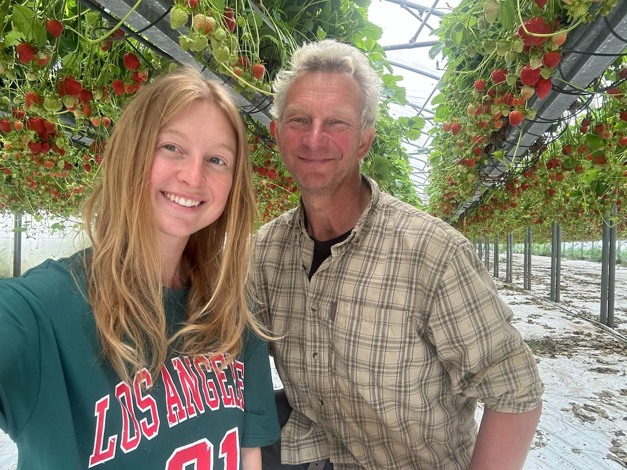
Appoline et Olivier
Asperge : Une baisse de la consommation en deuxième partie de saison
Partiellement en cause, une production du Sud plus précoce qui viendrait répondre en quantité à l’envie des Français de consommer de l’asperge en amont de la saison. « Le souci, c’est que nous arrivons trop tard. Les gens ont moins envie de consommer de l’asperge à l’approche de l’été qu’en début de printemps. D’autre part, il s’agit d’un produit premium qui coûte un certain prix et dans le contexte inflationniste que nous connaissons, tous les ménages ne sont pas prêts à consommer de l’asperge. On le ressent particulièrement cette année. Les jeunes générations sont aussi moins enclines à en consommer, même si c’est un produit qu’ils apprécient ».
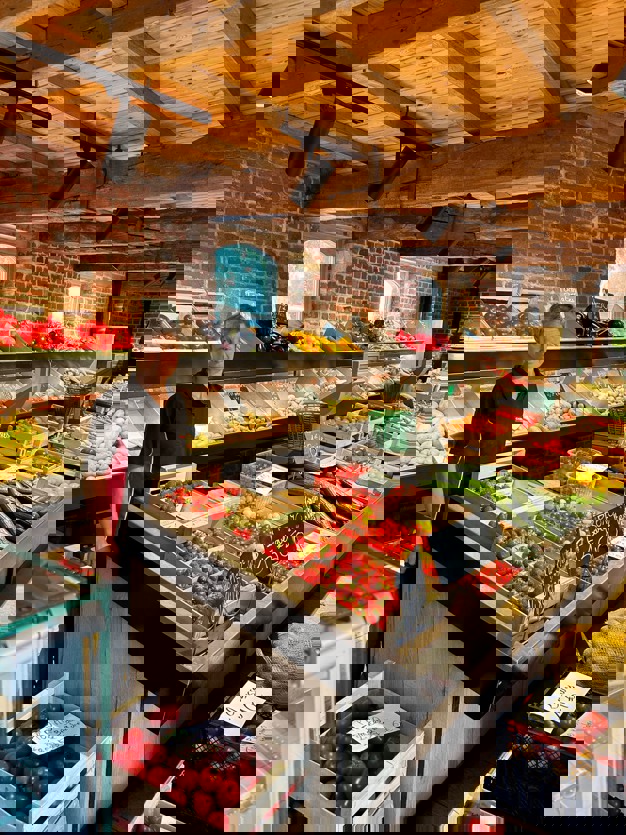
Françoise s’occupe d’approvisionner le magasin de vente directe situé sur la ferme
Fraise : des ventes fluides malgré une consommation timide
Constat différent pour la fraise qui, même considérée comme un produit « haut-de-gamme » se consomme autrement : « La fraise a toujours été un achat coup de cœur. On a envie de se faire plaisir, on achète une barquette de fraise que l’on mange facilement en snacking sans préparation nécessaire. Nous avons, en ce qui nous concerne, commencé la saison début avril avec la Gariguette. La production s’est étalée et le début de saison a été très compliqué avec un mois d’avril particulièrement mauvais. Les gens n’étaient pas réceptifs à manger ce genre de produit sous la pluie. Aujourd’hui, la consommation est timide mais présente et on sent que les gens ont envie de consommer de bonnes fraises locales, ce qui est une bonne opportunité pour nous. Il y a par ailleurs moins de fraises sur le marché, avec une production du Sud-Ouest qui touche à sa fin, un marché belge présent mais pas dans l’excès, un marché allemand compliqué qui aboutit à moins d’importations et une fraise espagnole quasi-absente. On ne s’en sort donc pas trop mal, même si nous devons toujours travailler dur pour comprimer nos coûts de production qui ne cessent d’augmenter pour rester en cohérence face à notre zone de chalandise et un prix plancher qui lui, reste le même au fil des saisons ».
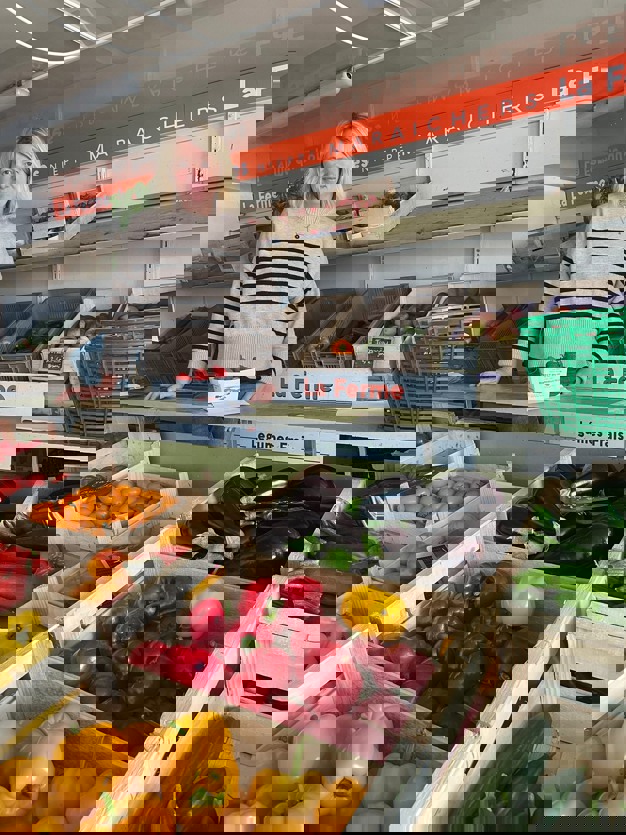
Catherine vend la production de la ferme sur les marchés de plein vent
La Ferme du Pont d’Achelles : un modèle basé sur la vente directe
La ferme du Pont d’Achelles, c’est avant tout une histoire de famille. « Ma sœur Françoise et moi sommes à la production, Françoise s’occupe de la préparation et de l’approvisionnement du magasin situé sur la ferme et mon épouse Catherine fait les marchés. Et depuis 3 ans maintenant, ma fille Appoline qui a suivi des études d’ingénieur agronome nous a rejoints ». Basée sur un modèle de vente directe du producteur au consommateur, la Ferme du Pont d’Achelles vend 90 % de sa production au détail, via le magasin situé à la ferme où la plus grosse partie de la production est vendue, les marchés de plein air mais aussi grâce à un service de vente en ligne ainsi qu’un distributeur automatique. Un choix historique déjà fait à l’époque des parents d’Olivier et de Françoise.
Pour plus d’informations :
Olivier Thomas et Françoise Thomas
La Ferme du Pont d’Achelles
Tél. : 03 20 48 60 43
Laferme-dupontdachelles@orange.fr
https://www.lafermedupontdachelles.fr
Reportage vidéo sur l’asperge au Canada par Radio Canada
Excellent reportage sur la culture, le triage et la vente des asperges chez Frédéric de Lignières
In Holland, “Asparagus yield per kilo at least 30% lower this year due to waterlogging” by FreshPlaza
“Asparagus yield per kilo at least 30% lower this year due to waterlogging”

“Labor has always been a challenging factor, but fortunately, there are still enough people willing to harvest the asparagus. Given the weather conditions, I’m very happy about that. People have had to harvest almost continuously in boots. That’s why we’re organizing a barbecue tomorrow evening to keep morale high,” Will continues.
A cautious estimate is that the kilo yield this season will be at least 30% lower. “Last year, we already had a 15-20% lower yield due to the cold spring, and that was quite a hit, but now the harvest is even lower. This means that the cost of harvesting, which was already significantly higher due to rising labor costs, is soaring even further.”
“It makes quite a difference if you get 150 kilos less per harvest from a hectare. And the reasonably good price formation doesn’t just compensate for the lower yields, although we do fortunately see understanding from the sales side for the challenges we as growers face. I think we’ve still done not too badly in delivering the volumes for both the promotions and the regular weeks, but we had to constantly pull out all the stops.”
“What the effect of this year will be on the 2025 harvest, nobody can say yet, but consequences are inevitable. We dig up plants in each field to monitor plant activity. We see that there has been a massive leaching of fertilizers. So, they need to be reapplied, but we can hardly get into the field.”
A smooth year becomes exceptional
“On the sales side, the challenges are less significant. Demand continues to exceed supply. That will certainly remain the case in the coming years. We know what is being planted in Europe, and it shows a declining rather than increasing trend. An extreme year used to be an exception, now it seems exceptional if things go smoothly. You also see quite a few growers stopping asparagus cultivation.”
Teboza also continues to supply green Spanish asparagus. “The night temperatures in Spain are relatively cool, which allows us to extend the Spanish season somewhat. We had a good season in Spain with high quality and good price formation. The prospects for Spanish cultivation look good for the coming years too. The green asparagus requires significantly less water than, for example, other annual crops, which has allowed us to relatively easily access water and land so far.”
 For more information:
Will Teeuwen
Teboza
Zandberg 14b
5988 NW Helden
Tel: +31 (0) 77 307 1444
w.teeuwen@teboza.nl
www.teboza.com
« Le rendement des asperges en Hollande a baissé de près de 30 % cette année à cause des inondations » par FreshPlaza
« Le rendement a baissé de près de 30 % cette année à cause des inondations »

« La main-d’œuvre a toujours été un facteur difficile, mais heureusement, pour l’instant, il y a suffisamment de personnes prêtes à récolter les asperges. Compte tenu des conditions météorologiques, j’en suis très heureux. Les gens ont dû récolter presque continuellement avec leurs bottes. C’est pourquoi nous organisons également un barbecue demain soir pour garder le moral », poursuit Teeuwen.
Selon une estimation prudente, le rendement en kilogrammes sera donc inférieur d’au moins 30 % cette saison. « L’année dernière, nous avions déjà enregistré une baisse de rendement de 15 à 20 % en raison du printemps froid, ce qui était déjà très mauvais, mais maintenant la récolte est encore plus faible. Le prix de revient de la récolte, qui était déjà très élevé en raison de l’augmentation du coût de la main-d’œuvre, s’envole encore davantage.
« 150 kilos de moins par hectare et par récolte, c’est une énorme différence. Et les prix raisonnablement bons ne compensent pas simplement les rendements plus faibles, même si, heureusement, nous constatons que les responsables de la commercialisation comprennent les défis auxquels nous sommes confrontés à la production. En outre, je ne pense pas que nous nous soyons mal débrouillés pour livrer des volumes tant pour les campagnes que pour les semaines normales, mais nous avons dû mettre les bouchées doubles, et ce en permanence. »
« Personne ne peut encore dire quel sera l’effet de cette année sur la récolte de 2025, mais des conséquences ne sont pas à exclure. Nous arrachons des plantes dans chaque parcelle pour surveiller l’activité de la plante. Nous constatons ainsi qu’il y a eu un lessivage massif des engrais. Il faut donc les réappliquer, mais nous ne pouvons pas tout le temps aller sur le terrain. »
Les années faciles se font exceptionnelles
« Du côté de la commercialisation, les défis sont moins importants. La demande reste supérieure à l’offre. Il en sera certainement ainsi dans les années à venir. Nous savons quelles plantes sont mises en terre en Europe et la tendance est plutôt à la baisse qu’à la hausse. Une année extrême était autrefois une exception, aujourd’hui c’est l’inverse : il est plutôt exceptionnel que tout se déroule sans problème. Par conséquent, de nombreux producteurs cessent de cultiver des asperges. »
Teboza propose également des asperges vertes espagnoles. « Les températures nocturnes sont relativement fraîches en Espagne, ce qui nous permet de prolonger un peu la saison. Nous avons eu une bonne campagne en Espagne, avec une bonne qualité et de bons prix. Les perspectives pour la récolte espagnole sont également bonnes pour les années à venir. L’asperge verte a besoin de beaucoup moins d’eau que, par exemple, d’autres cultures annuelles, et nous avons donc un accès relativement facile à l’eau et au sol jusqu’à présent. »
 Pour plus d’informations :
Will Teeuwen
Teboza
Tél. : +31 77 307 1444
w.teeuwen@teboza.nl
www.teboza.com