
Dormancy management for maintaining productivity in winter crop production
Photoperiodic lighting can make a huge difference in strawberry production. This article is timely in the season you need to consider extension lighting or night interruption lighting to improve the productivity of your strawberry plants.
Off-season greenhouse strawberry plants are often planted in late summer to start producing fruits in October or November. However, sometimes after the first flush of production, plants may go into a slow growing phase, not producing as many flowers and fruits and not extending leaves. Overall morphology is rosette-like with dark green leaves with short petioles. This is because plants are getting in the dormancy phase as a response to the light environment.
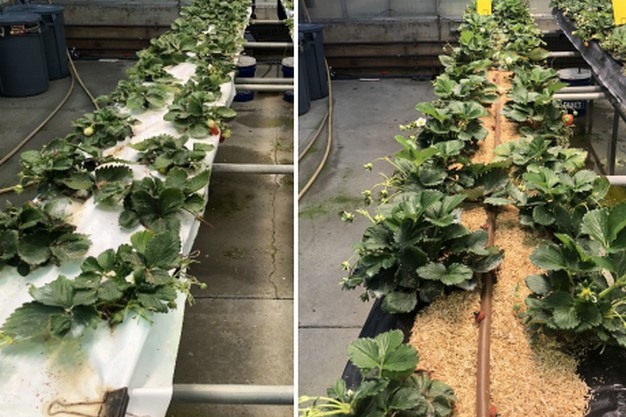 Figure 1. ‘Tochiotome’ strawberry plants showing dormancy symptoms in early January (left). The same plants recovering from the symptoms after three weeks under night interruption lighting (right).
Dormancy in strawberry is induced under short-day conditions when average temperature is greater than 15 °C (Sønsteby and Heide, 2021). Many growers and researchers may have misunderstood that low temperature is part of the stimuli for entering plants into dormancy. In fact, while short-day conditions are considered as the primary factor inducing dormancy in many species, some species such as apple and pear require low temperature for entering dormancy regardless of photoperiod (Heide and Prestrud, 2005). Strawberry plants do not exhibit ‘absolute dormancy’ as their growth is not completely ceased: the reason why the status in strawberry is called ‘semi-dormancy’. The state of semi-dormancy is characterized by reduced growth while still retaining the capacity of growth when transferred to long days. In contrast, plants in the state of absolute dormancy cannot be overcome by photoperiod alone.
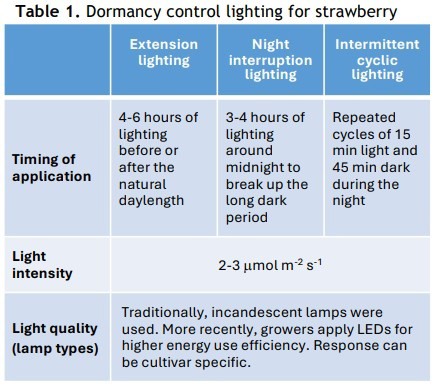
When plants start showing low productivity associated with the typical morphology of dormancy status, long-day lighting has been shown as an effective way to overcome the dormancy symptoms. As good news, this photoperiodic response requires only a small amount of light (a minimum of 2 µmol m⁻² s⁻¹) to apply as extension lighting or night interruption lighting. In the Netherlands and Belgium, intermittent cyclic lighting may also be common. This practice in Europe typically follows the winter-resting period of the traditional “double-cropping” system in greenhouses. Specific application methods of dormancy control lighting are shown in Table 1.
Most greenhouse strawberry growers in North America grow cultivars typically considered as facultative long-day plants. Because supplemental photosynthetic lighting is commonly provided for winter strawberry production in greenhouses, creating long-day conditions is common, and therefore dormancy would rarely become an issue. However, when greenhouse production occurs in areas where supplemental photosynthetic lighting is not necessary in winter (e.g., Southwestern U.S., Mexico), strawberries may be exposed to dormancy-inducing short-day conditions. In addition, some growers may wish to grow short-day cultivars for specific traits, such as unique flavor and fruit color, and may apply short-day conditions to assure continuous flower induction. Sensitivity to dormancy-inducing short-day conditions seems to be cultivar-specific (Lin et al., 2025b). Therefore, photoperiodic lighting needs to be carefully applied over short-day cultivars so that it would not inhibit flowering. If cultivars of interest are known to be sensitive to dormancy-inducing short-day conditions, it is recommended to start photoperiodic lighting in late October, as indicated by a compendium of strawberry cultivation in Japan (Nobunkyo, 2008).
Aside from the traditional approach of lighting up strawberry, some research has been conducted to develop alternative means to manage dormancy in strawberry production under short-day conditions. At Ohio State University, it was demonstrated that supplemental far-red
light could prevent dormancy under short-day conditions (Lin et al., 2025a). To implement, more research is needed to optimize the far-red intensity and application methods. Gibberellic acid (GA) application has been also practiced in other countries as alternative approach; however, GA-based growth regulators have not been registered for strawberry fruit production in North America.
For more information:
Chieri Kubota
Email: kubota.10@osu.edu
Yiyun Lin
Email: lin.2266@osu.edu
Pooja Tripathi
Email: Tripathi.78@osu.edu
American Floral Endowment
Tel.: +1 (703) 838-5211
afe@endowment.org
www.endowment.org Publication date: Mon 1 Dec 2025