4Disc : Cutting cultivator for very shallow soil cultivation for the inter-row
As a world trade fair premiere, 4Disc is presenting the InterCut, a cutting cultivator for ultra-shallow and full-surface soil cultivation for the area between the ridges. The InterCut works from 1 cm with permanently horizontally rotating, sharp discs that cut through the weeds precisely at the root collar. The sharp cutting edge in combination with the angle of attack keeps the soil open-pored. The cutting cultivator can be conveniently and precisely adjusted to a depth of 1-12 cm using spindles. The two-bar cutting discs are followed by the three-row «Turn Over» harrow, which is safe to use thanks to its spe- cially angled design and loosely places weeds on top to dry. The InterCut is attached to a narrow-track tractor. According to the manufacturer, the ultra shallow work is guaranteed. 4Disc is fuel efficient and easy to pull.
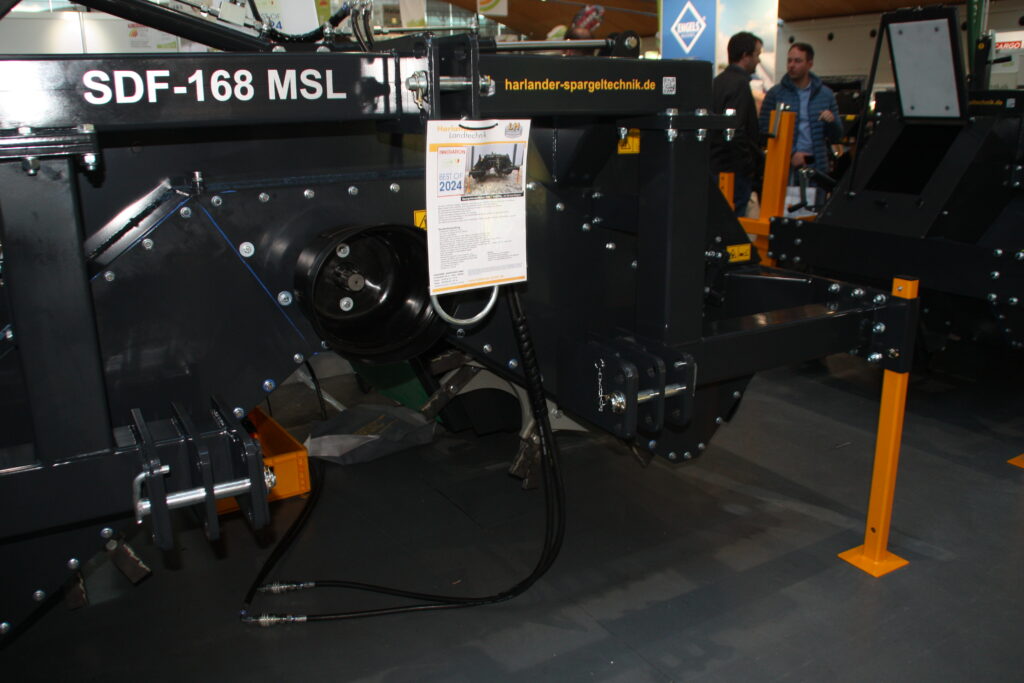
Harlander Landtechnik from Aresing (Germany): Hydraulic service flap for the asparagus bed cutter
As a world first, Harlander Landtechnik will launch the SDF-168 MSL asparagus bed cutter with hydraulic service flap. These wide-opening flaps make cleaning the machine and changing the beaters easier. Both activities can be carried out easily from above through the open flaps. This significantly reduces the time required for cleaning and maintenance and increases employee safety. Harlander has also developed various flap shapes and materials with which the asparagus bed cutter can be better adapted to different soil conditions. The flaps are inter- changeable and the entire side housing sections can be opened. The interior of the machine has been designed to be free of concealed edges that are difficult to clean.
Euro Green Tech : EGT-ASPARAGO SE electric harvester
EGT
Euro Green Tech presented its latest creation: the EGT-ASPARAGO SE electric harvester. The EGT-ASPARAGO SE offers a working autonomy of 16 hours, significantly reducing the environmental impact compared to traditional combustion engines. The ergonomic and efficient design of the machine ensures that the operator can work comfortably seated, adjusting both the seat height and the distance from the control pedals. the EGT-ASPARAGUS SE ensures precise and efficient harvesting, reducing waste and maximizing crop yield. The front-wheel drive and electric steering improve the machine’s grip on the ground and maneuverability. Euro Green Tech also presents the EGT-ASPARAGUS SM, the versatile counterpart of the EGT-ASPARAGUS SE. with the EGT-ASPARAGUS SE and the EGT-ASPARAGUS SM, Euro Green Tech offers advanced solutions that meet the needs of modern farmers, while promoting more sustainable and responsible agricultural practices.
Hermeler : Special ridger for France
G. Dubon
Hermeler, an asparagus specialist manufacturer, proposed a ridger specially built for SIVAL and intended for the wide-spaced asparagus crops set up by some French asparagus growers. The Leofan 56 ABB, a variation of the Leofan 56, has a rotor distance of 1.80m. It allows the creation of a higher and, above all, wider mound suitable for asparagus groves planted in double rows.
Hello Nature : Laphrassea, organic fertiliser based on insect frass
Hello Nature offers Laphrassea, a source of organic matter obtained by the digestion of plant matter by insect larvae. Laphrassea makes it possible to meet the requirements of crops throughout their growth cycle thanks to the gradual release of nitrogen (N=3%), and to sustainably improve soil fertility thanks to the high potential for humus creation (75% organic matter). Laphrassea stimulates the microbiological activity of the soil through the presence of beneficial bacteria and chitin. Chitosan is considered a primary substance and can be used in organic farming. It claims to function as an “Elicitor with fungicidal and bactericidal effects by means of the stimulation of the plants’ natural defence mechanisms”.
Algas Pacific : The biostimulant revolution
Algas Pacific
One of the best results granted by Algas Pacific’s products is the 15% to 32% increase in asparagus root mass. Specialized in marine science and plant biostimulation, Algas Pacific has developed innovative algae solutions for sustainable agriculture proving efficiency of application at asparagus crop’s stages: establishment, growth, and harvest. In 12 years, results have shown: better rooting; 10% to 23% increase in yield; harvest precocity; better resistance to stress and diseases; and up to 18% greater size, caliber and weight of shoots. For Algas Pacific, customized programming and technical assistance are the key for achieving these results.
Innovak : The importance of root evaluation
Innovak
A healthy and strong root system is essential to ensure a high quality and yield of asparagus. Recently in asparagus in Europe and for many years in various crops (such as berries, grapes, avocado) in other continents, Innovak Global has introduced an efficient technique to evaluate root quality with the use of the minirhizotron camera Zuzunaga-Rosas et al., 2024). Currently, a trial is about to begin with asparagus on asparagus installed on land at the Darbonne nurseries in Le Barp, using Pfenery technology based on polyphenols of plant origin where a new root observation system called “Rhizobox” will be tested.
Walker brother : New hybrids using the One-year Whole Harvest Cultivation Method
Walker Brothers joined forces with Professor Motoki and his team from Meiji University in Japan to select new varieties using the One-year Whole Harvest Cultivation Method. One of the new hybrids, WB212 produce the highest marketable yield when cultivated using the One-year Whole Harvest Cultivation Method. As a result, the Walker Brothers Team has decided to set up a demonstration trial at their home base in New Jersey this spring. Domestic and international growers are expected to be able to visit the demonstration fields in New Jersey shortly.
Huon : Boosting microbial life
Huon offers the Revival to achieve optimal asparagus growth. This organic fertiliser based on aerobic composted farm manure and enriched with Trichoderma harzianum (AMM N°1220086) has the property of colonising the inter-root space, boosting the microbial life of the soil and enhancing organic matter. By optimising the breaking down of organic matter optimal regulation of nutrient inputs is ensured.
Centro Sur : Asparagus range
Centro Sur
With its LOS MONTEROS brand, Centro Sur only sells products with the PGI Asparagus de Huétor Tájar label, a distinction awarded for its excellent quality. In 2024, the company is off ering larger canned asparagus, a crunchier texture, and a milder, fruitier fl avour making it one of the most delicate asparagus varieties. Centro Sur also sells frozen green asparagus using a sustainable freezing process from renewable energy.
Agrivaloire : Specialist distributor for asparagus
Agrivaloire
As a specialist distributor, Agrivaloire is expanding its range by offering the new ridge moulding machine from Engels Machines, Tenrit Foodtec peelers, as well as knives and gouges. The EcoSpader 2030 is an innovative asparagus ridger that offers significant labour savings as well as greater respect for the soil and the environment. Distributed in France by Agrivaloire, the EcoSpader maximises the productivity of pickers and reduces the risk of musculoskeletal disorders. Agrivaloire is also the official distributor in France of Tenrit’s Asparagus range and offers new and used peelers, including the Tenrit SOLO A, a reference in the field of asparagus peelers.
Europlastic : It heats under the plastics…
Europlastic
Europlastic continues to innovate.This season a new thermal fi lm was developed by Europlastic. This new highly transparent fi lm, thanks to its light optimizing surfactant principle, allows a greater and faster heating of asparagus mounds. Condensation inside the tunnel is limited, promoting greater light transmission especially at the level of infrared rays that provide calories. A very early and very fast start of production was observed this season at the beginning of production with the use of these 2 films (one film placed directly on the mound and another on arches). Very promising results for future seasons.
Medinbio : GAIA SOL at the end of the harvest
Medinbio
If you’ve noticed fungal lesions on your asparagus during harvest: it’s time to take back control of the situation. GAIA SOL contains a synergistic combination of beneficial microorganisms: Bacillus amyloliquefaciens & Trichoderma harzianum. Medinbio recommends using GAIA SOL at the end of the harvest with strong irrigation for a perfect impregnation of the soil and to produce metabolites favourable to soil remediation.
Asparagus World : What are the pros and cons of drip irrigation ?
Jean-Michel Bourrousse : Drip irrigation is first and foremost a means of water conservation. The volume of water supplied can be up to 50% less than with the sprinkler method which suffers loss due to evaporation. The drip irrigation system also makes it possible to control and localise fertilisation. On the other hand, drip irrigation requires more technical expertise and monitoring of intakes. Drip piping can be buried, laid on the surface, or placed in foliage. The buried drip pipe, under the crown, is only used in heavy soils (clay, silt) which allow water to rise by capillary action at the level of the roots. For sandy and well-drained soils, the drippers should be placed on the ground or slightly buried (5 cm). The objective is to moisten a layer from 0-70 cm deep.
AW : What are the constraints on use?
J-M. B. : Drip irrigation requires a good level of technical knowhow and, above all, observation. You have to look in the soil and under the roots to check the moisture levels and gradients. Tensiometer probes are useful for this. The piping network must be checked because it can be degraded by insect larvae attacks (wireworms, etc.), birds and even small game. Water quality is also important. Usually, surface water (river, lake, etc.) is loaded with silt, algae and organic matter. Groundwater is, however, sometimes too high in calcium and iron. Drip irrigation therefore requires a good filtration system upstream of the installation and regular maintenance and checking of the network and piping.
AW : What are the rules for installing a drip system?
J-M. B. : The supply of water by drip can be achieved using recyclable piping (thickness of 200 micron) and renewed every year or using recoverable piping (1 mm thick) that can be used throughout the duration of the crop. Recyclable piping makes it possible to have new equipment every year but this can be more prone to damage. Recoverable piping is more robust but requires more maintenance. The number of irrigation lines depends on the nature of the soil and the number of planting rows, either 1 or 2. In silty clay, 1 line of drippers is installed beside the planting line. In sandy soil, it is essential to install two lines, one on each side. The piping is laid on the ground and slightly buried (5 cm). To avoid damage (insects, larvae, birds), the piping is sometimes installed in the foliage, which can lead to a less homogeneous distribution and to extra installation time. Once the installation is set up, it is very important to check the wet bulb formation at the roots and to monitor the moisture in the soil by visual observations (with an auger) and/or tensiometer probes.
Like all plants, asparagus is largely composed of water. If you need convincing, all you have to do is cut a spear to see a droplet appear in less than a minute. Nevertheless, “when it comes to providing it with this vital element, it is not necessary to give it a bath, because it hates soaking its feet in the water. It prefers a shower,” says international consultant Christian Befve. Indeed, the plant seems to dread stagnation at root level. This is why asparagus likes well drained soils. And even if the size of its root system can lead one to believe that this plant is adapted to, or even resistant to drought, its water needs are actually significant. The needs of asparagus are close to the PET (potential evapotranspiration). In temperate climates in the Northern Hemisphere (Europe, North America), this represents 400 to 500 mm from the end of April to mid-September. This is because the plant fears water stagnation at the root level. This is why asparagus likes well drained soils. However, its water needs are significant. Even if the size of its root system can lead one to believe that this plant is adapted, or even resistant, to drought. The needs of asparagus are close to the PET.
Avoiding the umbrella effect
C. Befve
All over the world, depending on the production area and technique used, the water needed for plant development is supplied by three methods: gravity irrigation by flooding, sprinklers and drip irrigation. It is estimated that only 5% of the world’s asparagus acreage is solely rain-fed, showing the importance of irrigation for this crop. Drip irrigation is the most used water supply method, representing 70% of surfaces, while flooding is used for 15% and sprinklers 15%. (source: C.Befve). Sprinklers can also be used under certain conditions to protect the crop from frost (see box). For maximum efficiency, water must be supplied at the root level. However, 80% of the root volume lies under the foliage. In the case of the gravity method (flooding between the rows) or sprinklers (which are prone to the ‘umbrella effect’, whereby the water does not penetrate below foliage), the water does not reach the roots, unlike what occurs with drip irrigation. It should be noted that the underground drip method used in the early days of this technique (1980-90s) has now been abandoned worldwide in favour of surface drip irrigation. Placed above the root level, the drip line creates the recommended ‘shower effect’. Localised sprinkler irrigation is a possible variant of localised drip irrigation. In this case, the water is supplied by sprinklers placed under the foliage. Water is also brought directly to the mound. “This technique is particularly attractive due to its use of surface water and/or water with a high mineral load (calcium, iron), which leads to problems with clogging of the drippers,” Befve said.
Drip irrigation allows precise control
C. Befve
The water supply must allow for the hydrological comfort of the plant in order to ensure the development of the shoots – which will later be harvested as spears in the first phase of the crop cycle – then leaf stalks and foliage. This second part of the vegetative cycle provides storage of reserves for the following year. Gravity irrigation allows for infrequent inputs of large volumes of water that saturate the soil every 3 to 4 weeks. The plant feeds on water retained in the “readily usable reserve” of the soil constituted by the clay-humic complex. This technique can only be used in soils with a high retention capacity. Its effectiveness is very limited in sandy soils. With sprinklers, water can be applied every week, depending on its availability, and the technical means used (strips, sprinklers). This regularity allows for more homogeneous water supplies to satisfy a plant’s needs. With drip irrigation, water can be applied several times a week, depending on the needs of the plant and the state of the soil reserves estimated using tensiometric probes. The division of the inputs makes it possible to maintain the “soil volume/air volume” ratio, which is favourable to the oxygenation of the roots. “It is only with drip irrigation that we can really talk about irrigation management,” says Christian Befve.
Hydrological comfort for the plant
“This control can be seen in the field directly on the plant. When the plant is in hydrological comfort, its cladodes are numerous, long and open, giving the foliage an ample volume,” the specialist says. Conversely, a situation of hydrological stress generates short, tightly packed cladodes in the shape of a ‘fox’s tail’. Moreover, adding water to the planting line ensures the development of the roots under the foliage area and at depth, unlike sprinklers and gravity, which moisten the soil over the entire surface. The roots then develop more superficially and in the inter-row. This, in turn, exposes them to degradation by the ridging tools. “This impact on the root system should be seen as leading to a reduction in the production potential and longevity of the crop,” Befve says. The management of water and fertiliser inputs thanks to drip irrigation takes place according to the physiological stages of the plant (see also When should fertiliser be added, and how?).
Maximum foliage development
After the harvest, when the first growth starts, irrigation and fertilisation must meet 110% of the PET for the first two weeks and 40% of the overall nitrogen requirement (see also Water efficiency and the effects of irrigation methods). The water must be supplied at close intervals to allow the plant to produce a large number of spears. For the next 3 weeks, irrigation can be less frequent and represent just 90% of PET. The mineral feed should be 10% of the total nitrogen inputs and 20% of the potash, magnesia, phosphorus, boron and calcium inputs. Then, after 5 weeks, the plant goes through a second growth to produce new spears. Water inputs must be high – 120% of PET – because the foliage of the plant is already developed. At this stage, its nitrogen requirement is 20%. Over the next three weeks, less frequent irrigation sessions should cover 80% of PET and provide 10% of nitrogen and 30% of potash, magnesia, phosphorus and boron requirements.
A third growth phase may take place 5 weeks later. Water requirements, 130% of the PET, are important because the plant is at the maximum development of its foliage. Nitrogen consumption of 20% of global input. These inputs should be maintained for 3 weeks. In the following weeks, irrigation is reduced to 70% of PET with watering sessions more spread out. Nitrogen inputs cease. During this third growth phase, the inputs of potash, magnesia, phosphorus and boron represent half of global input in order to ensure the plant can store sufficient reserves.
Water efficiency and the effects of irrigation methods
G. Dubon
The comparison table allows evaluation of how the different methods of irrigation of an asparagus plantation, as well as a non-irrigated crop, differ in outcomes across factors including water efficiency, the effects of crop management techniques, various constraints and their costs. Drip irrigation is the most water-efficient system. Compared to PET, it allows only 80% of this volume to be used to meet the needs of a crop. With losses mainly due to evaporation, sprinklers require 120% of the PET. And gravity (flood) irrigation, which accumulates runoff losses, consumes 150% of PET. The consumption or overconsumption of fertilisers is also linked to the consumption of water. The application of fertiliser by drip feed makes it possible to match the inputs to the demand of the plant (100% basis). To cover the same needs, the fertiliser application should be 120% for sprinklers and 150% for gravity irrigation. It should be noted that non-irrigated plots require more fertiliser (120% of needs) to compensate for the lack of availability of elements due to the lack of water. Irrigation methods also have a direct effect on the crop. Taking 100 as a base for the grass cover of a plot irrigated by sprinklers, the grass cover due to drip irrigation is 60, and 150 for the plot irrigated.
Water intake increases yield and life span
Irrigation is a critical factor in the yield and lifespan of an asparagus plantation. According to the data collected by Christian Befve and based on 100 yield/ha for an unirrigated crop, irrigation via flooding delivers an efficiency of 130, sprinklers 140 and drip irrigation 160. “It is the quality of the water supply and not the quantity of water supplied that makes this improvement possible,” says the specialist (see Box 1). He also believes that the lifespan of an asparagus plantation is also linked to its irrigation method: 6 years if unirrigated, 8 years with gravity irrigation, 10 years with sprinklers and 12 years with drip feed irrigation.
Investments and costs
C. Befve
Irrigating an asparagus plantation has a cost. It is zero if solely rainfed but increases to 100 euros/ha for gravity irrigation (flooding), 800 euros/ha for sprinklers and 1,500 euros/ha for drip irrigation. This increase is mainly due to the necessary investments in the equipment used (figures excluding boreholes and canals). Hours worked are also to be taken into account. They are estimated at 90 hours per hectare for flood irrigation requiring the development of plots (canals, channels); 25 hours for sprinklers for the time spent moving the sprinklers, and 11 hours for drip irrigation, which includes 6 hours of set-up and the rest in network monitoring.
Non-selective harvesters cut all spears regardless of their quality, length, or other requirements, while selective machines harvest spears based on specific criteria. When it comes to green asparagus, nonselective harvesters cut all spears, regardless of length, at or near the soil surface and place the cut spears in collection devices. For white asparagus, they cut all spears, regardless of length, just above the crown in the soil mound then transport both spears and soil onto a conveyor, before separating the spears from the soil by vibration. The soil is then re-mounded over the plant row, Drost says.
Selective harvesters for green asparagus require advanced sensor data processing to identify individual spears of the appropriate length from fields of spears of many different lengths. Spear identification is difficult in on-farm conditions where speed and accuracy are key. To be integrated into existing production systems, selective harvesters need to operate at speeds and efficiencies comparable to human labour and perform the task without damaging the harvested spear or injuring surrounding spears in the field that was not selected for harvest. Thus, harvesters require real-time (in the order of tens of milliseconds) perception and cognition of the spears, as well as high-speed actuators and robust mechanical designs. Given enough computational power and accurate GPS data, non-selected spears could be mapped for future harvest, which may speed up harvest operations. Predicting when spears achieve the appropriate length for harvest requires knowledge of spear growth rates in addition to position information.
Selective harvesters for white asparagus are more complex. To automate the harvesting process for white asparagus, the row guidance system needs to maintain the integrity of the asparagus soil mound, and the spear harvesting device needs to identify the spear’s location, cut off the spear under the ground, and successfully extract it from the soil with minimal damage to the spear. According to Drost, the guidance part is easier to create, while much more engineering is needed to get the spear-cutting and extraction mechanisms to work efficiently. Ground-penetrating radar has also been evaluated as an alternative approach to sensing crown depth to obtain the optimal cutting height for nonselective harvesters and would ensure that long spears would be cut while crown damage would be minimised.
Global demand for asparagus may be growing, but the high cost and shortage of labour is hampering many producers and fuelling interest in harvest mechanisation. One of the challenges facing mechanisation is today’s cultivars have been selected for hand harvesting and their traits don’t lend themselves to machine picking. For hand harvesting, desired characteristics include high total yield, excellent spear quality, good spear thickness, and improved earliness. When it comes to machine harvesting, desirable criteria include uniform and consistent spear emergence, a better knowledge of what triggers bud break and spear elongation, a good understanding of bud and bud cluster dominance, more uniform spear position in the planted row, spear growth regulation, and harvest termination details. In his article “Asparagus breeding: Future research needs for sustainable production”* (Front. Plant Sci., 27 March 2023), professor Daniel Drost, from the Utah State University’s Department of Plants, Soils and Climate, says a better understanding of such matters would bene fit producers across the world.
What can be learned from the development of mechanised tomato harvesting?
Drost writes that the history of the mechanical harvesting of tomatoes provides an analogy for how to approach the mechanisation of the asparagus harvest. Prior to the development of a harvesting machine for tomatoes, all tomato fruits were hand harvested and imagining how a mechanical harvester might work and what it might look like was difficult. Those developing the system figured that to allow for machine-picking, completely new varieties of tomato would be needed. Such new plants would need to produce fruit with greater firmness to protect them from machine damage, and have a very short fruit-set period, so that fruit ripening occurred over a concentrated period. A first step in the development of a machine-harvestable tomato variety was the release of the small determinate cultivar “Red Top.” Through selective breeding and screening, the VF 145 lines were later developed. These first mechanically harvested processing tomato cultivars paved the way for the present day preeminence of mechanisation in the harvesting of canning tomatoes, he says.
Daniel Drost
Apple tree selection has improved labour efficiency
When it comes to apple orchards, Drost says a primary objective is to grow trees that produce high-quality fruit with high productivity. Tree forms have changed over time via selection of di fferent plant types (dwarfing rootstocks) and the adoption of new training and pruning approaches. It’s been found that planting density has a stronger impact on fruit quality, growth, and light interception than training systems (shape) do at the same spacing. Similarly, light distribution within the canopy is more crucial than total light interception in terms of fruit quality. Efforts to increase fruiting spurs, as opposed to vegetative shoots, have signi ficantly improved plant performance, he writes. “More linear growth habits (spur or central leader type) optimise light capture while reducing the need for extensive training or pruning. Therefore, tree selection (or manipulation) creates new possibilities in orchard management, improves labour e ciency, and reduces inputs (fertiliser, water, pesticides, etc.) while ultimately enhancing productivity”, Drost says.
Fewer buds and bud clusters could simplify production without sacrificing productivity
Like tomato and apple, asparagus breeders need to identify new plant types – particularly identifying different crown architecture – more conducive to mechanical harvesting. Historically, asparagus breeding focused on high productivity and, more speci fically, on the identi cation of all-male lines, disease resistances, high spear yields (large crowns; lots of bud clusters), and spear quality. “Bigger plants do produce higher yields, but they do this randomly. Creating simpler systems (fewer buds and bud clusters) and identifying alternative plant forms could simplify production without sacri ficing productivity”, Drost says. He writes that current asparagus cultivars have highly di erentiated rhizomes (high branching; big crown), similar to indeterminate tomatoes. Existing asparagus varieties also have many bud clusters and buds, so there is the potential for high yields. But as plants develop, growth progresses in too many directions and bud break follows no real pattern or predictability. “These plant types are less adapted to mechanical harvesting due to the randomness of spear position, timing, or growth. Presently, there is no known way to regulate the timing of spear emergence, and it is di fficult to determine when or where spears will emerge. So, existing asparagus plant types and present-day asparagus harvesters are less compatible, and this reduces harvest e fficiency and increases harvest costs.” he says.
Daniel Drost
Stronger apical dominance a desired trait for mechanised harvesting
Ideally, asparagus plants with a more centralised growth habit (fewer secondary bud clusters or single/ limited axis of rhizome growth) would help concentrate maturity or overcome the uncertainty of where spears may emerge in the field, Drost says. In theory, asparagus crowns with stronger apical dominance may have fewer secondary bud clusters or may suppress those bud clusters from growing spears. Also, asparagus plants with a centralised rhizome (if identi fied) could be organised, much like spur or spindle apples, into narrow rows (high plant populations) and oriented in rows with distinct arrangements (bud clusters positioned directionally), which would better suit mechanical harvest. “This does not overcome the problem of regulating spear emergence but does regulate the field position of the spears.” While fewer bud clusters means fewer buds and lower spear yield per plant, lower perplant yields could be overcome by increasing plant populations. “Asparagus breeders need to not only consider traditional selection metrics but also keep a lookout for the unusual or off-types that may fit into nontraditional production systems,” Drost says.
All asparagus growers stand to bene fit
In summary, “changing asparagus production systems for mechanical harvesting would require additional understanding of apical dominance within the bud clusters, renewed e orts to synchronise spear emergence, and the need for asparagus breeders to look for and identify alternative plant types specifically for the machine harvest industry.” Drost also says: “While many regions of asparagus production with high acreage still rely on hand harvesting methods, architectural changes to the asparagus plant would and could bene t all asparagus production regions making harvest more e fficient and cost-effective. Furthermore, while much is known about asparagus growth, further work on the regulation of spear growth can help with understanding the dynamics and timing of spear elongation. Through the combined e fforts of breeders and physiologists, the changes described can improve asparagus productivity, adapt the plant to mechanisation, and still maintain the level of productivity and quality needed to make the system sustainable and profitable.”
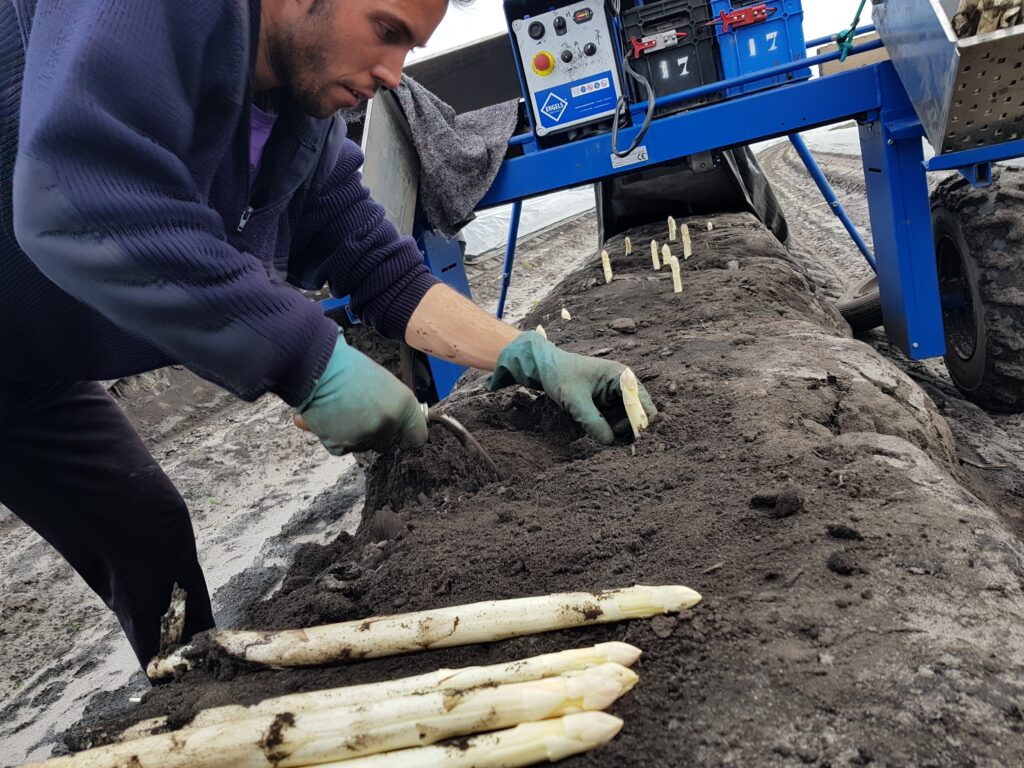
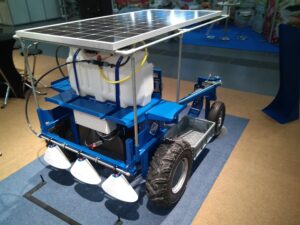
Engels Machines offers ASverde, an asparagus harvesting assistance machine from a prototype tested in 2023. The harvester is equipped with a rear-mounted sprayer to ensure the weeding of the bed at the same time. The machine can be adjusted to regulate the application rate according to the speed of progress and at each stop (stop-and-go). The kit is equipped with a photovoltaic panel that ensures up to 80% autonomy which limits charging cycles.
Funck: recovering plastic films and ducting
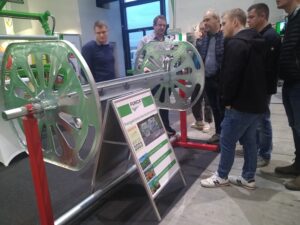
The Funck Machine Company has developed a drum with a central diameter that can be reduced so that it can be easily removed from the film roll. This drum, variable in diameter thanks to a simple mechanical system, allows plastic films and flexible drip ducting to be wound. It can be used for all film setting and dispensing machines from different manufacturers.
Hermeler: Emptying the Hems of Mulch Films
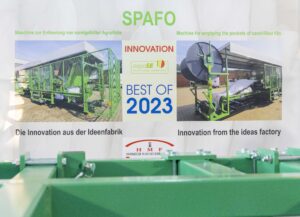
SPAFO, a platform for the recovery and processing of pocket mulching films for asparagus crops, was presented for the first time at ExpoSE. The machine is designed to cut open the bags and empty them of their contents (sand, soil), so that they can be recycled. According to the manufacturer, it ensures the removal of more than 90% of soils, which limits the weight of the films for transport and facilitates their reinsertion into the reuse cycle of used agricultural plastics.
Hepro: the smallest peeler on the market
Hepro, who have mastered the vertical peeling technology for asparagus, have designed the smallest peeling machine offering self-service «peeled asparagus to go» directly from the point of sale. Intended for shops or farm shops, this very compact machine only requires an electrical outlet.
FreezeDry : Freeze Drying at Home
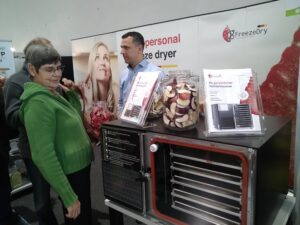
FreezeDry presents freeze-drying units with different capacities, from 2, 20 and 80 kg. The equipment from the agri-food industry and adapted to the scale of an SME freezes and then dehydrates all food products, fruit and vegetables, but also meat and fish. The products retain their colour and volume. The freeze-drying process takes between 10 to 50 hours depending on the size and thickness (0.5 mm/hour). The products are then sold dry.
Fardin Machine: Reducing Harvesting Time
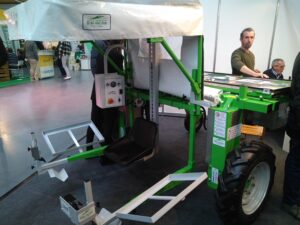
The Italian manufacturer has taken over the activities of the Ecogreen Company constructing machines to assist with the harvesting of green asparagus. The Far-Green is equipped with two 1,000-watt electric motors and has a gearbox directly connected to the drive wheel to improve traction. Its track is adjustable in width from 1.20 to 2.20 m as well as height adjustable to be used for harvesting white asparagus, with the adaptation of a structure to lift plastics. A platform is used to store crates. The manufacturer announced time savings of 50% – compared to a traditional harvest.
Neubauer: Handling Robot
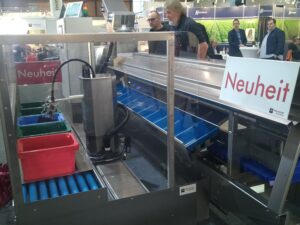
Neubauer presented a prototype for handling and crating asparagus at the grader outlet. The handling arm is equipped with a gripper able to grasp a dozen spears and place them in a box. Each arm ensures the release of 10 to 12 calibration outputs, i.e. approximately 500 kg/hour. It reduces the number of support people on the grader by replacing at least one person.
Bejo: Sirius, a late novelty
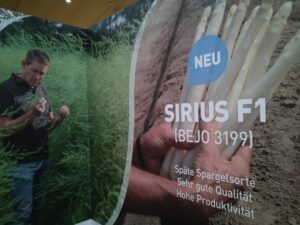
Sirius F1 (ex 3199) is a 100% male hybrid specially bred for the cultivation of late white asparagus. This variety has a very good yield with a high percentage of category 1, homogeneous in size. According to breeder Bejo, the spear is very white with a closed tip of excellent quality. The plant performs well against rust and hollow stems and purple discolouration. Sirius is also suitable for heated cultivation and completes the range with Prius, Cumulus and Cygnus.
En France, l’agrivoltaïsme est en plein essor. La loi récente relative à l’accélération de la production d’énergies renouvelables lui confère une définition claire et un cadre législatif. Dans ce contexte, Engie Green a développé CAMELIA, une nouvelle solution agrivoltaïque de haies solaires bifaciales verticales. Implantées en synergie avec une culture à haute valeur ajoutée telle qu’une culture d’asperges, elles permettent en priorité de protéger les cultures du vent et de diminuer leur évapotranspiration, tout en produisant de l’électricité renouvelable. La culture d’asperge est sensible aux vents forts : durant la période végétative, ils risquent de coucher les plantes, limiter le développement foliaire et générer une perte de rendement jusqu’à 15 %. Durant la récolte plein champ, les turions se tordent sous l’effet du vent dominant. Les turions tordus présentent de nombreux désavantages : fabrication de fibres côté vent, plus d’amertume, conditionnement en bottes impossible et besoin d’emballages plus grands. Sur le marché, ces asperges perdent plus de 50 % de leur valeur commerciale.
Valoriser la lumière reçue sur les deux faces
Les solutions actuelles de protection au vent, comme les microtunnels, les serres ou les haies naturelles, sont coûteuses et parfois difficiles à mettre en place. Les haies solaires CAMELIA sont composées de panneaux photovoltaïques bifaciaux, capables de valoriser la lumière reçue sur leurs deux faces. Positionnés à la verticale et orientés est-ouest, ils permettent d’obtenir une production d’électricité maximale au levant et au couchant du soleil, à la différence des panneaux solaires inclinés avec une orientation sud qui produisent majoritairement en milieu de journée.
Les haies solaires CAMELIA proposent un profil de production “à 2 bosses”, qui a l’intérêt de compléter celui des installations PV classiques pour mieux répondre aux besoins électriques et qui a aussi inspiré son nom : CAMEL (le chameau) – IA (Installation Agrivoltaïque).
En plus de l’intérêt énergétique, les bénéfices d’un point de vue physique sont multiples :
Effet brise-vent, protecteur et la diminution de l’évapotranspiration
Partage lumineux la lumière de la journée bénéficie à la culture.
Empreinte au sol limitée des haies verticales permettant de conserver toute la surface agricole.
Système d’ancrage simple, modulable et réversible.
Pas d’entrave au passage d’engins agricoles ni la mise en place de paillage ou de microtunnels.
Espace ouvert sous les panneaux permet de conserver le passage de l’air et d’implanter une bande de biodiversité.
Protection sanitaire de la culture, aération préservée.
Réduction de la vitesse des ventes dominants
À l’initiative d’Engie Green, une étude a été réalisée en 2022 par un bureau d’études spécialisé, pour caractériser cet effet de protection appliqué à une culture d’asperges et valider la résistance des haies photovoltaïques. Les simulations numériques ont permis d’établir qu’en positionnant les haies solaires perpendiculairement aux vents dominants, la vitesse de ces vents est divisée par deux sur plus de 95 % de la surface du champ et les risques de vent violents supérieurs à 80 km/h sont divisés par plus de 50. Cette solution agrivoltaïque peut bénéficier aussi aux grandes cultures fourragères et céréalières, aux PPAM et aux terres d’élevage.
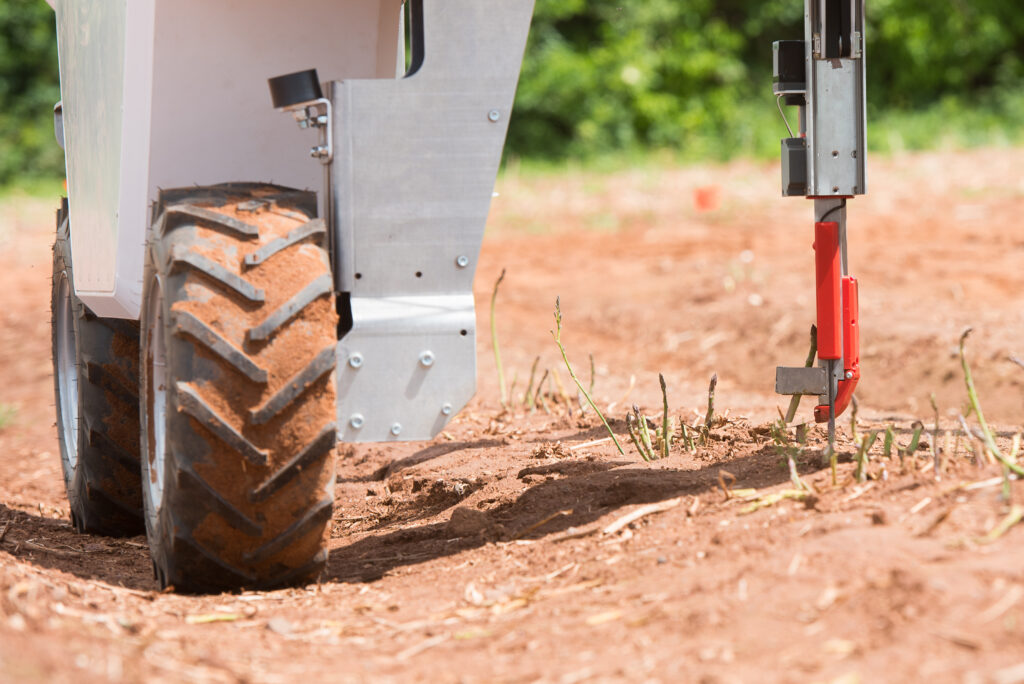
Demonstrating how a small herd of robots can work together to harvest asparagus is on the horizon next season for Muddy Machines. That’s one way the AgTech and robotics company plans to use a new round of seed funding totalling £1.5 million (over €1.7m) announced in August for its Sprout harvesting robot. The company’s technology allows farmers to precision harvest crops like asparagus. It says Sprout – now on its 3rd prototype – can already drive through fields harvesting accurately for up to 16 hours a day before needing a recharge, therefore hugely increasing the picking window. The new round of funding will be used to strengthen the company’s engineering team and build capacity to cope with more widespread adoption of its technology.
It will specifically focus on building a small herd of Sprout robots for the 2023 asparagus harvest season – all communicating with each other to autonomously harvest whole fields of asparagus – as well as generating initial revenues; continuing with the development of different crop harvesting capabilities; and planning production of the next generation of lightweight, battery-powered Sprout robots. Muddy Machines was founded in 2020 by Christopher Chavasse and Florian Richter with a vision to use robots to sustainably solve pressing labour issues in farming. The company has previously won nearly £2.5m in grants from Innovate UK and DEFRA.
Sprout has the support of UK’s largest asparagus grower Cobrey Farms
Muddy Machines has been developing its Sprout robot through trials this year on Redhill Farm, in South West England. Part of Cobrey Farms, the UK’s largest growers of asparagus, the startup has been provided with a portacabin office and barn to use as a workshop there. John Chinn of Cobrey Farms said it’s generally believed that robotic selective harvesting of fruit and vegetables, such as asparagus, is still a few years away from being commercially available and viable. “However, I believe Muddy Machines may well be the first to market with their asparagus harvest robot,” he said, with harvesting of Tenderstem and courgette likely to follow a few years later. In return for its collaboration, Cobrey Farms has been promised first right of refusal on the robots for asparagus harvesting for the first two years of their commercial availability. While there’s been remarkable progress with machine learning and the ability to recognise harvestable asparagus spears – leaving young spears for another day and not trying to harvest a weed – the next challenge is to improve the mechanics of cutting them, Chinn said.
The arrival of commercially available and viable robot harvesters for asparagus won’t come soon enough in the UK, where “the situation is desperate.“ “It’s not about cutting costs of labour, but our inability to find it. We have a 12-week season and this technology is vital if we are to harvest the crop,” he said. With around 1,350 people needed each picking season at Cobrey Farms, labour is one of the biggest costs to his business and finding ways to save costs and become more efficient is crucial for survival. While farm machinery is generally getting bigger and heavier, which is bad for soil compaction, Sprout is fairly small and light, at less than half the size of the smallest car. With several robots working in one field, each using GPS navigation and communicating with each other to ensure that they do not overlap, soil compaction will be reduced, Chinn said. He is also looking at ways to provide electricity to recharge the robots by harnessing renewable energy on the farm.
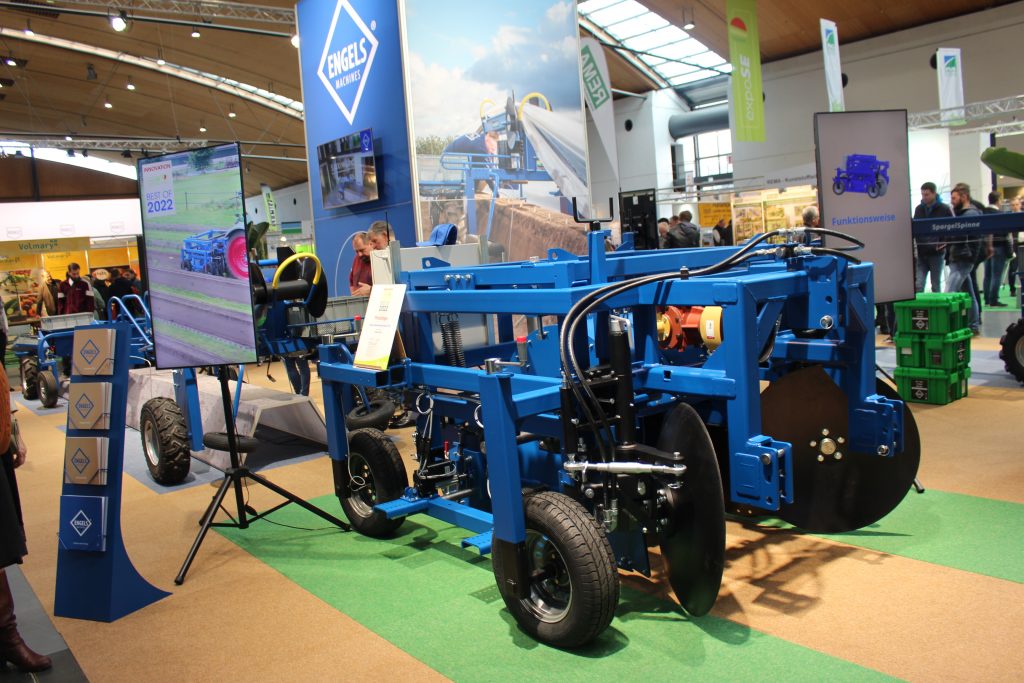
Designed by the Dutch manufacturer Engels, the EcoSpader 2030 asparagus ridger was awarded one of the “Innovation-Best of 2022” at ExpoSE. More than a ridger, the EcoSpader preserves the plant cover of the inter-row and allows an agro ecological approach by promoting the improvement of soil quality. To do this, the machine groups the volume of soil available for the mound using disks. It works the soil in depth without touching the crown in order to form a mound with a homogeneous soil to facilitate asparagus growth. The height of the mound is fixed, only its width can vary thanks to sensors and cylinders integrated into the machine. The machine can be used in plantations with an inter-row starting from 2.20 m.
Strauss : prototype of a harvesting robot
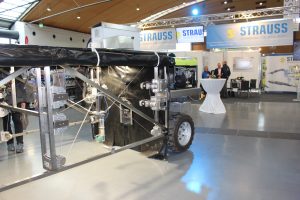
Strauss, a specialist in asparagus harvesting and packaging, presented a prototype of a robot for the harvesting of green asparagus. The harvesting arm is placed in a controlled light environment (covered cell) where asparagus (location + size) is detected using cameras. A picking arm, suspended and mobile thanks to pulleys, picks and deposits the asparagus on a conveyor tray. According to the manufacturer, the system is intended to be “rustic and efficient” and to harvest 2000 to 3000 asparagus per hour and facilitate the maintenance of the machine. The machine works autonomously on the plot and can change row by itself. By analysing the images the forecast of the next day’s harvest may be ensured. Finalisation of development and demonstrations to take place in 2023 with availability in 2024.
Ringo Plast : refrigerated boxes
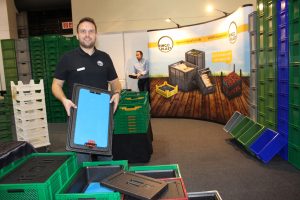
The Ringo Plast Company offers insulated crates of different sizes that can contain from 5 to 10 kg of asparagus (or other produce) in order to maintain the temperature for 6 to 8 hours and preserve the freshness of the product. They can also be equipped with additional freezing plates that improve shelf life.
Böckenhoff Folien : recycled plastic films
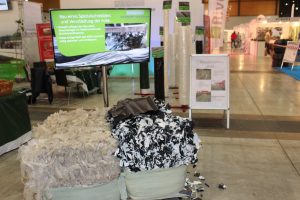
This supplier ensures the recycling of plastic sheeting, covering films and pocket films used in asparagus cultivation. After collection, the plastic films are shredded, washed and cleaned to remove all dirt and then baled for recycling. The service is charged at 110 euros per ton of films.
Daios : tunnel ventilation
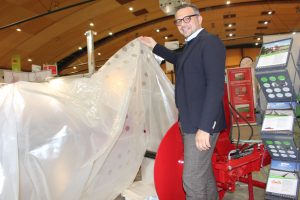
Daios, the plastic film manufacturer presented a new tunnel cover film. The cover, made of polyethylene of from 90 to 150 microns, designed for covering an 8.40m tunnel, is equipped with a 1.20m wide ventilation “box”. It consists of a perforated film and a cover film, placed at the ridge of the tunnel. This box ensures both the seal of the tunnel and its superior ventilation. According to the manufacturer, it is possible to reduce excessive summer temperatures by 5°C. The film is already available in Spain, Italy, Germany and Mexico.
Tenrit : peel your asparagus yourself
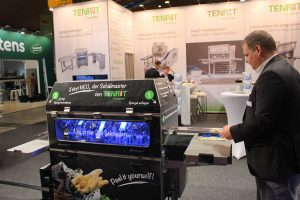
“Do it yourself”, this is what Tenrit offers with this adaptation to the direct sale of its automatic asparagus peeler. The basic peeler element is equipped with an automatic asparagus feeding conveyor that starts when the first asparagus is placed on it and it has a recovery tray reduced to the size of an asparagus bunch. It will take the customer/consumer 20 seconds to peel his one-kilo bunch of asparagus.
Kesse Böhner : self-service micro-marketplace
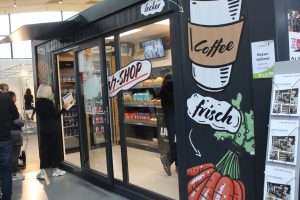
This micro market designed in a container is the commercial evolution of self-service in a small space. The customer enters this micro store, under video surveillance, using a bank card. Once inside, the customer weighs out and pays for the products installed on the shelves and in refrigerated cabinets. Several modules exist, the 18 m2 (6x3m) one costs 60,000 euros all inclusive.
Christiaens : total harvesting of green asparagus
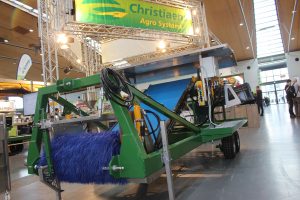
“Christian” is a harvester for green asparagus designed on the concept of “total harvest” already used by this manufacturer for white asparagus with his “Chris” harvester. The machine is equipped with a cutting bar, a conveyor belt and distribution for crating and sorting asparagus. All asparagus is harvested every 5 days. According to the manufacturer, the waste rate (particularly asparagus which is too short) is 20%. The loss is compensated by a harvesting yield (2 hours per hectare) and a very low harvest cost. The machine is also equipped with claws to ensure mechanical weeding.
Bejo : new late variety
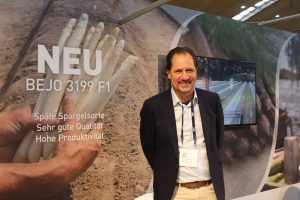
Bejo 3199 F1 is a new variety from the breeding program that gave rise to Cumulus, Prius and Cygnus. Bejo 3199 F1 is a late variety that comes in the April-June production window with a medium calibre and more than 50% asparagus being 22-26mm. According to the breeder, the taste quality of Bejo 3199 F1 comes second just after the Cumulus reference.
Manage consent
To provide the best experiences, we use technologies such as cookies to store and/or access device information. Consenting to these technologies will allow us to process data such as browsing behavior or unique IDs on this site. Failure to consent or withdrawing consent may adversely affect certain features and functions.
Functional
Always active
Technical access or storage is strictly necessary for the legitimate interest purpose of enabling the use of a specific service explicitly requested by the subscriber or user, or for the sole purpose of carrying out the transmission of a communication over an electronic communications network.
Preferences
Technical access or storage is necessary for the legitimate interest purpose of storing preferences that are not requested by the subscriber or Internet user.
Statistics
Technical storage or access that is used exclusively for statistical purposes.Technical storage or access that is used exclusively for anonymous statistical purposes. Absent a subpoena, voluntary compliance from your internet service provider, or additional records from a third party, information stored or retrieved for this sole purpose generally cannot be used to identify you.
Marketing
Technical access or storage is necessary to create user profiles in order to send advertisements, or to track the user on a website or across websites with similar marketing purposes.
 As a world trade fair premiere, 4Disc is presenting the InterCut, a cutting cultivator for ultra-shallow and full-surface soil cultivation for the area between the ridges. The InterCut works from 1 cm with permanently horizontally rotating, sharp discs that cut through the weeds precisely at the root collar. The sharp cutting edge in combination with the angle of attack keeps the soil open-pored. The cutting cultivator can be conveniently and precisely adjusted to a depth of 1-12 cm using spindles. The two-bar cutting discs are followed by the three-row «Turn Over» harrow, which is safe to use thanks to its spe- cially angled design and loosely places weeds on top to dry. The InterCut is attached to a narrow-track tractor. According to the manufacturer, the ultra shallow work is guaranteed. 4Disc is fuel efficient and easy to pull.
 As a world first, Harlander Landtechnik will launch the SDF-168 MSL asparagus bed cutter with hydraulic service flap. These wide-opening flaps make cleaning the machine and changing the beaters easier. Both activities can be carried out easily from above through the open flaps. This significantly reduces the time required for cleaning and maintenance and increases employee safety. Harlander has also developed various flap shapes and materials with which the asparagus bed cutter can be better adapted to different soil conditions. The flaps are inter- changeable and the entire side housing sections can be opened. The interior of the machine has been designed to be free of concealed edges that are difficult to clean.