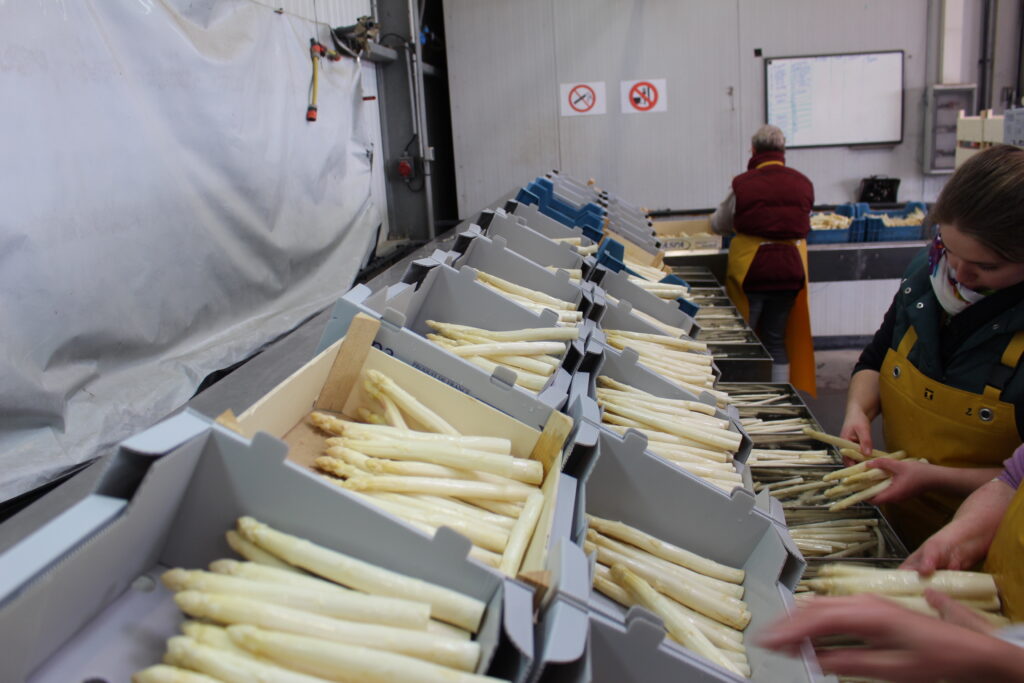
Like asparagus in spring, the new magazine from Asparagus World, 100% asparagus, has just been released ! Read Aspargus World No.7 and discover how asparagus is a good candidate for robotisation. Travel around the world of asparagus, from the United States to Peru, China, or Europe, and see why Poland is moving from white to green.
After the success of the last 4 editions, the 5th edition of International Asparagus Days will take place in Bordeaux (France) from 7 to 9 October 2025. The event will be held in association with the 1st edition of International Berries Days. Macfrut, the international trade fair for the fruit and vegetable sector in Italy, Befve&Co, and Interco Nouvelle-Aquitaine are organising two international professional events to bring together the entire asparagus and soft fruit sector. “There is an obvious complementarity between these productions. Asparagus producers are also producers of berries, many suppliers offer a range of products for these crops, and marketers have a common offer of asparagus and red fruits,” explain the organisers to the two sectors.
More than 100 specialised exhibitors
Organisers expect a large international participation of visitors. Already German, Spanish, Peruvian, and Turkish delegations are expected. More than 100 specialised exhibitors will be present on 8 and 9 October. These days will be devoted to visits to stands of plant material and equipment, services and marketers, to outdoor demonstrations (preparation, planting, maintenance and harvesting equipment, etc.), to pitches and technical workshops led by exhibitors and sponsors. 7 October and 10 October (optional) are devoted to visits to leading French farms (click here to see the program). International Asparagus Days and International Berries Days are free events with prior registration required (click here to register).
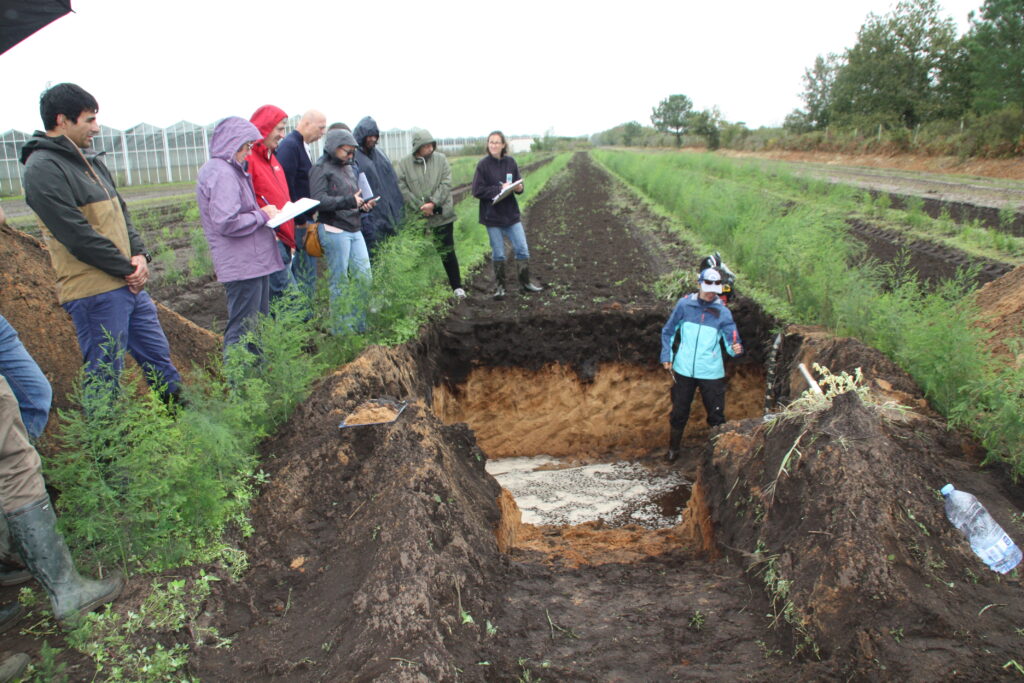
The AOPn Asperges de France devoted its 6th technical day, at the beginning of October, to the theme of asparagus replanting. This practice, while still infrequent in France, is nonetheless increasing due to the specialisation of farms and the lack of «virgin» asparagus plots. On the technical day, Christophe Paillaugue, president of Asperges de France estimated, «Of the 6000 ha of asparagus grown in France, about 500 to 600 ha are replanted each year, to ensure the renewal of the surfaces with a low percentage of replanting on the same plot.» However, this situation is tending to increase and also exists in many other producing countries, particularly in Germany. «Planting asparagus on top of asparagus can give disappointing results with lower yields in the first years and plant losses,» says Adèle Sahut, from Asperges de France. Crop losses can be up to 30% with a three-year reduction in the life of the asparagus grove. This is due to soil fungi which are pathogenic to asparagus (Fusarium, Rhizoctonia), autotoxins released by the roots of the previous crop and to the more general syndrome known as «soil fatigue». In addition, several presentations were given in the room making it possible to identify the microbial activity of soils in a broad way. «Fungi and bacteria contribute to the stability of the soil. The loss of diversity and activity leads to decreases in the mineralisation process and in the yield of the plants grown,» says Emile Benizri, a lecturer at INRAE.
20 years of asparagus replanting on top of asparagus
Carmen Feller, researcher at the Leibniz-Institute (Germany) presented the results of the Newsoil 21 programme, which made it possible to evaluate different prevention methods over five years (2017-2021): organic matter inputs, biofumigation, inoculation of microorganisms, varietal resistance. Christian Befve, an international consultant, also presented the «out of ground – in the ground» method, which consists of creating a large volume of homogeneous soil before planting with the addition of compost and micro-organisms using a spader. During the round table discussions, David Ducourneau, an asparagus producer in the Landes, detailed his twenty years’ experience of replanting asparagus on asparagus, i.e. three crops on certain plots, insisting on the importance of drainage. According to the experience of Ophélie Lendani,a technician with MaïsAdour technician,working with three asparagus growers, replanting on the same plot led to very marked reductions in yield, up to 40% after the 4th year of harvest. The afternoon of fieldwork on the asparagus groves of Planasa allowed the hundred or so participants to attend the presentation of organic solutions proposed by Innovak global and Medinbio, and also allowed them to observe crop profiles led by two specialists, Céline Collin Bellier, manager of Solenvie, and Emmanuelle Choné, agro-soil scientist from Agronomie Terroirs.
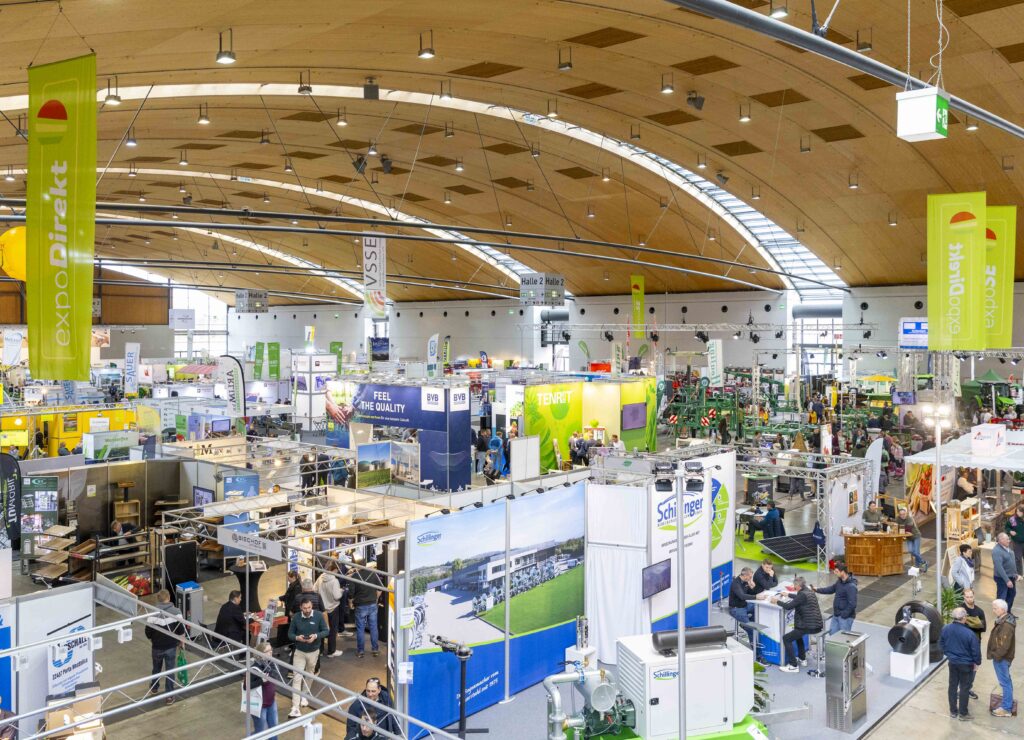
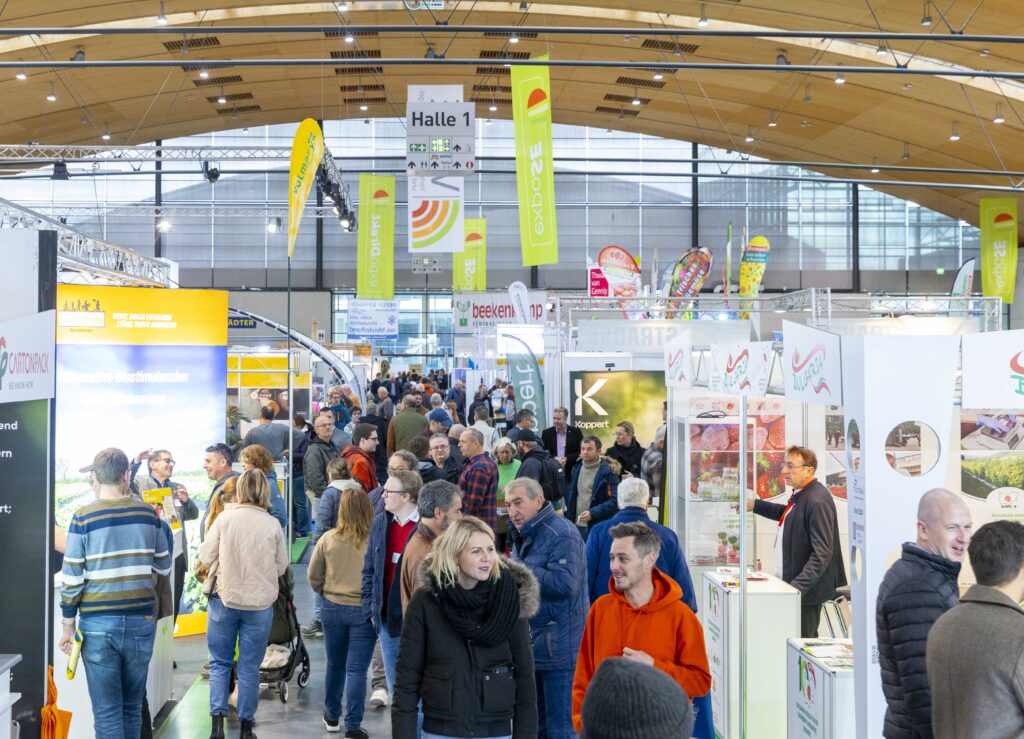
The 28th edition of the expoSE – the trade fair for asparagus and berry production in Europe – and the 13th expoDirekt – trade fair for direct sales – which took place at the Messe Karlsruhe welcomed more than 5,200 trade visitors on 20th and 21st November. Of the 440 exhibitors, almost 16% were participating in the trade fairs for the first time. «The overall mood of the trade fair duo was more confident than a year ago, and the exhibitors surveyed at random indicated that the number of investment projects would increase again,» says Simon Schumacher, organiser of the expoSE and expoDirekt trade fairs. 84% are convinced by the salon duo and will come back.
Three innovation awards for asparagus and strawberries
«The stable but slightly lower number of visitors reflects the concentration of the sector as well as the ever important need for information on new developments and innovations, as well as the interest in professional exchanges observed for the popularity of specialized forums,» says the manager. Three innovation awards were presented for each trade fair: expoSE and expoDirekt. The expoSE Innovation Awards went to 4Disc from Dortmund for its InterCut for ultra-flat tillage between asparagus rows, to Harlander Landtechnik for its asparagus mound rotavator with hydraulic service hatch and to Hexafarms from Berlin for its intelligent yield forecasting system for strawberries and berries under tunnel. The expoDirekt innovation awards went to two cooperating companies, getpacked and Click & Collect Service for getpacked & collect – which enables online shopping with collection of products from vending machines, to Pflanzentheke from Lorsch for their smart vertical farm system for direct marketing and to Schwab Automaten (Packmatisch) from Munich for the HofKiosk, the vending machine with product tray system. The next trade fair duo expoSE & expoDirekt as well as the four forums (see box) will take place from 19 to 20 November 2025 at Messe Karlsruhe.
The 35th Asparagus Day attracted a large number of visitors, with the focus squarely on technical topics such as replanting, the resurgence of the asparagus fly, the viability of asparagus growing and the possibilities for reducing the use of phytosanitary products in asparagus cultivation. It also afforded an overview of the cultivation and marketing of green asparagus in southern Spain and provided current information about the world of asparagus.
The forum on berry techniques recorded a good turnout for its 2nd edition, with nearly 80 participants. The forum addressed the importance of data-driven crop management for better plant growth and energy savings, as well as more reliable harvest forecasts for better planning of strawberry harvests by robots. These technical elements should also facilitate the transition from soil cultivation to trough cultivation as well as making irrigation easier.
The direct sales forum, organised by the trade magazine HOFdirekt and the VSSE, worked perfectly with topics on “Smart Shopping” and “The farm shop as a brand”.
More than 400 exhibitors from 13 countries specialising in the production of asparagus and strawberries and berries as well as in direct marketing will be present at the expoSE & expoDirekt trade fair duo from 20 to 21 November 2024 at the Karlsruhe Exhibition Centre. The organiser of this 28th edition of expoSE and the 13th expoDirekt is the Association of Asparagus and Strawberry Growers of Southern Germany (VSSE), the largest trade association of asparagus and strawberry growers in Germany with around 630 members. Since its creation in 1996), expoSE has become the leading European trade fair for the production of asparagus and berries. It offers a high concentration of German and European exhibitors for the production, harvesting, packaging and preservation of these products.
The 35th Asparagus Day will take place on November 20
Several specialists will discuss various topics including: Cultivation and marketing of green asparagus in southern Spain, asparagus replanting at Queckbrunnerhof, what to do in the face of the increase in asparagus fly attacks. Current information from the world of asparagus will also be provided in a short format. Faced with skyrocketing production costs, a specialist from North Rhine-Westphalia will ask «Is it still worth growing asparagus?». The conference will end with the possibilities of reducing pesticides in asparagus cultivation.
New : Stone Fruit Forum
For the first time, VSSE is organising the first stone fruit forum as part of the fair. Two renowned stone fruit experts, Peter Hilsendegen, DLR Rheinpfalz, and Thorsten Espey, LVWO Weinsberg, will present new trends in varieties and crop management on the topics of Plums and Cherries. Stone Fruit Forum | Focus on varieties on Wednesday, November 20, 2024, from 10:00 a.m. to 12:30 p.m. in conference room 4/5 of the Karlsruhe Fair. During the trade fair visit, the specific topic “Stone Fruit” is dealt with comprehensively and concentrated in one place.
Berry Technology Forum
The second edition of the Berry Technology Forum will take place on Thursday, November 21, 2024, from approximately 10:00 a.m. to 1:30 p.m., as part of expoSE, in the conference room of the Karlsruhe trade fair. The organisers are Marco Joseph and the Association of Asparagus and Strawberry Growers in Southern Germany (VSSE).
Germany : Rain reduces output but not prices in Germany
Persistent rains in Germany, particularly in the north, caused flooding and waterlogged soil in the leadup to the 2024 white asparagus season, reports AMI horticultural market analyst Claudio Glaesser. Depending on the soil structure, it wasn’t possible to start preparing the mounds until April, which was significantly later than usual. Despite this, a mild winter and high temperatures at the start of spring saw the harvest kick-off early, he says. Nevertheless, imports had to be used for what was also an early Easter this year, falling at the beginning of April. With the strong sunshine that followed Easter, there was a brief phase of supply pressure. Weeks of moderate temperatures and few hours of sunshine kept the market stable for large parts of the season from then on. Farmgate prices remained largely at a satisfactory level and retail prices in the important month of May were also in line with those of the previous year. The 2024 season ended sooner than usual in many areas due to the early start. In southern Germany, extreme rainfall and flooding also led to an abrupt end at the end of May. Overall, the harvest volume is likely to have declined in line with the reduction in the planed area due to the more difficult weather conditions, Glaesser said.
France : low production without recovery
Despite very difficult conditions for preparing the mounds (too much rain), the asparagus harvest in France started early. “The first asparagus in the South-West was harvested at the beginning of February in small quantities,” says Astrid Etèvenaux, director of Asperge de France. In March, good harvests in the South-West made it possible to supply the market for the Easter holidays (1 April). April was a “lack-lustre” month, depending on the production basins but especially the plots. In the Loire Valley, the late start of the harvest resulted in low volumes. The month of May was marked by low inflows in all French production areas. In the end, there was disappointment without a recovery in production, as has been observed in recent years due to the weather remaining cold. “Its low inputs have led to additional costs at the harvest and in the station. So higher production costs for less volume”, comments Astrid Etèvenaux. The market remained without much enthusiasm. Mass distribution and its promotional drives have made it possible to sell all French volumes without difficulty.
Italy : Asparagus in search of confirmation
“In 2024, Italian asparagus growing areas amount to 8000 hectares, for a production of 45 to 50,000 tons intended both for fresh consumption and also for the processing industry,” estimates Luciano Trentini, an asparagus specialist. In 2024, high temperatures (soil temperatures always above 14-15 degrees) in February and early March made it possible to start the harvest 15 days early. Unfortunately, the drop in temperatures during the Easter holidays, accompanied by heavy rain, slowed down the flow of deliveries to both the north and the south of Italy. Then the sudden rise in temperatures that followed allowed a recovery of the quantities produced to the point of creating a degree of uncertainty on the market, which then quickly rebalanced. High temperatures and the now persistent problem of labour availability have led to a reduction in the harvesting period. In the end, production fell by about 15% in southern Italy and 30% in the north. The lower availability on the market has led to an increase in prices that has allowed the sale of top-quality processed green asparagus, both in the North and in the South, at around 3.5-4 euros per kg, while white asparagus in the North at around 5.5 euros per kg. “Analysis of consumption shows that the consumption of asparagus in Italy is reaching 20,000 tons, worth 111 million euros,” concludes Luciano Trentini.
Spain : Encouraging outlook for 2025
Thanks to plenty of rain, green asparagus production in the province of Granada this year could end up totalling 20% more than that of 2023, despite initial expectations that it would instead suffer a reduction of 10-15%. Furthermore, according to Antonio Zamora, president of the Spanish organsiation the Green Asparagus Interprofessional and of the Centro Sur cooperative, the quality has been “extraordinary thanks to the rain at the start and during the season.” Speaking to Spanish media, Zamora said many production zones in Granada – which accounts for 70% of Spain’s green asparagus crop – now have enough rain in their reservoirs and water catchment areas to plan for similar levels of production in 2025, while others will have to see how summer evolves. Spanish producers, however, continue to face a shortage of farm labour, an issue the Inerprofessional is lobbying authorities on in a bid to reduce red tape when it comes to recruiting workers in other countries.
Netherlands : Rain causes yield to plummet
An unprecedentedly wet season has pushed yields 30-40% below average this year for Limburg-based Teboza, one of the leading Dutch white asparagus growers. Teboza’s Will Teeuwen says it rained from late October to May (especially in the latter month), preventing the usual preparation for harvest and harvesting itself in many fields. He believes it was a similar situation elsewhere in the Netherlands as well as in Belgium and the Rhineland region of Germany. On the positive side, the firm was able to market what it was able to harvest and the shortage pushed prices higher than last year, though not enough to offset the increased cost of farm inputs. Teeuwen says the outlook for next season is for yields about 20% below average, unless a very warm summer expedites the recovery of the waterlogged fields. “What we see now is the regrowth of the fields is not good,” he said. After five previous seasons dealing with overly dry weather and learning how to use water more efficiently, the firm is now studying why some of its fields fared better in terms of drainage and how to remove excess water more efficiently.
Asparagus can be grown almost anywhere in the world, in many climates and sometimes in very different soils. Its good preservation, the maintenance of its taste qualities and, above all, the added value that this vegetable generates throughout its production and distribution chain have turned it into a “globalised” crop in the same way as certain fruits such as banana, avocado, mango, kiwi, apple and, more recently, blueberry. It is an example of intercontinental trade in vegetables.
The “globalisation” of trade flow
C. Befve
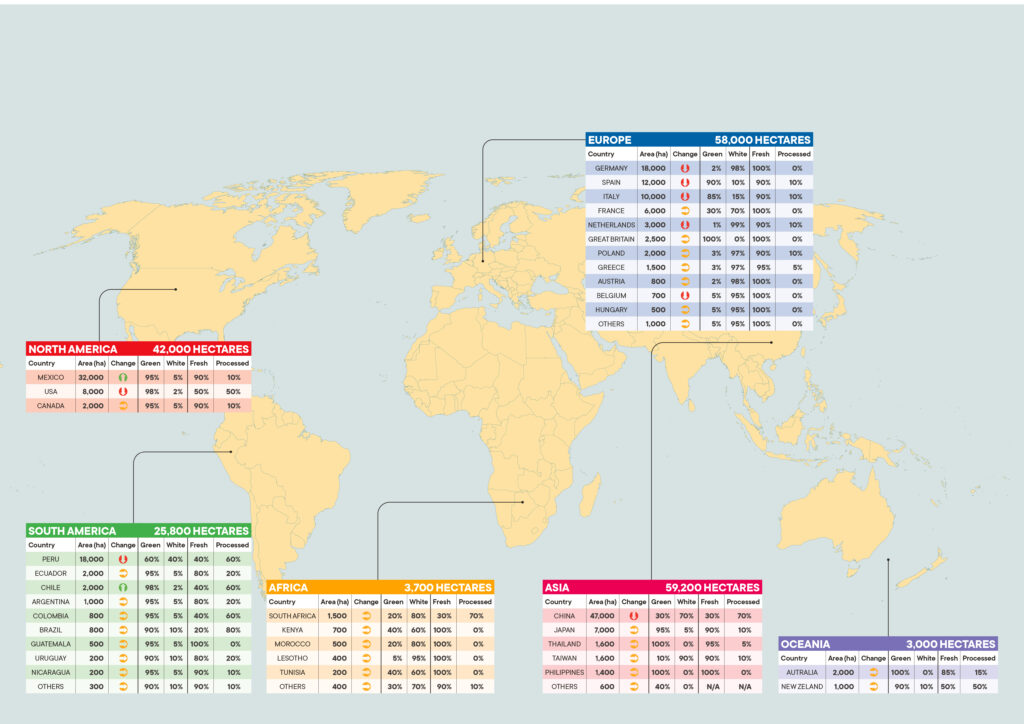
The end of the last century saw steady growth in asparagus production around the world. From 140,000 ha in 1988, world production crossed the 200,000 ha mark just before entering the new millennium. Then it continued to progress up to 280,000 ha. The expansion of planted area has mainly occurred thanks to the emergence of new production areas, such as Peru and Mexico. Until then, asparagus was mainly grown in the countries where it was consumed, but it has taken off in countries where agronomic conditions were favourable to it and, above all, where labour is inexpensive. The “globalisation” of the flow of goods (by sea and air) and new transport technologies (containers) have led to the intensification of trade. Currently, global asparagus production spans 190,000 ha across four major production areas.
“Luxury product” in Japan
Asia grows asparagus on over 59,000 ha, with China alone accounting for 47,000 ha. China’s production is 70% white asparagus and 30% green asparagus and it has diverse end markets: 60% for preservation, 30% for the fresh market and 10% frozen. It is the world’s largest producer of canned asparagus. With a much smaller area (7,000ha), Japan is the other country in Asia where asparagus is a traditional crop. In Japan, Asparagus is sold for the fresh market with high added value and seen almost as a “luxury product” (see Asparagus World n°5/2023). Thailand and the Philippines have modest but stable production areas of about 1,600 ha of 100% green asparagus. Taiwan is focused on the fresh white asparagus market (90%). In this part of the world, Australia (2,000 ha) and New Zealand (1,000 ha) grow green asparagus, principally for their own domestic markets.
Peru’s weak point vis-à-vis Mexico
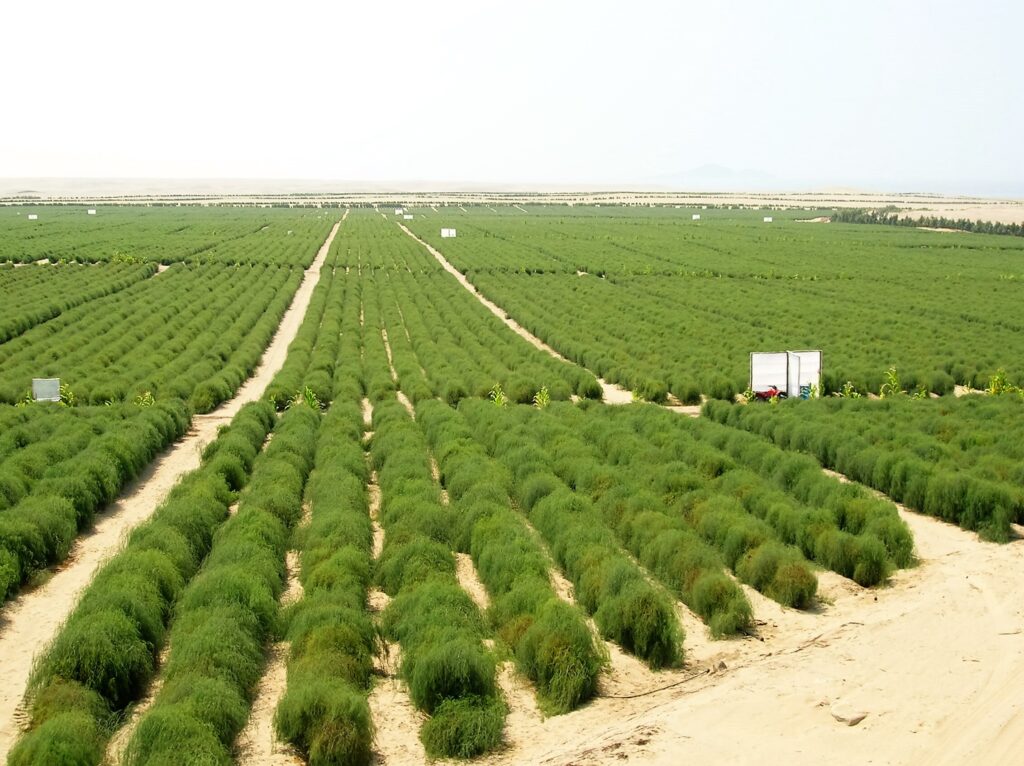
On the American continent, the predominantly green asparagus production of the countries of the North – the US (8,000 ha) and Canada (2,000 ha) – pales in comparison with that of Mexico (32,000ha). Climatic conditions, labour costs and proximity to the lucrative North American market are the factors driving the growth of Mexican asparagus, which continues upward. (See World Asparagus n°1/2019). Further south, Peru (18,000ha) is the largest asparagus-producing country in Latin America. It is one of few countries – along with its smaller neighbours, such as Ecuador (2,000 ha) and Colombia (800 ha), but also Thailand – that is able to grow asparagus year-round. Peru’s production is spread across green (60%) and white (40%) asparagus. The canned goods market is its largest outlet (50%), followed by the fresh (40%) and frozen (10%) markets (see Asparagus World n°3/2021 & n°4/2022). But the distance to the North American market (9+ days by sea) and very expensive air freight are weak points in relation to its main competitor, Mexico, which has gained a lot of market share. In the past 15 years, the economic situation has forced Peru not only to reduce its acreage but to shrink its production schedule by two months and stop exports in January and February. As a result, Peru has lost its position as the world’s leading asparagus-producing country. Chile (2,000 ha) is a dynamic market with green asparagus areas mainly oriented towards supplying the frozen segment (60%). On the same continent, Argentina (1,000 ha) (see Asparagus World n°6/2024), Brazil (800 ha), Guatemala (500 ha), Uruguay and Nicaragua (200ha), are also asparagus-producing countries.
Attempts that did not endure
Asparagus production is almost absent from the African continent (3,700 ha), with rare exceptions in the North and South. South Africa has the largest asparagus area (1,500 ha) focused on white asparagus production (80%), most of which goes to canneries (60%). The production of fresh asparagus finds its outlets on the domestic market as well as for export, particularly to Japan. Lesotho (see Asparagus World n°6/2024) and Kenya are also asparagus-producing countries. In North Africa, Morocco (500 ha) and Tunisia (200 ha) have hosted projects often led by European companies attracted by labour costs and precocity. In many cases, these attempts have not proved sustainable in the long run.
Europe invests its hopes in innovation
Europe is the botanical and historical cradle of asparagus production (58,000 ha). This is very clearly split between the production and consumption of green asparagus in the Mediterranean (Spain, Italy) and Anglo-Saxon (UK) countries and white asparagus production on Continental Europe (Germany, France, the Netherlands). Asparagus production in Europe is exclusively for the fresh market. In terms of surface area, Germany is the leading producer (18,000 ha), mainly of white asparagus. Spain (12,000 ha) and Italy (10,000 ha) are very much oriented towards the cultivation of green asparagus. Then comes France (6,000 ha), which produces white asparagus (70%) though is seeing growth in green asparagus (30%), then the Netherlands (3,000 ha) 100% white asparagus, and the UK (2,500 ha) 100% green asparagus. There is also white asparagus production in Poland (2,000 ha), Austria (800 ha), Belgium (700 ha), Hungary (500 ha). The general trend in European production is towards a decrease in surface area, particularly in Germany (see Asparagus World n°5/2023) and the Netherlands but also in Spain and Italy. The surface area is shrinking due to the lack of profitability of the crop, which is very much affected by the rising cost of labour, but also by a decrease in consumption. More recently, the effects of climate change and reduced water availability are also limiting renewal and new plantings in Mediterranean countries. To stay competitive, Europe has relied on technological innovation. It has developed very productive varieties and gained precocity by using plastic covers. European producers are trying to reduce their production costs by developing the mechanisation of cultivation and the robotisation of harvesting.
Signs of emergence from crisis
This world tour of asparagus-producing countries can be summed up as “producer/consumer countries” that have reduced their surface area. And “producer/exporter countries” that expanded them. The competitiveness of each of these is constrained by the cost of labour, the cost of getting to market (logistics) and by the sales price. The cost of labour is a parameter that is constantly increasing (see box). The availability of asparagus around the world plays a role in market fluctuations. By analysing the evolution of asparagus areas and world prices, Christian Befve, an international consultant, notes that when the world asparagus production passes the 240,000 ha mark, prices are destabilised and the market enters a crisis situation. “This is the situation that the asparagus world has just experienced over 2014-18 with a strong increase in global surface area, from 210,000 ha to 280,000 ha over this period, leading to stagnation and a fall in prices, then to a phase of grubbing up and regression of areas,” he says. Since 2022, when the global surface area fell below 200,000 ha, there has been an increase in world asparagus prices. “Does this signal that we are starting to emerge from the global asparagus crisis?” the expert wonders.
It takes over a kilo of asparagus to pay for an hour of work
In a comparison between the number of kilos of asparagus (at the farmgate price) needed to pay for an hour of harvesting work in France and Peru, data provided by international consultant Christian Befve shows they have grown in parallel. For example, in 2005, it took 2 kg of asparagus to pay for one hour of work in France but just 1.3 kg in Peru. By 2025, the gap between the origins will have widened, to 2.5 kg in Peru and more than 4 kg in France.
The British Asparagus Conference, hosted by the Asparagus Growers Association, is scheduled for Wednesday 26 June 2024 at Cobrey Farms, Coleraine Buildings, Ross-on-Wye. The conference offers a comprehensive programme tailored to address key aspects of asparagus cultivation and production.
A trade exhibition alongside the event
The morning sessions will feature presentations covering various topics, followed by demonstrations in the afternoon focusing on harvesting aids designed to streamline operations and reduce labour costs, as well as viewing asparagus field trials. Additionally, delegates will have the opportunity to tour the packhouse and machinery, gaining valuable insights into the latest advancements in the industry. Running alongside the event will be a trade exhibition, providing delegates with the chance to explore offerings from a range of companies and network with fellow industry professionals. The networking lunch will further facilitate discussions among growers, agronomists, machinery companies, and other associated industries. For businesses seeking to elevate their brand visibility within the industry, sponsorship opportunities are available. Additionally, there will be a drinks reception and conference dinner on the evening of Tuesday 25 June 2024 at The Feathers Hotel, High Street, Ledbury.
For more information please contact Pauline Sutton : pauline.sutton@britishgrowers.org.
Read Aspargus World No.6 and take a journey into a world of asparagus to unsuspected destinations such as Lesotho or Namibia, or distant ones such as Tasmania or Ecuador. It also means travelling into the future with the adaptation of varieties to harvesting robots. Asparagus World No.6 also proves that asparagus cultivation techniques are ever evolving. Deep soil preparation is an innovation to improve the profitability of a crop. Knowledge of diseases, such as Fusarium, is also essential.
A macro-economic analysis of the asparagus sector
The irrigation dossier shows the importance of water as a factor in yield. Adapting water supplies to the plant’s needs is crucial. And mastery of irrigation techniques is essential. This magazine also offers a macro-economic analysis of the global asparagus sector. It provides the elements to enable understanding and reflection to understand the stakes and economic balances of asparagus cultivation and trade.
To provide the best experiences, we use technologies such as cookies to store and/or access device information. Consenting to these technologies will allow us to process data such as browsing behavior or unique IDs on this site. Failure to consent or withdrawing consent may adversely affect certain features and functions.
Functional
Always active
Technical access or storage is strictly necessary for the legitimate interest purpose of enabling the use of a specific service explicitly requested by the subscriber or user, or for the sole purpose of carrying out the transmission of a communication over an electronic communications network.
Preferences
Technical access or storage is necessary for the legitimate interest purpose of storing preferences that are not requested by the subscriber or Internet user.
Statistics
Technical storage or access that is used exclusively for statistical purposes.Technical storage or access that is used exclusively for anonymous statistical purposes. Absent a subpoena, voluntary compliance from your internet service provider, or additional records from a third party, information stored or retrieved for this sole purpose generally cannot be used to identify you.
Marketing
Technical access or storage is necessary to create user profiles in order to send advertisements, or to track the user on a website or across websites with similar marketing purposes.