Over the last few years several pot-based fertilising trials were conducted to investigate different aspects of fertiliser application in asparagus. One of these trials was designed with seedlings in sandy soil with different nutritional contents.
Trial design
The trial contained several groups of 5 randomly positioned 5.5l pots, each group having just one nutrient withheld (all macro minerals and most microminerals). As base material sandy subsoil of an existing asparagus field was analysed and then fertilised according to the trial design.
Seedlings were produced in grow plates filled with upper sandy soil from the same field. Once seedlings had developed at least one stalk, two plants were transferred into each pot. Overhead irrigation occurred at -200hPa and an additional small amount of the macro minerals and boron was applied once in the summer. In autumn, the crowns were weighed, and the mineral status of the roots analysed. This was repeated over three consecutive years.
Results and discussion
The induced lack of nutrients was evident in the amount of crown mass in autumn. Some treatments did not differ from the control (e.g. without giving Mg or Mo), whereas other treatments showed significant reduction in root mass (e.g. without any fertiliser or P).
When a mineral was withheld from the plants, it translated to a reduced content in the root. For example, without giving nitrogen (“-N”), this group only contained 61 % of nitrogen compared to the average amount of all of the samples. The control group that received the whole spectrum of nutrients (“+all) was showing nearly 100% of each nutrient in the analysis. This indicates a close relationship between the soil and the root content, too – at least in the young stage of the asparagus plant.
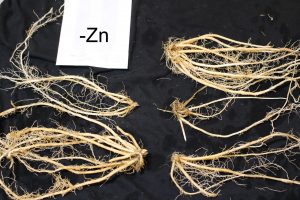
Zinc was the only exception. Although lack of this mineral caused a significant reduction in root mass there was only a small decrease in root content. There could be two explanations. Firstly, plants that lacked zinc in the soil showed the biggest differences between root mass in this trial (data not presented). Individual plants
either grew normally or had significantly reduced growth (picture plants with lack Zn). Secondly, the data showed all groups had an overall low zinc content compared to other trials and high amounts of data from crop fields in praxis.
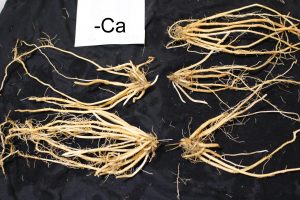
Additionally, calcium appears to be an especially important nutrient in asparagus. The relationship between fertilization and root content was closest in this trial with very young plants. Lack of calcium also caused a lack of many other minerals. Closer inspection of the roots revealed a reduction in fibrous roots which may decrease absorption of some other micronutrients (picture plants with lack Ca).
In conclusion
Although there were significant differences in the growth of the crowns and mineral content of the roots there were no visible symptoms in fern. Other trials with plugs or crown also showed similar results. This indicates that root tissue samples may be more useful for improving fertilisation strategies than fern.
The substantial differences in crown weight without visible differences in fern appearance in these various fertilisation strategies show that asparagus can have a significant “hidden hunger”. This also indicates that checking the nutrient status of asparagus roots during winter can be a useful tool for improving plant growth.
As other crops, asparagus shows some antagonism in the absorption of minerals. For example, manganese and calcium show that lack of one of these leads to better absorption of the other. This could be used to check the basic absorption potential of the immobile calcium in older plants.
Yield of asparagus is the result of a complex sequence of physiological processes, which are influenced by environment and management in current and previous years. Meanwhile the knowledge of yield physiology has much improved. It is known that the total amount of asparagus yield is related to carbohydrate supply in storage roots. Also the number of buds can limit the total number of high quality spears. The apical dominance of a growing asparagus spear within one bud cluster is repeatedly described, but is rarely quantitatively proven. Therefore, our objectivity was to quantify the effects of apical dominance and bud cluster activity on asparagus yield pattern and to provide new experimental data for modeling of the asparagus crop.
Experimental container trial
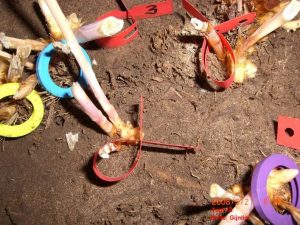
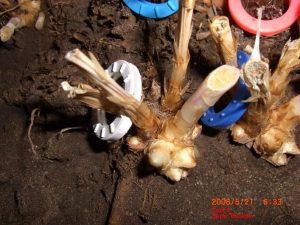
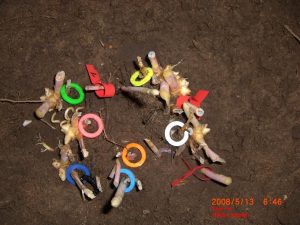
In April 2004, ten 40 L containers were filled with loamy sand taken from the top layer of an asparagus field at the research station in Großbeeren. A single, one year old asparagus plantlet was planted in each container. There were five containers planted with the cultivar ‘Gijnlim’ and five with ‘Backlim’. The containers were set up in the field. Water and nutrients were supplied by drip irrigation. On April 1st, 2008 the soil on top of the asparagus crowns was carefully removed. The containers were set up in a growth chamber at 20 °C from April 7th, 2008 until July 4th, 2008. During this time spear length was measured daily except weekends and spears were cut close to the crown when longer than 25 cm. Each spear was assigned to a bud cluster, where a bud cluster was defined as a dense group of buds, clearly distant from other groups of buds on the crown. During the time in the growth chamber the containers were watered once a week but not fertilized. The light in the growth chamber was on only during the measurements.
Apical dominance of a growing spear
It has been stated by Tiedjens already in the year 1926 that the pattern of bud break is controlled by apical dominance within each bud cluster on the crown, i.e. growing spears produce inhibitory effects, which extends only to the buds of the same bud cluster.
There were many bud clusters in our experiment, which had only one growing spear at the same time because new spears started to grow only after the previous spear was harvested. This pattern confirms the message that a growing spear inhibits the development of the next bud. However, there were also bud clusters with up to four spears growing simultaneously. Hence, the appearance patterns of spears were quite diverse. Based on the frequency distributions observed in our study we suggest to consider the effect of apical dominance within asparagus bud clusters as a stochastic process, in which the probability for a spear to start growing decreases with the number of spears already present at the same bud cluster. After a spear was harvested from a bud cluster, which had no other growing spears it took some time before a new spear started to grow.
Number of buds and spears
The active time of bud clusters was defined as number of days between begins of growth of the first and of the last spear at one cluster. The average number of active bud clusters was about five clusters per plant in both cultivars at begin of the experiment. Thereafter, the time course of active bud clusters showed marked differences between cultivars as cultivar Backlim developed fewer active bud clusters and stopped earlier to produce spears. The average spear appearance rates per plant showed characteristic patterns. Initially several – but not all – plants had a high spear appearance rate, which was caused by simultaneously growing spears at those bud clusters that were active from the begin of the experiment. Thereafter followed a period with an almost constant rate, which resulted in a linear increase of spears.
After a spear was harvested from a bud cluster which had no other growing spears it took some time before a new spear started to grow. On each day when a new spear started to grow we counted the number of previous days without growing spears at the same bud cluster. This number of days is called LAG. LAG equal to zero refers to spears that started growing when other spears were still present on the same bud cluster. At the end of the experiment, the average LAG for ‘Gijnlim’ and ‘Backlim’ was 5 and 3 days respectively. However, at the beginning of the experiment there was no LAG because two or more spears were growing simultaneously on all active bud clusters.
The number of harvested spears was significantly different between cultivars in our study. It is known, that the number of buds is genetically controlled. The main period of bud formation is during fern growth following harvest and only few buds are formed during harvesting. But even if new buds were formed, they may not be viable and hence do not contribute to spear yield of the current harvest. We observed that only a few new buds were formed during our experiments. Therefore, the plants run out of buds during the unusually long harvest period. The cultivar recommendations for plant distance in the row are an indicator of the number of bud clusters. For example, a larger plant distance in the row is suggested for ‘Gijnlim’ than for’ Backlim’. A genetically determined lower number of bud clusters mostly leads to thicker stems.
Carbohydrates in storage roots and spears
Our hypothesis that decreasing growth rates in time were caused by decreasing carbohydrate supply was not confirmed in this study. At the end of the experiment plants showed a broad range of carbohydrates in storage roots. However, there was no significant correlation with spear growth rate.
Studies in our research group comparing cultivars with varying adaptation to the Canadian winter suggest that survival can be related to the timing of dormancy induction and acquisition of freezing tolerance in the autumn, as well as the timing of dormancy release with the loss of freezing tolerance in the spring. Subjecting crowns dug sequentially in the autumn and spring to controlled freezing temperatures allowed an estimation of LT50, or the temperature at which 50% of plants die, an indicator of freezing tolerance. Compared to UC157, Guelph Millennium acquired freezing tolerance earlier in the autumn, and maintained freezing tolerance later in the spring. Interestingly, the fern of Guelph Millennium also senesced earlier in the autumn than that of UC 157. Differences in LT50 values were correlated with levels of metabolites in the crown, known to affect the freezing of cells, and the rhizome appeared to be more vulnerable to damage than the storage roots.
Both cultivars had similarly high levels of freezing tolerance in late autumn and early spring, suggesting they may be equally capable of surviving during the coldest periods of winter. Due to the technical difficulties of digging crowns from frozen soil in mid-winter, LT50 values have not been estimated and cultivar difference during this period cannot be fully discounted.
Why does an un-adapted cultivar such as UC157 not survive well in Canada? The delay in dormancy acquisition and senescence in the autumn may make ferns vulnerable to early frosts. In turn, this could disrupt the reallocation of metabolites to the crown, which is vital for plant health and vigour. Most significantly, early loss of freezing tolerance in the spring can increase susceptibility to damage from subsequent freeze-thaw cycles, which are common in Canada. UC157 steadily lost freezing tolerance once the soil thawed, while Guelph Millennium maintained high levels for several weeks. The timing of dormancy release can be related to a critical trigger temperature. UC157 may respond to cool soil in early spring, while several weeks of soil warming appear necessary to affect Guelph Millennium.
Cultivar selection is an important decision for growers. Caution is necessary when considering cultivars bred in different regions. So, it is crucial to obtain trial data over multiple seasons, especially in cold climates, to account for erratic annual variations.
Southern Ontario’s asparagus production region is widely bordered by 3 of the Great Lakes. This fact alone provides a moderating effect on temperatures and reduces the likelihood of lethal frosts. So, planting fields closer to these (or other) bodies of water can provide significant benefits. During frost events, temperatures can be 3-4 degrees warmer in fields that are within 2-3km of a lake than in fields further inland.
2 Field location:
Higher portions of a rolling field will always be less prone to frosts than those in lower areas where the cold air drains into.
3 Use of an overwintering cover crop:
Many of Ontario’s asparagus fields are autumn-planted to cereal rye. Besides the reduction in erosion and the benefits to the soil, this cover crop acts to slow the warming up of the ground in the spring and thus delays spear emergence. (There is limited benefit to attempting to hit early local markets given that they are usually flooded with very cheap Mexican imports during the start of our season.) Delayed emergence means a reduction in crop exposure to a killing frost.
4 Use of mulch:
We are currently experimenting with the use of a straw mulch which we place over the top of plants early in the spring. Similar to the use of the rye cover crop, the straw acts as an insulating blanket and keeps the ground from warming up, thus delaying emergence.
5 Varietal selection:
Due to the relatively cold and hard winters in Ontario, there are virtually no differences in terms of emergence between varieties from various asparagus breeding programmes. Nevertheless, Fox Seeds is currently investigating varieties that can produce a larger proportion of total spears later in the season to avoid the significant impact of an early frost and to offer growers a more even production profile.
It has been well established that frost damage occurs when ice forms inside plant cells. According to research, at a temperature of -2.8˚C, around 50% of asparagus spears show damage (Arora & Wisniewski). To successfully reduce the risks of frost damage, a mix of passive and active measures must be used. Passive measures might include the choice of the site of the asparagus field, the varieties used based on their earliness and techniques that delay the emergence of the spears. Active measures might involve irrigation, wind machines and crop covers to conserve heat, add heat and mix in warmer air.
First and foremost, before engaging in crop protection against frost, we have to ask whether it is in fact worth it because, depending on the type of frost, your efforts might all be in vain. When a radiation frost hits, there is no wind (under 8km/h), the sky is clear, and the layer of cold air is only about 10 to 60 metres high. Under such conditions, if we can achieve thermal inversion, the frost protection will be effective. But when winds are stronger, the sky is cloudy and the layer of cold air is 150 to 1,500 metres above ground level, we are facing advection frost, which is much more difficult to protect against. Also, when using irrigation as protection, we must be aware of the dew point. Why is it important to know about the dew point? Because the greater the difference between the air temperature and the dew point temperature, the drier the air is. The drier the air, the more the irrigation water will evaporate. When water evaporates, it absorbs heat and cools the air around the shoots. Thus, when the air is drier (has a lower relative humidity) and/or the wind is greater, more litres of water per hectare are needed and the irrigation should be started earlier and at a higher temperature. Sufficient water volumes are also necessary. Insufficient irrigation can do more damage than not irrigating at all in some cases. Remember that irrigation should be maintained continuously until the ice begins to melt or when the crop is receiving direct rays from the sun.
Temperature at which it is recommended to start irrigation, based on the dew point
Dew point
Air temperature
-1.1°C
0° C
-1.7° C
0.5° C
-2.8° C
1.1° C
-3.8° C
1.6° C
-4.4° C
2.7° C
-5.5° C
3.3° C
-6.7° C
3.8° C
-8.3° C
4.4° C
The use of protection covers can provide crops with temperatures that are up to 6ºC or more above the outdoor temperature, depending on the manufacturer. Hoops are needed to protect the tips. Depending on the labour force and the acreage to cover on the farm, this might be a worthwhile strategy to consider. Another good option is the use of wind machines, which can cover 3 to 5 hectares, depending on the topography. But keep in mind that they become useless with winds of over 7km/h or in cases of advection frost.
Another alternative worth considering is irrigating the morning before a light frost, as moist soil absorbs heat better. At night, the accumulated heat will rise towards the surface and the plant canopy. Make sure that the first 10-15cm of soil is moistened. This method will work better if performed on a sunny day on bare soil. However, you should bear in mind that this method might save only the shorter spears, but it may represent a good option where water supply is insufficient or acreage is too large for protection with night-time irrigation.
If, despite everything, the asparagus suffers frost damage, we will often observe a delay before the crown develops new spears, leading to delays in the harvest schedule. Removal of the damaged spears from the field usually helps to shorten this gap and return to a bountiful harvest more quickly.
Effects of Rye on Emergence in Michigan
Through a grant supported by the Michigan Asparagus Research Board, scientists at Michigan State University (MSU) have been working with commercial asparagus growers on the sandy soils of west Michigan to evaluate the effects of winter rye (Secale cereale) on soil temperature and spear emergence. In Michigan, rye is commonly broadcast into senescing fern in the autumn and allowed to grow in early spring to protect soils and reduce wind abrasion of spears. Some growers let rye grow as long as possible in the spring in the hope of delaying emergence, avoiding potential frost damage and allowing more time for picking crews to make their way to Michigan. To better understand the impact of rye on spear emergence, the MSU team, led by Dan Brainard, set up field experiments on a grower’s farm, comparing soil temperature and spear emergence in plots terminated as early as possible in the spring (mid-April) versus those where rye was allowed to grow as late as possible (early-May). In both years of the experiment, they found that delayed termination of rye lowered peak soil temperatures by 1-2oC and delayed spear emergence by 1-3 days. By early-May, when the chance of a late killing-frost is about 25%, 10-15,000 fewer spears per hectare had emerged in the late-killed rye plots. By late-May, when risk of frost is minimal in Michigan, total spear emergence was the same in both treatments. The team is also evaluating the effects of plastic mulch on spear emergence, and using data from these experiments to develop a predictive model of spear emergence for Michigan growers based on soil temperatures.
As with all other vegetables, the production and consumption of organic asparagus is growing all over the world, especially in the European market, which is experiencing particularly strong growth in this segment. The development of surface areas has accelerated over the last 5 years, as farmers convert to organic agriculture. However, as seen in other vegetable crops, there is a wide range of asparagus growing areas, from one hectare for some producers to a hundred hectares for large farms.
Tested and developed by organic producers
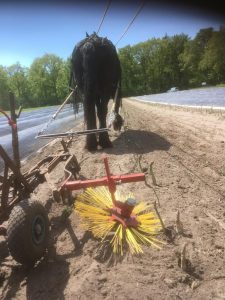
For the vast majority of asparagus producers, their practices of organic farming are motivated by their beliefs and commitment to the environment and consumer health. But the growing market opportunities and the value of organic products are also factors (see box). Nevertheless, there are also many obstacles to production. There is a certain level of risk-taking in organic farming, especially in protecting crops against diseases and pests, and there is no margin for error. Anticipation and prevention are the keys to a successful organic asparagus crop. Organic asparagus producers are also pioneering new techniques, which are sometimes taken up by conventional (non-organic) producers to eliminate phytosanitary treatments. One such example is the burning of weeds to avoid using herbicides. Organic degradable plastic mulch is also used to prevent competition from weeds. Similarly, the generalised use of drip feed ducted irrigation is aimed at reducing water consumption and limiting the spread of weeds. New soil-working equipment, such as rotating brushes to destroy weeds at the foot of asparagus, are also being tested and developed by organic producers.
Plant crop in good conditions
The ban on synthetic chemicals has required research into other means of pest and disease control. The use of auxiliaries such as nematodes to control asparagus beetle larvae is one line of development. Commercial biocontrol solutions and elicitors are also being put in place to protect crops. In addition to technical solutions, organic farming also calls for more monitoring of the plots and more correlation between the different leavers of production: varietal choice, crop implantation, fertilisation, irrigation, etc. (see AW No. 2) so as to plant the crop in the most favourable growing conditions and limit the risk of diseases and pests. For some producers, organic farming serves as a stepping-stone in the transition to biodynamic agriculture (see Asparagus AW No.1).
Benefits and Constraints of Organic Culture
The pluses
Personal benefits (production philosophy, respect for the land and life)
Financial benefits (€1.5-€2 more per kg for the producer)
Responding to strong consumer demand
Pioneering production techniques
The minuses
The lack of synthetic treatments forces farmers to anticipate all kinds of crop problems, such as fungal problems, pest attacks and weed control.
Although nurseries are making efforts to quickly increase the supply, there is currently a lack of availability of organic plants both in terms of the quantity of crowns and varietal diversity.
Strong tensions between the availability and price of inputs, especially organic matter.
In italia, nel 2021, gli asparagi verdi e bianchi precoci hanno subito un’impennata delle richieste per via di una serie di situazioni legate alla scarsa presenza di prodotto proveniente oltre che dal Sud America (Messico e Perù), anche dalla Spagna a causa dall’andamento climatico avverso caratterizzato da temperature fredde che di fatto hanno ritardato le raccolte in molte aree d’Europa.
Uno specifico cavo elettrico isolato
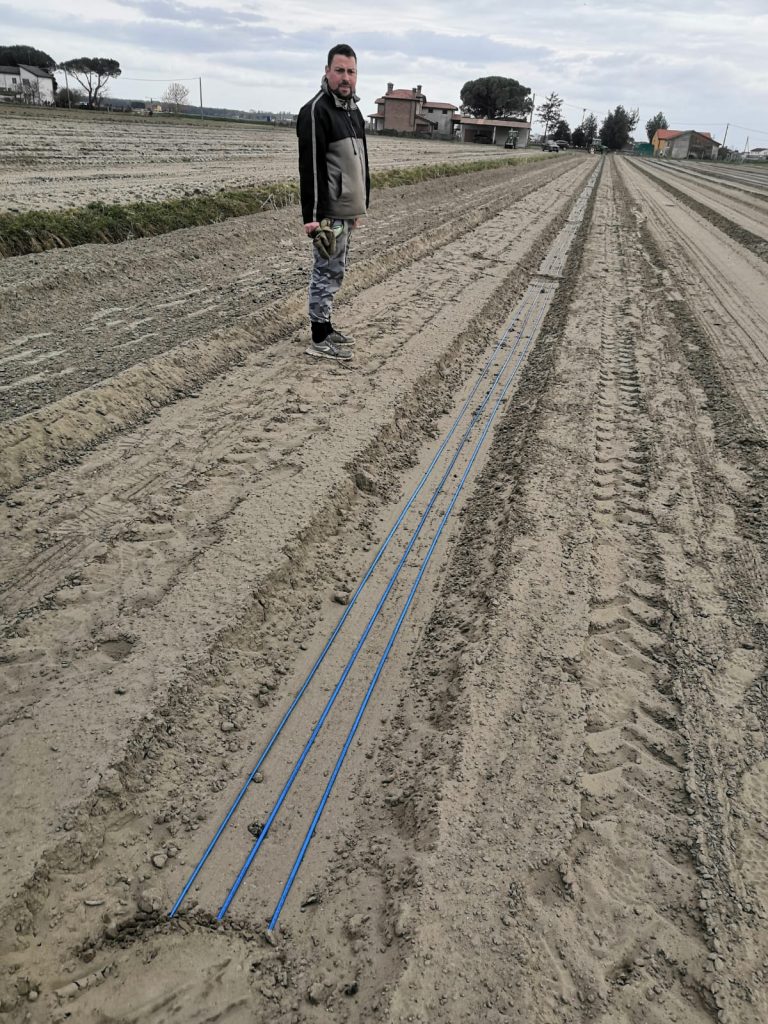
A Bosco Mesola, in Provincia di Ferrara, una zona molto vocata per la coltivazione dell’asparago in cui si coltiva l’Asparago Verde di Altedo IGP, Davide Zanellati, un giovane imprenditore, socio della Coop Casa Mesola, con la collaborazione agronomica dello scrivente e della ditta Ener Green di Piacenza che si è occupata della progettazione dell’ impianto elettrico, ha realizzato nel 2020 una asparagiaia della superficie di poco inferiore a 1 ettaro dotata di un impianto di riscaldamento basale funzionante a corrente elettrica. Un secondo ettaro, sempre nella medesima azienda è in via di preparazione e il trapianto dell’asparago avverrà nell’aprile 2021. Per la coltivazione realizzata nel 2020 si è preferito distanziare le file a 3 metri ed è stata scelta una densità di circa 28.000 piante/ettaro. Questa asparagiaia dispone di un sistema di riscaldamento del terreno funzionante con l’ausilio di uno specifico cavo elettrico isolato posto alla profondità di circa 25 cm, che ha permesso di programmare la temperatura del suolo a livello dell’apparato radicale fra i 15 ed i 17 gradi, sufficienti, in questo 2021, per raccogliere e avviare la commercializzazione degli asparagi verdi a partire dai primissimi giorni di marzo, in linea con i tempi programmati. Per poter valutare l’efficienza dell’impianto, nonostante la giovane età dell’asparagiaia, si è optato per la raccolta già dal primo anno. Tenuto conto della situazione, si sono raccolti turioni per soli 20 giorni, dall’1° al 20 marzo, per evitare di stressare troppo la coltivazione. Ai fini di una valutazione agronomica e produttiva, sono state poste a dimora quattro cultivar: Verdus, Magnus Vitalim e Vittorio. Per questa prova che consideriamo innovativa, l’energia elettrica è stata fornita attraverso uno specifico contratto dalla rete pubblica distributrice. E’ una tecnologia che può rientrare anche nei sistemi produttivi innovativi che possono utilizzare gli incentivi pubblici dell’agricoltura 4.0. Al momento naturalmente è presto per fare valutazioni economiche, visto che solo nei prossimi anni sarà possibile trarre conclusioni e fare valutazioni più precise circa i risultati produttivi e il mantenimento delle temperature a diverse condizioni ambientali rispetto a quella dell’inverno 2021 caratterizzato da temperature piuttosto basse e scarsa piovosità. Le esperienze maturate nella produzione dell’asparago riscaldato con acque calde ci hanno fornito comunque elementi significativi circa il risultato dell’attività in corso. Alla fine della raccolta programmata al 20 marzo sono stati raccolti 26 quintali di asparagi sulle 20.000 piante poste a dimora dei quali oltre il 70% erano di categoria extra.
Energia elettrica fornita da fonti rinnovabili
Per quanto concerne la tecnica di coltivazione adottata al momento dell’accensione dell’impianto e della erogazione del calore, si è preferito coprire le file con un film biodegradabile per ridurre la dispersione del calore e contemporaneamente limitare al massimo la presenza delle erbe infestanti. Le file dell’asparago sono state ulteriormente ricoperte con un piccolo tunnel del tipo Nantese utilizzando un film trasparente termico dotato di tasche per facilitare la raccolta. Una prima sommaria valutazione sui costi di installazione di impianti come quello descritto, che si prevede possa avere una durata di circa 10 anni, ci consente di affermare che l’investimento per riscaldare 1 ettaro di asparagiaia sia dell’ordine dei 30-32.000 euro. E’ evidente che per impianti di dimensioni maggiori si potranno avere economie di scala anche importanti. Nelle condizioni agronomiche descritte la potenza approssimativamente necessaria per il riscaldamento di quell’ettaro è di circa 70 kW. Non in tutte le condizioni di lavoro sarà necessario l’impiego dell’intera potenza nominale dell’impianto. I consumi giornalieri dipenderanno fortemente dalle condizioni climatiche in cui il sistema si trova a operare e cioè dalla scelta di coltivare in file singole o binate, dalla zona climatica in cui si realizzerà l’impianto, dalla tipologia di terreno e dalle tecniche colturali adottate che potranno incidere in modo significativo sulla potenza necessaria. Ugualmente il costo dell’energia può avere prezzi diversi se questa viene fornita da rete pubblica od ottenuta da fonti rinnovabili quali il fotovoltaico o altro. Una prima sintetica analisi nella situazione descritta e per l’annata in corso in cui si è operato in questo 2020/21 ci fa pensare che il costo per Kg di asparagi verdi raccolti e commercializzati nel periodo che va dal 20 febbraio al 20 aprile, possa variare da 5,5 euro/kg nel caso di una produzione di circa 6 tonnellate/ettaro per scendere a 4 euro/kg nel caso in cui la produzione raggiunga le 9 tonnellate/ettaro. I valori calcolati e stimati, comprendono le quote di ammortamento per l’impianto dell’asparagiaia, l’ammortamento dell’impianto elettrico riscaldante, delle spese per il collegamento alla linea pubblica di erogazione dell’energia elettrica, delle spese di gestione dell’asparagiaia (concimazione, irrigazione, manodopera, etc). Essendo l’impianto gestito in coltivazione diretta dal titolare dell’azienda sono state escluse dal calcolo le spese per i costi figurativi quali il del prezzo d’uso del capitale fondiario, gli interessi per l’uso delle macchine e attrezzature e del capitale di anticipazione.
Maggiori informazioni a Macfrut 2021
10 marzo 2021. Cv Vitalim in fase di raccolta . Fino al momento della raccolta, per impedire la fuoriuscita delle malerbe e per mantenere il calore, la coltivazione è stata pacciamata con film biodegradabile. La coltura è protetta da un piccolo tunnel.
Naturalmente, come preannunciato, nel momento in cui è stato redatto questo articolo non è ancora stato possibile avere informazioni più precise su alcune delle spese e dei ricavi e quindi siamo ricorsi a dati certi e stime. Tenuto conto della situazione commerciale di questo 2021 in cui l’andamento di mercato dell’asparago è stato attivo, il bilancio è da considerarsi positivo. I lati positivi di questo sistema sono sicuramente da ricercare nella facilità d’uso, nei bassissimi costi di manutenzione dell’impianto, nella elevata affidabilità e sicurezza di erogazione dell’energia elettrica. Per il 2022, con l’obiettivo di affinare la tecnica dell’uso di questa fonte di calore e continuare le valutazioni agronomiche ed economiche, con molta probabilità disporremo oltre al nuovo impianto, di una serra coltivata ad asparagi con copertura fotovoltaica la cui energia prodotti servirà anche per l’alimentazione dei cavi riscaldanti. Gli asparagicoltori dei diversi Paesi produttori che intendono valutare questa tecnica dovranno fare i conti con i costi sostenuti nei loro paesi. I dati economici evidenziati fanno riferimento ai dati e costi in Emilia-Romagna In occasione di IAD International Asparagus Days che si terrà a settembre in concomitanza di Macfrut 2021 sarà possibile avere maggiori informazioni in merito.
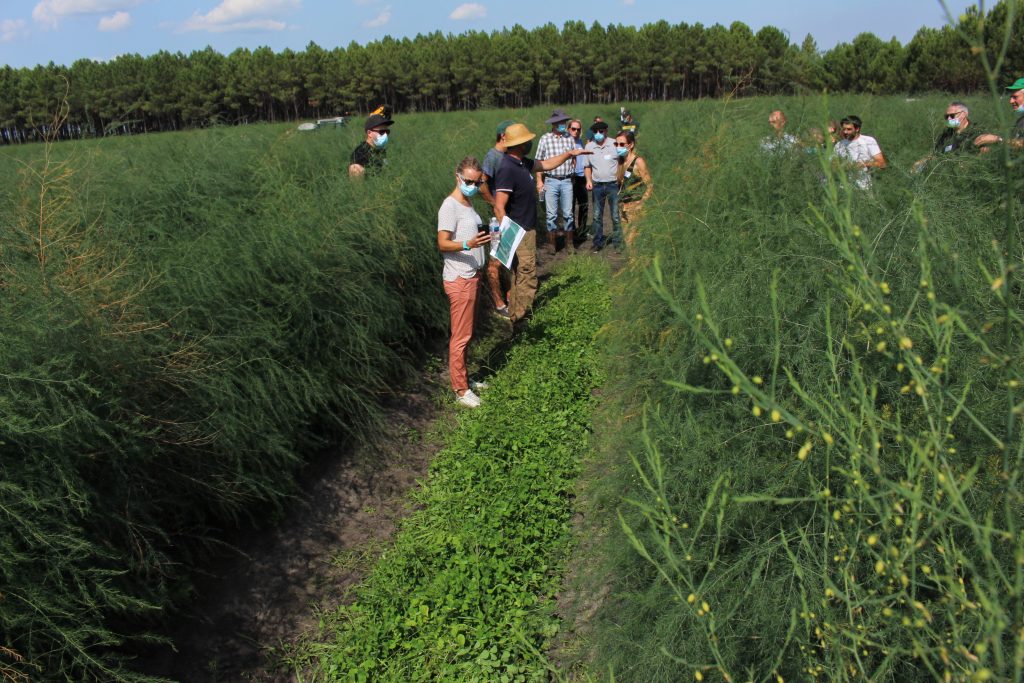
The idea of combatting weed invasions by using other plants is beginning to spread in asparagus farming. Sown in combination with several species, such as common vetch, hairy vetch, oats, rye, faba beans, clover, etc., these plants are referred to as “plant cover”. Plant cover helps limit weed development, improves soil structure and is a source of organic matter. This particular topic was the focus of the 4th technical day of the AOPn Asparagus of France congress.
These plants improve soil structure
This “plant cover” is only implanted in the in-between rows. Such controlled grassing makes for easier passage of machines and harvesters during harvest, especially in clayey soils. As they develop height, they create a micro-climate at the ridge level by reducing the effect of wind. The absence of wind prevents mulch from flying away and greatly reduces the number of twisted spears in green asparagus.
Plant cover also has beneficial effects on compaction and water runoff, and therefore on soil erosion. According to French agronomic data, 60mm of rain in 30 minutes results in 68% runoff, and the loss of 1,120 kg of soil and 80 kg of organic matter per hectare. The presence of plant cover limits runoff to 6%, soil losses to 40kg and lost organic matter to 3kg.
These plants also improve soil structure by bringing organic matter in the form of roots and vegetation after mowing. Their roots fragment the soil, facilitate water exchange and improve soil biodiversity. “The soil is a place where exchanges occur between air, water, minerals and organic matter, which is structured and organised by biological activity,” said Maëlle Depriester, sustainable development councillor of Maine and Loire, underlining the importance of this environment. A living soil is a place of complex biodiversity that can contain billions of bacteria, millions of nematodes and mites, and metres of fungus mycelium per gram of earth, not to mention the multitudes of macrofauna in the form of earthworms, insects, etc.
Producing organic matter in the field
“By adding minerals, carbon and soluble sugars, plant cover provides raw materials for the humus, but, above all, it promotes synthesis,” said Herminie Szitas, technical manager of Jouffray-Drillauda. Plant cover improves or maintains soil structure. It also represents two tons of dry matter, or about 600kg of young humus, per hectare. Its beneficial effects on the structure and life of the soil prepare the soil for new planting in the in-between rows, in the case of replanting. But plant cover is also a crop that needs planting, maintaining and protecting (see box).
Damien Violleau, head of asparagus growing, underlines just how far the possibilities extend: “You have to start de-compacting your head before de-compacting the ground,” he said. Violleau, who is already practising agriculture in living soil, prefers to “produce organic matter directly in the field rather than bringing in compost. Having cover in place also reduces weed invasion, especially if you have successful removal and take care during planting.”
Plant cover in testing
Plant cover in testing
Since 2018, French cooperative Copadax has tested nine forms of inter-row plant cover for asparagus to assess their agronomic effects and weed control effectiveness. The cover is sown after ridge splitting (June-July); then, in some cases, it is pulverised in September/October and destroyed during pre-ridging at the beginning of winter. “The aim is to retain the three most interesting cover types and then make more detailed assessment of their level of recovery and return of organic matter and their impact on performance, which may not be negligible,” said Christophe Labrouche, Copadax’s technical manager. The results of the first few years have already shown the importance of vegetation cover density and soil humidity (even if it means watering), in order to successfully establish the vegetation cover.
Risk of competition and drops in yield
Plant cover is also a crop that need irrigating and mowing to prevent the risk of competition with the asparagus.
The risk of competition or reduced yields due to the presence of plant cover is very low or even non-existent as long as certain rules are followed. It is essential to be able to irrigate by locating water supplies through drip feed ducts or a ramp equipped with a drop hose system. The introduction of green manure is not recommended if the crop cannot be irrigated because this carries a risk of creating competition for water between asparagus and plant cover, which would penalise future yields. The plant cover must not grow laterally and invade the mound. Hence, it is necessary to control it either via directed chemical weeding or mechanical weeding at the foot of the mound. From the end of July until autumn, the grass grows too tall. Its excessive development reduces the aeration of the crop and limits the entry of light, which promotes stemphillium and rust. Therefore, installing plant cover requires ensuring large gaps between rows, especially for white asparagus. The grass is planted at the end of July at a width of 50cm to reduce its potential for taking soil when ridging-up. Before sowing the vegetation cover, it is possible to bring soil back to the foot of the mound in order to make a reserve of soil for use during ridging. Maintenance is carried out through regular mowing. The number of passes is the same as for soil maintenance, but it requires three times less diesel consumption than for soil work.
Die zahlreichen Stürme haben dafür gesorgt, dass die Blastunnel in zeitigen Frühjahr haüfig abgelassen werden mussten – des damit verbundene Aufwand is enorm.
1998 ist Erwin Tillemans in den Spargelanbau eingestiegen, damals mit einer kleinen Fläche von 0,5 ha. 2001 wurde erstmalig ein Blastunnel errichtet, der sich dann gleich in der ersten Nacht verselbständigt hat und weggeflogen ist. 2004 wurde eine neue Hofstelle gebaut, 2008 ein neues Wohnhaus. Spargel ist heute die einzige Kultur im Betrieb, die Anbauflächen wurden permanent erweitert.
Ging es über viele Jahre nur stetig bergauf, so hat Erwin Tillemans seit 2017 – ähnlich wie viele seiner Berufskollegen – festgestellt, dass die Wirtschaftlichkeit der Spargelproduktion deutlich gelitten hat. „2016 war noch ein gutes Jahr, aber die Banken haben ihn in diesem Jahr schon darauf hingewiesen, dass es langsamer in der Branche vorangehen wird und die Märkte gesättigt sind. Der Spargelbauer war zu diesem Zeitpunkt beeindruckt von dem guten Überblick, den die Banken damals schon hatten, denn über mehrere Jahre waren zuvor beträchtliche GMO-Mittel in den Bereich geflossen, die zu erheblichen Anbauausweitungen geführt hatten“.
Erwin Tillemans hat davon nicht partizipiert. Er vermarktet seinen Spargel frei. Im frühen Bereich, wenn im eigenen geheizten Gewächshaus oder unter Blastunnel geerntet wird, zählen auch einige Kunden in Deutschland zu seinen festen Abnehmern.
Zurück zum Anbau im Blastunnel, der in Panningen und Umgebung populär ist, obwohl immer mehr Anbauer – wenn sie eine Altersgrenze um die 60 Jahre erreicht haben – sich von diesem Kulturverfahren verabschieden: „Es ist doch alles ganz schön schwer und man muss unbedingt gute Nerven haben“, erklärt Erwin Tillemans.
Wer im Blastunnel anbaut, muss die Wettervorhersage sehr gut im Blick haben. Wird z.B. für den Folgetag eine Windstärke von 6 oder noch darüber hinaus angesagt, muss der Tunnel abgelassen werden. Im Vorfeld muss die Anlage komplett gestochen werden, denn die aufliegende Folie würde die herauswachsenden Köpfe beschädigen und zu erheblichen Verlusten durch Abbrechen führen.
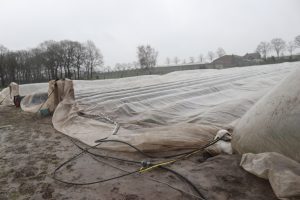
Gerade in diesem Jahr war das zeitige Frühjahr durch sehr viele Stürme geprägt und die Tunnel mussten häufig abgelassen werden. Liegt die Folie auf den Dämmen auf und es regnet, besteht die Gefahr, dass sich „Wassersäcke“ bilden. Und diese zu entfernen, ist nicht immer einfach. Ist der Sturm passé, muss die Folie wieder aufgeblasen werden.
Das System mit dem Blastunnel hat im Betrieb von Erwin Tillemans über Jahre gut funktioniert, aber gerade in den jüngst zurückliegenden Jahren ist die Konkurrenz durch den Anbau unter Minitunnel groß geworden. In diesem Jahr 2020 konnte Erwin Tillemans am 27. Februar den ersten Spargel unter dem Blastunnel ernten. Knapp zwei Wochen später konnten schon bis zu 450 kg (und zum Teil noch darüber) an guten Tagen pro ha geerntet werden. Sortiert entspricht das einer Menge von ca. 380 kg Spargel. Doch die Schwankungen der Erntemengen sind zum Teil von Tag zu Tag beträchtlich. 70 Arbeitskräfte sind erforderlich, um die Ernte auf den insgesamt 23 ha Blastunnelflächen einzubringen. Die Temperaturführung im Tunnel ist schwierig, spätestens im April besteht die Gefahr, dass durch hohe Temperaturen immer mehr offene Köpfe gebildet werden. Eine Lösung besteht dann nur darin, die Tunnelfolie abzunehmen und in der Folgezeit entsprechend geringere Erträge zu erzielen.
Nicht nur die Installation der Tunnel, auch deren Abbau ist recht arbeitsaufwändig, auch wenn dies für Erwin Tillemans inzwischen zur Normalität geworden ist. Beim Abbau müssen die Folien, nachdem der Druck aus den Befestigungsschläuchen entwichen ist, aus den Gräben entnommen und aufgewickelt werden. Anschließend muss der Druckschlauch aus den Gräben entnommen werden, was jedoch insbesondere dann schwierig ist, wenn er stark verschmutzt ist. „Aber wenn der Sturm eine Minitunnelanlage durcheinander bringt, ist das auch mit viel Arbeit verbunden“, sagt Erwin Tillemans.
In dieser Saison ist er bei der Ernte aus dem Blastunnel mit 12 €/kg für Doppel-A-Spargel gestartet. Unter dem Strich ist die Saison für den Blastunnel recht gut gelaufen, Preise und Mengen waren für den Anbauer aus Limburg akzeptabel. Die gesamte Umsetzung der erforderlichen Hygienemaßnahmen war jedoch auch mit wesentlich höherem Aufwand verbunden. Nachdem die Ernte im Blastunnel beendet war, sind die Preise in den Niederlanden deutlich in den Keller gegangen. Warum dies so ist, kann Erwin Tillemans sich kaum erklären, denn weder das Mengenaufkommen noch das Wetter, das über die Konsumfreudigkeit der Verbraucher entscheidet, haben nach seiner Meinung einen Anlass dazu geboten.
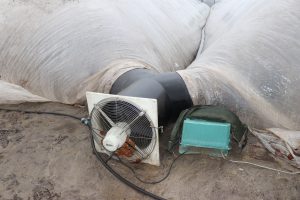
Über ventilatoren wird ein Überdruck erzeugt und somit die Folien im Tunnel nach oben gehalten.
Wie funktioniert das Verfahren?
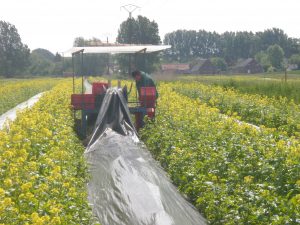
Zunächst wird um einem Bereich von sieben Reihen ein 60 cm tiefer Graben mit einer Kettenfräse gezogen. Im Anschluss daran wird die Folie ausgebreitet und mit ihren Rändern im Graben abgelegt. Im nächsten Schritt werden Schläuche im Graben abgelegt und mit Hilfe von Kompressoren soweit aufgepumpt, dass der Druck die Folie an den Seiten fixiert. Von der Frontseite wird Luft eingeblasen, sodass die Folie sich nach oben hebt und eine deutliche Erwärmung im Innenraum und damit auch eine Verfrühung der Spargelernte, ermöglicht.
In France, photovoltaic (PV) greenhouses have appeared on the agricultural landscape in opportunistic fashion. When combined with agricultural activities, electricity production would appear a rather seductively virtuous solution. Many companies specialising in green energy production have offered partnerships to farmers (see box). There have been many attempts to grow crops under PV greenhouses, including with tomato, strawberry, raspberry, lettuces, etc. But capturing the light via photovoltaic panels and the shading this causes come at the expense of the luminosity available to the crops. “Our climate assessment and modelling work has shown a 46% decrease in light transmission under venlo-type PV greenhouses,” said Christine Poncet of INRAE Sophia Agrobiotech during an event dedicated to this topic in 2018. However, this light transmission depends on the design of the greenhouse, its orientation, its surface area, the rate of occultation (the exposed part is usually facing south, or 50% of the roof) and the transparency of the photovoltaic panels.
Problem-free harvest roll-out
Cultivation and technical itinerary are equally important factors in ensuring successful photovoltaic greenhouse production. Asparagus is a crop that offers great potential as its production cycle seems to be well suited to the particular conditions of photovoltaic greenhouses. In fact, in the spring, the production of spears does not depend on the brightness of the shelter. The sun’s radiation alone can generate soil warming. At the end of harvest, the asparagus vegetation in the greenhouse receives enough brightness, which is at its maximum during the summer period. What’s more, the protection PV greenhouses offer from rain and wind, as well as part shading and the delaying of the first frosts seem to favour the development of foliage and longer storage. This is why several French asparagus producers have already committed themselves to this form of farming.
Regis Serres produces green asparagus of remarkable straightness and high-quality
One such case is Régis Serres, a farmer in the Lauragais region (France). Today, he has a 10-hectare Reden Solar photovoltaic greenhouse park that is shared between asparagus and red kiwi production. He planted his first green asparagus in 2017. In the 2021 campaign, Régis Serres started the harvest on February 20th and had already harvested 2.5 tons by March 15th. As Serres explains, “Usually, the harvest runs from February 20 to May 25 and reaches about 4 tons per hectare. The harvest is smoothed out, with none of those production hits from the temperature variations that outside production is subject to.” This technology also provides the highest-quality asparagus. The greenhouse’s protected enclosure leads to a remarkably straight asparagus with excellent tip quality. “There is very little discarded at sorting – just 2%,” said Serres. The regularity of production also facilitates the commercial development of this high-end product, which is very popular with restaurant owners, even if this year’s pandemic has limited this segment of the market.
“Greater potential returns”
To obtain quality green asparagus, Régis Serres uses the Vitalim variety for its precocity and Grolim for its calibre. These varieties can obtain calibres of 16-22 mm and 22mm, respectively, as demanded by distributors. They are planted at a density of 10 plants per linear metre, in double rows, with an inter-row of 3.20m, or 35,000 plants per hectare. At the end of harvesting, the producer carries out light weeding and installs a drip irrigation system. The vegetation develops during the summer into four successive shoots that can reach up to 3m high. Régis Serres plans to top the first shoot at a height of 1m to avoid the shedding of vegetation. During this period, the plants’ health protection is limited to the use of an insecticide against aphids and asparagus beetle. There are no treatments used for foliage disease. The vegetation is halted by ceasing irrigation in early October, so that plants stop growing in mid-November, and the foliage turns yellow and dries out in December. The farmer grinds and removes the vegetation in mid-January. He then opens the greenhouse to allow the cold to plunge the crowns into vegetative rest for a few weeks. Régis Serres says that he is satisfied with his “production tool”, even though he thinks there is a potential for higher yields, albeit with slower growth of the asparagus. The producer and his team of pickers also appreciate the working conditions offered by this protected space. The various grinding and tillage work is always done on time and in good conditions, without the constraints associated with working in external environments. The convenience offered at harvest time is also very much appreciated. In addition, consumers love his asparagus, which not only looks better, but tastes better too.
Regularity and consistency of production
In the Landes region (France), Laurent Ginlardi also produces asparagus in a Mecojit photovoltaic greenhouse. He has 3 production sites of 2 ha. On two of his sites, the shelters are double-span greenhouses 2 x 6m wide and spaced 5m apart. This set-up allows for significant brightness.
Light enters through the sides and the opening facilitates ventilation. In 2017, Laurent Ginlardi
Laurent Ginlardi notes a regularity of production and a homogeneity of the calibres of his white asparagus.
planted the Vitalim variety at 24,000 plants per hectare. Each span is planted with two rows 2.80m apart. The growing cycle is comparable to that employed by Régis Serres, but Laurent Ginlardi has chosen to produce white asparagus, which means the mounds are covered with black/white plastic. By keeping the greenhouses closed in early spring, the producer gains 1 to 2 weeks of precocity compared to field crops grown under a small plastic tunnel. He is also seeing regularity of production and homogeneity of calibres, which is advantageous for direct sales of his asparagus in the region’s various markets. “However, there is a difference between the row of asparagus most exposed to the sun and the others. Water requirements are higher and the quality of asparagus is lower,” said Ginlardi. In fact, he has observed a temperature variation of up to 10ºC between the sunny side of the greenhouse and the shaded side. Ginlardi, who also has another 2-hectare multi-span photovoltaic greenhouse, admits he no longer wants to produce asparagus in the field.
Buy-back deal entices producers
In France, like in Italy, the very attractive buy-back price of electricity has enabled the installation of a photovoltaic (PV) greenhouse park of several hundred hectares. And many projects are still underway, even though the feed-in tariff per kilowatt has dropped. In most cases, these are partnerships between energy producers and farmers. The former invests in the PV greenhouse and pockets the income from the sale of electricity, while the latter makes his land available for a period of 20 to 30 years and has the use of the greenhouse (not equipped), usually free of charge to ensure his agricultural activity over this period. This constitutes an enticing deal for producers, who get to have a “tool” without having to make the investment. The aim of the programme is to attract capital from non-agricultural sources. However, the findings and outcomes from various experimental trials (Ademe, INRAE, MAAP Working Group) tempered this enthusiasm somewhat due to the lack of light transmission in PV greenhouses caused by the covering of the south side in photovoltaic panels, often representing 50% of the roof. Experience has shown that not all vegetable species and production systems are economically viable and that crops should be adapted to these particular constraints.
Achieving brighter photovoltaic greenhouses
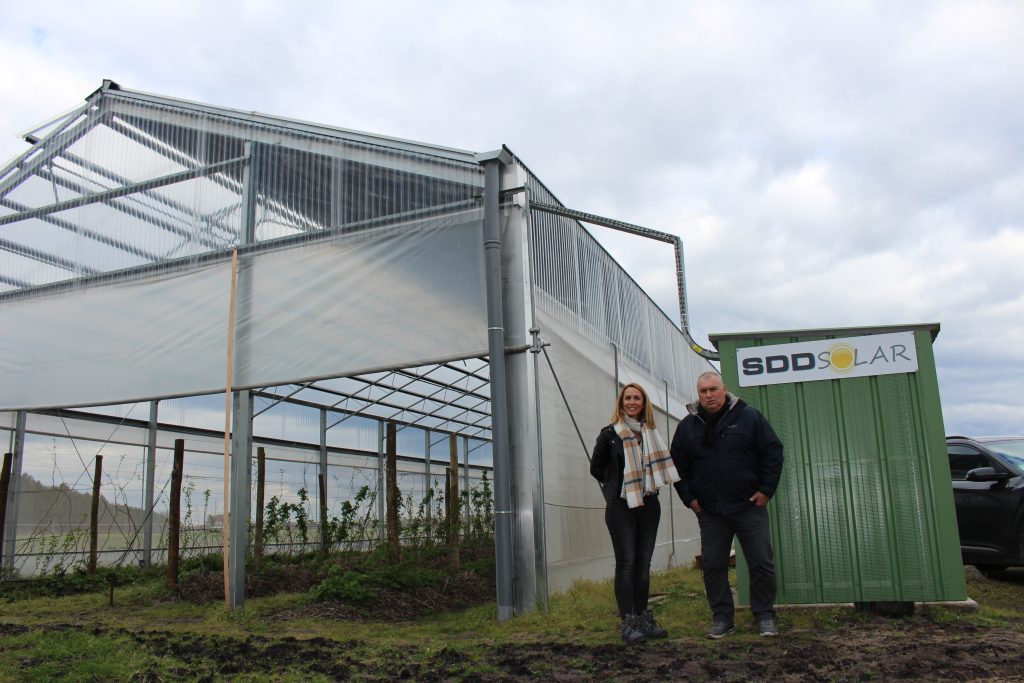
There are many types of photovoltaic greenhouses, and some poorly sized ones have too much shade. This penalises plant production and means that the structures are less productive. Faced with numerous failures, SDD Solar has developed a prototype photovoltaic greenhouse. Managers Philippe Dupouy and Hélène Dutrey said, “Our goal has been to make energy available to agriculture,”. Their 10 x 4.5m single-span greenhouse with channel was designed to achieve a compromise between power generation, brightness and ventilation. The photovoltaic panels are placed on the south side of 50% of the roof surface and achieve a light transmission of 20%. The rest of the cover is made of polycarbonate or glass. The sides of the greenhouse are closed using plastic films and insect-proof nets, thereby facilitating aeration and reducing the entry of pests. “The design of our greenhouses can be adapted to suit the crops envisaged. We want to be part of industry development projects alongside farmers,” said the SDD Solar managers. As part of a contract partnership, SDD Solar provides the greenhouse for agricultural production. According to the company, greenhouse development projects are underway in asparagus, kiwi, berries and vegetable crops in south-western France and abroad.
Manage consent
To provide the best experiences, we use technologies such as cookies to store and/or access device information. Consenting to these technologies will allow us to process data such as browsing behavior or unique IDs on this site. Failure to consent or withdrawing consent may adversely affect certain features and functions.
Functional
Always active
Technical access or storage is strictly necessary for the legitimate interest purpose of enabling the use of a specific service explicitly requested by the subscriber or user, or for the sole purpose of carrying out the transmission of a communication over an electronic communications network.
Preferences
Technical access or storage is necessary for the legitimate interest purpose of storing preferences that are not requested by the subscriber or Internet user.
Statistics
Technical storage or access that is used exclusively for statistical purposes.Technical storage or access that is used exclusively for anonymous statistical purposes. Absent a subpoena, voluntary compliance from your internet service provider, or additional records from a third party, information stored or retrieved for this sole purpose generally cannot be used to identify you.
Marketing
Technical access or storage is necessary to create user profiles in order to send advertisements, or to track the user on a website or across websites with similar marketing purposes.