The agricultural sector is undergoing a drastic technological transformation because of the COVID-19 pandemic. Farmers need information to make better decisions on time and the current restrictions make it more difficult to be present every day in the field, so decisions have to be made remotely by fewer people.
Many start-ups in the agro-technology sector have received millions of dollars to develop solutions based on drones, satellites, internet of things, sensors, big data, analytics, robots and artificial intelligence, which provide valuable information so farmers can have greater profitability based on making informed decisions. The most successful companies in the digitisation process are those that put technology adoption high on their priority list and where stakeholders are actively involved in the process.
When the manager of a leading agro-exporter in Peru told me that he wanted us to help him in his digitisation process, I understood that it was a long-term task. Preliminary analysis revealed that the internet speed was very limited and that there was a wealth of data, but it was disorganised and not very accessible to all areas.
Raptor Forms
Field evaluations, for example, were collected empirically on a reduced area with paper and pencil, and then digitised later on. When a real problem was detected, it was too late to do something and fix the problem.
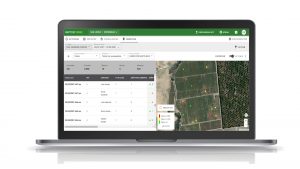
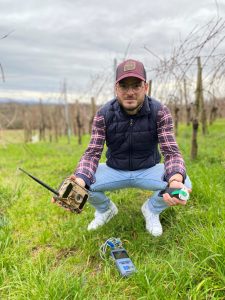
Today’s high internet speeds make it possible to view satellite images or high-resolution drone images to detect problems in the vegetation due to salts in the soil, water stress or disease. It is also possible to use mobile phones or tablets to collect photos or information where problems are detected. For example, in the case of asparagus, it is possible to measure damage due to prodiplosis, noctuids and elasmopalpus. This information can be collected in digital form on the evaluator’s mobile phone and viewed in real-time on a computer controlled by the manager or the head of irrigation or production. All the information is integrated in a single platform that also incorporates meteorological and irrigation data.
Agro-technologies serving asparagus
Having all the information organised on a single platform, without errors and immediately available allows us to use artificial intelligence to find correlations that can help anticipate droughts or disease related to rises in temperature or humidity, or find correlations between the vegetation index or NDVI of a satellite image and estimated yield.
The automation process also allows control of the quality and quantity of production in the field by ensuring more productive plots. Tools such as digital codes or QRs permit better monitoring and traceability. All of this information can help us reduce logistics and labour costs since we know in advance the daily production and how many people we need. All decisions today can be made on an informed basis, rather than by simple intuition.
*Space AG is a Peruvian start-up with a clear mission to feed the world using technology. It has extensive experience with superfoods like blueberries, avocados, grapes and asparagus. The firm’s main products are Airview (for collecting data using satellites and drones), Raptor View (a decision support platform that integrates information from different sources) and Raptor Forms (a mobile application for making evaluations and collecting field data).
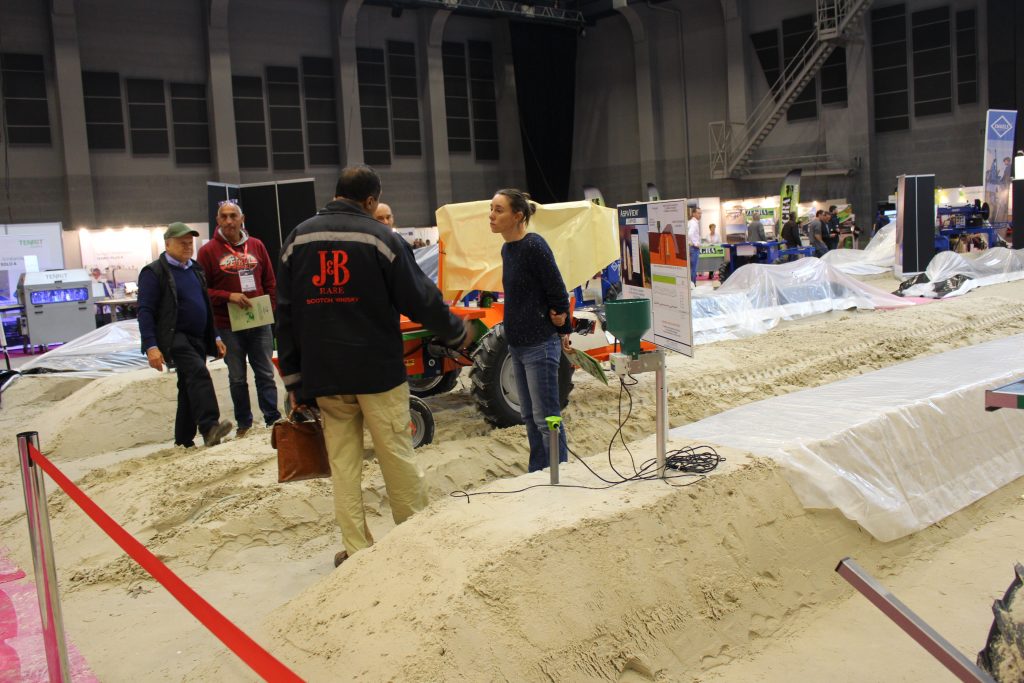
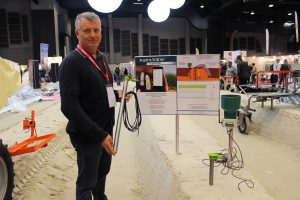
Corhize is offering Aquatech, a capacitive sensor that allows temperature measurements in the ground every 10 cm to which is added a free sensor on the surface to give the temperature under the mulch. In addition to water consumption, horizon by ground horizon, the probe allows better management of plastic films. The probe can be connected to a platform with an asparagus-specific module, Aspaview, with values to estimate the risk of burns, flowering, predicting performance at Day+1 and Day+2, calculating hours of cold and degrees days.
Base
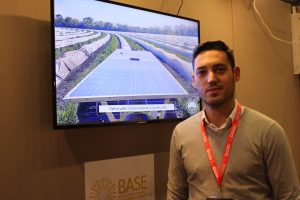
Solar battery recharging
Sellande by Base offers a charging system not connected to the electrical grid from photovoltaic panels on harvest assistance machines. According to the manufacturer, the power generated of 400 watts prevents the batteries from being recharged daily and limits their premature wear. For this increase in range, Base offers a kit for existing machines with different purchasing options.
Cyklop
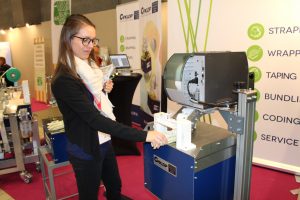
Tying and labelling bunches
Cyklop offers the Elastobinder: a machine that binds asparagus bunches with two thin elastic bands (Stepper ®) paired with a label printer. The machine combines the two operations at the same time and can fix 20 links per minute. According to users, the kit is easy to set up. The printer can use pre-printed labels but also ensure full printing with barcode and in several languages.
Naturagriff
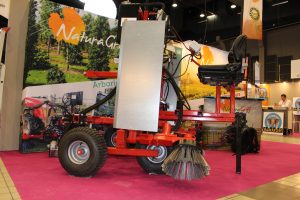
Mechanical weeding by brushing
Already a specialist in mechanical weeding in arboriculture, now offers a machine specifically for asparagus cultivation. The machine is mounted on a pendulum frame and a hydraulic power pack rotates and controls the brushes. Each brush is independently adjustable for tilt, gauge and depth of work. The machine allows weeding right up to the edge of the plastic and to the sides of the mound. It can work between 10 and 15 km/h.
Jautrou
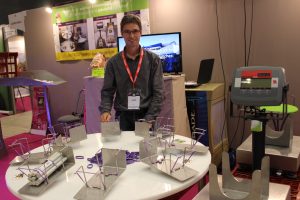
Makes bunches more easily
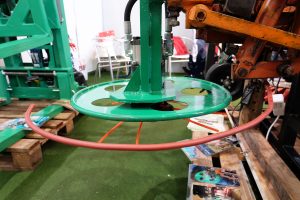
Rapido Bottes, built by Jautrou, makes it possible to make bunches from a circular tray mounted on an electric motor. A gauge allows the shaping and weighing of the bunch. The system which is simple enough for small organisations to implement, allows 1 to 4 people to work and ensure the manufacture of 800 bunches per hour. The company also offers a cover to protect the crates from wind and sun to limit the dehydration of asparagus as well as a soaking system for soaking the crates in water.
Farmax
Deep ground working
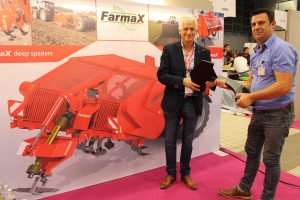
The Dutch manufacturer Farmax offers a “special asparagus” spader allowing working on a width of 1.60 m and at a depth of 0.60 m. The machine replaces ploughing and avoids creating a “sole.” It ensures good aeration of the soil and a homogeneous mixture of organic material inputs favourable to the establishment of the crop. Varying from 80 to 12 rotations per minute allows it to advance at 2 km per hour.
Engels
For film management
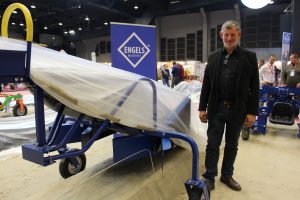
Using two plastic films, one thermal and one black/white, Engels offers a combination of six positions. These options allow the films to be managed according to the weather conditions to ensure good stability of the mound temperature. The system also allows a reduction in the time spent in handling plastics and an improvement in the quality of the harvest. The company is working on a model of “management” of plastic films in order to optimize the temperature in the mound, between 18-20 degrees Celsius at the root tray level and below 35 degrees Celsius under the plastic. It should also allow the harvest rate to be determined in line with market trends.
Besnard
Improved calibration machine
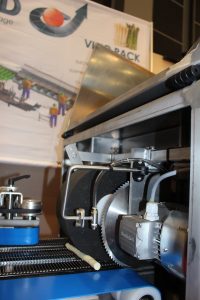
Besnard has improved its electronic washing/calibration line with the addition of a water jet just before the spear cutting blade. This adaptation allows for better cutting quality and protects teeth from premature wear. A foam wheel also allows for better maintenance of the asparagus as it is cut. At the other end of the chain, a new, more intuitive and personalised control screen makes it easier to adjust the machine. An internet connection also allows remote adjustment and troubleshooting.
Koppert
Biocontrol against asparagus beetle
Koppert offers several bio-solutions for the cultivation of asparagus including Capirel: composed of auxiliary nematodes to fight the asparagus beetle, Crioceris asparagi. Capirel’s formulation sprays auxiliaries on vegetation where they seek and kill larvae. +Squad is an additive proposed by Koppert to optimize the effectiveness of Capirel by delaying dehydration of nematodes and increasing the duration of their effectiveness. Trianum-G, a bio-control fungicide based on Trichoderma harzianum strain T22 is also proposed for the facilitation of crown implantation and prevention of the development of soil pathogenic fungi (approved General Treatments against Pythiacs).
Reyenvas
Seven layers in oneFilm
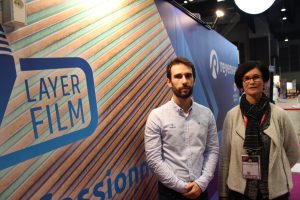
The manufacturer offers a wide range of plastic films including the Rey Pro mth+. This black/white hemmed thermal film is composed of 7 layers interspersing a thermal layer inside the black and white film. According to the manufacturer, it provides 3 to 5 days of precocity and its thickness (175 microns) improves its duration of use reducing the problem of recycling (less waste/tax). Reyenvas is also innovating by offering Rey Pro nature a green/white hemmed film which has the same advantages as all opaque two-tone films, while improving its integration into the landscape and reducing its visual impact.
Harlander
WEEDING THE SIDES OF THE MOUNDS
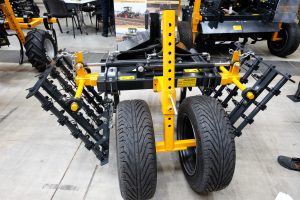
The SDS 70 front-mounted tine harrow has been designed to mechanically weed both sides of asparagus mounds. This 2.20 m wide kit is adjustable to adapt to the height variations of the mounds (thanks to its central wheels), their width (with a hydraulic system). Springs reinforce or decrease the pressure of the crowns on the mound.
THEILMANN
CLEAR THE ASPARAGUS
This prototype wire brush cutter, 5 to 6 mm in diameter is for use on asparagus and berries. It operates between 6,000 and 8,000 rpm at a speed of 5 km/h and at an adjustable angle of attack. It leaves behind vegetation of two to three centimetres. The large holes drilled in the protective plate of the work head evacuate air which would otherwise flatten vegetation to the ground and decrease the efficiency of the passage.
Hepro
Peeling and fresh cut machine
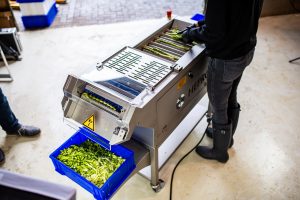
Hepro offers a compact vertical white asparagus peeler which allows for an “industrial quality” approach. The machine peels up to 2000 asparagus per hour. It can be used as a base for the use of the Hepro RSS, which allows white or green asparagus to be cut into cylindrical chunks. The pieces are cut by a fixed knife block. The head size is about 20 mm or 25 mm (standard version). Middle and end head pieces can be removed separately on request. The cutting of asparagus allows mixtures, white/green, in sachets.
Tenrit
cutting machine
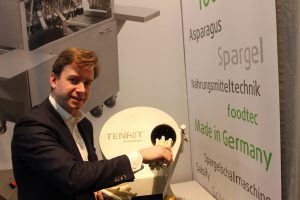
The TAC70/R is a specialised cutting machine for asparagus. It is used for cutting asparagus into cylindrical chunks with asparagus which has already been peeled. The machine allows to cut the asparagus between 1 and 7 cm and the cut can be straight or diagonal. This machine is especially suitable for direct sale and customers are given the chance to consume asparagus differently (wok, pie, soup, etc.).
Strauss:
One sorting machine for all asparagus
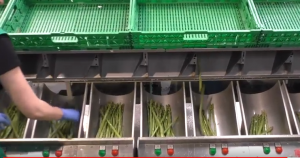
The Optisort G-Series from Strauss is the most preferred asparagus sorting machine. Different customised machine sizes allow the processing of white and green asparagus by one machine. To prepare the asparagus for the optical sorting, first it is cut to a certain length by a sophisticated aligning and knife system, developed through long experience. Afterwards it is cleaned with a lot of water at very low pressure. Low water consumption is achieved through recycling. Then the asparagus is singled and transported individually to the optical quality recognition unit in its own cup thus avoiding incorrect classifications and, from there, to the appropriate collecting container, subdivided into different quality levels. Optisort G-Series methodology allows for every piece of asparagus to be individually checked.
Manage consent
To provide the best experiences, we use technologies such as cookies to store and/or access device information. Consenting to these technologies will allow us to process data such as browsing behavior or unique IDs on this site. Failure to consent or withdrawing consent may adversely affect certain features and functions.
Functional
Always active
Technical access or storage is strictly necessary for the legitimate interest purpose of enabling the use of a specific service explicitly requested by the subscriber or user, or for the sole purpose of carrying out the transmission of a communication over an electronic communications network.
Preferences
Technical access or storage is necessary for the legitimate interest purpose of storing preferences that are not requested by the subscriber or Internet user.
Statistics
Technical storage or access that is used exclusively for statistical purposes.Technical storage or access that is used exclusively for anonymous statistical purposes. Absent a subpoena, voluntary compliance from your internet service provider, or additional records from a third party, information stored or retrieved for this sole purpose generally cannot be used to identify you.
Marketing
Technical access or storage is necessary to create user profiles in order to send advertisements, or to track the user on a website or across websites with similar marketing purposes.