For the production of green asparagus, the use of plastic films meets different objectives to those of the production of white asparagus. In the case of green asparagus, only transparent films are used, as the spear needs light to produce chlorophyll (green) or anthocyanins (violet, purple). This film is placed on arches to create a tunnel where asparagus can grow. The precocious effect is sought by a warming of the soil that allows the plant to “wake up” earlier. For this, it is important to use a plastic with high thermal properties that will retain the calories at night which were stored during the day, as proposed by the company Europlastic. But the benefits of a plastic cover are elsewhere. The first step is to protect asparagus from the effects of climate, wind and rain, to improve its uprightness and visual appearance in order to obtain a premium quality.
Smoothing out temperature extremes
The plastic tunnel therefore acts as a mini-greenhouse. This protected area enjoys more moisture than the exterior air and is conducive to the quality of the asparagus. On the other hand, this small volume of air can quickly turn into an oven, reaching very high (or even too high) temperatures. In fact, in plots of green asparagus, films are usually removed in the morning and then replaced in the evening, which requires a lot of manipulation. To limit this labour time, film manufacturers offer a variety of solutions to avoid rising temperatures during the day. Europlastic offers a film which acts as a filter for short wave infrared radiation which is the source of the increase in temperatures. Daios uses the reflective power of ceramics added in a translucent film to reflect 30-40% of non-visible infrared rays. The aim of these films is to maintain the plastic cover for the duration of the crop by levelling out extremes in temperature. It is then possible to use harvest assistance machines in the same way as for green asparagus. The film is lifted and then replaced at harvest time, avoiding additional handling and reducing labour time. Another positive effect is that the tunnel becomes an enclosed space, which protects asparagus from diseases and pests, especially the asparagus beetle that has been on the rise in recent years.
The use of plastic cover films has brought asparagus cultivation into a new area. In the 1980s, a few microns of clear thermal plastic first warmed the soil more quickly to gain precocity, and then the widespread use of black/white pocket plastics in the 2000s profoundly changed production techniques. Today, the use of arches and the combining of plastics mean that production can be managed according to the meteorology, the production slots targeted, the availability of labour and market prices.
A “temperature comfort range”
But plastic films are first and foremost used as a way to improve the yields of an asparagus crop. According to data compiled by Christian Befve, an asparagus consultant, each plastic and plastic combination brings a gain in production. They all allow yields to be doubled (see GRAPH 1). Plastic films act first on the temperature of the soil. The rise in temperature depends on the ambient temperature but especially on the sunlight and the intensity of the light that passes through the thermal mulch. Temperature is a decisive factor in the growth of asparagus. Physiological data indicate that asparagus wakes up when the temperature reaches 11 degrees at 10 cm below the root plateau for early varieties (Darlise, Vitalim etc), 12 degrees for mid-season varieties and 13 degrees for late varieties. Temperature also has a direct influence on productivity. At the beginning of the season a degree Celsius gained starting from when the plant wakes means an extra 30 kg/ha/day harvested, in mid-season it is 10 kg/ha/day. On the other hand, if the temperature exceeds 25 degrees C at 10 cm below the plateau, the yield can drop in the order of 10%. At above 350C, production activity is almost nil.
The temperature in the mound is very important for the growth of asparagus, for the quantity harvested and the quality of the spears. According to established data, the asparagus must be in a “temperature comfort range” of between 18 to 20 degrees Celsius at 20 cm below the top of the mound. Below this, the asparagus grows little. Above, spear quality problems appear (pinking, flowering). The data provided by Engels Machines show that it is possible to regulate the temperature of the mound by managing the different plastics and their positioning. The management of plastics is conducted according to the temperature of the mound. This management is subject to different influences and depends on a variety of objectives: desire for precocity, reduction of production peaks, spread of production, regularity of quality, etc. and better management of the workforce.
Playing with different configurations of films
The increase in temperature in the mound is related to the radiant heat reaching the mound. This can be modulated in different ways. Engels Machines has defined 6 installation combinations of three mulch films that can influence the temperature increase in the mound. Taking 100 as a base for the mini-tunnel+black plastic configuration, graph 2 shows a decreasing gradient of the thermal effect of different combinations. It can be noted that in all cases the white face reduces the thermal effect of the sun exposure the most. But it cannot be said that it cools the mound. This management of the various plastic covers can be carried out during the harvest with assistance machines with no additional working time. Regulation of the mound temperature requires forward planning by observing the temperature in the mound and taking into account the future climatic parameters (temperature, sunshine, rain, etc.). So Engels Machines has defined the management criteria and offers a plastics management service. It shows that it is possible to moderate the temperature of the mound in the plant’s comfort zone, 18 to 22 degrees Celsius, by adjusting the different configurations of the films (see Graph 3). According to Tom Smolders of Engels Machines, who worked on establishing this data, a more stable temperature over 24 hours reduces the percentage of hollow stems. This qualitative problem occurs when the temperature difference between the top of the mound and the root plateau is greater than 4oC. The different plastic films are not only for gaining in precocity. On a late variety (eg Backlim) it is also possible to use a combination of high-performance film to group production and limit the harvest period in order to lengthen the growing period of the plant.
“Compromise solutions” between precocity and use
Given the strategic importance of plastic films, manufacturers have expanded their range with increasingly specific and technical films. The thickness of the films is increasing the main reason for which is the direction of laying on the arch. According to Daios, the film placed perpendicularly requires a thickness of 50 microns to ensure their maintenance. On the other hand, a film placed parallel to the arch must be of greater thickness of 70 microns. With the development of harvesting machines, this mini-tunnel technique is being widely developed because it allows the use of two plastic layers without increasing the time devoted to the laying and lifting of films. While the covering and uncovering of films placed perpendicular to the arches increase harvest time by 30%. The race for the precocity brought about by the use of plastic films comes at a cost. It is quantified by adding the costs of plastic films, the depreciation of the arches and harvesting machines, the cost of refilling pocket films (estimated at 0.12 euros in France), laying and lifting, storage, etc. and the cost of recycling, which will only increase.
In response to this, some manufacturers offer “compromise solutions” between precocity and ease of use by welding together a black/white pocket plastic film and a thermal plastic one. This double film creates an air space between the black/white film and the thermal film that acts like a mattress and allows the mound to heat up. This double film can be placed on arches with a new insulating effect between the film and the mound. This area permits the condensation of moisture from the area to re-humidify the mound. According to Europlastic, the manufacturer of this film, the thermal film is enriched with UV stabilisers in order to increase its lifespan and make it equivalent to the black/white cover. The two films used together also have better resistance to handling that extends the life of the cover. Additionally, at the time of set up it requires one single filling of the pockets. It also means less rolls in storage post-harvest. So Europlastic is talking about an economical film.
In its range of mulch films, Reyenvas offers a 7-layer film using technology to incorporate a thermal layer inside the black-white film. Combining these properties gains 3 to 5 days of precocity compared to a conventional black/white film. This unique film limits the cost of refilling pockets, handling, and then storing. The 7-layer film is thicker (175 microns) and more resistant. There is a tendency evolving towards thicker films that will also be more resistant. Their lifespan will be extended to provide a partial solution to the plastic recycling problem. The lengthening of the film life, also offered by Daios, increases the years of film depreciation and reduces the cost of recovery taxes and disposal difficulties.
It is becoming desirable for plastics to be more discreet. For this reason, manufacturers such as Daios and Reyenvas offer green/white films to better integrate into the landscape. According to Daios, these films would also provide temperature gains compared to black/white film.
Early production: planting an early variety at shallow depths with several plastics and mini-tunnels
Late production: plant a late variety at depth and cover with white plastic
Grouped production: regulate the temperature of the soil at the root plateau (between 18 and 21 degrees Celsius) depending on the variety by managing the different plastic films
Spread-out production: plant several varieties at different depths and use several combinations of plastic films
Anticipating to limit temperature
Black mulch heats up more than white. White mulch limits the temperature in the mound despite a slight increase in temperature. It doesn’t cool the mound. It is therefore necessary to anticipate the changeover of face well before temperatures in the ground become too high. To regulate the temperature of the mound moderately, after the black plastic + tunnel it is better to use the white face and keep the other plastic on the tunnel, rather than take the plastic off of the tunnel and keep only the black. This second technique causes too great a temperature range in the mound.
Plastic and quality
The quality of the asparagus is made in the mound and on the mound. The use of plastics plays a big role in the quality of crops.
In the mound: It is important to limit the temperature range, between 18 and 21 degrees Celsius depending on the variety, to prevent the asparagus tip from flowering and to keep its tip closed.
On the mound: the temperature on the surface of the mound, and under the plastic, can get very high (60oC) causing the tip to burn. To reduce the losses due to this problem, harvesting must be done early in the morning, the plastic blanket must be turned white face on the outside. It is possible to place hoops very close to the mound that create an air cushion between the mound and the black/white plastic.
In the UK, ‘asparagus decline’ due primarily to crown and root rot caused by Phytophthora asparagi and Fusarium species can result in up to 60% loss of stand amounting to up to £16M in lost revenue per annum. With key operations causing the damage, finding practical solutions to this problem is essential. Only a 10% reduction in yield losses due to ‘asparagus decline’ would amount to a saving of >£1.6M to UK asparagus growers per year. A team from Cranfield University, in collaboration with Cobrey Farms, have been sponsored by AHDB (AHDB Horticulture FV 450a), to develop a suite of best management practices (BMPs) targeted at either preventing or remediating soil compaction in inter-bed wheelings. The main aims of these BMPs are to improve soil structure, reduce soil erosion risk, promote asparagus yields and stand longevity.
Soil management problem
The compaction caused by standard operational procedures, is often eliminated by sub-soiling in crop production. For asparagus, sub-soiling of inter-bed wheelings is used to promote infiltration of water, which reduces the amount of surface water run-off and therefore reduces the risk of soil erosion. However, sub-soiling as well as annual re-ridging are highly invasive. These operations cause damage to asparagus storage roots making the crop susceptible to crown and root rot promoting yield decline.
Experimental field trial
The length of field trial is critical to understanding the impact of management decisions. Changes, in particular improvements to soil structure delivered by modification to practices, can take years before their effect is fully appreciated. Therefore, in order to prove BMP advice, a long-term experimental field trial was established in April 2016 on a 4.5 ha asparagus field in Ross-on-Wye, south eastern Herefordshire, England. The trial comprises 48 experimental plots of the variety Gijnlim, which represents about 70% of UK field grown asparagus.
A range of soil management practices were established that included mulch applications in the wheelings, companion cropping, shallow soil disturbance (SSD, also called sub-soiling) and conventional ridging (R) practices against zero-tillage (not ridged nor sub-soiled) options.
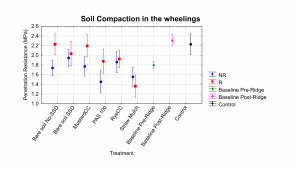
1 Soil Compaction in the wheelings, average values for all depths (0-60 cm); R = Ridged, NR = Non-ridged, SSD = Sub-soiled, No-SSD = Not sub-soiled, Control = Conventional practice (Bare soil No-SSD Ridged), CC = Companion Crop; Vertical bars denote 0.95 confidence interval.
The impacts of different soil management practices are being evaluated via measurements on asparagus storage root distribution, yields and general crop health observations. Changes to soil structure were assessed using a selection of grower-friendly soil structure indicators, such as speed of water infiltration, penetrative resistance and visual soil assessment. Based on previous research undertaken by Cranfield University and Cobrey Farms, it had been established that SSD in association with straw or PAS 100 compost application reduced run-off and soil erosion by more than 80%. Therefore, PAS 100 compost and straw mulch were used in this experiment in SSD trials, to test effects of long-term mulch application on asparagus performance and soil structure. Literature often highlights that the generation of biopores through a bio-drilling effect of cover crops and companion crops in compacted soils can result in increased yield of follow-on cash crops. Plant roots ‘engineer’ the soil structure by penetrating and displacing it, creating air pores, by depositing adhesive compounds which encourage soil aggregation, and via a range of other root deposits which provide energy and nutrient sources for soil biota. The importance of canopy cover, stem density and root density in reducing soil erosion has also been demonstrated. Use of companion crops therefore presents an opportunity to provide soil protection and erosion control within asparagus production systems as well as bio-remediate soil structure. Companion crops included in the trial are rye (Cereale secale), which is commonly used amongst North American asparagus growers and mustard (Sinapis alba), which was selected for its extensive rooting system and associated bio-drilling potential. However, to date, companion cropping has not been adopted within UK asparagus systems as a common practice. Yet the use of companion crops in UK asparagus production as a replacement for conventional sub-soiling practices presents an opportunity to provide soil structural rejuvenation, alleviation of soil compaction and soil erosion control.
Management practice effects on soil structure
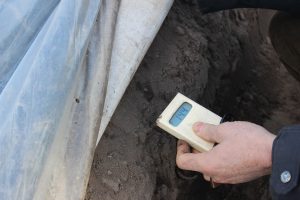
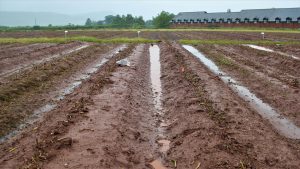
Three years after the establishment of the management treatments, meaningful differences can be observed between several BMP treatments. The Rye companion crop non-ridged (NR) did not alleviate soil compaction in any depth. It was in fact more compact than the bare soil zero-tillage treatment. The Rye NR treatment has also been consistently associated with lower yields than the bare soil zero-tillage treatment, suggesting that soil structure might be playing a crucial role in sustaining high asparagus yields. In non-ridged treatments, there was generally good soil structure and high infiltration rates. As expected, soils that were less compacted were associated with increased infiltration rates and soil moisture. Although asparagus in general prefers light, well drained soils, it can temporarily tolerate wet heavier soil conditions. Problems may arise in the winter/spring when the water ponds on the surface, increasing risks of disease transmission (in particular Phytophthora crown rot). Mulches not only retain water in the deeper horizons, but also on the surface. The effect of high moisture soils on asparagus root systems and susceptibility to diseases is yet to be fully understood. Higher soil compaction in the inter-bed wheelings was in most cases associated with ridging. Sub-soiling partially alleviated compaction caused by ridging, however, improvements to soil structure were also seen with the zero-tillage treatments. Therefore, given the additional cost of two further passes required to sub-soil, the use of post-ridging sub-soiling is economically questionable. Mulch applications (especially straw mulch) not only prevented soil compaction but also remediated the pre-existing baseline soil compaction. Straw mulch was the only treatment where ridging did not compact soil further. The use of mulches also lead to better soil structure than seen with the use of companion crops. This could be due to a higher observed abundance of earth worms and other soil biota, which were seen in the mulch plots, and have previously been proven to have a positive effect on soil structure. This will be further studied in 2020.
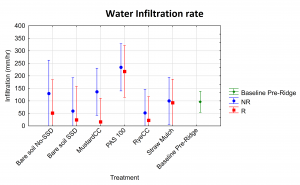
Water infiltration was significantly better in PAS 100 compost plots as compared to other treatments. This also corresponded with observed improvements to soil structure.
2 Water infiltration rate on different treatments; R = Ridged, NR = Non-ridged, SSD = Sub-soiled, No-SSD = Not sub-soiled, CC = Companion Crop; Vertical bars denote 0.95 confidence interval.
Asparagus Root System
Water logging in the inter-row wheelings.
Although we cannot confirm yet whether size of the root system tells us anything about asparagus yields directly, several strong trends have been observed between root and soil data. Most notably we found that higher infiltration rate in inter-bed wheelings of ridged treatments was strongly associated with higher root masses at 30-60cm depths and 60cm distance from the crown. In contrast, where the soil compaction of the soil was higher, fewer roots (lower root masses) were found at 30-60cm depth at a distance of 30cm from the crown, while more roots (higher root masses) were found closer to the soil surface at 60cm distance from the crown. Initial results of this trial demonstrate that soil compaction and tillage operations affect the size of the root system. The trials will continue to investigate how this affects yield and stand longevity in future years.
Over the next 3-4 years, this field experiment will continue to generate valuable insights on the efficacy of best soil management practices to prevent soil compaction and erosion and increase stand longevity.
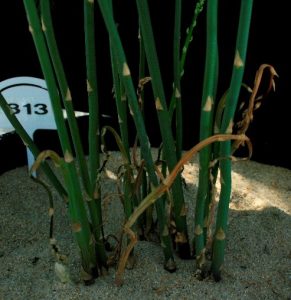
Sur pousses âgées : cladodes de couleur jaune or, voire desséchées si la carence persiste. La tige reste verte.
Sur jeunes pousses, les symptômes sont moins marqués.
Particularité : le magnésium est très peu mobile dans la plante.
Rôle du Magnésium
Elément important pour la synthèse de la chlorophylle et la photosynthèse.
Participe à la synthèse des éléments stockés dans les racines (sucres, protéines…).
Fondamental pour la construction cellulaire, principalement en phase de croissance de l’asperge.
Pertes racinaires
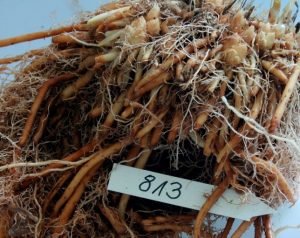
Réduction très importante du poids des racines : 60%.
Carence en Potassium
Symptômes
Décoloration du bout des cladodes presque identique au magnésium, avec un dessèchement plus prononcé.
Pousses âgées : jaunissement et dessèchement de la végétation si la carence persiste.
Particularité : la potasse est très mobile dans la plante.
Rôle du potassium
Régulateur des stomates et de la transpiration.
Améliore les réserves en sucre.
Intervient sur la résistance au gel.
Pertes racinaires
Réduction importante du poids des racines : 40%.
Carence en Soufre
Symptômes
Entraine une moindre production de chlorophylle.
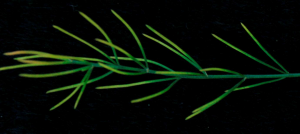
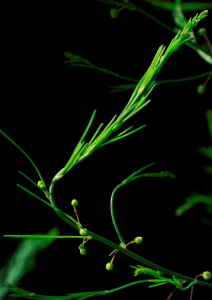
Couleur de la jeune végétation « vert fluo ».
Perturbe la croissance et l’assimilation de l’azote.
Plus visible (couleur vert pâle) sur les jeunes pousses. Tend à disparaitre avec le vieillissement de la plante.
Couleur très pâle des fleurs.
Rôle du soufre
Participe à la production d’acides aminées essentiels et dans l’activation des enzymes liés à la croissance.
Pertes racinaires
Réduction très importante du poids des racines : 57%.
Carence en Phosphore
Symptômes
Cladodes des vieilles pousses plus foncées et qui finissent par tomber
Dessèchement et chutes des cladodes des bouts des tiges, en cas de carence sévère.
Rôle du phosphore
Elément de construction des acides nucléiques et de transfert de l’ATP.
Joue un rôle de maintien dans la structure cellulaire.
Favorise la floraison et la fructification.
Pertes racinaires
Non mesurée.
Carence en Calcium
Symptômes
Chlorose et nécrose des jeunes pousses.
Augmentation de la production de graines, mêmes pour les variétés mâles.
Organes et racines raccourcis.
Mort des jeunes pousses, avec productions de nouvelles pousses qui meurent à leur tour en cas de carence sévère.
Rôle du Calcium
Stabilisation et construction des parois cellulaires.
Influence l’activité des enzymes en lien avec les membranes.
Favorise la croissance racinaire.
Nécessaire à la germination des pollens.
Pertes racinaires
Non mesurée, mais réduction visuelle importante.
Carence en manganèse
Symptômes
Jeunes pousses chlorotiques et nécrosées.
Jeunes pousses vertes et flétries.
Déformations inhabituelles des pousses latérales.
Décoloration blanchâtre des pointes des cladodes.
Rôle du manganèse
Important pour la photosynthèse et la formation des chloroplastes.
Favorise la production des jeunes racines latérales.
Active la croissance en influençant la croissance en longueur des cellules.
Pertes racinaires
Poids des racines non affecté.
Carence en Zinc
Symptômes
Entre nœuds raccourcis et distance entre cladodes fortement réduite.
Nanisme, pousse en forme de rosette.
Coloration foncée des cladodes.
Rôle du Zinc
Elément de constitution des enzymes, qui jouent un rôle majeur pour la photosynthèse, le métabolisme respiratoire, la synthèse des protéines et la production des substances de croissance.
Influence la production d’acide 3 acétique, important pour la croissance.
Pertes racinaires
Réduction significative du poids des racines : 32%.
Carence en Bore
Symptômes
Visibles sur jeunes et vieilles pousses.
Sur jeunes pousses : flétrissement brusque des extrémités, suivi d’un dessèchement et de la mort des cladodes.
Sur vieilles pousses : cladodes courts et nécrotiques.
Rôle du Bore
Favorise la croissance en longueur des cellules et la stabilité des parois cellulaires.
Favorise la production de sucres.
Pertes racinaires
Réduction significative du poids des racines : 21%.
L’évolution génétique, l’apparition de nouvelles variétés et l’optimisation des techniques culturales de ces dix dernières années, posent la question de l’actualité des références établies en matière d’alimentation minérale de l’asperge par Morse en 1916; Born en 1979, Follett en 1984, Benson et Paulsen en 1990 , Hartmann et Warman en 1991, puis Bergman en 1993.
De nouvelles références pour quatre éléments
Aujourd’hui, les derniers travaux du Dr C. Feller et d’A. Müller du Leibniz Institute of Vegetable and Ornamental Crops, à Großbeeren en Allemagne, complètent et corrigent les travaux réalisés 12 ans plus tôt. Ces travaux ont été réalisés pendant deux années consécutives (2013 et 2014) selon une méthodologie permettant d’induire des carences et d’en évaluer les impacts. (voir encadré 1)
Aux vues des résultats (voir taleau 1), les références établies par Bergmann en 1993 restent d’actualité. Pour le Magnésium, elles sont comprises entre 0.15 à 0.30 %. Pour le Soufre elles sont supérieures à 30 ppm et pour le Zinc entre 20 à 60 ppm. En revanche, les références analytiques établies par Bergmann en 1993 doivent être augmentées. Pour le Calcium, elles passent de 0.40 % à plus de 0.80 %, le Potassium de 1.5 à 2.5 %. Pour le Bore, la référence de 50 ppm augment à plus de 150 ppm et celle du Manganèse de 75 à plus de 100 ppm. Ces valeurs établissent ainsi de nouvelles références pour ces quatre éléments.
Un véritable impact sur le potentiel productif
Au-delà des conséquences sur la fonction chlorophyllienne (perte de surface foliaire), les résultats de cette recherche mettent en évidence la perte de masse racinaire, organe majeur de stockage des réserves glucidiques (voir ci-contre). Hormis la carence en manganèse, toutes les autres carences ont un impact majeur sur la réduction du volume et du poids des racines. Dans l’ordre, la carence Magnésienne (Mg) et Soufrée (S) sont les plus significatives avec une perte de masse racinaire de 60 et 57%. Viennent ensuite le Potassium (K), le Zinc (Zn) et le Bore (B), avec respectivement 40%, 32% et 21% de perte. Elle n’a pas été mesuré pour le Calcium (Ca), mais reste visuellement significative. Bien souvent les symptômes de carence se confondent avec d’autres symptômes. Ils n’ont pas les mêmes origines et nécessitent un examen approfondi. Les causes peuvent être nombreuses : maladies, insectes, sècheresse, gel, phytotoxicité d’engrais foliaires ou d’herbicides. Aussi, les carences peuvent s’extérioriser de différentes manières : chloroses, nécroses partielles ou totales, couleurs des cladodes et des fleurs, déformations et nanismes plus ou moins importants. Pour un diagnostic certain, une analyse foliaire, complétée d’une analyse de sol est nécessaire. Le tableau des résultats « Analyse des rameaux et des cladodes », peut d’ores et déjà servir de référentiel.
Méthodologie des travaux du Dr C. Feller et d’A. Müller
Les asperges ont été cultivées pendant deux années consécutives (2013 et 2014). La 1ère année, les plants ont été cultivés en pots de 3l, remplis de terre. L’année suivante, ils ont été transplantés dans des pots de 12 litres, remplis de matière neutre (sable de quartz lavé). A compter de ce moment, les plants ont été fertilisés toutes les semaines à l’aide d’une solution nutritive contenant tous les éléments nutritifs essentiels, sauf celui qui entraînera la carence. Ils ont été comparés à un témoin normalement fertilisé. Les éléments manquants étaient soit le potassium (K), le magnésium (Mg), le soufre (S), le bore (B), le manganèse (Mn) ou le zinc (Zn). Les mesures ont été réalisées sur 3 variétés fréquemment cultivées en Allemagne (Gijnlim, Rapsody et Cumulus). En 2014, deux modalités supplémentaires induisant une carence en phosphore (P) et en calcium (Ca) ont été ajoutés sur la variété « Cumulus ». Ces deux éléments n’ont été examinés que visuellement. Pendant la culture 2014, tous les symptômes visibles de carence ont été enregistrées et photographiés. Fin 2014, les plantes ont été récoltées, puis analysées. Ces analyses ont été faites sur les cladodes, les rameaux et des racines. Elles ont été complétées par la mesure en degré Brix des racines (fin 2014).
Tab 1 Analyse des rameaux et des cladodes
Résultats en % ou ppm sur Matière Sèche
% Calcium
% Magnésium
% Potassium
% Soufre
Bore (ppm)
Manganèse (ppm)
Zinc (ppm)
Valeur du TEMOIN
0.87
0.20
2.78
0.39
163
81
21
Sans Mg
0.62
0.05
2.92
0.31
140
72
27
Sans Mn
0.82
0.19
2.45
0.36
163
62
20
Sans K
1.51
0.42
0.42
0.34
203
140
31
Sans Zn
0.91
0.21
2.72
0.41
170
77
18
Sans B
0.82
0.20
2.68
0.41
31
83
22
Sans S
1.02
0.26
2.69
0.20
217
120
25
Ref. Bergmann 1993
0.40 à 0.80
0.15 à 0.30
1.5 à 2.4
> 0.30
40 à 100
25 à 100
20 à 60
ABSTRACT
In a context of genetic evolution of asparagus varieties and optimization of cultivation techniques, research work on the identification of asparagus deficiencies resumed in Germany in 2013 and 2014. This work confirms the references established by Bergmann for Magnesium, Sulfur and Zinc. They modify upwards (up to triple), the reference values of Calcium, Potassium, Boron and Manganese. In addition, they highlight the diversity of deficiency symptoms and the risk of confusion with other causes. Also and as a major fact, they demonstrate the impact of severe deficiencies on the reduction of root mass (except manganese).
El espárrago por sí solo se ha posicionado como un ítem de prestigio y alta popularidad para todo tipo de consumidores. Si a esto le sumamos la condición de producto orgánico tenemos entonces un producto de demanda en continuo crecimiento.
Conceptos generales
Las preguntas más frecuentes entre los interesados en el manejo orgánico son ¿Cómo voy a reemplazar los agroquímicos necesarios para que mi cultivo sea rentable? ¿Conseguiré los mismos resultados utilizando productos orgánicos que agroquímicos convencionales?
Lo primero que hay que tener en cuenta es que no se trata de sustituir agroquímicos de síntesis con otros aprobados por los organismos correspondientes, se trata de un sistema completo y complejo de manejo del cultivo que involucra trabajar “en conjunto” con lo que la naturaleza nos ofrece para mantener el equilibrio y lograr producciones de calidad, en cantidad suficiente, sin producir contaminación de ningún tipo en el producto y en el ecosistema.
Una parte muy importante es tomar conciencia del hábitat que rodea al cultivo y cómo este nos puede ayudar en nuestro propósito. Vegetación autóctona, barreras naturales, topografía del terreno, condiciones climáticas, condición de los suelos, etc. Con respecto al cultivo en sí, lo importante es tratar de que la planta desarrolle por sí misma la mayor cantidad de defensas posibles de manera tal que las aplicaciones fitosanitarias sean solo como ayuda y no el único método. Las esparragueras que se desarrollen fuertes, equilibradas nutricionalmente, con la cantidad apropiada de agua y manejo adecuado de cosecha, estarán en mejores condiciones de resistir plagas, enfermedades y estrés. A su vez producirán la suficiente cantidad de espárrago como para que el cultivo sea rentable. Cómo podemos lograr que todo esto ocurra? En primer término tomando conciencia que la agricultura orgánica es un sistema, no una receta y como tal hay que atender a todas las partes del mismo.
Manejo del cultivo
El espárrago es un cultivo que responde muy bien al manejo del agricultor. Esto nos da un plus con respecto a otros cultivos ya que todas las acciones que tomemos se manifestarán en el cultivo fácilmente. El espárrago orgánico tiene las mismas necesidades fisiológicas que un espárrago convencional. La forma de proporcionárselas será lo que deberemos adecuar para lograr la condición de orgánico.
Analizaremos los siguientes puntos:
Fertilización
La agricultura orgánica no centra la mayor importancia en los requerimientos de nutrientes de la planta, sino en la salud y fertilidad de los suelos. Fortaleceremos este concepto para asegurar la nutrición de la esparraguera de acuerdo a sus necesidades y a la disponibilidad de nutrientes que un suelo sano pueda proporcionarle.
Lo importante es determinar la fuente de los diferentes nutrientes y las prácticas que podemos realizar para favorecer la fertilidad y sanidad del suelo. Las cantidades de nutrientes, estarán dadas por diversos factores inherentes a cada situación en particular (suelo, edad de las plantas, producción, etc.).
Las distintas prácticas que podemos realizar para favorecer la fertilidad del suelo son
Asociaciones de cultivos o coberturas vegetales en los interfilares de la esparraguera. Siempre que se cuente con el agua suficiente, es una excelente práctica. Depende de las necesidades del suelo podremos consociar con leguminosas (inoculadas con rhizobium), cereales invernales, etc. esto también proporcionara al suelo la estructura necesaria para favorecer a los organismos benéficos. Estas asociaciones pueden ser temporarias o permanentes, cada agricultor verá la forma en que esta práctica le resulte más beneficiosa.
Aplicar distintos tipos de compostas vegetales o animales, correctamente fermentadas, para evitar contaminación de suelo, agua o producto
Aplicación de microrganismos
Aplicación de minerales
Como en todos los casos, es importante contar con análisis de suelo y agua para saber en qué condiciones iniciaremos nuestro cultivo.
Igual que en cualquier cultivo de espárragos, especialmente en el orgánico, la fertilización de pre siembra es fundamental para el éxito
La incorporación de una buena fuente de materia orgánica en cantidades adecuadas, no solo dará la nutrición necesaria a la futura planta sino que también creará las condiciones óptimas para la proliferación de microrganismos benéficos de los cuales hablamos anteriormente. Podremos aplicar composta animal o vegetal. Además será muy importante agregar en este momento la cantidad suficiente de mineral fosfórico y si es necesario K como sulfato que se irán biodisponibilizando. También cualquier tipo de enmienda como por ejemplo yeso agrícola, sales calcáreas, o cualquier otra corrección que se requiera.
En plantación se puede utilizar acolchados plásticos biodegradables para dar tiempo a la pequeña plántula a desarrollar fuerte y sana hasta poder competir con las malezas de forma efectiva.
Es importante en este punto comenzar con la microbiología. Los microorganismos del suelo ponen nutrientes a disposición de las plantas (biodisponibilidad) a través de la descomposición de la materia orgánica y su reacción bioquímica con la porción mineral del suelo. Bacterias y hongos aeróbicos forman una relación simbiótica con las raíces de la planta proporcionándoles nutrientes fácilmente asimilables. Asimismo algunos, como las micorrizas, forman una capa protectora sobre la raíz que impide el ataque de patógenos. Otros producen antibióticos naturales como la estreptomicina, que destruye patógenos del suelo. Hay algunos organismos específicos que protegen las semillas y las plántulas contra varias enfermedades, varias especies de bacilos, trichodermas y pseudomonas que protegen las raíces de las plantas contra enfermedades infecciosas.
Existen en el mercado varios productos con mezclas de estos microrganismos benéficos con los que deberemos inocular el suelo y luego dar condiciones para su proliferación. El suelo se compone de una cadena compleja de organismos. Su salud depende totalmente de que esa cadena se mantenga vibrante, activa y dinámica. En esparragueras ya implantadas podemos utilizar una serie de productos para mantener la fertilidad de nuestro suelo. Podemos utilizar fuentes permitidas de N, P y K así como también micronutrientes. También es importante el agregado de ácidos húmicos y fúlvicos por las muchas ventajas que estos ofrecen.
Control de plagas y enfermedades
Partiremos de la base que una planta fuerte y equilibradamente nutrida será capaz de lidiar más fácilmente con cualquier plaga o enfermedad que quiera atacarla. Cuando las medidas preventivas, que incluyen controles culturales y físicos, no son capaces de controlar poblaciones de plagas y enfermedades, la última opción es el uso de productos permitidos. El espárrago es un vegetal naturalmente rústico y con gran capacidad de adaptación lo que hace que sea bastante simple manejarlo de forma orgánica. El monitoreo regular y sistemático de la esparraguera va a proveer de información acerca del estatus tanto de las poblaciones de plagas como de benéficos. Debemos saber identificar cuales son plagas, cuales son benéficos, y cuales son neutrales, sus ciclos de vida y qué comen cada uno de ellos. También nos permitirá evaluar si las medidas aplicadas para su control están dando el resultado esperado. Si es posible, hay que elegir cultivares de espárrago que sean resistentes a algunas de las principales plagas y enfermedades en su área. Identificar el daño temprano en el ciclo del cultivo, es una forma efectiva para reducir las poblaciones de plagas y el daño producido por ellas. Los insectos también pueden ser vectores de enfermedades, por lo que reconocer los síntomas de enfermedades comunes es fundamental para que el control sea integral. El manejo orgánico de plagas puede incluir trampas (feromonas, adhesivas, de agua, de luz) la liberación de insectos benéficos, el uso de cultivos trampa, y otras técnicas agronómicas aprobadas para la producción orgánica.
El control de las enfermedades seguirá las mismas reglas. Prevención, observación y control integral. El uso de pesticidas es un último recurso en la producción orgánica, y deberán ser productos aprobados e incluidos en el listado de productos permitidos. Pueden ser extractos de vegetales como piretrinas, neem, cítricos, chiles, etc. Productos minerales como azufre, cobre, arcillas, silicatos, caolín, aceites, jabón de potasa, etc. La utilización del pirodiservo es de gran ayuda en lugares donde esté permitido el uso de fuego.
Control de malezas
No hay muchas opciones para el control de malezas, lo más seguro es el control mecánico o manual. Tener en cuenta que las malezas, bien llevadas, pueden ser un aliado en contra de plagas y enfermedades. En plantación se puede utilizar acolchados plásticos biodegradables para dar tiempo a la pequeña plántula a desarrollar fuerte y sana hasta poder competir con las malezas de forma efectiva. Existen herbicidas orgánicos pero no son selectivos y a veces tampoco muy eficientes.
Riego
El manejo del riego en la esparraguera orgánica no difiere de la de sistema convencional. Lo haremos de manera tal de incorporarlo al sistema ecológico que hemos creado para permitir la salud del suelo y por lo tanto de la planta.
Conclusión
Como vemos es todo un sistema que tenemos que manejar, o más bien llevar a las condiciones de equilibrio que logren que nuestro cultivo se desarrolle en condiciones óptimas.
La agricultura orgánica es una forma de vida, una diferente forma de pensar y actuar, que nos aportará no solo un interesante beneficio económico sino también la satisfacción de estar colaborando con la salud del planeta.
Summary
Organic asparagus has the same physiological needs as conventional asparagus. It is how we meet these needs that we must adjust in order to achieve organic status. Organic agriculture places greatest importance on the health and fertility of soils. We need to strengthen these elements according to the asparagus’ needs and the nutrients present in the soil so as to ensure the plant receives sufficient nutrition.
It is assumed that a strong and well-nourished plant will be able to deal more easily with any pest or disease that wishes to attack it. Regular and systematic monitoring of asparagus will provide information about the status of both pest and beneficial populations. Such supervision will also allow us to assess whether the control measures applied are giving the expected results. If possible, choose asparagus cultivars that are resistant to some of the major pests and diseases in your area.
Over the last decade, consumer awareness of the agricultural use of pesticides around the world has greatly increased. This new reality has intensified the need for solutions to reduce our reliance to chemical pesticides. What if we could monitor and anticipate the arrival of pests and diseases before any sign of them in the field? Could we choose the best treatment and the most appropriate moment for spraying, considering in which conditions it will evolve? All this is essential to optimize fungicides applications, avoiding unnecessary treatments and, perhaps, moving forward toward a more sustainable production system. The spore trap is a device that anticipates fungal risks before visible signs of disease appear on plants in a given region. In fact, like pollen, a spore is a reproductive cell invisible to the naked eye which, carried by the wind, is deposited on the plant of the crop of interest. Its development gives place to the growth of fungal diseases such as rust (Puccinia asparagi), and purple spot (Stemphylium vesicarium) in asparagus. Currently, management strategies for these diseases are based essentially on visual observations in the field, guessing the best timing of fungicide applications. However, we already have all in hands to set up this method of integrated pest management in our own fields.
After every sampling period, a spore count is performed for both diseases collected by the machine.
Purple spot and asparagus rust are well suited for spore sampling monitoring, because of their dispersion mode, spores coming from the crop residues at the surface of the soil. In this way, spore sampling, using the device installed near the ground, is at the forefront of capturing any spores that may emerge from the residues. There’re many different types of spore sampling devices available and suited for different usage, each with their strengths and their weaknesses. In Québec, Canada, we decided to use Rotorod-type spore traps because of its relative universality. Sampling is conducted 3 days a week, with each sampling period being from 8:00 am to 2:00 pm. The device is working by solar energy and connected to a timer and a small motor, which makes turning an underlying bar at 2,400 rpm. Speed brings down two sticks from the bar by centrifugal force. Carried by the wind, the spore then adheres to the sticks integrated into the sensor in the field. After every sampling period, a spore count is performed for both diseases collected with the device. With the help of the team of Hervé Van Der Heyden, phytopathologist at Phytodata Inc. here in Sherrington, Québec, the count is made with a microscope. Knowing that each fungus has is own DNA profile, we can hope that in a near future we will be able to speed up the count by using the PCR method like it’s already used for other diseases in other crops like onions and potatoes. That way, once the sampling done, we can get a picture of what’s going on in the field within 24 hours. From there, with the help of the closest weather station, we can target the optimal time to apply an appropriate disease-control product and more importantly, only if needed.
The first trials conducted in 2019 is very encouraging toward a better integrated management of purple spot and asparagus rust. A spore-sampling network at a regional scale between a group of asparagus growers would enhance the usefulness of the system, providing a clear picture of the evolution of these diseases during the season and over the years. Combined with other decision-support systems like field scouting and weather-based forecasters similar to TOM-CAST used in North America, growers and crop advisors will be equipped for accurate decision making. At the key, a more precise positioning of the fungicide applications, leading to fewer sprayings, economy of scale, a more sustainable way of producing asparagus and improved social acceptability. During the next few years, we will work to optimize the use of the spore traps by evaluating what is the best height to capture spores depending on the period of the growing season because the location of the trap influences the number of spores captured and the threshold of intervention. We will also be working on understanding better the pattern of spore release which is essential to determining when and how long to sample to avoid underestimating the number of spores; how can we use this to detect Fusarium spp. and other diseases that can affect the asparagus and developing a network in the major growing zones in Quebec. Lots of possibilities and interesting perspectives to come!
Testimony
The grower’s experience
Mario Rondeau, Asperges Primera, Green asparagus grower in St-Thomas, Québec, Canada
“The spore trap is a very interesting tool in reducing pesticides and improving the efficiency of phytosanitary treatment. It is still in development but very promising. We only have 1 year of experience with the sensor and the amount of information collected is important. With correlations with temperature, humidity, rains, etc., we will be able to predict the application period fairly well. We can also more clearly choose which mode of action of the fungicide suit best to the stage of development of the fungi as well. The use of the sensors will continue in 2020 with a lot of optimists!’’
The Lebourg family is based in Cestas in the south-west of France, where it runs an 800 ha farm on which asparagus is a diversification crop, with 35 hectares planted in 2017 and 2018. Here, ridge cropping is justified because the layer of “alios”, which limits the depth and drainage of the soil, is very close to the surface (40 or 50 cm deep). In 2018, the Lebourg family embarked on an “out-of-the-ordinary” project to make 70 cm beds in a semi-circle to follow the path of the watering pivot. The large gap between rows (more than 3.50 m) allows a large volume of earth to be brought into the bed. “And instead of planting 20 cm below the surface, we planted 20 cm above,” explains Philippe Lebourg.
Modify and raise all equipment
“Large beds allow for more regular production because they reduce temperature contrasts. The first spring harvests have been slightly delayed, but volumes are rapidly becoming more stable,” said Philippe Lebourg. In addition, the beds are covered with a double mulch: thermal mulch and tarpaulin. The planting was done in double rows at 30,000 crowns/ha, or 11 crowns per linear metre, mostly with Darzilla (70%), then Vitalim, Terralim, Cygnus and Prius. The biggest adaptation was to the hardware. “With beds 70 cm high, we had to modify and raise all of the equipment, from tractors to harvest assistance machines,” said Lebourg. The move to a large gap has reduced the costs of setting up the crop as well as harvesting costs. In fact, going from 2.50 m to 3.63 m reduces the length of beds per hectare by 45%, from 4,000 to 2,875 linear metres (ml). There is a direct saving on the purchase of hoops and plastics. This also applies to the cost of harvesting, where there is a 30% gain: less distance covered and more spears to harvest per metre improve the hourly yield of the pickers.
In Morocco, planting crowns at height helps to limit the risk of fusarium attacks due to excessive humidity in winter.
More Info
Also in Morocco
Ridge cropping has also been tested in Morocco, in the region of Kénitra. The area has shallow sandy soils with a concentration horizon of 30cm. In addition, the rise of the water table in winter creates unfavourable conditions for the roots, with the risk of fusarium. This is why ridge cropping is practised on many crops, including fruit trees, mainly stone fruit, on raspberry and, of course, on asparagus. Beds are made before planting to position the crowns 25-30 cm above point zero. The technique has elicited great interest in the asparagus sector. However, one limitation of the technique is the difficulty of making high beds for white asparagus production. On the other hand, the technique i svery well suited to the production of green asparagus.
The production potential of an asparagus field is conditional on the volume of good soil available to the root mass of each plant. In a plot, the 0-20 cm horizon is the richest. In soil analyses, it is not surprising to find that this first part of the soil has 3% organic matter, while at a 40-60cm depth, the organic matter rate is only 0.2%. In some cases, the plant will be unable to use this deep horizon because it is too sensitive to rises in the water table or is composed of hard rocks.
Between 25 and 30 cm above ground level
The raised bed technique can respond to different situations. The objective is to take the good earth from across the entire surface area of the plot and bring it back to the ridge. The ridges are spread well apart, at least 3.50 m, and can be 30 cm in height. The planting is therefore done at between 25 and 30 cm above ground level. In this way, the space that can be explored by the roots is twice as large as for a traditional plantation. Also, from the first year of planting, the roots of the young crop find there way down to a depth of 0.70 m because the soil is rich and aerated. Usually, the roots only explore depths of up to 0.50 m. Ridge cropping also allows for natural drainage. Asparagus crowns are always found outside the wet zone during wet and rainy winters or springs.
During the ridging-up of the crop, the earth from the inter-rows is brought in to form ridges of 0.70 m in height. This large volume of soil, directly in contact with the thermal plastic, makes for a faster and more homogeneous warming of the ridge, which is 30-40% higher than normal. The extra heat stored allows for earlier and higher production, according to the ratio of 1oC extra equals a harvest gain of 30 kg per hectare per day during the early period. Ridge cropping also limits the raising of the crowns – the root plateau – which are already located in a comfort zone (aerated soil).
Concentrate moisture at the foot of plants
Growing in raised beds requires a great distance between rows in order to have the maximum amount of soil for the ridge and then for the bed. This constraint then turns into an advantage. In fact, the reduction in the number of rows per hectare means that the density of plants per linear metre has to be increased with a double-row planting. Fewer rows per hectare also brings savings on mulch and hoops and therefore in labour for harvesting and time spent on all maintenance work. The elevation of the beds does not necessarily require specific equipment, but does demand some adaptation of the conventional equipment with modifications that some manufacturers can offer. Tractors must have more ground clearance to allow them to straddle the beds. A higher bed also results in more exposure, resulting in faster drying. Plants will go deeper to look for moisture and compensate for some of this drying out. Localised irrigation is a must in order to concentrate moisture at the foot of the plants. About 10% more input will be required on the row and per hectare. The technique developed in Peru by Christian Befve has now been adopted successfully in Europe, as Philippe Lebourg, an asparagus producer in the south-west of France, testified at the time of the IAD 2019 visits.
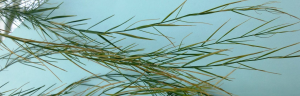
An asparagus bed can be established using different parts of the asparagus: the transplant seedling, the crown and the seed. However, it is quite rare to see crops set up from seed. This technique was first developed in Peru. Some examples can be found in green asparagus crops in the United States and in white asparagus in Germany.
Several categories depending on the weight of the crown
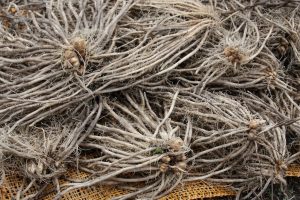
While the low cost of seed reduces the expenditure required to establish the crop, it is expensive and difficult to control germination and then breeding and maintenance of the crop before the first harvest. The seedling and the crown are therefore the essential bases of asparagus cultivation around the world. In both cases, the plant material used combines the genetic potential of the variety (contained in the seed – most varieties are hybrids) and the vegetative potential of the plant. The seedling and the crown are therefore the result of combining the breeder’s and the nursery’s creativity. Seedlings are mainly used in South America, Asia and southern Italy for green asparagus, and sometimes in Spain for white asparagus. The mini-plug plant offers an alternative to the transplant seedling, the only variation being the volume of soil used. The crown is mainly used in Europe. Although the current EU regulations require a minimum weight of 25g, the asparagus crowns typically supplied to professionals weigh at least 40g. Some nurseries even offer several categories depending on the weight of the crown (e.g. 40-70g and 70g+, corresponding to categories A and A+).
The planting process varies depending on whether a plant or a crown is used. In the case of a crown, the first phase of breeding lasts one year and is entrusted to a nursery (see box). The plant material is then planted by the asparagus producer. The crown constitutes “dormant plant material.” In the first year, the plant develops its foliage. The crown grows and then accumulates reserves at the end of its vegetative cycle (autumn). In the year after planting, a first harvest of 25% of the asparagus’ potential is possible. Then, the foliage must be allowed to grow again. In “planting year +2″, the harvest reaches 50% of the potential. Thanks to its accumulated reserves, the crown makes it easy to establish an asparagus bed and then for the transplant to take. Using a crown, the time spent maintaining the plot (irrigation, weeding) is shorter before the first harvest. On the other hand, the additional cost of the crown means an increase in plant investment (about +30% compared to the seedling).
More Info
Transplanting requires greater technical skill
A transplanted seedling is put in place a few months after the seed is sown, using “living plant material”. It is therefore important to plan to introduce water as soon as the seedling is planted. A seedling can be planted later than a crown can. In some cases, it is even possible to collect a very early harvest from the old asparagus bed before replanting. The year of planting is reserved for the development of the seedling (crown and foliage).
“Planting year +1” is also reserved for the growth of the crown. Indeed, it is difficult to envisage a harvest, even a partial one, except for early, well-established plantations. The harvest in “planting year + 2” yields 50% of the production potential. Transplanting a seedling requires a greater level of technical skill and closer monitoring of the crop than is required when transplanting a crown. However, the actual planting is easier as it is possible to see the seedlings, while the crowns are buried in the soil. However, eventually the roots of the transplanted seedlings go deeper into the soil to explore a larger area. The purchasing price is lower for seedlings. On the other hand, in the first year after planting seedlings, the asparagus producer essentially becomes a crown producer. This requires precise control of irrigation and especially careful weeding. Therefore, the money gained from adopting the seedling technique must be invested in maintaining the crop. Moreover, the “non-productive period of the lot” lasts for an additional year, which implies additional land costs.
Transplanting: raising the plant before harvesting
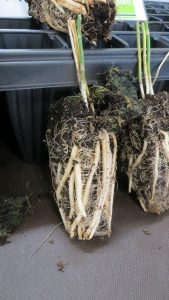
Care must be taken to ensure that the roots of the plug plants do not accumulate or “bunch-up”.
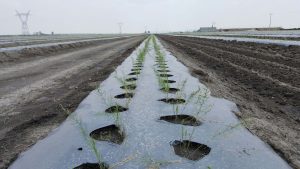
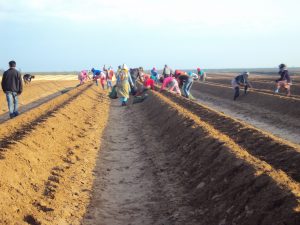
The transplant option involves planting plug plants from the seedlings of a given year between June and September. The main advantage of this method is that it compensates for a lack of crown availability. The technique might also make it easier to choose the variety or to order plants later. What’s more, the plug allows planting while in growing conditions. It can also make it easier to plant in heavy soil. In terms of organisation, the gap between harvest and planting allows producers to make best use of their workforce. But the time savings during the planting year are offset by the additional year required to maintain the asparagus. More precise monitoring of irrigation is required to ensure the plug takes as it has lower reserves than a crown does. Some nurseries supplying transplants offer several types of plugs. Care must be taken to ensure that the roots of plug plants do not accumulate or “bunch-up” and they keep their swivel character to facilitate their development.
More Info
Crowns are cultivated by specialists
The crowns are mostly lifted and shipped according to customer demand.
Crown production is carried out in soils that are free of disease (e.g. Purple Rhizoctone and Fusariasis). These are either new soils that have never received asparagus or are long-rotating soils (more than 6 to 7 years) that have previously been disinfected. Seeding in March is carried out at a density of 220,000 to 260,000 seeds/ha, depending on the richness of the soil, the calibres of crowns sought, and whether the varieties produce larger or smaller crowns. The germination rate is quite low (75 to 95%) and germination time is long. Therefore, control of weeds is required in the nursery. This is carried out using pre-lift herbicides followed by mechanical weeding between rows and manual weeding on the rows. The process is repeated every month as competition from weeds severely penalises the growth of asparagus and thus the calibre of the crowns. Plant protection is applied and monitored closely to prevent any disease or pest harming the foliage. Crowns are collected in February and March before the vegetation is thinned out. Depending on the customers’ requests, this may involve grubbing and direct delivery or refrigerated storage of crowns (for no more than a month) prior to shipment. The grubbing of crowns requires the use of specific equipment, which is available to European and US nurseries. This decisive step in crown production justifies the development of transplants in some countries. The crowns are soaked in an anti-fungal treatment, except in the case of organic crowns for organic plants.
More Info
Choosing a good crown
A crown’s calibre is a predictor of the energy it will have to help it to establish itself and ensure the emergence of stems. Every bit as important as the weight of the crown itself is the regularity of the weight among a batch of crowns as uniformity assists planting (especially with high densities) and ensures the homogeneity of the plot to come. The crown consists of a tray and a system of fleshy roots that make up the plant’s reserves. Look for a spread, balanced tray to facilitate its future development, as well as a significant number of spear buds, on average 5 to 7 (variable depending on the variety). This number is an indicator of the number of stems that will emerge. Plenty of vegetation in the first year will ensure good implantation of the asparagus. Stocky crowns can also facilitate machine planting and/or positioning during high density planting (8 to 9 crowns per linear metre).
7 tips for planting
1 Order the crowns one year before planting to make sure you have the desired variety and quantity. Ordering a transplant requires about 4 months’ delivery time.
2 Anticipate and plan ahead when planting as it may require preparatory work such as the opening of trenches and possibly the drainage, de-compaction, sub-soiling, addition and incorporation of organic matter and/or dressing manure. Soil disinfection and the destruction of perennials may also be necessary.
3 Upon taking delivery of the crowns, if the batches are heterogeneous, it is important to sort the crowns according to their calibre to avoid competition that could prove fatal for the smallest crowns, which might wither within a few years (2 to 3 years) after planting.
4 Store the crowns in a well-ventilated and dry shed by spreading the bags (de-palletised), or in a cold chamber (2-5 degrees Celsius). They can be kept for 5 to 7 days under these conditions. Transplants should be kept outside and the hygrometry of the plug should be maintained.
5 Plant crowns or seedlings as soon as possible. It’s best to plant warm plants in warm soil.
6 Aim to plant in good conditions. Allow the soil to dry up if there has been too much rain or wait for it to warm up if it has been too cold. Planting/establishing the crop is a key step in the subsequent performance of the asparagus throughout its entire production period (8 to 15 years).
7 Soak transplants and crowns in humic acid and/or mycorrhizae solutions to improve establishment and to provide health protection against Fusarium, Erwinia and Phytophthora.
Manage consent
To provide the best experiences, we use technologies such as cookies to store and/or access device information. Consenting to these technologies will allow us to process data such as browsing behavior or unique IDs on this site. Failure to consent or withdrawing consent may adversely affect certain features and functions.
Functional
Always active
Technical access or storage is strictly necessary for the legitimate interest purpose of enabling the use of a specific service explicitly requested by the subscriber or user, or for the sole purpose of carrying out the transmission of a communication over an electronic communications network.
Preferences
Technical access or storage is necessary for the legitimate interest purpose of storing preferences that are not requested by the subscriber or Internet user.
Statistics
Technical storage or access that is used exclusively for statistical purposes.Technical storage or access that is used exclusively for anonymous statistical purposes. Absent a subpoena, voluntary compliance from your internet service provider, or additional records from a third party, information stored or retrieved for this sole purpose generally cannot be used to identify you.
Marketing
Technical access or storage is necessary to create user profiles in order to send advertisements, or to track the user on a website or across websites with similar marketing purposes.