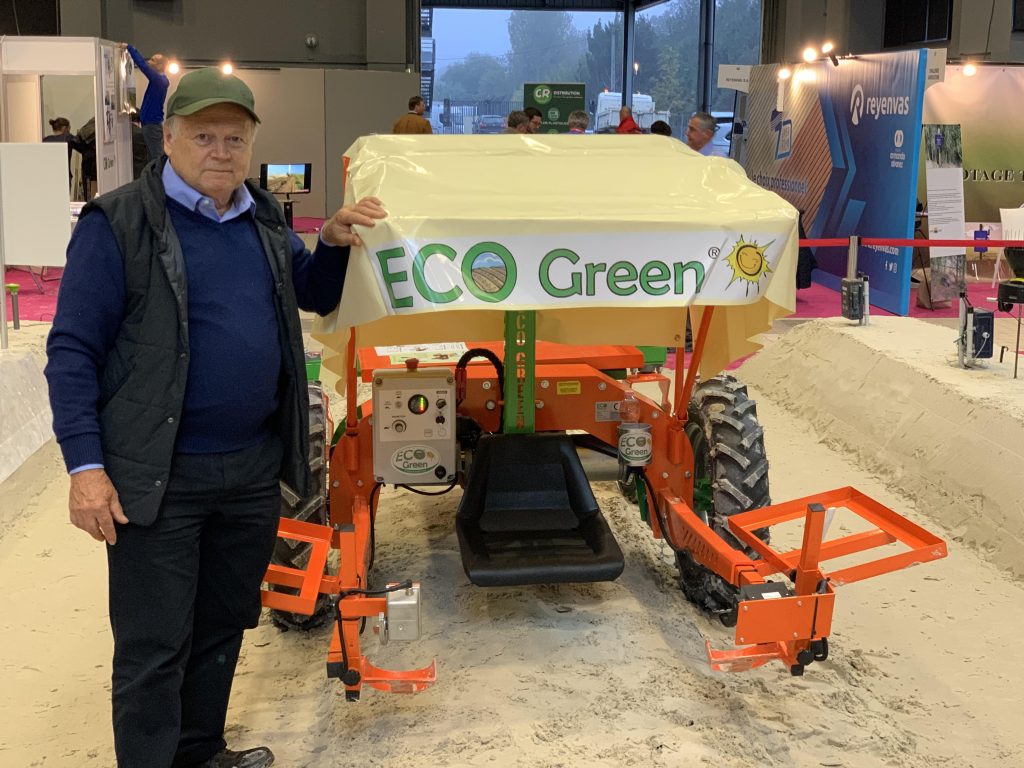
Ecogreen develops environment-friendly technology and its latest innovation is the AV1, an electric harvesting machine for green asparagus. It has a front wheel drive and an electrical steering, as well as two electric motors and four batteries that can give 16 hours of life. The machines have large strong wheels that are perfectly adapted to muddy ground. Owner Leonardo Zanarini said, “We believe that these kinds of environment-friendly machines are part of the future of asparagus. That’s why we are also developing new photovoltaic prototypes with solar panels.”
Founded 15 years ago, Ecogreen is an Italian-based company that manufactures self-propelled electric machines designed to facilitate the manual harvesting process. The high-quality machines are manufactured with special care to meet the needs of modern farming.
French specialist in organic fertiliser Sopropêche has developed a compound for asparagus called castor meal. This organic fertiliser derives from a castor by-product which is used for its NPK content (4.5/2/1). “In the version offered by Sopropêche, our castor meal is vegetal cake from India. The versatile properties of this product allow the asparagus plant to develop much faster,” said sales manager Jean-François Hoyez.
Sopropêche offers a wide range of organic fertiliser (vegetal cakes, seabird guano, vegetal ashes, hoof and horn meal, manures) that meet different types of cultures, such as viticulture, arboriculture, and market gardening, to provide optimum nutrition for soil and plants.
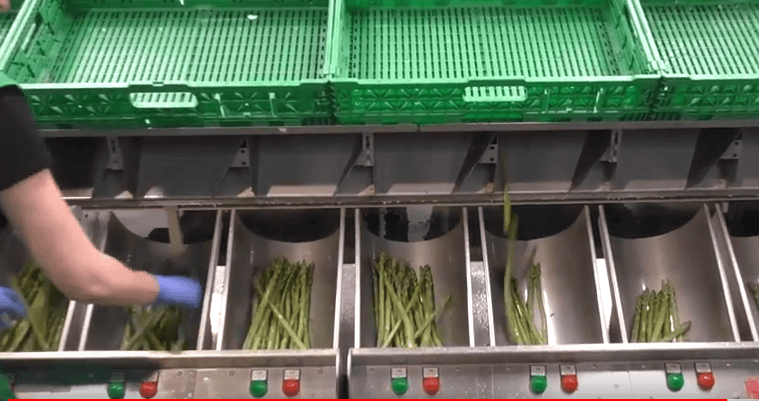
The Optisort G-Series from Strauss is the sector’s favourite asparagus sorting machine. With customised machine sizes, white and green asparagus can be processed by one machine. To prepare the asparagus for optical sorting, first it is cut to a certain length by a sophisticated and long-developed aligning and knife system. Afterwards, it is cleaned using an abundant quantity of water at almost zero pressure. Low water consumption is achieved through recycling. Then, using an optical quality recognition unit, the asparagus is singulated and placed in a cup, and from there, it is moved on to the appropriate collecting container, which is subdivided into different quality levels. The Optisort G-Series methodology allows every asparagus to be checked, with incorrect classifications avoided using 360-degree optical viewing in the sorting cup.
Bejo has been gathering experience in asparagus breeding for over 15 years. The Bejo asparagus programme focuses on white, green, anthocyanin-free green, and purple varieties. The company only develops 100% male varieties as this means there are no berries, so all of the plants’ energy goes into producing the asparagus, resulting in more uniform, quality spears and in a higher yield. Purple varieties are also a part of the breeding programme, which has recently led to the launch of the Erasmus variety, the first 100% male, purple variety in the world. Erasmus has high-quality, thick spears with an intense purple colour. It’s an early variety that produces very high yields, with high upright foliage and a good taste. This kind of asparagus is for growing in cold and intermediate areas, and also in mini tunnels. Erasmus purple salad asparagus is an interesting addition to the current asparagus market. It can be eaten raw due to its sweet taste and is the ideal way to appeal to modern consumers wishing to enter the world of asparagus and who like to prepare quick and healthy meals.
Bejo is a leader in breeding, producing and selling vegetable seeds, with operations in more than thirty countries. The company has expanded over the years in an organic, ongoing process, shaped by interaction between growers, dealers, supply chain partners and its employees.
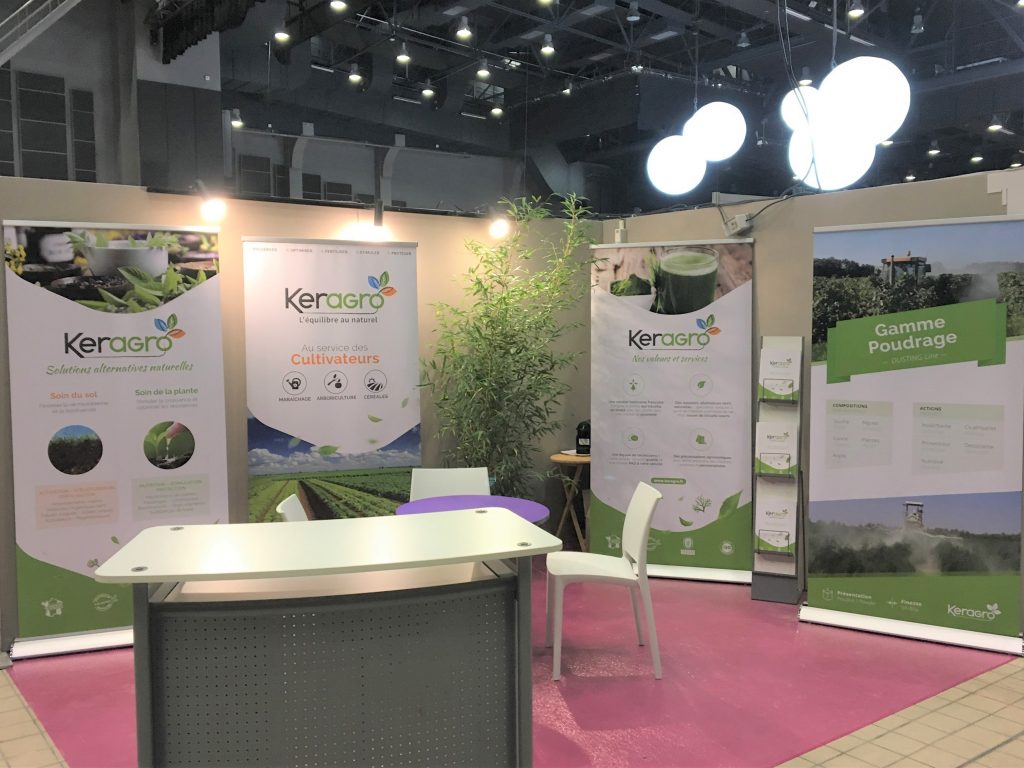
Keragro manufactures a range of powder applications capable of preventing certain invasions and cryptogamic diseases. DRYING, DESSICATION, PROTECTION and SCARRING OVER, these are the virtues of seaweed and trace elements that make up these formulas developed for asparagus growers. KeraSoufre has a proven track record for its repellent and fungistatic effect, KeraSilice for its moisture absorbing effect and strong scarring power. For those who do not have dusting lines, Keragro manufactures specialities for spraying made from medicinal plants and algae, aimed at strengthening and stimulating crops to regulate Biotic and Abiotic stresses.
Producing in New Jersey for over 50 years, Walker Brothers has increased the number of international markets on which its asparagus is sold: “As the world’s largest producers of green asparagus, we distribute to the main markets, especially in South America and southern Europe. But we are now looking to strengthen our presence in other important markets, such as Africa, the Middle East and the Asian Pacific area by increasing our production. Exports to India and Bangladesh are already growing. Vietnam, Indonesia, Taiwan and South Korea are other interesting destinations, » said Wenjing Chen, the firm’s international representative. Walker Brothers produces exclusively green and violet asparagus, especially of the Grande F1 ™ variety, the most appreciated variety on the European and American markets for its taste and texture. It also supplies the Atlas F1™ and Walker Deluxe F1 green varieties as well as the Purple Passion F1.
SDD SOLAR a pour activités le développement des projets solaires, le financement, l’exploitation et la maintenance de centrales de production d’électricité d’origine renouvelable. SDD SOLAR a développé un concept innovant de serres horticoles qui peuvent être adaptées à différentes cultures dont l’asperge blanche et verte. L’intérêt de ce concept est multiple : sécuriser la production soumise aux aléas climatiques (pluie, vent, excès de chaleur, basses températures), lutter contre les parasites et les ravageurs, rendement optimisé, précocité, amélioration des conditions de travail.
Fondée en mai 2018, SDD SOLAR a pour activités le développement des projets solaires, le financement, l’exploitation et la maintenance de centrales de production d’électricité d’origine renouvelable, la réalisation d’études et de missions d’assistance relatives au développement de projets de centrales photovoltaïques.
SDD SOLAR travaille principalement au montage de projets « agri-voltaïques », des serres , des volières… pour l’ensemble des productions agricoles à destination des agriculteurs et des industriels du monde agricole en France et à l’international, l’objectif étant de faire des projets de filières pour assurer la pérennité de leurs exploitations agricoles avec un gain financier sur le long terme.
SDD SOLAR a développé un concept innovant de serres horticoles qui peuvent être adaptées à différentes cultures:
– un espacement entre serres pour optimiser l’exploitation du rayonnement solaire naturel
– une ventilation maximale par ouverture latérale contrôlée et automatisée de bâches, filets…
– un système de contrôle de la température par ouverture automatisée et indépendante des modules photovoltaïques, situé sur les pans Nord faisant office d’ouvrants
– des panneaux avec un taux de luminosité pouvant aller de 5 à 30 %
Des industriels dans les secteurs de l’asperge verte, blanche ou violette, de la framboise et du kiwi…ont validé le concept des serres « agri-voltaïques » de SDD SOLAR et souhaitent le développer et le proposer à leurs adhérents.
L’intérêt de ce concept est multiple :
– sécuriser la production soumise aux aléas climatiques : pluie, vent, excès de chaleur, basses températures
– lutter de façon plus efficace contre les parasites et les ravageurs
– une meilleure gestion des intrants
– une économie d’eau avec moins d’évapotranspiration
– un rendement optimisé
– une précocité de la culture
– une amélioration des conditions de travail
SDD SOLAR possède toutes les compétences pour mener à bien les projets en France et à l’International en réalisant les études techniques , les implantations de projet, la construction d’un business plan, la maîtrise et la connaissance des instances administratives et la recherche d’investisseurs.
149 route de Samadet
40700 SERRES-GASTON
Tél : 06.83.93.38.89
Mail : sddsolar40@gmail.com
SDD Solar
Photovoltaic greenhouses
The activities of SDD SOLAR are involved in development of solar projects, financing, operating and maintaining renewable energy power plants. SDD SOLAR has developed an innovative concept of horticultural greenhouses which can be adapted to different crops including white and green asparagus. There are multiple advantages to this concept: securing production subject to unpredictable climatic conditions (rain, wind, excess heat, low temperatures), control of parasites and pests, optimising yield, precocity, improving working conditions.
In the UK, ‘asparagus decline’ due primarily to crown and root rot caused by Phytophthora asparagi and Fusarium species can result in up to 60% loss of stand amounting to up to £16M in lost revenue per annum. With key operations causing the damage, finding practical solutions to this problem is essential. Only a 10% reduction in yield losses due to ‘asparagus decline’ would amount to a saving of >£1.6M to UK asparagus growers per year. A team from Cranfield University, in collaboration with Cobrey Farms, have been sponsored by AHDB (AHDB Horticulture FV 450a), to develop a suite of best management practices (BMPs) targeted at either preventing or remediating soil compaction in inter-bed wheelings. The main aims of these BMPs are to improve soil structure, reduce soil erosion risk, promote asparagus yields and stand longevity.
Soil management problem
The compaction caused by standard operational procedures, is often eliminated by sub-soiling in crop production. For asparagus, sub-soiling of inter-bed wheelings is used to promote infiltration of water, which reduces the amount of surface water run-off and therefore reduces the risk of soil erosion. However, sub-soiling as well as annual re-ridging are highly invasive. These operations cause damage to asparagus storage roots making the crop susceptible to crown and root rot promoting yield decline.
Experimental field trial
The length of field trial is critical to understanding the impact of management decisions. Changes, in particular improvements to soil structure delivered by modification to practices, can take years before their effect is fully appreciated. Therefore, in order to prove BMP advice, a long-term experimental field trial was established in April 2016 on a 4.5 ha asparagus field in Ross-on-Wye, south eastern Herefordshire, England. The trial comprises 48 experimental plots of the variety Gijnlim, which represents about 70% of UK field grown asparagus.
A range of soil management practices were established that included mulch applications in the wheelings, companion cropping, shallow soil disturbance (SSD, also called sub-soiling) and conventional ridging (R) practices against zero-tillage (not ridged nor sub-soiled) options.
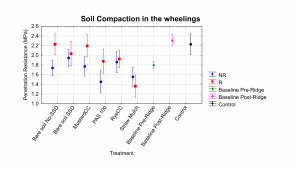
1 Soil Compaction in the wheelings, average values for all depths (0-60 cm); R = Ridged, NR = Non-ridged, SSD = Sub-soiled, No-SSD = Not sub-soiled, Control = Conventional practice (Bare soil No-SSD Ridged), CC = Companion Crop; Vertical bars denote 0.95 confidence interval.
The impacts of different soil management practices are being evaluated via measurements on asparagus storage root distribution, yields and general crop health observations. Changes to soil structure were assessed using a selection of grower-friendly soil structure indicators, such as speed of water infiltration, penetrative resistance and visual soil assessment. Based on previous research undertaken by Cranfield University and Cobrey Farms, it had been established that SSD in association with straw or PAS 100 compost application reduced run-off and soil erosion by more than 80%. Therefore, PAS 100 compost and straw mulch were used in this experiment in SSD trials, to test effects of long-term mulch application on asparagus performance and soil structure. Literature often highlights that the generation of biopores through a bio-drilling effect of cover crops and companion crops in compacted soils can result in increased yield of follow-on cash crops. Plant roots ‘engineer’ the soil structure by penetrating and displacing it, creating air pores, by depositing adhesive compounds which encourage soil aggregation, and via a range of other root deposits which provide energy and nutrient sources for soil biota. The importance of canopy cover, stem density and root density in reducing soil erosion has also been demonstrated. Use of companion crops therefore presents an opportunity to provide soil protection and erosion control within asparagus production systems as well as bio-remediate soil structure. Companion crops included in the trial are rye (Cereale secale), which is commonly used amongst North American asparagus growers and mustard (Sinapis alba), which was selected for its extensive rooting system and associated bio-drilling potential. However, to date, companion cropping has not been adopted within UK asparagus systems as a common practice. Yet the use of companion crops in UK asparagus production as a replacement for conventional sub-soiling practices presents an opportunity to provide soil structural rejuvenation, alleviation of soil compaction and soil erosion control.
Management practice effects on soil structure
Three years after the establishment of the management treatments, meaningful differences can be observed between several BMP treatments. The Rye companion crop non-ridged (NR) did not alleviate soil compaction in any depth. It was in fact more compact than the bare soil zero-tillage treatment. The Rye NR treatment has also been consistently associated with lower yields than the bare soil zero-tillage treatment, suggesting that soil structure might be playing a crucial role in sustaining high asparagus yields. In non-ridged treatments, there was generally good soil structure and high infiltration rates. As expected, soils that were less compacted were associated with increased infiltration rates and soil moisture. Although asparagus in general prefers light, well drained soils, it can temporarily tolerate wet heavier soil conditions. Problems may arise in the winter/spring when the water ponds on the surface, increasing risks of disease transmission (in particular Phytophthora crown rot). Mulches not only retain water in the deeper horizons, but also on the surface. The effect of high moisture soils on asparagus root systems and susceptibility to diseases is yet to be fully understood. Higher soil compaction in the inter-bed wheelings was in most cases associated with ridging. Sub-soiling partially alleviated compaction caused by ridging, however, improvements to soil structure were also seen with the zero-tillage treatments. Therefore, given the additional cost of two further passes required to sub-soil, the use of post-ridging sub-soiling is economically questionable. Mulch applications (especially straw mulch) not only prevented soil compaction but also remediated the pre-existing baseline soil compaction. Straw mulch was the only treatment where ridging did not compact soil further. The use of mulches also lead to better soil structure than seen with the use of companion crops. This could be due to a higher observed abundance of earth worms and other soil biota, which were seen in the mulch plots, and have previously been proven to have a positive effect on soil structure. This will be further studied in 2020.
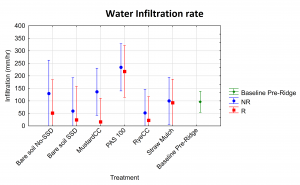
Water infiltration was significantly better in PAS 100 compost plots as compared to other treatments. This also corresponded with observed improvements to soil structure.
2 Water infiltration rate on different treatments; R = Ridged, NR = Non-ridged, SSD = Sub-soiled, No-SSD = Not sub-soiled, CC = Companion Crop; Vertical bars denote 0.95 confidence interval.
Asparagus Root System
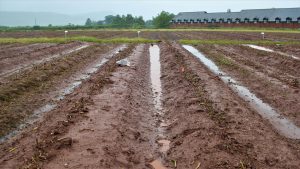
Water logging in the inter-row wheelings.
Although we cannot confirm yet whether size of the root system tells us anything about asparagus yields directly, several strong trends have been observed between root and soil data. Most notably we found that higher infiltration rate in inter-bed wheelings of ridged treatments was strongly associated with higher root masses at 30-60cm depths and 60cm distance from the crown. In contrast, where the soil compaction of the soil was higher, fewer roots (lower root masses) were found at 30-60cm depth at a distance of 30cm from the crown, while more roots (higher root masses) were found closer to the soil surface at 60cm distance from the crown. Initial results of this trial demonstrate that soil compaction and tillage operations affect the size of the root system. The trials will continue to investigate how this affects yield and stand longevity in future years.
Over the next 3-4 years, this field experiment will continue to generate valuable insights on the efficacy of best soil management practices to prevent soil compaction and erosion and increase stand longevity.
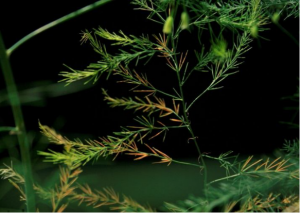
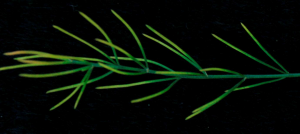
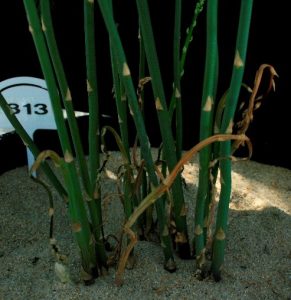
Sur pousses âgées : cladodes de couleur jaune or, voire desséchées si la carence persiste. La tige reste verte.
Sur jeunes pousses, les symptômes sont moins marqués.
Particularité : le magnésium est très peu mobile dans la plante.
Rôle du Magnésium
Elément important pour la synthèse de la chlorophylle et la photosynthèse.
Participe à la synthèse des éléments stockés dans les racines (sucres, protéines…).
Fondamental pour la construction cellulaire, principalement en phase de croissance de l’asperge.
Pertes racinaires
Réduction très importante du poids des racines : 60%.
Carence en Potassium
Symptômes
Décoloration du bout des cladodes presque identique au magnésium, avec un dessèchement plus prononcé.
Pousses âgées : jaunissement et dessèchement de la végétation si la carence persiste.
Particularité : la potasse est très mobile dans la plante.
Rôle du potassium
Régulateur des stomates et de la transpiration.
Améliore les réserves en sucre.
Intervient sur la résistance au gel.
Pertes racinaires
Réduction importante du poids des racines : 40%.
Carence en Soufre
Symptômes
Entraine une moindre production de chlorophylle.
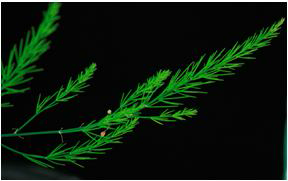
Couleur de la jeune végétation « vert fluo ».
Perturbe la croissance et l’assimilation de l’azote.
Plus visible (couleur vert pâle) sur les jeunes pousses. Tend à disparaitre avec le vieillissement de la plante.
Couleur très pâle des fleurs.
Rôle du soufre
Participe à la production d’acides aminées essentiels et dans l’activation des enzymes liés à la croissance.
Pertes racinaires
Réduction très importante du poids des racines : 57%.
Carence en Phosphore
Symptômes
Cladodes des vieilles pousses plus foncées et qui finissent par tomber
Dessèchement et chutes des cladodes des bouts des tiges, en cas de carence sévère.
Rôle du phosphore
Elément de construction des acides nucléiques et de transfert de l’ATP.
Joue un rôle de maintien dans la structure cellulaire.
Favorise la floraison et la fructification.
Pertes racinaires
Non mesurée.
Carence en Calcium
Symptômes
Chlorose et nécrose des jeunes pousses.
Augmentation de la production de graines, mêmes pour les variétés mâles.
Organes et racines raccourcis.
Mort des jeunes pousses, avec productions de nouvelles pousses qui meurent à leur tour en cas de carence sévère.
Rôle du Calcium
Stabilisation et construction des parois cellulaires.
Influence l’activité des enzymes en lien avec les membranes.
Favorise la croissance racinaire.
Nécessaire à la germination des pollens.
Pertes racinaires
Non mesurée, mais réduction visuelle importante.
Carence en manganèse
Symptômes
Jeunes pousses chlorotiques et nécrosées.
Jeunes pousses vertes et flétries.
Déformations inhabituelles des pousses latérales.
Décoloration blanchâtre des pointes des cladodes.
Rôle du manganèse
Important pour la photosynthèse et la formation des chloroplastes.
Favorise la production des jeunes racines latérales.
Active la croissance en influençant la croissance en longueur des cellules.
Pertes racinaires
Poids des racines non affecté.
Carence en Zinc
Symptômes
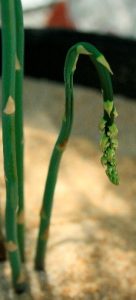
Entre nœuds raccourcis et distance entre cladodes fortement réduite.
Nanisme, pousse en forme de rosette.
Coloration foncée des cladodes.
Rôle du Zinc
Elément de constitution des enzymes, qui jouent un rôle majeur pour la photosynthèse, le métabolisme respiratoire, la synthèse des protéines et la production des substances de croissance.
Influence la production d’acide 3 acétique, important pour la croissance.
Pertes racinaires
Réduction significative du poids des racines : 32%.
Carence en Bore
Symptômes
Visibles sur jeunes et vieilles pousses.
Sur jeunes pousses : flétrissement brusque des extrémités, suivi d’un dessèchement et de la mort des cladodes.
Sur vieilles pousses : cladodes courts et nécrotiques.
Rôle du Bore
Favorise la croissance en longueur des cellules et la stabilité des parois cellulaires.
Favorise la production de sucres.
Pertes racinaires
Réduction significative du poids des racines : 21%.
L’évolution génétique, l’apparition de nouvelles variétés et l’optimisation des techniques culturales de ces dix dernières années, posent la question de l’actualité des références établies en matière d’alimentation minérale de l’asperge par Morse en 1916; Born en 1979, Follett en 1984, Benson et Paulsen en 1990 , Hartmann et Warman en 1991, puis Bergman en 1993.
De nouvelles références pour quatre éléments
Aujourd’hui, les derniers travaux du Dr C. Feller et d’A. Müller du Leibniz Institute of Vegetable and Ornamental Crops, à Großbeeren en Allemagne, complètent et corrigent les travaux réalisés 12 ans plus tôt. Ces travaux ont été réalisés pendant deux années consécutives (2013 et 2014) selon une méthodologie permettant d’induire des carences et d’en évaluer les impacts. (voir encadré 1)
Aux vues des résultats (voir taleau 1), les références établies par Bergmann en 1993 restent d’actualité. Pour le Magnésium, elles sont comprises entre 0.15 à 0.30 %. Pour le Soufre elles sont supérieures à 30 ppm et pour le Zinc entre 20 à 60 ppm. En revanche, les références analytiques établies par Bergmann en 1993 doivent être augmentées. Pour le Calcium, elles passent de 0.40 % à plus de 0.80 %, le Potassium de 1.5 à 2.5 %. Pour le Bore, la référence de 50 ppm augment à plus de 150 ppm et celle du Manganèse de 75 à plus de 100 ppm. Ces valeurs établissent ainsi de nouvelles références pour ces quatre éléments.
Un véritable impact sur le potentiel productif
Au-delà des conséquences sur la fonction chlorophyllienne (perte de surface foliaire), les résultats de cette recherche mettent en évidence la perte de masse racinaire, organe majeur de stockage des réserves glucidiques (voir ci-contre). Hormis la carence en manganèse, toutes les autres carences ont un impact majeur sur la réduction du volume et du poids des racines. Dans l’ordre, la carence Magnésienne (Mg) et Soufrée (S) sont les plus significatives avec une perte de masse racinaire de 60 et 57%. Viennent ensuite le Potassium (K), le Zinc (Zn) et le Bore (B), avec respectivement 40%, 32% et 21% de perte. Elle n’a pas été mesuré pour le Calcium (Ca), mais reste visuellement significative. Bien souvent les symptômes de carence se confondent avec d’autres symptômes. Ils n’ont pas les mêmes origines et nécessitent un examen approfondi. Les causes peuvent être nombreuses : maladies, insectes, sècheresse, gel, phytotoxicité d’engrais foliaires ou d’herbicides. Aussi, les carences peuvent s’extérioriser de différentes manières : chloroses, nécroses partielles ou totales, couleurs des cladodes et des fleurs, déformations et nanismes plus ou moins importants. Pour un diagnostic certain, une analyse foliaire, complétée d’une analyse de sol est nécessaire. Le tableau des résultats « Analyse des rameaux et des cladodes », peut d’ores et déjà servir de référentiel.
Méthodologie des travaux du Dr C. Feller et d’A. Müller
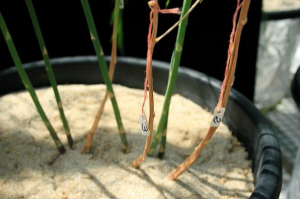
Les asperges ont été cultivées pendant deux années consécutives (2013 et 2014). La 1ère année, les plants ont été cultivés en pots de 3l, remplis de terre. L’année suivante, ils ont été transplantés dans des pots de 12 litres, remplis de matière neutre (sable de quartz lavé). A compter de ce moment, les plants ont été fertilisés toutes les semaines à l’aide d’une solution nutritive contenant tous les éléments nutritifs essentiels, sauf celui qui entraînera la carence. Ils ont été comparés à un témoin normalement fertilisé. Les éléments manquants étaient soit le potassium (K), le magnésium (Mg), le soufre (S), le bore (B), le manganèse (Mn) ou le zinc (Zn). Les mesures ont été réalisées sur 3 variétés fréquemment cultivées en Allemagne (Gijnlim, Rapsody et Cumulus). En 2014, deux modalités supplémentaires induisant une carence en phosphore (P) et en calcium (Ca) ont été ajoutés sur la variété « Cumulus ». Ces deux éléments n’ont été examinés que visuellement. Pendant la culture 2014, tous les symptômes visibles de carence ont été enregistrées et photographiés. Fin 2014, les plantes ont été récoltées, puis analysées. Ces analyses ont été faites sur les cladodes, les rameaux et des racines. Elles ont été complétées par la mesure en degré Brix des racines (fin 2014).
Tab 1 Analyse des rameaux et des cladodes
Résultats en % ou ppm sur Matière Sèche
% Calcium
% Magnésium
% Potassium
% Soufre
Bore (ppm)
Manganèse (ppm)
Zinc (ppm)
Valeur du TEMOIN
0.87
0.20
2.78
0.39
163
81
21
Sans Mg
0.62
0.05
2.92
0.31
140
72
27
Sans Mn
0.82
0.19
2.45
0.36
163
62
20
Sans K
1.51
0.42
0.42
0.34
203
140
31
Sans Zn
0.91
0.21
2.72
0.41
170
77
18
Sans B
0.82
0.20
2.68
0.41
31
83
22
Sans S
1.02
0.26
2.69
0.20
217
120
25
Ref. Bergmann 1993
0.40 à 0.80
0.15 à 0.30
1.5 à 2.4
> 0.30
40 à 100
25 à 100
20 à 60
ABSTRACT
In a context of genetic evolution of asparagus varieties and optimization of cultivation techniques, research work on the identification of asparagus deficiencies resumed in Germany in 2013 and 2014. This work confirms the references established by Bergmann for Magnesium, Sulfur and Zinc. They modify upwards (up to triple), the reference values of Calcium, Potassium, Boron and Manganese. In addition, they highlight the diversity of deficiency symptoms and the risk of confusion with other causes. Also and as a major fact, they demonstrate the impact of severe deficiencies on the reduction of root mass (except manganese).
Gérer le consentement
Pour offrir les meilleures expériences, nous utilisons des technologies telles que les cookies pour stocker et/ou accéder aux informations des appareils. Le fait de consentir à ces technologies nous permettra de traiter des données telles que le comportement de navigation ou les ID uniques sur ce site. Le fait de ne pas consentir ou de retirer son consentement peut avoir un effet négatif sur certaines caractéristiques et fonctions.
Fonctionnel
Toujours activé
L’accès ou le stockage technique est strictement nécessaire dans la finalité d’intérêt légitime de permettre l’utilisation d’un service spécifique explicitement demandé par l’abonné ou l’utilisateur, ou dans le seul but d’effectuer la transmission d’une communication sur un réseau de communications électroniques.
Préférences
L’accès ou le stockage technique est nécessaire dans la finalité d’intérêt légitime de stocker des préférences qui ne sont pas demandées par l’abonné ou l’internaute.
Statistiques
Le stockage ou l’accès technique qui est utilisé exclusivement à des fins statistiques.Le stockage ou l’accès technique qui est utilisé exclusivement dans des finalités statistiques anonymes. En l’absence d’une assignation à comparaître, d’une conformité volontaire de la part de votre fournisseur d’accès à internet ou d’enregistrements supplémentaires provenant d’une tierce partie, les informations stockées ou extraites à cette seule fin ne peuvent généralement pas être utilisées pour vous identifier.
Marketing
L’accès ou le stockage technique est nécessaire pour créer des profils d’internautes afin d’envoyer des publicités, ou pour suivre l’utilisateur sur un site web ou sur plusieurs sites web ayant des finalités marketing similaires.