
Germination 95%
Environ 50.000 semnces par kilo
Prix en fonction des quantités
Contact:
Alfonso Fernadez Venegas
EMEA Garlic and Asparagus Business Director
+34 671 700 313
afernandez@planasa.com
Germination 95%
Environ 50.000 semnces par kilo
Prix en fonction des quantités
Contact:
Alfonso Fernadez Venegas
EMEA Garlic and Asparagus Business Director
+34 671 700 313
afernandez@planasa.com
PLANASA PONE A DISPOSICIÓN DE SUS CLIENTES SEMILLAS DE ESPÁRRAGO VARIEDAD UC – 157 (F1) DE PRODUCCIÓN PROPIA.
PRODUCIDAS EN SUS SEMILLEROS DE ESPAÑA (SEGOVIA).
– GERMINACIÓN 95%
– Aproximadamente 50.000 SEMILLAS / Kg.
– PRECIO NEGOCIABLE SEGÚN VOLUMEN
Contacto:
Alfonso Fernadez Venegas
EMEA Garlic and Asparagus Business Director
+34 671 700 313
Afernandez@planasa.com
PRODUCIDAS EN SUS SEMILLEROS DE ESPAÑA (SEGOVIA).
– GERMINACIÓN 95%
– Aproximadamente 50.000 SEMILLAS / Kg.
– PRECIO NEGOCIABLE SEGÚN VOLUMEN
Contacto:
Alfonso Fernadez Venegas
EMEA Garlic and Asparagus Business Director
+34 671 700 313
Afernandez@planasa.com
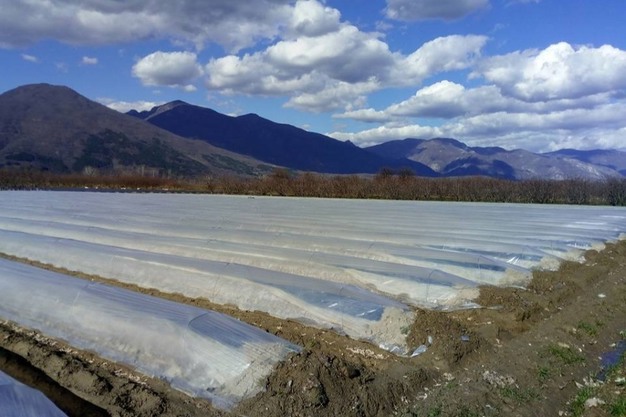
The Greek white asparagus cultivation season in Almopia, one of the key zones of this crop in Greece, is finally entering its last phase under favorable weather conditions, after the adverse weather that initially impeded the timely covering of the crops.
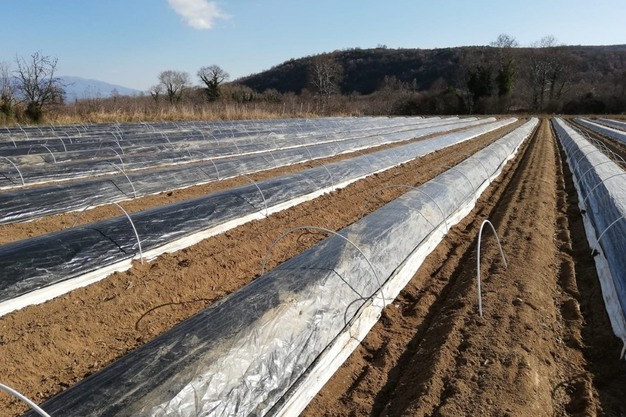
Mr. Christos Tripkos, general manager of Almopia Producers Association, says: “The rainy days of January caused a delay in the cultivation tasks, and we finally managed to cover our white asparagus in early February. Our cooperative manages 75 Ha, while in the whole area of Almopia, the asparagus crops extend to 250 Ha. In the middle of February, 20-25% of both our crops and the crops of the whole area remain uncovered. However, the weather has turned favorable. The night temperature is rising. We need it to stay above 0 degrees Celsius for the rest of February.”
The harvest beginning is estimated to take place in about two weeks from now. This means a one-week delay compared to the normal production calendar. According to Mr. Tripkos, “We will already be in the market by the beginning of March. If the March temperatures oscillate between 7 and 25 degrees Celsius, then we will have good productivity, despite the late start of the harvest. For us, it is essential to have already marketed at least 70% of our crop by April 10-15, because this is when the German asparagus arrives in great volumes on the German market, which is our target.”
The general manager of the Greek asparagus cooperative attended Fruit Logistica and was very satisfied with what was discussed there. As he comments, “The messages we are receiving are very encouraging. The demand is higher than last season. We have already proceeded with intention-based agreements with our German and Dutch clients, including Rewe, Edeka, and Aldi. We renewed agreements with all the companies we already collaborate with and also made agreements with new ones.”
“However, it is too early to speak about prices,” Mr. Tripkos stresses. “Prices are fixed every week for the following week. The first prices for the first March batches will be announced from February 25 to 28,” he concludes.
For more information:
Christos Tripkos
Almopia Producers Association
Mob: +30 697 340 4343
Email: info@asparagus.gr Publication date: Fri 13 Feb 2026
José Antonio Gómez, Cooperativa Centro Sur:
Approximately one-third of the green asparagus crops in Vega Baja del Genil, the primary production area in Granada and Spain, are still flooded due to recent storm Marta. The storm’s passage caused the Vilano stream and the River Genil to overflow, resulting in extensive damage to fields, irrigation channels, infrastructure, and communications, which has left Huétor Tájar cut off by road.
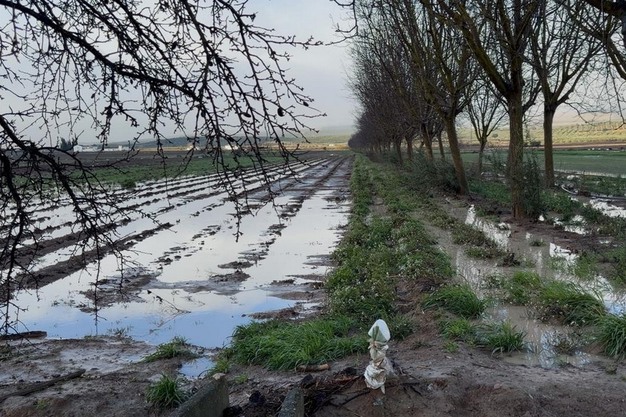
“We estimate that between 25 and 30% of the asparagus crop in Huétor Tájar has been lost. That’s nearly 3 million kilos of produce, just at the start of the season,” stated José Antonio Gómez, a member of the Governing Body of the Centro Sur Cooperative. “It’s raining on wet ground in this area, as we already had a lot of rain before this new storm passed through,” he added.
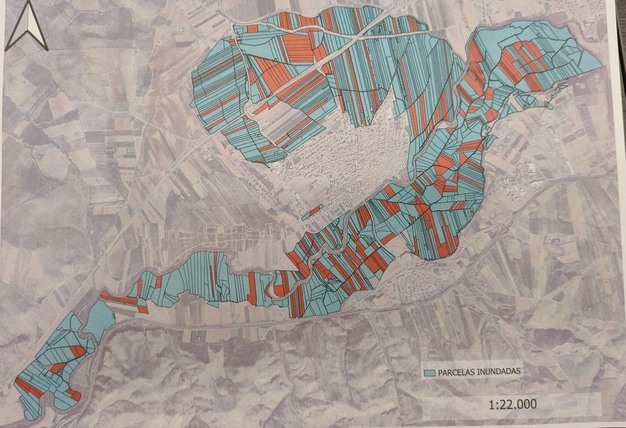 Map showing the flooded plots around the Huétor Tájar municipality.
The campaign was about to start soon. The first batches from earlier locations had already been harvested, and producers expected to begin harvesting the area that is now flooded in about 10 days,” José Antonio Gómez points out. “Undoubtedly, this is a significant loss that is slowing the growth of surface area and planned production for this year. On the other hand, other growing areas will benefit from the rain.
 Flooding in the town of Huétor Tájar.
Asparagus plays a vital role in the local economy, with about 80% of the population relying directly or indirectly on this activity. It involves over 2,000 cooperative members and holds a designation of origin recognized by the European Union. Consequently, floods pose a risk of causing significant disruptions and loss of work during the season, which mainly occurs from March to June.

The damage mainly affects the asparagus-growing regions, but historical hydraulic infrastructure has also suffered significant damage. During floods, watercourses diverted at the start of the 20th century revert to their original paths. In response, the Town Council has called for urgent aid, the declaration of a seriously affected area, and a special agricultural employment program to mitigate the economic and social consequences of the disaster.
Publication date: Wed 11 Feb 2026
Près d’un tiers des cultures d’asperges vertes de la Vega Baja del Genil, principale zone de production de ce légume à Grenade et en Espagne, sont toujours inondées suite aux inondations qui ont particulièrement touché la commune de Huétor Tájar suite au passage de la tempête Marta. Le débordement du ruisseau Vilano et de la rivière Genil a causé d’importants dommages aux champs, aux canaux d’irrigation, aux infrastructures d’irrigation et aux communications, laissant la municipalité isolée par la route.
“Nous estimons qu’entre 25 et 30 % de la récolte d’asperges de Huétor Tájar a été perdue, ce qui représente environ 3 millions de kilos de produits, juste au début de la saison”, déclare José Antonio Gómez, membre du conseil d’administration de la coopérative Centro Sur. “Il pleut sur un sol déjà humide dans cette région, car nous avions accumulé beaucoup de pluie avant celles-ci”.
 Carte des parcelles inondées autour de la municipalité de Huétor Tájar.
“Le démarrage de saison était imminent. En fait, les premiers lots situés dans les zones antérieures avaient déjà été récoltés, tandis que la zone inondée allait commencer à être récoltée dans une dizaine de jours”, souligne José Antonio Gómez. “Il s’agit sans aucun doute d’une perte importante qui ralentit la croissance de la superficie et de la production prévue pour cette année. D’un autre côté, d’autres zones de culture bénéficieront de la pluie”.
 Débordements dans la ville de Huétor Tájar.
L’asperge est une culture clé pour l’économie locale, puisque près de 80 % de la population dépend directement ou indirectement de cette activité, qui compte plus de 2 000 coopératives membres et une appellation d’origine reconnue par l’Union européenne. Les inondations risquent donc d’entraîner la perte de nombreuses journées de travail au cours d’une saison qui s’étend principalement de mars à juin.

Les dégâts affectent particulièrement les zones de culture des asperges, mais les infrastructures hydrauliques historiques ont également été gravement endommagées, car les cours d’eau, détournés au début du XXe siècle, reprennent leur cours initial lors des inondations. Face à cette situation, le conseil municipal a demandé une aide d’urgence, la déclaration d’une zone gravement touchée et un programme spécial d’emploi agricole pour atténuer l’impact économique et social de la catastrophe. Pour plus d’informations :
Centro Sur, S.C.A
Ctra. de la Estación, s/n.
18360, Huétor Tájar. Espagne.
T : +34 958332020
info@centro-sur.es
centro-sur.es
José Antonio Gómez, Cooperativa Centro Sur:
Approximately one-third of the green asparagus crops in Vega Baja del Genil, the primary production area in Granada and Spain, are still flooded due to recent storm Marta. The storm’s passage caused the Vilano stream and the River Genil to overflow, resulting in extensive damage to fields, irrigation channels, infrastructure, and communications, which has left Huétor Tájar cut off by road.
“We estimate that between 25 and 30% of the asparagus crop in Huétor Tájar has been lost. That’s nearly 3 million kilos of produce, just at the start of the season,” stated José Antonio Gómez, a member of the Governing Body of the Centro Sur Cooperative. “It’s raining on wet ground in this area, as we already had a lot of rain before this new storm passed through,” he added.
Map showing the flooded plots around the Huétor Tájar municipality.
The campaign was about to start soon. The first batches from earlier locations had already been harvested, and producers expected to begin harvesting the area that is now flooded in about 10 days,” José Antonio Gómez points out. “Undoubtedly, this is a significant loss that is slowing the growth of surface area and planned production for this year. On the other hand, other growing areas will benefit from the rain.
Flooding in the town of Huétor Tájar.
Asparagus plays a vital role in the local economy, with about 80% of the population relying directly or indirectly on this activity. It involves over 2,000 cooperative members and holds a designation of origin recognized by the European Union. Consequently, floods pose a risk of causing significant disruptions and loss of work during the season, which mainly occurs from March to June.
The damage mainly affects the asparagus-growing regions, but historical hydraulic infrastructure has also suffered significant damage. During floods, watercourses diverted at the start of the 20th century revert to their original paths. In response, the Town Council has called for urgent aid, the declaration of a seriously affected area, and a special agricultural employment program to mitigate the economic and social consequences of the disaster. For more information:
Centro Sur, S.C.A
Ctra. de la Estación, s/n.
18360, Huétor Tájar. Spain.
Tel: +34 958332020
Email: info@centro-sur.es
centro-sur.es Publication date: Wed 11 Feb 2026