Archive

Asparagus industry in E.China’s Jiangxi shows international human rights officials path to poverty relief (Web editor: Zhong Wenxing, Liang Jun)

Asparagus industry in E.China’s Jiangxi shows international human rights officials path to poverty relief

By Li Yawei in Le’an (Global Times) 09:30, November 21, 2025

In Le’an county, East China’s Jiangxi Province, nestled among the mountains, farmers wear contented smiles as they harvest the final batch of asparagus this year. A reporter from the Global Times on Wednesday joined officials in the field of human rights on a tour of this county to witness the vivid practice of safeguarding farmers’ human rights through its asparagus industry.

The Human Rights Action in China – 2025 Jiangxi Tour took place from November 16-23, and was participated by officials, experts, scholars from countries including France, Mexico, Ireland, Switzerland, and China.

During the trip, participants visited Le’an county to observe its specialized asparagus industry. Following six years of development, the local asparagus cultivation area has expanded from 30 mu (approximately 2 hectares) to 2,500 mu, with greenhouse coverage reaching 1,500 mu, making it the largest single asparagus planting base in China, said a local official surnamed Yu.

Although the industry is now thriving, the substantial initial investment and prolonged production cycle deterred local farmers six years ago, said Yu. To address this issue, the local government adopted a contract model, whereby it provided essential production elements such as greenhouses, seeds, and fertilizers, while farmers took charge of daily management.

Yu said farmers can sell their harvested asparagus to local enterprises at a price of 0.6 ($0.08) to 0.8 yuan per jin (0.5 kilograms).

David Lopez, Permanent Representative and Consultant in Human Rights of International Association for Human Rights and Social Development, told the Global Times on Wednesday that the government assumes primary responsibility for the initial investments and natural market risks, liberating farmers from the high-risk, capital-intensive predicament and enabling them to work and earn within a relatively secure environment.

In addition to sales revenue, the local government also provides farmers with a monthly minimum income of 2,700 yuan, Yu said.

David said the guaranteed income provided by the government functions as a safety net by ensuring stable and predictable cash flow for locals. “This effectively safeguards the basic living expenses of farming households and prevents the risk of seasonal poverty,” he added.

Tiny stalks of asparagus have now become a source of income for the local villagers. The county’s asparagus sales reached 6-million-yuan last year, with products mainly distributed across the country, as well as exported to Europe and Southeast Asian countries, according to local government.

“The work is flexible, close to home, and the pay is decent,” Chen Chahua, a 64-year-old local villager, told the Global Times on Wednesday. “During the peak asparagus season this year, I earned 6,000 yuan in a single month,” she said with a smile.

“The better farmers manage the asparagus, the higher the yield, and the more income they earn,” Yu said.

Linking farmers’ income directly to their output stimulates their labor enthusiasm and creativity, and positions them as direct beneficiaries of their own work outcomes, David said.

During the visit, officials also tasted the last batch of this year’s asparagus. As he ate, David expressed his hope that the asparagus yield would continue to grow steadily next year, bringing further benefits to the local farmers. Yu responded, “This is certain. We have already figured out the methods, we are very confident about it.”

So far, the local asparagus industry has created employment for over 300 farmers, with an average annual income of approximately 40,000 to 50,000 yuan per person, effectively boosting rural household earnings.

David said instead of standing by, the local government innovated mechanisms to address the core challenges faced by farmers who were willing to engage in cultivation but hesitated due to financial constraints or lack of resource. Such effort demonstrates local authority’s efforts to safeguard human rights by resolving the most pressing and practical difficulties in people’s lives, he added.

He also noted that the model goes beyond mere subsidy-based poverty alleviation, enabling famers to achieve stable poverty eradication and long-term development through their own work. It also stands as an example of the internationally advocated principle of “promoting human rights through development,” he added.

(Web editor: Zhong Wenxing, Liang Jun)

Photo Report: 29th expoSE/expoDirekt:

“We see, especially here in Germany, a steady trend from open field strawberries to covered cultivation” by FreshPlaza Photo Report: 29th expoSE/expoDirekt:

“We see, especially here in Germany, a steady trend from open field strawberries to covered cultivation”

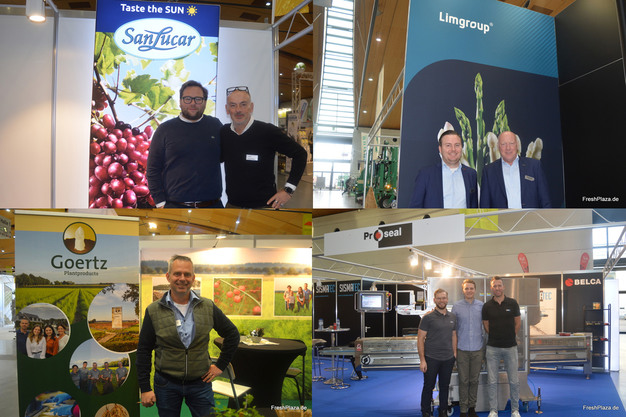
“We see, especially here in Germany, a steady trend from open field strawberries to covered cultivation. This was the main reason for us to participate, as many soft fruit growers do traditionally come to Karlsruhe.” That’s what the team with Looije Agro Technics shared when asked about their debut on the expoSE / expoDirekt, which took place this week in Karlsruhe, Germany. The trade show, focusing on the strawberry and asparagus, have broadened considerably, and again counted 60 companies making their debut, resulting in a mix of traditional suppliers and, more and more, greenhouse companies. For example, an international supplier may be positioned next to a local farm shop. “But oh well, that is also the charm of this event,” one exhibitor aptly summed up the uniqueness of the expoSE/expoDirekt.

On both days, it was pleasantly busy in both exhibition halls where 426 exhibitors from 16 countries presented their novelties and products. Most exhibitors are still from Germany and the Netherlands, although French, Polish, Italian, Spanish and some Eastern Europeans also took part.

New exhibitors predominantly positive
At the same time, there are also exhibitors who return after several years, including machine supplier Top Control from South Tyrol. “For us, it may have been 10 years since we last had our own stand. Back then, we still had a limited portfolio, which put us a bit out of place here. Meanwhile, we have grown fast and this is just the perfect platform for us. So, we’ll definitely come back next year.”

Covered soft fruit growing on the rise, asparagus growing in transition
As some exhibitors point out, protected growing is on a steady rise, particularly in Germany, but also in other countries in western and central Europe. Consequently, due to the disappearance of traditional outdoor growing and the scaling up of mostly smaller, but more efficient crops on racks and under foil tunnels, the total protected acreage is declining. Growers who do not keep up with the pace of change will eventually mostly disappear, experts and suppliers predict.

Meanwhile, a similar development is taking place within the asparagus sector. “Previously, you could still see growers literally and figuratively letting older plots bloom. Nowadays, these kinds of plots go out earlier and are replanted, mostly with more modern varieties,” reports one planting material supplier. In terms of variety innovation, however, things are not keeping up: Limgroup took the opportunity to present the new variety Ruralim and Enza Zaden is also working on a new variety for North-West European cultivation, which will be marketed from next season and has no official name as yet.

Sustainable packaging alternatives needed
A hot topic in the sector at the moment is the dreaded PPWR packaging law, effective from 2030 across the EU. Suppliers are already responding to this after several years without too many innovations with new, sustainable packaging and are massively calling on the industry to switch to PPWR-compliant packaging and associated machinery in time. This necessary switchover is also expected to continue in the coming years until its official introduction on 1-1-2030, although the urgency does not yet seem to have dawned on everyone, suppliers said.

Click here for the photo report

For more information:
https://www.expo-se.de/ Publication date: Fri 21 Nov 2025

© FreshPlaza.com / Hugo Huijbers

White asparagus peeler to increase consumption in France by FreshPlaza

Enya Vermuë, Agrivaloire

White asparagus peeler to increase consumption in France

Agrivaloire has been operating in the asparagus sector for 35 years, with expertise handed down from generation to generation. Founded by the parents of Enya Vermuë, who now runs the company, Agrivaloire initially built its reputation on the sale of asparagus plants before expanding its business in response to a growing problem: the lack of manpower in farms. “We gradually developed partnerships with European manufacturers that could provide machines to help growers,” explains Enya Vermuë. Thanks to her father’s Dutch origins and his many contacts in Belgium, the Netherlands, and Germany, Agrivaloire now plays an essential intermediary role between foreign suppliers and the French market and provides after-sales service.

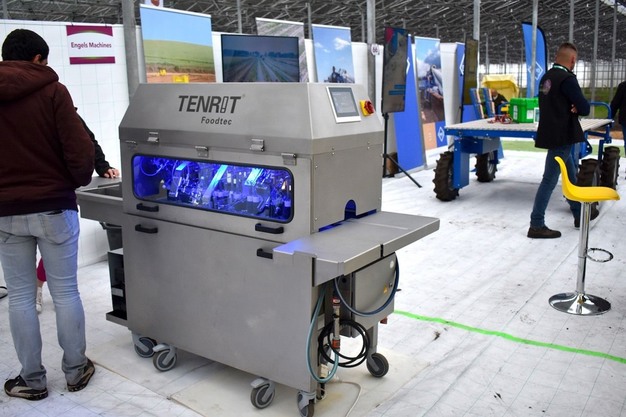
Enya Vermuë at IAD 2025, presenting the Peelmaster Mini peeler from Tenrit Foodtec
A must-have machine in Germany, a novelty in France
Agrivaloire will be exhibiting a number of machines from its partners at the IAD-IBD, including various models of asparagus peelers. “This machine has been around for more than 25 years in Germany, but is still seen as an innovation in France,” explains Enya Vermuë. Coincidentally, the consumption of white asparagus in Germany is much higher than in France.

“At the time, a study highlighted the fact that in Germany, the time spent preparing meals was much shorter than in France: 25-30 minutes compared with 1h30. Using this machine saves precious preparation time. Today, the French have also reduced the time spent preparing meals to around 30 minutes. Habits have changed, and perhaps it is time to adapt our tools to this new lifestyle.”

According to a study published by CTIFL in 2025 on the perception of asparagus, 56% of non-consumers say it takes too long to prepare asparagus, and 45% say they do not know how to cook it. Peeling, in particular, is seen as an awkward, technical, discouraging stage for younger consumers. The asparagus peeler could therefore respond to a societal change in the French market, as it did in Germany, by simplifying preparation and making asparagus consumption more accessible. According to Enya Vermuë, this tool could even be “a lever for boosting consumption of white asparagus in France.”

Asparagus peeler: the industrial model presented at the IAD show

Three models to suit all needs
At the show, Agrivaloire presented three models that meet very different needs. The first, an industrial model, is the historic version, with its many settings and options. The second, a self-service model designed to be installed directly next to the asparagus section in supermarkets, attracted a great deal of interest. “As well as being extremely practical, it is a fun way to liven up the aisle: it is the star of the display!”

Finally, Tenrit Foodtec’s Peelmaster Mini is a compact version, launched last year, aimed at small shops and convenience stores. “The Peelmaster Mini peels 1 kg of asparagus in 20 seconds. There are no buttons or settings. The asparagus is inserted on one side and comes out perfectly peeled on the other. It will be available on the French market for rent or purchase from 2026.” These last two versions stand out for their ease of use.

A good response from the French market
While the French market was still cautious two years ago, attitudes are changing. “Last year, we leased six machines and sold three models. For a launch, that is already very encouraging.” This year, the number of contacts and demonstrations at the show confirms the growing interest in this type of equipment.

By making it easier to prepare asparagus, Agrivaloire hopes to stimulate French consumption, which is still modest compared to that of its European neighbors. This approach is fully in line with the company’s mission: to support the asparagus sector by innovating and making life easier for producers and consumers alike.

For more information:
Enya Vermuë
Agrivaloire
enya.vermue@agrivaloire.fr