Quand l’automatisation vient soutenir les producteurs de myrtilles et d’asperges avec le groupe Maf-Roda lors des International Asparagus & Berries Days par FreshPlaza
Berryway et Optisort de Maf Roda :
Quand l’automatisation vient soutenir les producteurs de myrtilles et d’asperges
A l’occasion du salon IAD – IBD qui s’est tenu le mois dernier dans la région bordelaise, le Groupe Maf-Roda – sponsor Platinium de l’évènement – est venu présenter ses solutions de tri et calibrage destinées aux fruits rouges et aux asperges. Deux installations qui ne sont pas passées inaperçu.
Berryway et Berryscan : une technologie à la pointe qui permet une grande précision dans le tri tout en respectant le fruit Ainsi, la calibreuse Berryway a attiré l’attention des visiteurs, puisqu’elle constitue une solution complète pour le post‑récolte des myrtilles, alliant délicatesse dans la manipulation et grande précision dans le tri. « La Berryway est conçue pour traiter les myrtilles avec le maximum de délicatesse. Chaque ligne prend soin des fruits pour limiter les chocs et garantir leur intégrité », explique Fabrice Blanc, directeur général de Maf Roda. Modulable de deux à dix-huit lignes, chacune traitant 160 à 200 kg de myrtilles/heure/ligne pour un poids moyen de 2g par fruit, Berryscan s’adapte aussi bien aux petits producteurs qu’aux structures industrielles.
Le module Berryscan vient renforcer cette performance grâce à un tri optique multispectral particulièrement précis. Photographiant chaque baie sur 360°, il analyse couleur, forme et qualité externe, tout en détectant les défauts comme les fruits mous, déshydratés ou abîmés. « Grâce à la technologie Insight, nous pouvons mesurer le taux de sucre pour garantir un produit constant et savoureux », précise Fabrice Blanc. Basé sur l’intelligence artificielle, le logiciel permet d’ajuster finement les critères de tri (forme, fermeté, taille, Brix) et d’automatiser l’ensemble du processus jusqu’au conditionnement.
Déjà largement déployée à l’international – des États-Unis à l’Afrique du Sud en passant par l’Europe de l’Est – la solution suscite désormais un intérêt marqué en France. « La demande pour des lignes de tri performantes et automatisées progresse fortement », observe Fabrice Blanc. En réduisant la dépendance au tri manuel tout en maximisant la qualité finale, Berryway et Berryscan se positionnent comme des outils indispensables pour les producteurs cherchant à gagner en précision, en productivité et en valeur ajoutée.
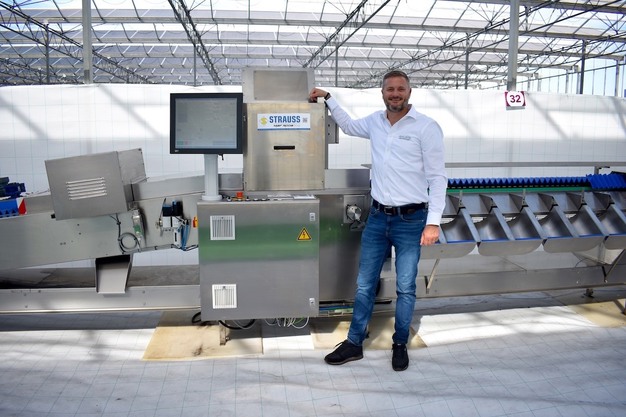
Une calibreuse à asperges permettant une grande précision dans l’associativité Côté asperges, Maf-Roda propose également depuis l’acquisition de la société allemande Strauss, une gamme de solutions complète, allant de l’aide à la récolte au conditionnement en passant par le calibrage et le pesage. Au salon, ce fut la calibreuse pour asperges blanches et vertes qui fut présentée : « Dans cette filière aussi, nous pouvons proposer des solutions clé-en-main qui s’adaptent à tout type de structure », précise Fabrice Blanc.
Des solutions d’autant plus appréciées dans un secteur particulièrement gourmand en main d’œuvre, puisqu’aucune intervention humaine n’est requise, si ce n’est la réception du produit une fois conditionné. « Nous sommes les premiers à faire de l’automatisation en bottes. Notre calibreuse permet d’avoir une grande précision dans l’associativité, à +/- 4g sur la botte. La capacité de nos machines s’étend de 800kg/ 1,2T à 2T/h ». Une autre particularité des calibreuses Strauss – Maf-Roda, réside dans l’efficacité du lavage qui se fait à haute-pression. Un atout certain pour des produits sortant directement du sol tels que les asperges, souillées par le sable qui se glisse dans leurs écailles.
A noter que la calibreuse à asperges présentée à l’occasion du salon peut également être adaptée à la production de poireaux, de courgettes mais aussi de rhubarbe.
Pour plus d’informations : Christophe Nivet Maf-Roda Tél. : +33 5 63 63 27 70
« Nous nous engageons en faveur de l’asperge verte, bien qu’elle nécessite beaucoup de main-d’œuvre »
Il existe des entreprises qui se distancient de la production de légumes à grande échelle et qui se consacrent à des cultures minoritaires, comme l’asperge verte et l’asperge blanche. Il est encore possible d’aller plus loin et de se différencier davantage si l’on parle de cultures biologiques et biodynamiques, ce qui est plus compliqué compte tenu de la force des parasites et des changements climatiques que nous subissons.
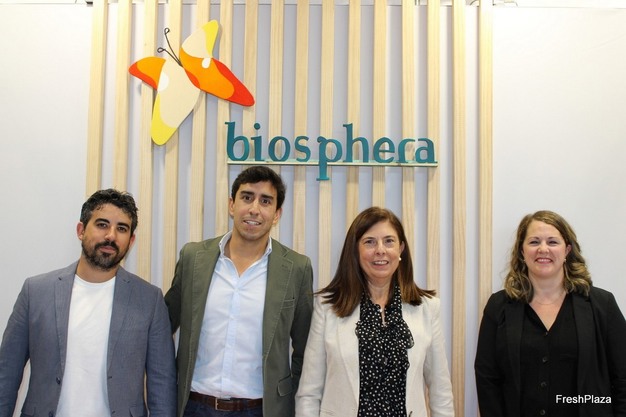
« Nous nous consacrons à la production et à la commercialisation de fruits et légumes biologiques et biodynamiques, notamment les fruits à noyau, les brocolis, les choux-fleurs, les choux, les laitues, les melons et les pastèques, entre autres. Nous sommes spécialisés dans les asperges vertes et blanches. Nous pensons que, parmi les grandes cultures espagnoles, nous devons nous différencier et c’est là notre stratégie. Nous misons sur l’asperge verte, bien qu’elle nécessite beaucoup de main-d’œuvre », souligne Paco García, directeur technique de Biosphera, car « nous n’avons pas recours à la mécanisation. »
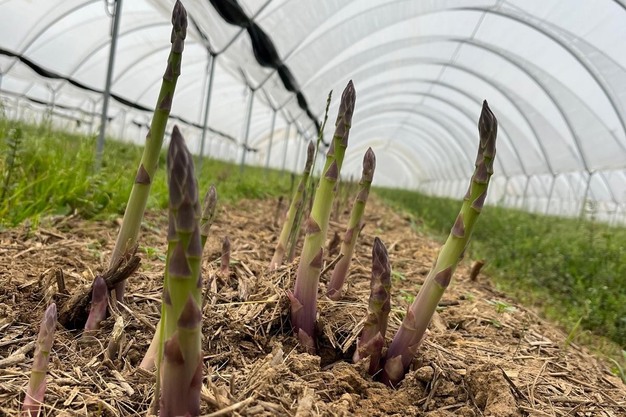
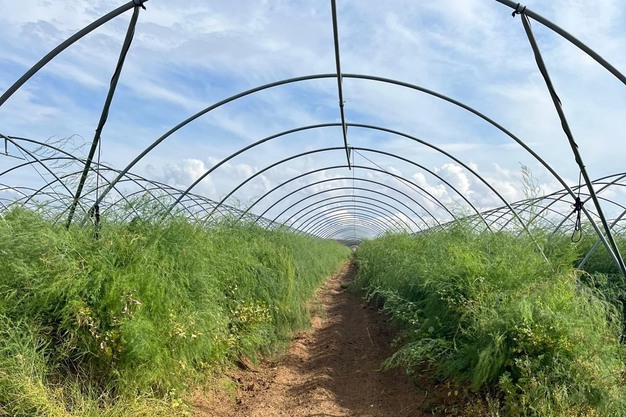
« Nous avons environ 100 hectares d’asperges vertes et blanches et nous commencerons en janvier jusqu’à la fin du mois d’avril. Nous sommes les seuls à pratiquer cette culture dans la région », explique M. García, qui ajoute que cela s’explique par le fait que « l’asperge est une culture rustique, même si elle n’est pas très menacée par les parasites, et qu’elle exige beaucoup de technique. »
Au total, « nous travaillons jusqu’à 500 000 kg par an, ce qui est très apprécié en Allemagne et en Suisse. C’est une culture permanente qui demande un investissement assez important, on ne l’arrache pas et on ne la sème pas tous les ans. Elle nécessite un entretien annuel, mais les plantes peuvent germer jusqu’à 8 ou 10 ans. »
En ce qui concerne l’approvisionnement en eau, « ce n’est pas une culture pluviale, mais il est vrai que l’eau doit être juste ce qu’il faut. Elle n’a pas besoin de beaucoup de froid, mais plutôt de lumière et de soleil et de températures relativement élevées pour sa date. »
Entre tout cela, « nous avons 800 hectares de cultures d’été et d’hiver qui sont principalement destinées à l’Allemagne, la Suisse et la France, entre autres. Je dirais que les fruits à noyaux sont notre point fort avec environ 6 millions de kilos par an. »
Comme c’est le cas dans de nombreuses entreprises de culture, « nous travaillons pour les supermarchés et dans le cadre de programmes. C’est bien de servir les marchés, mais pas en tant que client principal, car il y a trop de défis à relever dans l’agriculture pour planter sans savoir où l’on va. »
« Nous ne travaillons qu’avec des produits biologiques et biodynamiques. Si, dans le premier cas, les restrictions sont fortes, dans le second, les limites sont encore plus importantes. Ce ne sont pas des cultures faciles, mais pour l’instant, il est rentable de les maintenir parce qu’il faut se différencier et ajouter de la valeur à ses produits. Les clients apprécient ces techniques de production et reconnaissent leur valeur élevée en termes de prix. »
Cette année encore, l’ensemble du secteur des asperges et des fraises s’est retrouvé à Karlsruhe. Sur deux jours, les deux halls d’exposition ont accueilli 426 exposants venus de 16 pays qui ont présenté leurs nouveautés et leurs produits. La plupart des exposants sont originaires d’Allemagne et des Pays-Bas, mais des Français, des Polonais, des Italiens, des Espagnols et quelques Européens de l’Est ont également participé au salon. Au fil des ans, l’offre de la foire s’est considérablement élargie et aujourd’hui, un fournisseur international peut se trouver à côté d’un magasin à la ferme. « C’est vraiment ce qui fait le charme de cet événement », a déclaré un participant en soulignant le caractère unique de l’expoSE/expoDirekt.
Nouveaux exposants positifs Bien qu’après presque 30 ans, le salon soit devenu un rendez-vous incontournable pour de nombreux fournisseurs du secteur des asperges et des petits fruits, il y a eu cette année encore plus de 60 nouveaux exposants, dont Looije Agro Technics. « Nous constatons, surtout ici en Allemagne, une vraie tendance à passer de la culture de fraises en plein champ à la culture sous abri. C’est la principale raison de notre participation, car de nombreux producteurs de petits fruits viennent traditionnellement à Karlsruhe. » Parallèlement, certains exposants reviennent après plusieurs années, notamment le fournisseur de machines Top Control du Tyrol du Sud. « Pour nous, cela fait peut-être dix ans que nous n’avons pas eu notre propre stand. À l’époque, nous n’avions qu’un portefeuille limité, ce qui faisait que nous n’avions pas notre place ici. Entre-temps, nous nous sommes développés rapidement et ce salon est la plateforme idéale pour nous. Nous reviendrons donc sans aucun doute l’année prochaine. »
Petits fruits couverts en hausse, asperges en transition Comme le soulignent certains participants, la culture sous abri est en constante augmentation, en particulier en Allemagne, mais aussi dans d’autres pays d’Europe occidentale et centrale. En raison de la disparition des cultures traditionnelles en plein air et de l’augmentation des cultures, plus petites mais plus efficaces, sur des gouttières et sous des tunnels, la superficie totale cultivée diminue. Les experts et les fournisseurs prévoient que les producteurs qui ne suivent pas finiront par disparaître. »
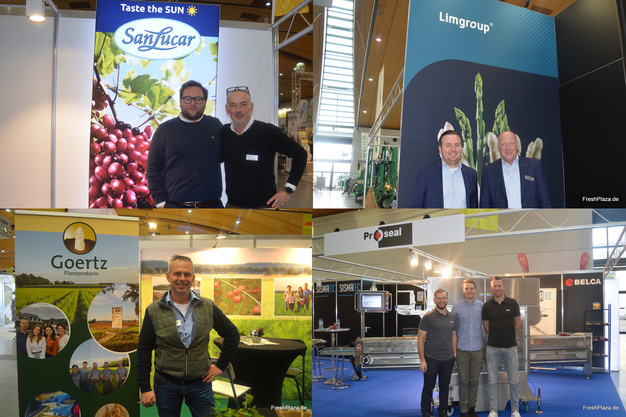
Le secteur des asperges connaît une évolution similaire. « Avant, on voyait encore des producteurs laisser fleurir des parcelles plus anciennes, au sens propre comme au sens figuré. Aujourd’hui, ces parcelles sont arrachées plus tôt et replantées, la plupart du temps avec des variétés plus modernes », rapporte un fournisseur de matériel de plantation. En termes d’innovation variétale, cependant, le secteur ne suit pas encore. Limgroup a toutefois profité de l’occasion pour présenter sa nouveauté Ruralim et Enza Zaden travaille sur une nouvelle variété destinée à la culture en Europe du Nord-Ouest. Celle-sera commercialisée à partir de la saison prochaine et n’a pas encore de nom officiel.
Besoin d’alternatives durables en matière d’emballage Un sujet brûlant dans le secteur en ce moment est la redoutable loi PPWR sur les emballages, qui entrera en vigueur à partir de 2030 dans l’ensemble de l’UE. Les fournisseurs réagissent, après plusieurs années sans vraiment d’innovations en matière d’emballage durable et appellent massivement le secteur à passer à temps à des emballages conformes à la loi PPWR. Cette évolution nécessaire doit se poursuivre dans les années à venir jusqu’à l’introduction officielle, bien que l’urgence ne semble pas encore avoir été perçue par tous les acteurs de la filière.
Le Pérou prévoit une croissance de 10 % de ses exportations agroalimentaires d’ici 2025
Au cours des deux dernières décennies, le Pérou s’est imposé comme un acteur majeur sur la scène agricole internationale, se positionnant parmi les principaux exportateurs mondiaux de produits tels que les asperges, les myrtilles, les avocats et les raisins de table. Cette croissance a non seulement fait des exportations agricoles la deuxième source de revenus du pays après l’exploitation minière, mais elle a également contribué de manière significative à l’emploi national, en touchant près d’un quart de la population.
Diversité géographique et climatique : le grand avantage du Pérou L’un des principaux atouts du Pérou est sa diversité naturelle. Avec jusqu’à 38 types de climats différents sur l’ensemble de son territoire, le pays peut produire des denrées alimentaires tout au long de l’année. Cette capacité lui confère un avantage comparatif par rapport à d’autres pays qui dépendent de saisons plus marquées.
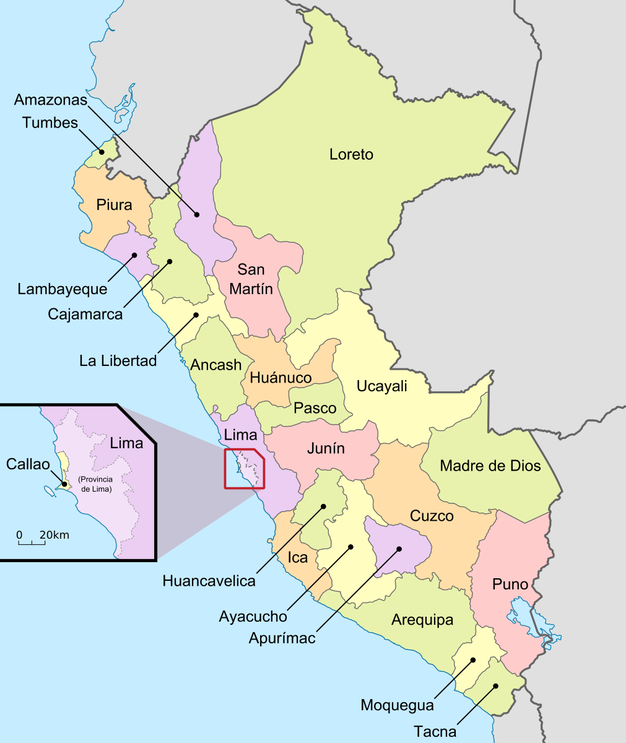
Géographiquement, le Pérou est divisé en trois régions : la Côte, les Hauts Plateaux et la Jungle. La côte péruvienne, bien qu’étant une région essentiellement désertique, concentre environ 60 % de la population – principalement urbaine – et a réussi à développer une agriculture à haute valeur ajoutée grâce à l’utilisation extensive de systèmes d’irrigation technicisés. Cela a permis la production de cultures destinées à l’exportation telles que le raisin de table, l’avocat, la mangue, les myrtilles, l’asperge, l’artichaut, l’oignon et le poivron, en particulier dans les mains de grandes agro-industries. Il convient de mentionner que la côte nord, et dans une moindre mesure la côte centrale, est vulnérable au phénomène côtier El Niño, qui apporte périodiquement des pluies abondantes et parfois dévastatrices.
En revanche, les hautes terres abritent 26 % de la population nationale, avec une prédominance de petits agriculteurs exploitant des parcelles de moins de cinq hectares. Ces producteurs se concentrent sur le marché intérieur et cultivent des produits traditionnels tels que les pommes de terre, le maïs, le quinoa, les choux, les carottes et les tomates. Toutefois, certaines régions andines produisent également des cultures plus commerciales, telles que l’avocat, et des cultures telles que la cerise sont en cours d’expérimentation.
La jungle, qui représente 60 % du territoire national, n’abrite que 14 % de la population. L’agriculture de subsistance y prédomine, bien que la production commerciale de café, de cacao, de bananes, de gingembre et de curcuma ait augmenté ces dernières années.
Structure agricole et défis pour les petits exploitants La plupart des produits agro-exportés du Pérou – tels que l’avocat, la mangue, la banane, les agrumes, les asperges, les poivrons, les artichauts, les oignons, le gingembre et le curcuma – sont cultivés par de petits producteurs, une configuration en partie favorisée par la réforme agraire des années 1970 et la fragmentation subséquente des terres par voie d’héritage. Les petites exploitations sont nombreuses dans certaines zones de la côte et dans l’ensemble des hauts plateaux et de la jungle.
Cette atomisation des terres crée des obstacles à une commercialisation efficace, en raison d’un manque d’organisation, d’infrastructure, de normalisation et d’accès à la technologie. Pour surmonter ces obstacles, plusieurs entreprises exportatrices misent sur l’intégration des petits producteurs par la formation, la fourniture d’intrants et le regroupement des volumes de production.
En revanche, les cultures telles que les raisins et les myrtilles sont principalement cultivées sur de grandes extensions gérées par des entreprises agro-industrielles, ce qui facilite la standardisation, le respect des normes phytosanitaires internationales et l’accès direct aux marchés mondiaux.
Chiffres de croissance : les exportations agroalimentaires en voie d’atteindre 14 milliards de dollars Selon les projections de la Ministre du Commerce Extérieur et du Tourisme, Teresa Mera, les agro-exportations péruviennes dépasseront les 14 milliards de dollars en 2025, ce qui représentera une croissance de 10 % par rapport à l’année précédente. Ce dynamisme se concentre principalement dans les régions côtières, Ica, La Libertad, Piura et Lambayeque représentant plus de 80 % des exportations totales.
Top 5 des agro-exportations péruviennes (2024)
1. Myrtilles Avec plus de 20 000 hectares plantés, le Pérou est le premier exportateur mondial de myrtilles, devant les États-Unis et le Maroc, qui occupent les deuxième et troisième places avec des expéditions 6 fois inférieures à celles du Pérou. En 2024, il a exporté 325 846 tonnes pour une valeur de 2 269 millions de dollars. La Libertad et Lambayeque représentent plus de 75 % de la production. La saison des récoltes commence généralement en juin, atteignant les volumes d’exportation les plus élevés en septembre et octobre et se terminant en mars de l’année suivante. Les États-Unis sont la principale destination, absorbant 57 % des expéditions, suivis par l’Union européenne (22 %), la Chine et Hong Kong.
2. Raisin de table Le Pérou est également en tête des exportations de raisin, avec 558 063 tonnes expédiées en 2024, pour une valeur de 1 705 millions de dollars, devant le Chili (529 470 t) et la Chine (483 373 t en 2023). La récolte commence en septembre et dure jusqu’en avril de l’année suivante, le plus grand volume d’expéditions à l’étranger se situant en décembre et janvier. Ica et Piura représentent plus de 80 % de la production. Les principaux marchés sont les États-Unis (47 %), l’Union européenne (17 %) et l’Asie (13 %). La superficie cultivée dépasse les 22 000 hectares.
3. Les avocats Avec environ 35 000 hectares cultivés dans tout le pays, notamment à Lambayeque, La Libertad, Lima et Ica, le Pérou a exporté 570 457 tonnes en 2024, pour une valeur de 1 247 millions de dollars. Il est le deuxième exportateur mondial, après le Mexique (1 1220 918 t) et devant Israël (151 374 t en 2023). Les exportations ont lieu pratiquement toute l’année, mais la plupart des expéditions à l’étranger ont lieu entre mars et septembre. L’UE est le principal acheteur d’avocats péruviens (51,8 %), suivie des États-Unis (13,9 %).
4. Asperges Le Pérou a la capacité unique de produire des asperges tout au long de l’année. En 2024, il a exporté 96 731 tonnes (406 millions de dollars). Il est le deuxième exportateur mondial, derrière le Mexique (129 837 t) et devant les Etats-Unis (42 873 t en 2023). La Libertad est en tête de la production nationale avec 50 %. La superficie est d’environ 28 000 hectares.
5. Mangues Principalement concentrées à Piura (65 %), les mangues péruviennes sont exportées entre octobre et avril. En 2024, 177 903 tonnes ont été expédiées pour 317 millions de dollars, faisant du Pérou le quatrième exportateur mondial, derrière le Mexique (461 766 t), la Thaïlande (377 351 t) et le Brésil (266 575 t en 2023). La superficie cultivée est de 42 000 hectares.
En 2024, le Pérou a exporté 195 032 t d’agrumes pour une valeur de 255 millions de dollars, tandis que les exportations de paprika séché ont atteint 34 400 t et généré 130 millions de dollars. Les oignons frais ou réfrigérés ont exporté 308 368 tonnes, avec des revenus de 127 millions de dollars. Les artichauts préparés ou conservés se sont élevés à 43 445 tonnes et ont rapporté 120 millions de dollars, et les bananes, principalement biologiques, ont atteint 150 760 tonnes pour une valeur de 115 millions de dollars. Enfin, le gingembre a atteint 47 793 t exportées, pour une valeur de 104 millions de dollars, malgré la récente baisse des volumes. Ensemble, ces 11 produits représentent 53 % des exportations agroalimentaires péruviennes. Outre ces produits, le café (8,6 %) et le cacao (5,8 %) restent des acteurs importants du panier agro-exportateur.
Destinations internationales et logistique portuaire Les principales destinations des agro-exportations péruviennes sont les suivantes : États-Unis (34,7 %), Pays-Bas (14,8 %), Espagne (6,4 %), Royaume-Uni (3,7 %), Chili et Mexique (3,5 % chacun), Équateur (3,1 %), Allemagne, Chine et Canada (entre 2,4 % et 2,6 %). Par région : Les États-Unis et le Canada absorbent 37,1 %, l’Europe 33,2 %, l’Amérique latine 17,2 % et l’Asie 10,1 %.
Les principaux ports de départ en 2024 sont Callao (39 %), Paita (Piura ; 19,4 %), Salaverry (La Libertad ; 14,1 %), Pisco (Ica ; 11,6 %) et Chiclayo (Lambayeque ; 4,7 %). Une attention particulière doit être accordée au port de Chancay (0,5 % en 2024), qui se profile comme un point clé pour renforcer la connexion avec le marché asiatique, où la demande de fruits péruviens croît rapidement.
Expansion future : investissements et nouveaux projets agricoles L’agence publique Proinversión a identifié un grand potentiel d’expansion de l’agriculture moderne dans le pays. Elle estime que, grâce à des partenariats public-privé (PPP), quelque 250 000 nouveaux hectares pourraient être mis en culture, ce qui représenterait un investissement de plus de 4,3 milliards de dollars. Cela permettrait de doubler la zone d’agro-exportation actuelle, qui est actuellement d’environ 250 000 hectares. Le développement des projets agricoles devrait être entre les mains de grandes entreprises agroalimentaires.
Les projets les plus importants sont les suivants Chavimochic III Etapa (La Libertad ; ~111 000 ha), Majes Siguas II Etapa (Arequipa ; ~38 500 ha), Chinecas (Ancash ; ~83 000 ha) et Chancay-Lambayeque (Lambayeque ; ~20 000 ha). De plus, l’inclusion de 168 000 ha supplémentaires est en cours d’évaluation dans le cadre de projets tels que Olmos II (Lambayeque), Pampas Verdes (Ayacucho), Alto Piura et Chira (Piura).
*Les données fournies dans cet article proviennent du Ministère du Développement Agraire et de l’Irrigation (Midagri), du Ministère du Commerce Extérieur et du Tourisme (Mincetur), de la Surintendance Nationale des Douanes et de l’Administration Fiscale (Sunat), de l’Institut National de la Statistique et de l’Informatique (Inei) et de Faostat.
Autorisation exceptionnelle pour utiliser de l’extrait d’ail comme nématicide dans les cultures de fraises à Huelva
Le Ministère de l’Agriculture, de la Pêche et de l’Alimentation a accordé une autorisation exceptionnelle pour la commercialisation et l’utilisation de produits phytopharmaceutiques formulés avec de l’extrait d’ail à 100 % [SC] P/V comme nématicide dans la culture de fraises à Huelva.
Cette mesure répond au besoin de désinfection du sol dans la production de fraises en Andalousie, où la surface disponible est limitée et où les infrastructures ne peuvent pas être facilement déplacées entre les parcelles. Les organismes à combattre sont principalement des nématodes et des champignons, dont la présence rend indispensable l’utilisation de traitements spécifiques pour assurer la viabilité de la culture. La demande a été présentée par la Direction Générale de l’Agriculture et de l’Élevage du Gouvernement Régional d’Andalousie, compte tenu de l’absence d’alternatives efficaces contre ces organismes.
L’autorisation sera valable jusqu’au 11 février 2026 et permet l’utilisation de ces produits phytosanitaires de manière contrôlée et limitée, exclusivement à Huelva. Seuls les agriculteurs et les professionnels formés pourront appliquer les traitements, sous la supervision des autorités régionales.
Selon la résolution ministérielle, jusqu’à six applications par saison sont autorisées, avec un intervalle minimum de dix jours entre les traitements, à raison de quatre litres par hectare, appliqués directement sur le sol par irrigation au goutte-à-goutte, manuellement ou à l’aide d’autres systèmes. Le volume d’eau recommandé varie entre 1 000 et 30 000 litres par hectare, sans période de sécurité spécifique pour cette utilisation.
Actuellement, environ 63 % des parcelles de fraises à Huelva sont infestées par des nématodes phytoparasites, selon les données de Miguel Talavera de l’IFAPA. Malgré l’utilisation généralisée de désinfectants chimiques, on estime que ces nématodes causent une perte annuelle moyenne de 6 % de la récolte.
Parmi les nématodes les plus fréquents figurent Meloidogyne hapla, le principal phytoparasite de la fraise à Huelva ; Pratylenchus penetrans, présent dans 20 % des parcelles et qui peut s’associer à des champignons du sol augmentant la gravité de certaines maladies ; et les espèces Hemicycliophora, qui affectent la culture précocement lorsque les densités d’inoculum sont élevées. La prévalence des nématodes phytoparasites et les pertes qu’ils causent ont augmenté suite aux restrictions d’utilisation des nématicides.
Sylektis: Transformer la récolte agricole avec le tout premier robot de récolte autonome polyvalent. Pour accentuer notre croissance, nous proposons à notre communauté l’opportunité de devenir actionnaire de Sylektis et de contribuer au changement dans l’agriculture durable. Sylektis a une excellente expérience dans la récolte des asperges blanches et vertes.
Sylektis: Transformer la récolte agricole avec l’AsperCut, le tout premier robot de récolte d’asperges blanches et d’asperges vertes. Vidéo de l’AsperCut en action:https://youtu.be/jO_I0FiE2Ds?si=bEw4fxVoiMPxpkLy Pour lancer notre croissance, nous vous proposons l’opportunité de devenir actionnaire de Sylektis et de contribuer au changement dans l’agriculture durable. Les défis du marché agricole :Dépendance aux importations pour plus de 50% des fruits et légumes en France, entraînant des conséquences sur la qualité et l’environnement. Manque chronique de personnel agricole, avec un besoin annuel de 270 000 saisonniers. Accroissement de l’agriculture robotisée: marché estimé à 27,7 milliards USD d’ici 2029, avec un TCAM de 13,1%. La réponse de Sylektis :Sylektis s’attaque à ces problématiques avec un robot de récolte polyvalent novateur, conçu pour les fruits et légumes, qui : – Diminue de 88% les besoins en personnel, un opérateur contrôlant plusieurs robots de récoltes. – Augmente la précision de la récolte grâce à une vision 3D et une IA sophistiquée, réduisant les gaspillages. – Réduit de 50% l’empreinte carbone, promouvant la production locale et durable. Nos réalisations et perspectives :Validation solide du marché : Potentiel de ventes de 147 millions d’euros. Levée de 1M€ pour soutenir la R&D, avec un retour sur investissement prévu sur 4 ans. Vente de 8 robots dès 2027 puis montée à 100 robots par an dès 2029.Projection d’un chiffre d’affaires supérieur à 4 M€ dès 2027-28. Modalités d’investissement :Les investissements sont réservés aux 30premiers investisseurs retenus. Pour plus d’informations, contactez directement par email ou téléphone Wilfried Garrigue, président de Sylektis. Notre équipe est prête à discuter avec vous et à répondre à toutes vos questions. Avec Sylektis, le futur s’est maintenant, alors n’hésitez pas à nous rejoindre!
What does the new Genius variety of white asparagus have to offer? by FreshPlaza
Bejo France at the International Asparagus Days
What does the new Genius variety of white asparagus have to offer?
Among the professionals present at the International Asparagus Days (IAD) and International Berry Days (IBD) trade fairs, vegetable seed specialist Bejo – Silver sponsor of the event – presented a new variety of white asparagus called Genius. This variety is part of the “new generation of asparagus,” adding to an already extensive range of white asparagus that arrive more or less early depending on the region.
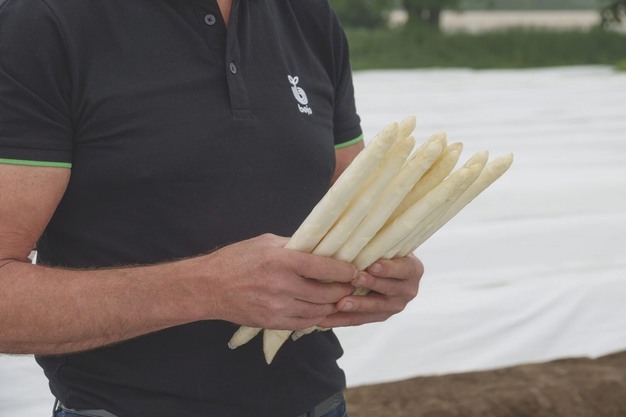
Designed for the semi-early segment, Genius F1 is a 100% male seasonal variety, with the particularity of being very vigorous while offering excellent yield quality. Its robust plant structure makes it resistant to leaf diseases, rust, and hollow stems. Its strong, dense foliage ensures sustained productivity over the years. Its shoots are smooth, uniform, thick, very white, and large, with tightly closed bracts. Not only does this mean a better packing rate – essential for growers seeking optimum yields – but it also ensures superior quality on the fresh market. Asparagus can be grown both in the open field and in greenhouses. With an optimized planting density of 4 to 5 claws per meter, growers can maximize yields while maintaining excellent stem quality.
Feedback from growers and experts is already positive. “Previous trials have shown excellent yields and quality. The variety has a nice closed head structure and has proved its resistance to leaf diseases over the years. We are convinced that Genius will set a new quality standard for white asparagus cultivation in northwestern Europe,” explains Gerhard Völkel, head of crops at Bejo.
After more than a decade of development and large-scale trials in the Netherlands, Germany, and France, Genius is now commercially available for the 2025 season.
For more information: Yannick Chevray Bejo France “Beauchêne” 49250 Beaufort en Vallée Phone: +33 (0) 2 41 57 64 75 Mobile: +33 (0) 6 07 95 44 95 y.chevray@bejo.fr www.bejo.fr Publication date: Mon 20 Oct 2025
Soft fruit in the spotlight for the first time, alongside asparagus
From October 7th to 10th, 2025, the 5th edition of the International Asparagus Days (IAD) will be held in Bordeaux. This is a key event for professionals in the sector from all over the world who want to keep up to date with the latest technologies, production techniques, and market developments. But this year marks the start of a new chapter with the launch of the first edition of the International Berries Days (IBD). The asparagus will be sharing the limelight with these small soft fruits: two families of products that at first glance seem very different, yet complement each other in many ways.
Asparagus and soft fruit: Technical crops for the same market “In terms of production, these are two crops that require a certain precision and a high level of technical expertise,” explains Christian Befve, founder of the two international days and partner of Macfrut and Interco Nouvelle Aquitaine. “Many asparagus producers also grow soft fruit. In terms of timing, the complementarity is also interesting, since the asparagus harvest takes place before the soft fruit harvest (except for the strawberry, which is at the junction between the two crops). All asparagus growers can start growing soft fruit, whether in the ground or above ground. There are no prerequisites in terms of soil composition. On the other hand, soft fruit growers can diversify into asparagus if they wish.”
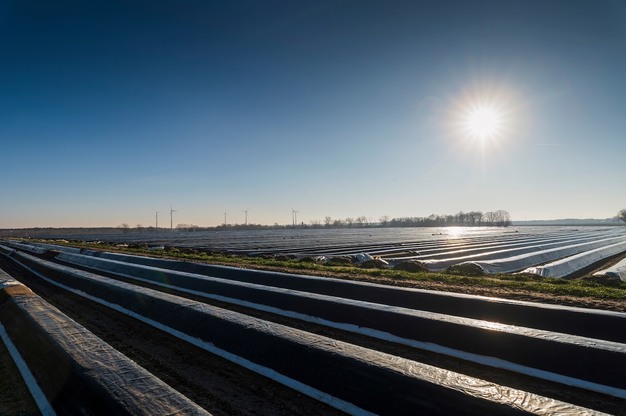
Even in conditions of heavy soil and rocky terrain, it is possible to produce asparagus using a technique that consists of ‘growing without soil in the soil’. “All you have to do is prepare the soil to a width of 1.5 m and a depth of 80 cm, which allows it to be completely corrected. With mulching, we can then protect the mound and preserve the structure we have created.” A technique devised by Christian Befve that is proving highly effective and also has the advantage of being cheaper than growing in the ground.
Another interesting similarity is the market for both product families. “Asparagus and soft fruits are luxury products. The consumers who eat asparagus have the same purchasing power as those who eat soft fruit. Over 50% of suppliers and marketers work with both asparagus and berries. These are two highly profitable markets (which together generate US$96 billion worldwide), with consumption mainly of blueberries soaring in many countries and demand for organic produce rising sharply, especially in Europe.”
Soft fruit: A sector rich in opportunities Although soft fruit is now only grown on 600,000 hectares around the world, the area under production continues to increase. “The development of consumption is an obvious driver of this growth, but it is also driven by varietal innovation and producers who are investing in new varieties that are more resistant and better adapted to climate change. Developing production in consumer countries is also particularly interesting, given that soft fruit is very fragile and has difficulty withstanding transport, not to mention the trend towards consumption of local products. We should not stop as long as there is a market.”
Asparagus: A market in full recovery The same applies to berry producers who would like to start growing asparagus. “The market is currently in full recovery, and we even have a shortage of asparagus plants. History has shown us that the balance between supply and demand was reached at 250,000 hectares. Today, we have planted around 190,000 hectares, so we are 60,000 hectares short of achieving this balance. Given the shortage of asparagus, the crisis is now behind us, and we need to plant now, because we can be sure of a reasonable market for the next 10 years. This is a great opportunity for berry growers to diversify into another lucrative crop. IAD is typically the kind of event that can respond to the needs and questions of growers who want to get started.
As proof of this, I recently gave a talk on asparagus in Spain to producers who pointed out the difficulties they were having in expanding their crops because of water restrictions and labor problems. But some techniques can save water if you know how to apply them at the right time. Establishing a greater distance between rows can also significantly reduce labor requirements. At the end of the conference, the growers were aiming to plant a total of 400 hectares over the next two years. When we respond to growers’ needs by providing practical solutions and good technical support, limiting thoughts give way to the desire to embark on production with greater peace of mind. This is also one of the aims of these two international days.”
The 4-day program will include technical visits focusing on asparagus and soft fruit, as well as conferences, workshops, demonstrations, and a trade fair.
Tuesday, October 7th – Asparagus Tour (Gironde): In the morning, participants will visit Vignobles Bouillac, a farm covering 100 ha of vineyards and 20 ha of vine nurseries, which markets 15 ha of asparagus under the PGI Asperges du Blayais label. Jean-Pierre Bouillac, the farmer, and Danielle Chambaraud, president of the Association of Asperges du Blayais producers, will be on hand for the visit. Lunch and wine tasting will be held on site. In the afternoon, participants will visit the Lebourg farm, which covers 900 hectares, including 80 hectares of turf and 49 hectares of white asparagus, as well as corn (grain and popcorn), carrots, and potatoes.
Tuesday October 7th – Soft Fruit Tour (Lot-et-Garonne): The tour will begin with a morning visit to Pépinières Saint-Armand and Fruits Rouges du Confluent, which grow 12 ha of strawberries in greenhouses (producing 900/1000 tons of strawberries a year), 20 ha of strawberry nurseries (producing 7 million tray-plants), and 40 ha of kiwis. The morning will end with lunch, before heading off to Aquisol, a farm with 60 ha of greenhouses, including 13 ha of strawberries (800T/year), 8 ha of raspberries (230T/year), and 8 ha of blueberries (160T/year). Various technical itineraries will be presented: conventional, organic, soilless, and open-field cultivation. Alongside soft fruit, the farm also produces vegetables such as aubergines, cucumbers, peppers, lettuce, kohlrabi, spinach, and kiwis.
Wednesday and Thursday, October 8-9: A trade fair will be held over the two days, with booths selling plant material, equipment, nurseries, services, marketing, research, and training. Technical visits and outdoor demonstrations (preparation, planting, maintenance, and harvesting equipment) will be organized during the event, with the possibility of on-site catering. Pitch sessions and technical workshops will also be run by exhibitors and sponsors in a central agora. The opening ceremony will take place at 11 am on Wednesday, and will close with a Cocktail and Show evening at the Cabaret Music-Hall “Le Grain d’Folie” at 7 pm in Artigues-près-Bordeaux.
Over the two days, participants will be able to visit Planasa: at 10 am, a presentation on strawberry research will be given, alongside a presentation on the different varieties of asparagus. At 3 pm, participants will have the opportunity to visit blueberry fields, and at 4 pm, they will discover “replanting asparagus on asparagus.”
From 3 pm to 5 pm on Thursday, there will be a conference on “Soft fruit: What innovations for tomorrow’s markets?”
Friday 10 October – Soft Fruit Tour (Dordogne): In the morning, a visit to the Interprofessionnel Technical Center for Fruit and Vegetables in Lanxade will be organized. On this occasion, participants will discover the 190-hectare technology hall, where 52 species of fruit and vegetables are tested. Participants will also have the opportunity to visit the Invenio experimental station in the fruit and vegetable sector at Douville. Invenio is an association of fruit and vegetable growers who wish to combine their efforts in experimentation, varietal research, and technological innovation. A visit to the Douville site will provide an overview of the latest French research into strawberry and raspberry planting material and cultivation.
The afternoon will be devoted to a visit to the farm run by the Teychenné family, members of the Socave cooperative. This is an opportunity to discover traditional production in soil with the “PGI Périgord Strawberry” label, and unheated hydroponic production of remontant strawberries.
Innovations such as the Aspercut, France’s first harvesting robot, will be on display at IAD and IBD. In all, there are around ten harvesting robots in the world, which are said to have “greatly improved in performance and efficiency in recent years.” These robots “tend to be profitable,” which will inevitably have an impact on the market over the next few years.
Four days of sharing, visits, conferences, and meetings with a common objective for both events: To position ourselves as the true crossroads between research, production, technology, and marketing. The date is strategically chosen, after Fruit Attraction was held the previous week in Madrid. “This will make it easier for professionals from far away to travel to Bordeaux,” explains Christian Befve. “It is a unique opportunity to put growers in touch with marketers and suppliers, and to discover the latest technologies (bio-control, artificial intelligence, robotization…) that are gradually reorganizing the sector. Taking part in IAD and IBD is also an opportunity to understand how to adapt the corresponding cultivation techniques to the soil and climate conditions of each production site without distortion. Compliance with health and social regulations, respect for the environment, and anticipation of climate change are also key issues that will be addressed during this 4-day meeting. This really is a key event for any professional interested in growing asparagus or soft fruit.”
Wilfried Garrigue, Sylektis: “A reliable, robust, and accessible tool built on a low-tech approach.”
AsperCut: A breakthrough innovation giving asparagus farmers back their independence?
The asparagus sector could be on the verge of a major transformation with the upcoming release of AsperCut, France’s first robotic asparagus harvester, expected next season. This project was born out of a stark realization: the shortage of agricultural labor poses one of the greatest threats to French—and more broadly, European—farming. This was particularly evident during the COVID years, when the asparagus harvest in France was seriously jeopardized. It was from this challenge that Sylektis emerged, founded by Wilfried Garrigue and Stéphane Abraham.
A low-tech philosophy for greater reliability “Our background isn’t in agriculture but in industry, and we firmly believe that industrial robotics solutions can be adapted to agriculture,” explains Wilfried Garrigue. “We launched the project in 2020 and are now on the third version of the AsperCut prototype, which is becoming highly operational and productive.”
While AsperCut isn’t the first robot developed to automate asparagus harvesting, it marks a real technological shift compared to existing models. “Rather than reinventing everything from scratch, we focused on proven, widely used technologies from both the industrial and agricultural sectors. The machine is composed of three main elements: a custom-designed straddle tool carrier, the harvesting robot, and an AI module that detects the asparagus. This pragmatic, low-tech approach makes the machine more affordable and significantly more reliable for farmers.”
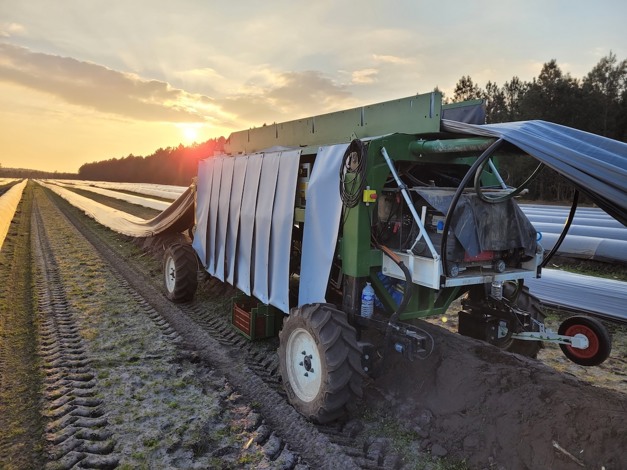
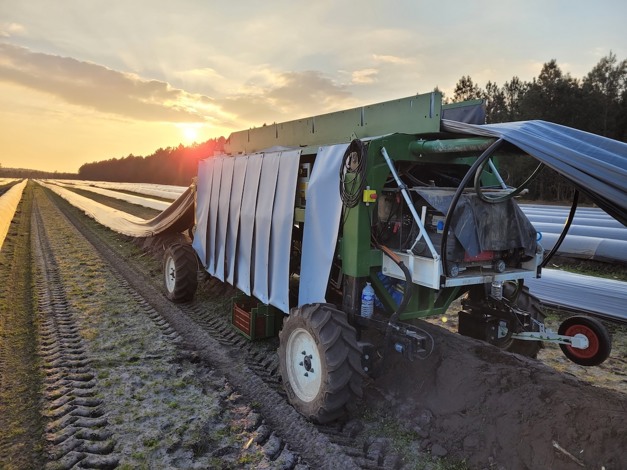
A focus on harvest quality over speed What sets AsperCut apart is its simplicity and durability, qualities the founders prioritized to win over skeptical growers. “Farmers are often wary of robotics, which can feel overly complex, fragile, and hard to use or maintain. That’s why we avoid calling it a ‘robot’; we prefer ‘harvesting machine’. Compared to existing machines, we wanted to develop something smaller, more cost-effective, and focused on harvesting quality rather than speed,” Garrigue explains. “Our machine measures 4 meters long, 2.5 meters wide and high, and weighs 3.5 tons. We’ve deliberately chosen to stop the machine when harvesting rather than moving continuously—this would require much more complex and less reliable robotics. By stopping, we ensure a cleaner, more efficient harvest. The machine can cut the asparagus in a single motion—something that’s not easily achieved by hand—and avoids pinching or damaging the spears, thereby preserving quality. We’ve also developed and patented a tool that can harvest even slightly twisted asparagus, greatly reducing harvest variability.”
Designed for moderate production areas of 2 to 4 hectares, the strategy is to sell several small machines rather than a single large one. This approach adapts easily to various farm sizes and ensures that farmers aren’t left stuck if one machine fails.
Autonomous operation powered by smart AI detection The AsperCut operates autonomously along asparagus beds using a 3D AI-based detection system that pinpoints the exact position of each spear. “We’re at a turning point in terms of available technology,” Garrigue notes. “Cameras and computers have become far more accessible, which has allowed us to integrate this tech into our machines. Going fully electric would have been a step too far for now, but our priority is solving the harvesting challenge. The machine navigates rows on its own, detects asparagus, stops to harvest, and places the spears in a crate. Once a row is complete, it halts for an operator to collect the crates and reposition them to the next row. This process ensures asparagus isn’t left in the crates too long post-harvest. It’s a hybrid machine powered by electricity with an onboard generator for full autonomy.”
Designed for both white and green asparagus Though the original focus was on white asparagus, Sylektis is pushing further, developing a solution for green asparagus as well. “Our vision is a modular harvesting platform that can accommodate up to two robots—one for white asparagus at the front and one for green at the back. Or even two of each for larger operations. We’re collaborating with Fanuc, the world leader in industrial robotics, to develop the green asparagus harvesting module.”
Tackling the labor crisis with a competitive edge “The core issue today in agriculture is labor. Unlike tilling or weeding, harvesting remains a manual task, but we simply don’t have the workforce anymore. These jobs are tough and increasingly unattractive. Since harvesting is also the phase that adds the most value to the crop, AsperCut has strong potential for return on investment. With Maxime Pallin, a farmer in France’s Médoc region who has helped test our prototype for the past three years, we’ve identified the performance goals needed to meet both technical and economic demands. The 2025 season will be key to confirming those targets and launching commercial sales.”
Boosting local capacity and reducing imports through autonomy Although harvesting costs are important, the main goal isn’t necessarily to be cheaper than seasonal labor. “The real aim is to address the labor shortage and ensure that farmers can harvest their crops. Today, 50% of asparagus is imported, and many farmers tell us they would plant and harvest more if only they had the manpower. With AsperCut, we want to empower growers to expand local production, reduce dependence on imports, and make asparagus farming more sustainable. It’s a long-term investment with environmental and economic benefits. With a plantation lasting ten years, AsperCut removes the uncertainty around labor availability for the entire lifespan of the crop. In that sense, it’s a true breakthrough innovation.”
A commitment to supporting farmers in France and beyond As AsperCut nears industrial production, Garrigue and Abraham are approaching the next phase of their journey with confidence and ambition. “We’re proud to be the first to design and build a French-made harvesting machine. France Relance 2030 has supported us from the beginning, and we’re currently fundraising to support industrialization.
We plan to start selling the first units this year, with pre-production delivery set for 2026. Our machines will be distributed through local tractor dealers to ensure ongoing support and maintenance. Labor challenges aren’t unique to France, and we aim to bring AsperCut to farmers across Europe—and possibly further.
We’re also exploring adaptations for other crops facing the same issues, like grape harvesting. Agriculture is at risk: if we can’t harvest, we’re handing over our food sovereignty. We believe AsperCut offers a real solution, and we’re fully committed to helping farmers make this transition.”
To provide the best experiences, we use technologies such as cookies to store and/or access device information. Consenting to these technologies will allow us to process data such as browsing behavior or unique IDs on this site. Failure to consent or withdrawing consent may adversely affect certain features and functions.
Functional
Always active
Technical access or storage is strictly necessary for the legitimate interest purpose of enabling the use of a specific service explicitly requested by the subscriber or user, or for the sole purpose of carrying out the transmission of a communication over an electronic communications network.
Preferences
Technical access or storage is necessary for the legitimate interest purpose of storing preferences that are not requested by the subscriber or Internet user.
Statistics
Technical storage or access that is used exclusively for statistical purposes.Technical storage or access that is used exclusively for anonymous statistical purposes. Absent a subpoena, voluntary compliance from your internet service provider, or additional records from a third party, information stored or retrieved for this sole purpose generally cannot be used to identify you.
Marketing
Technical access or storage is necessary to create user profiles in order to send advertisements, or to track the user on a website or across websites with similar marketing purposes.




 Yannick Chevray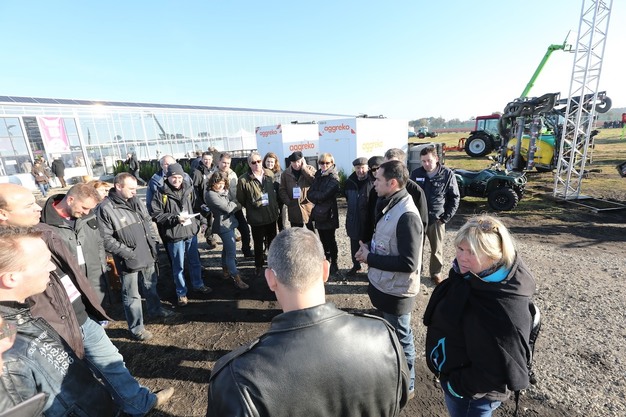

 Even in conditions of heavy soil and rocky terrain, it is possible to produce asparagus using a technique that consists of ‘growing without soil in the soil’. “All you have to do is prepare the soil to a width of 1.5 m and a depth of 80 cm, which allows it to be completely corrected. With mulching, we can then protect the mound and preserve the structure we have created.” A technique devised by Christian Befve that is proving highly effective and also has the advantage of being cheaper than growing in the ground.