
Archive

«Los espárragos verdes gozan de menos publicidad, pero tiene éxito entre los jóvenes» En el periodo entre Semana Santa y finales de junio, los espárragos blancos a menudo monopolizan la conversación, pero los espárragos verdes también están en temporada. por FreshPlaza

La variante verde es menos dependiente de los caprichos del tiempo

«Los espárragos verdes gozan de menos publicidad, pero tiene éxito entre los jóvenes»

En el periodo entre Semana Santa y finales de junio, los espárragos blancos a menudo monopolizan la conversación, pero los espárragos verdes también están en temporada.
Este producto belga quizá goce de menos publicidad que su hermano blanco, pero aun así, se está volviendo cada vez más popular, sobre todo entre los jóvenes. «Llegan un poco más tarde que los espárragos blancos, pero ambas temporadas terminan más o menos a la vez.

Un cultivo más sencillo y la conveniencia para el consumidor hace de este un producto muy apreciado», cuenta Katrien De Backer, cuyos padres y su tío Jos Amelinckx dirigen la empresa frutícola Amelinckx, y que trabaja también en el comercio de frutas y hortalizas.
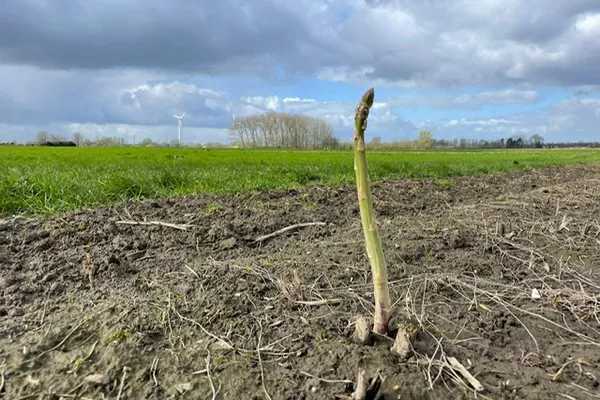
«Para recolectar los espárragos verdes no hay que cavar hoyos», continúa.

«Lo único que hay que hacer es cortarlos, tras lo cual están listos para venderse bastante rápido. Por otro lado, también es un producto atractivo para el consumidor, ya que no hace falta pelarlo y además tiene una textura más suave.

Esto permite cocinarlos de más maneras, y no estar limitado a cocerlos o hacerlos al vapor. Por ejemplo, son ideales para asar a la parrilla o para saltear en el wok, y eso te permite tener un plato saludable en la mesa en muy poco tiempo.

Creemos que esa conveniencia explica su éxito, sobre todo entre los jóvenes. Para nosotros, se trata de un cultivo que encaja perfectamente en las operaciones de la empresa».

La temporada de espárragos verdes también coincide prácticamente con la de los blancos, explica Katrien. «Solo llegan un poco más tarde.

Los espárragos blancos se pueden adelantar usando calefacción bajo plástico o cubiertas. La variante verde, sin embargo, crece por sus propios medios, pero también termina el 24 de junio, que es la fecha tradicional para ello. Esto implica una temporada más corta y también algo menos de volumen, ya que la variedad verde es más fina y los tallos gruesos son algo a evitar. La producción es menor, pero el precio compensa. Los espárragos verdes normalmente alcanzan un precio medio más alto que los blancos. Tampoco importa, porque los verdes a menudo se consumen como acompañamiento, mientras que los espárragos blancos tienden a ser un ingrediente principal y, por lo tanto, se consumen más a la hora de cenar».

«Además, se trata de un cultivo que depende menos de las condiciones meteorológicas. Cultivamos en suelo de arena/arcilla. La arena drena el agua de lluvia, pero la arcilla asegura que se retenga suficiente agua para cubrir las necesidades de los espárragos. Por lo tanto, casi nunca tienes problemas de exceso de agua, pero aun así hay suficiente humedad como para garantizar que los espárragos tengan una textura suave. Una gran diferencia en comparación con su hermano blanco».

Buenos precios, pero volúmenes limitados de espárragos blancos
Katrien cuenta que, por esta razón, el espárrago blanco se ha visto mucho más afectado por el tiempo lluvioso de primavera. «Hasta ahora hemos tenido una temporada muy tranquila para los espárragos blancos. Tuvo un arranque muy temprano que nos permitió empezar antes de Semana Santa; sin embargo, las temperaturas han sido bajas durante toda la primavera. Creo que solo hemos tenido 3 días con buen tiempo en los que aumentó un poco la producción. Luego volvimos a tener problemas durante una semana porque los precios se desplomaron. Sin embargo, la situación se enderezó bastante rápido. Lo limitado de los volúmenes, por otro lado, ha garantizado unos precios aceptables».

«Ahora mismo se están pagando entre 6 y 8 euros por el producto de buena calidad, mientras que el año pasado trabajábamos con precios de alrededor de 3 a 4 euros. Hablamos de casi el doble. Por otro lado, la calidad no está siendo tan buena. Debido al exceso de agua, un cierto porcentaje de productores ni siquiera se ha puesto manos a la obra, porque en sus terrenos había demasiada humedad y eso impidió prepararlos. Además, algunos productores con parcelas más antiguas terminaron antes porque el porcentaje de producto de segunda categoría era demasiado alto. El resultado ha sido una oferta cada vez más limitada durante las últimas semanas, por lo que los precios, sin duda, no bajarán. Si tuviéramos buen tiempo, lo cual daría un impulso al consumo, creo que podríamos acabar registrando precios incluso más elevados».

«Esperemos que así sea», continúa Katrien. «No mucha gente ha podido disfrutar aún de unos deliciosos espárragos al aire libre. Si al final mejora el tiempo, muchos probablemente encenderán las barbacoas y despegará el consumo de todo tipo de hortalizas y frutos rojos. Es algo que se nota también con los tomates o la lechuga. El consumo es bajo debido al mal tiempo y los precios, por lo tanto, permanecen bajos. Para que mejoren los precios, el consumo y la calidad del producto hace falta sol».

Cerezas y albaricoques
Es una esperanza que muchos comparten, dado que el sol y el calor son necesarios para muchos productos. «Las cerezas también se beneficiarían. Comenzamos con la cosecha el Día de la Madre, mucho antes que el año pasado, por lo que estamos trabajando con buenos precios. Los volúmenes son aún bastante limitados y los precios se mantienen bastante altos tanto para las cerezas de España como para las de Francia. Por ahora, hay que estar dispuesto a pagar un poco más por ellas. Y el tiempo tampoco está siendo lo bastante seco».

«Para este cultivo, lo mejor son unas condiciones secas por la mañana con un poco de sol. Sin embargo, el tiempo sigue siendo demasiado lluvioso, y los daños se pueden multiplicar rápidamente. En el invernadero, la situación ahora mismo es relativamente manejable. Sin embargo, para las variedades tempranas que están al aire libre hay mucha incertidumbre. Las raíces de los árboles absorben incluso la lluvia que cae junto a los árboles y esto podría provocar el agrietamiento de las cerezas. Habrá que esperar y ver lo que sucede. La naturaleza es difícil de engañar. Por otro lado, nos satisface mucho poder empezar a trabajar de nuevo con un producto tan bonito».

Katrien concluye con una nota positiva. «Todo el producto belga está volviendo al mercado y cada vez hay más. La semana pasada empezamos ya con la primera cosecha de nuestros albaricoques. Se trata de unos albaricoques con la piel rosa en lugar de naranja, y que se han convertido en todo un éxito. El año pasado tuvimos la primera cosecha, pero este año los árboles están realmente llenos por primera vez. Nos alegra mucho verlos así, y creo que momentos así te hacen consciente de que disponer de un producto delicioso es algo que no se puede dar por sentado. A veces parece que las cosas llegan a las tiendas con mucha facilidad, pero los consumidores deben darse cuenta de que, en realidad, que haya productos tan buenos disponibles es todo un milagro», concluye Katrien.

Para más información:
Amelinckx Asperges & Fruit

Koningin Astridlaan 171
2880 Hingene (Bélgica)
Tel.: +32(0)475 26 99 15
info@topasperges.com
www.topasperges.com
 

Michigan asparagus harvest concludes early due to labor costs by FreshPlaza

Michigan asparagus harvest concludes early due to labor costs

A Michigan asparagus producer has indicated a decision to terminate the current season’s harvest approximately 10 days sooner than usual, attributing the decision primarily to labor expenses.
The producer, a fourth-generation farmer named Jordon Walsworth, communicated to Brownfield the diminishing yields as the season progresses, which has led to an earlier cessation of harvesting activities in recent years.

Walsworth highlighted the increasing financial burden of labor costs as a critical factor in this decision, noting the challenge of justifying continued harvest operations under these conditions.

Walsworth’s family, with over five decades of experience in asparagus cultivation, has ceased the renewal of asparagus fields two years prior, contemplating the viability of continuing such cultivation amidst escalating costs.

The farm’s participation in the H-2A program, essential for securing seasonal labor, has seen a significant rise in expenses over the last three years, pushing the farm towards considering a transition to row crops should the labor cost issue persist unresolved.

With an expected cessation of harvesting activities in less than three weeks, the situation underscores broader challenges faced by asparagus producers in Michigan, the leading asparagus producing state in the U.S.

Source: brownfieldagnews.com


Publication date:
Posted in Sin categoría

Gauchin-Verloingt : Du producteur au consommateur à l’occasion d’un atelier gourmand à la ferme En lien avec l’association Les insatiables, acteur d’une alimentation durable et les Asperges vertes de la vallée de la Ternoise à Petit-Gauchin, parL’Abeille de la Ternoise

https://labeilledelaternoise.fr/2024/05/29/gauchin-verloingt-du-producteur-au-consommateur-a-loccasion-dun-atelier-gourmand-a-la-ferme-du-champ-a-lassiette-ils-se-sont-regales/

Elle prédit la défaite du parti travailliste et la victoire de l’Angleterre à l’Euro en jetant des asperges vertes en l’air, .. Jemima Packington est connue sous le nom de «The Asparamancer» ou d'»aspergemancienne». Elle est la seule au monde à pratiquer cet art divinatoire … par le Midi Libre

https://www.midilibre.fr/2024/06/01/elle-predit-la-defaite-du-parti-travailliste-et-la-victoire-de-langleterre-a-leuro-en-jetant-des-asperges-en-lair-11988113.php

In Belgium, Green sibling less dependent on weather whims «Green asparagus enjoys less publicity but is very popular among young people» by FreshPlaza

Green sibling less dependent on weather whims

«Green asparagus enjoys less publicity but is very popular among young people»

While the period from Easter to the end of June is often dominated by discussions about white asparagus, it is also the prime season for green asparagus. A Belgian product that may not enjoy as much publicity as its white counterpart but is nonetheless becoming increasingly popular, especially among young people. «They start a bit later than the white asparagus but finish around the same time. The easier cultivation and convenience for the consumer makes it a very beloved product,» explains Katrien De Backer, whose parents and uncle Jos Amelinckx run the fruit company Amelinckx, and who is also involved in the fruit and vegetable trade herself.

«For green asparagus, you don’t need to dig and fill holes,» she continues. «It’s simply a matter of cutting, after which it’s quickly ready for sale. On the other hand, it’s also a fun product for consumers, as they don’t need to peel it, and it’s softer in texture. This means you can prepare it in different ways, not just boiling or steaming. For example, it’s ideal for grilling or stir-frying in a wok, allowing you to put a healthy dish on the table in no time. This is why it particularly appeals to young people. A quick bite in the asparagus family. For us, it’s a crop that fits perfectly into our operations.»

Green asparagus also has roughly the same season as white asparagus, Katrien explains. «They just start a bit later. You can advance the white asparagus with heating under plastic or cloches. However, the green variety grows mainly on its own strength, but they also finish at the traditional end of June 24th (ed. St. John’s Day). This means a shorter period, and you also get slightly fewer kilos because the green is a finer variety where you don’t want thick stems. It means less yield, but that compensates with price. The green ones typically go for a higher price than the white asparagus. It doesn’t matter, because the green ones are often used as an addition to a dish, whereas white asparagus often stars and thus more is consumed per dinner.»

«Moreover, it’s a crop that is less dependent on weather conditions. We grow on sand/loam soil, which means the rain is essentially drained away by the sand. On the other hand, loam ensures that just enough water is retained to supply the asparagus. Therefore, you almost never have problems with waterlogging, but you still keep enough moisture to maintain the soft texture in the asparagus. A significant difference compared to its white sibling.»

Good prices, but limited volumes of white asparagus
Because, as Katrien states, that product suffers a lot more from the drizzly spring weather. «It has really been sluggish this season for white asparagus. It was naturally a very early season, allowing us to start before Easter. However, the temperatures were low throughout the spring. I think we’ve only had 3 days of good weather, which slightly increased production. Then we immediately suffered for a week because prices plummeted. However, this recovered almost immediately. The limited volumes, on the other hand, have led to acceptable prices.»

«Looking at it now, we are at 6 to 8 euros for good quality, where last year we were dealing with prices around 3 to 4 euros. That’s almost double the price. On the other hand, there’s also quite a bit of lower quality. The excess water also led to a certain percentage of growers not starting because they were on too wet a plot, preventing them from making the ridges. Moreover, there were growers with older plots who stopped earlier because the percentage of class II was too high. The result is that the supply seems to be getting more limited in the last weeks of the season, and prices will certainly not decrease. Should we get nice weather, causing consumption to spike, I even think we’re heading into an even more expensive period.»

«Let’s hope so,» Katrien continues. «There are still few people who have been able to enjoy delicious asparagus on the terrace. If it finally happens, the barbecues will be fired up and the consumption of all vegetables and soft fruits will probably finally get going. You see it in tomatoes and lettuce as well. Consumption is low due to the bad weather, and prices remain low as a result. For prices, consumption, and product quality, it’s slowly but surely time for the sun to show itself.»

Cherries and apricots
This is a hope many will share with Katrien. She also sees in other products that it’s time for warmth and sunshine. «The cherries could use some too. We’ve started picking since Mother’s Day. A bit earlier than last year, so we’re working with good prices. The volumes are still quite limited and the cherries from Spain and France are also quite firm in price. So, it’s really for the enthusiast willing to pay a bit more. But we see that everything is still too damp.»

«The best scenario is for the crop to be dry every morning with sunshine. But the climate remains too moist, causing a minor damage to quickly escalate. In the greenhouse, as we grow them, it’s still relatively okay. Yet, we’re already seeing it and in the early varieties that are outside, it’s all wait and see. Even the rain that falls next to the trees is absorbed by the roots, causing the cherries to potentially burst. We’ll have to see how it turns out. Nature is hard to deceive or even seduce. On the other hand, it’s very nice that we can start again with a beautiful product. Let’s certainly not forget the beauty.»

Katrien wants to end on a positive note. «All Belgian products are coming back to market and more and more are being added. We also started with the first pick of our apricot cultivation last week. They are apricots with a pink skin instead of the traditional orange, and it has been very successful. Last year we had the first harvest, but this year the trees are actually perfectly full for the first time. It’s just beautiful to see and I think a time like this just shows that it’s not a given that delicious products are available on the shelves. It all seems easy to come by, but consumers should realize that it’s genuinely a miracle when beautiful products are available,» concludes Katrien.

For more information:
Amelinckx Asparagus & Fruit
Koningin Astridlaan 171
2880 Hingene, Belgium
+32(0)475 26 99 15
info@topasperges.com
www.topasperges.com


While the period from Easter to the end of June is often dominated by discussions about white asparagus, it is also the prime season for green asparagus. A Belgian product that may not enjoy as much publicity as its white counterpart but is nonetheless becoming increasingly popular, especially among young people. «They start a bit later than the white asparagus but finish around the same time. The easier cultivation and convenience for the consumer makes it a very beloved product,» explains Katrien De Backer, whose parents and uncle Jos Amelinckx run the fruit company Amelinckx, and who is also involved in the fruit and vegetable trade herself.

«For green asparagus, you don’t need to dig and fill holes,» she continues. «It’s simply a matter of cutting, after which it’s quickly ready for sale. On the other hand, it’s also a fun product for consumers, as they don’t need to peel it, and it’s softer in texture. This means you can prepare it in different ways, not just boiling or steaming. For example, it’s ideal for grilling or stir-frying in a wok, allowing you to put a healthy dish on the table in no time. This is why it particularly appeals to young people. A quick bite in the asparagus family. For us, it’s a crop that fits perfectly into our operations.»

Green asparagus also has roughly the same season as white asparagus, Katrien explains. «They just start a bit later. You can advance the white asparagus with heating under plastic or cloches. However, the green variety grows mainly on its own strength, but they also finish at the traditional end of June 24th (ed. St. John’s Day). This means a shorter period, and you also get slightly fewer kilos because the green is a finer variety where you don’t want thick stems. It means less yield, but that compensates with price. The green ones typically go for a higher price than the white asparagus. It doesn’t matter, because the green ones are often used as an addition to a dish, whereas white asparagus often stars and thus more is consumed per dinner.»

«Moreover, it’s a crop that is less dependent on weather conditions. We grow on sand/loam soil, which means the rain is essentially drained away by the sand. On the other hand, loam ensures that just enough water is retained to supply the asparagus. Therefore, you almost never have problems with waterlogging, but you still keep enough moisture to maintain the soft texture in the asparagus. A significant difference compared to its white sibling.»

Good prices, but limited volumes of white asparagus
Because, as Katrien states, that product suffers a lot more from the drizzly spring weather. «It has really been sluggish this season for white asparagus. It was naturally a very early season, allowing us to start before Easter. However, the temperatures were low throughout the spring. I think we’ve only had 3 days of good weather, which slightly increased production. Then we immediately suffered for a week because prices plummeted. However, this recovered almost immediately. The limited volumes, on the other hand, have led to acceptable prices.»

«Looking at it now, we are at 6 to 8 euros for good quality, where last year we were dealing with prices around 3 to 4 euros. That’s almost double the price. On the other hand, there’s also quite a bit of lower quality. The excess water also led to a certain percentage of growers not starting because they were on too wet a plot, preventing them from making the ridges. Moreover, there were growers with older plots who stopped earlier because the percentage of class II was too high. The result is that the supply seems to be getting more limited in the last weeks of the season, and prices will certainly not decrease. Should we get nice weather, causing consumption to spike, I even think we’re heading into an even more expensive period.»

«Let’s hope so,» Katrien continues. «There are still few people who have been able to enjoy delicious asparagus on the terrace. If it finally happens, the barbecues will be fired up and the consumption of all vegetables and soft fruits will probably finally get going. You see it in tomatoes and lettuce as well. Consumption is low due to the bad weather, and prices remain low as a result. For prices, consumption, and product quality, it’s slowly but surely time for the sun to show itself.»
Cherries and apricots
This is a hope many will share with Katrien. She also sees in other products that it’s time for warmth and sunshine. «The cherries could use some too. We’ve started picking since Mother’s Day. A bit earlier than last year, so we’re working with good prices. The volumes are still quite limited and the cherries from Spain and France are also quite firm in price. So, it’s really for the enthusiast willing to pay a bit more. But we see that everything is still too damp.»

«The best scenario is for the crop to be dry every morning with sunshine. But the climate remains too moist, causing a minor damage to quickly escalate. In the greenhouse, as we grow them, it’s still relatively okay. Yet, we’re already seeing it and in the early varieties that are outside, it’s all wait and see. Even the rain that falls next to the trees is absorbed by the roots, causing the cherries to potentially burst. We’ll have to see how it turns out. Nature is hard to deceive or even seduce. On the other hand, it’s very nice that we can start again with a beautiful product. Let’s certainly not forget the beauty.»

Katrien wants to end on a positive note. «All Belgian products are coming back to market and more and more are being added. We also started with the first pick of our apricot cultivation last week. They are apricots with a pink skin instead of the traditional orange, and it has been very successful. Last year we had the first harvest, but this year the trees are actually perfectly full for the first time. It’s just beautiful to see and I think a time like this just shows that it’s not a given that delicious products are available on the shelves. It all seems easy to come by, but consumers should realize that it’s genuinely a miracle when beautiful products are available,» concludes Katrien.

For more information:
Amelinckx Asparagus & Fruit
Koningin Astridlaan 171
2880 Hingene, Belgium
+32(0)475 26 99 15
info@topasperges.com
www.topasperges.com


Posted in Sin categoría

selon Amelinckx Asparagus & Fruit (Belgique) : « L’asperge verte est moins médiatisée mais très populaire chez les jeunes » par FreshPlaza

Amelinckx Asparagus & Fruit (Belgique) :

« L’asperge verte est moins médiatisée mais très populaire chez les jeunes »

Si l’asperge blanche fait surtout parler d’elle entre Pâques et la fin du mois de juin, c’est aussi l’époque de l’asperge verte.
Un produit belge qui jouit peut-être d’un peu moins de publicité que sa cousine blanche, mais qui devient néanmoins de plus en plus populaire, en particulier auprès des jeunes. « La saison des asperges vertes démarre un peu plus tard que celle des blanches, mais se terminent en même temps.

La facilité de culture et d’utilisation pour le consommateur en fait un produit très populaire », explique Katrien De Backer, dont les parents dirigent avec son oncle Jos Amelinckx l’entreprise fruitière Amelinckx. De Backer est elle-même employée dans le commerce des fruits et légumes.

« Pour les asperges vertes, il n’est pas nécessaire de creuser puis reremplir pour récolter », poursuit-elle. « Il suffit de les couper et elles peuvent ensuite rapidement être vendues.

D’autre part, c’est aussi un produit agréable pour le consommateur, car il n’y a pas besoin de l’éplucher et sa texture est plus fondante. Cela permet également de les préparer autrement qu’en les faisant bouillir ou cuire à la vapeur. Par exemple, elles sont idéales pour des grillades ou un wok, ce qui permet d’avoir un plat sain sur la table en un rien de temps. C’est d’après nous pour cela que ce produit est particulièrement apprécié par les jeunes. Une variante commode au sein de la famille des asperges. Cette culture s’intègre parfaitement dans notre activité de production. »

De Backer explique que les asperges vertes suivent à peu près la même saison que les asperges blanches. « Leur saison commence juste un peu plus tard. On peut en effet avancer la récolte des asperges blanches, en chauffant les cultures sous plastique ou mini-tunnels.

La variété verte, quant à elle, pousse à son rythme et se termine également à la date traditionnelle de la St Jean. Cela signifie donc une période plus courte et un nombre de kilos inférieur, car la variété verte est une variété plus fine, qui ne doit de préférence pas produire de tiges épaisses. Le rendement est donc moindre, mais cela se compense par le prix.

En fait, les asperges vertes se vendent en moyenne plus cher que les blanches. Par ailleurs, les vertes constituent la plupart du temps un ajout à un plat, alors que les blanches en sont habituellement la vedette, avec une consommation de tiges plus élévée par personnes. »

« En outre, c’est une culture qui dépend moins des conditions météorologiques. Nous cultivons sur un sol sablo-limoneux, de sorte que la pluie est en fait évacuée par le sable comme une sorte de drainage. D’autre part, la part d’argile permet de conserver juste assez d’eau pour les asperges. Par conséquent, on ne souffre pratiquement jamais d’engorgement, tout en conservant suffisamment d’humidité pour que les tiges gardent leur texture fondante. C’est toute une différence par rapport à la blanche ».

De bons prix, mais des volumes limités d’asperges blanches
Selon De Backer, la blanche connaît beaucoup plus de difficultés avec le temps pluvieux de ce printemps. « Jusqu’à présent, la saison des asperges blanches a été très lente. Bien sûr, la saison a été très précoce, ce qui nous a permis de démarrer pour Pâques. Toutefois, les températures sont restées basses tout au long du printemps. Je pense que nous n’avons eu que trois jours de beau temps et que la production a augmenté. Cela nous a affectés pendant une semaine, car les prix ont immédiatement chuté. Ils se sont ensuite rétablis presque immédiatement. Les volumes limités ont en outre permis d’obtenir des prix acceptables. »

« En effet, les prix actuels se situent entre 6 et 8 € pour une bonne qualité, alors que l’année dernière nous travaillions à environ 3 ou 4 €. C’est presque le double du prix. D’un autre côté, nous avons aussi une qualité inférieure mais raisonnablement bonne. L’excès d’eau a également eu pour conséquence qu’un certain pourcentage de producteurs n’ont pas pas pu démarrer parce qu’ils se trouvaient sur une parcelle trop humide, de sorte qu’ils n’ont pas pu préparer leurs billons. En outre, certains possédant des parcelles plus anciennes se sont arrêtés plus tôt parce que le pourcentage de classe II était trop élevé. Il en résulte qu’au cours des dernières semaines de la saison, l’offre ne fait que se restreindre et les prix ne baisseront certainement pas. Si le beau temps persiste, entraînant un pic de consommation, je pense que nous connaîtrons même une période encore plus chère. »


« Espérons-le », poursuit De Backer. « En fait, peu de gens ont encore pu déguster de délicieuses asperges en terrasse ! Lorsque le temps s’y mettra enfin, les barbecues se multiplieront et la consommation de légumes et de fruits rouges pourra enfin décoller. On le constate avec les tomates et salades : la consommation est faible en raison du mauvais temps et les prix restent bas. Pour les prix, la consommation et la qualité des produits, il est plus que temps que le soleil se mette à briller. »

Cerises et abricots
C’est un souhait que beaucoup de producteurs partagent avec elle. D’autres produits ont vraiment besoin d’avoir de la chaleur et du soleil. « Même les cerises ! Nous avons commencé à cueillir depuis la fête des mères, ce qui est beaucoup plus tôt que l’année dernière, ce qui signifie que nous travaillons avec de bons prix. En effet, les volumes sont encore assez limités et les prix des cerises en provenance d’Espagne et de France sont élevés. Pour l’instant, il s’agit donc d’un produit destiné aux amateurs qui sont prêts à payer un peu plus. Seulement, et nous le constatons ici aussi, tout est encore trop humide. »

« Le mieux, c’est quand les cultures sont sèches et qu’il y a du soleil tous les matins. Lorsque le climat reste trop humide, un petit dégât peut vite prendre de l’ampleur. Sous serre, ce n’est pas encore trop grave. Pourtant, nous le ressentons déjà et pour les variétés précoces qui sont à l’extérieur, il faut encore attendre et voir. La pluie qui tombe au pied des arbres est absorbée par les racines, ce qui pourrait faire éclater les cerises. Il nous faut être patient. La nature ne peut guère vous tromper et encore moins vous séduire. Il est pourtant toujours très agréable de recommencer une saison avec un beau produit. »

De Backer souhaite donc terminer sur une note positive. « Tous les produits belges reviennent sur le marché en force. La semaine dernière, par exemple, nous avons commencé la première cueillette de notre récolte d’abricots. Il s’agit de fruits à la peau rose au lieu d’orange. La culture s’est très bien passée. L’année dernière, nous avons eu la première récolte et cette année, les arbres sont parfaitement pleins. Cela fait plaisir à voir et je pense qu’une telle période montre précisément que cela ne va pas de soi d’avoir sur les étals des produits délicieux. Les consommateurs doivent se rendre compte que c’est vraiment une aubaine de trouver de si beaux produits », conclut-elle.

Pour plus d’informations :
Amelinckx Asparagus & Fruit
Tél. : +32 475 26 99 15
info@topasperges.com
www.topasperges.com