Archive

New blueberry varieties will play an increasingly important role in Oregon by Oregon Berries and FreshPlaza

New blueberry varieties will play an increasingly important role in Oregon

Within the past five years, the development of new blueberry varietals has shown exponential growth. “These new varieties really have the consumer in mind,” says Jeff Malensky with Oregon Berry Packing. “They are firm, have an excellent flavor profile, and have a larger size.”

New varieties
Growers in Oregon heavily rely on northern highbush varieties that require a higher number of chill hours. However, development of these varieties takes longer compared to low chill varieties that don’t require the chill hours. It takes more time to develop northern highbush varieties and once brought to market, they take years to reach full production. “However, we feel lucky that Oregon headquartered Fall Creek is very advanced in the development of northern highbush varieties.” In addition, the collaboration between Oregon Berry Packing and Twin River Berries provides more opportunities to develop varieties together. “It has definitely given us access to a wider range of new varieties, including LoretoBlue™, Sekoya Crunch, ArabellaBlue®, PeachyBlue™, and Everlast,” shared Malensky.

ArabellaBlue variety.

Overseas program
In Oregon, Duke, Draper and Calypso are still the main varieties, but this is expected to gradually change in the coming years as the new varieties have a firmness component that is favored by consumers domestically as well as internationally. The overseas market remains an important part of the company’s blueberry program. “For Asia, quality is very important and we want to be able to continue our export programs to this part of the world.” For that, firm, high-flavor fruit is required and that’s what Oregon is able to grow thanks to its dry summer climate, low humidity, as well as warm days and cool nights.

Heat stretches
Oregon’s blueberry harvest is basically finished for the season. It started early, about 10 to 14 days ahead of the normal start date but also ended about two weeks early. “The bulk of the crop was harvested by the end of July,” said Malensky. Overall, the season turned out very positive, but after a challenging start. At the beginning of harvest, in the month of June, Oregon was faced with two heat stretches. The first one happened during the initial harvest, and the second one came about ten days later. These periods of hot weather really impacted the sizing of Duke, the prominent variety. “The pounds of that early fruit just didn’t come in.”

Thankfully, the end of June was much cooler than usual and the weather continued to be beneficial going into July. After the initial heat wave, temperatures pretty much stayed below 85°F for the remainder of the season. “Those lower temperatures turned things around and had a very positive impact on the quality of the crop, resulting in some of the best quality blueberries ever.” Total production volume for the state is expected to be around 155 million pounds, which is similar to last year’s near-record volume. “If it wasn’t for the heat stretch, we could have had a record volume this season,” Malensky shared.

Demand for processed blueberries
While the majority of harvest finished by the end of July, small volumes of some later varieties are still in the field. In addition, some growers have put high-quality fruit in storage to extend the season. As a result, fresh Oregon blueberries will still be available in stores for a few more weeks. In addition to the fresh segment, the processed blueberry industry is also doing well. Demand for Individually Quickly Frozen blueberries, as well as juices, powders, and extracts is showing steady growth and Oregon Berry Packing is growing that part of the business, too.

For more information:
Jeff Malensky
Oregon Berry Packing
Ph: +1 (503) 640-4410
jeff@oregonberry.com
www.oregonberry.com

Berry shelves in India evolve with year-round production and premium branding by Connectagro and FreshPlaza

Berry shelves in India evolve with year-round production and premium branding

India’s berry market is undergoing rapid transformation. Local growers are expanding protected cultivation, introducing advanced genetics, and extending production windows. On the consumer side, premium retail, quick commerce, and strong branding are helping berries shed their earlier image of costly exotics and establishing them as accessible, aspirational products.

Konnect Agro entered India’s berry industry in 2021, when blueberries were largely imported, raspberries were unavailable in the domestic market, and strawberries were mostly seasonal. “At that time, berries, specifically blueberries, were considered a niche product. Since then, the market has evolved significantly with rising urban middle-class consumption, health-conscious buyers, premium retail chains and the advent of quick commerce leading to an uptick in demand,” says Saurabh Vinayak, Konnect Agro Pvt. Ltd.

Protected cultivation expands
Protected cultivation has become central to the expansion of India’s commercial berry production. While open-field cultivation exists at higher altitudes for mid- and high-chill varieties, Saurabh says most commercial low-chill berry production is now taking place in polyhouses, tunnels and net houses.

“Berries are highly sensitive to temperature, humidity, and rainfall, which is why protected cultivation matters particularly in India, given its climatic diversity and extreme weather fluctuations,” he says.
The company grows blueberries, raspberries and strawberries, with Blueberries being the core portfolio that includes varieties such as Sekoya Pop from Fall Creek and Demba & Dana from Fruit Vision.

Longer windows, fresher supply
The different genetics allow Konnect Agro to target a longer production cycle. “Sekoya Pop offers us a market-leading variety known for its high quality and yield while Fruit Vision offers early, high-yielding genetics, which gives us an extended harvest window,” Saurabh explains.

Raspberries offer another interesting development, with Konnect Agro harvesting the crop year-round. The ability to extend the domestic production calendar could become increasingly relevant as Indian consumers gain better access to berries throughout the year.

“Compared with imported fruit, locally grown berries benefit from a shorter supply chain, allowing them to reach consumers quickly and efficiently. India also offers relatively low production costs; however, the industry remains in its early stages. Growers are still working to identify optimal locations and genetics suited to diverse climatic zones,” Saurabh notes.

He adds that not all regions are conducive to berry cultivation. India’s varied climate makes commercial production challenging without rigorous R&D and trial plots. “Also, the currently identified regions for growing berries pose a challenge in terms of land acquisition and consolidation.”

Access to proprietary genetics and skilled manpower resources remains a significant challenge, alongside limited expertise in implementing advanced agronomy practices. High capital requirements for protected cultivation and substrate farming further constrain growth. While India’s cold-chain infrastructure via road transport has improved considerably, Saurabh shares that last-mile logistics still requires greater attention to ensure efficient handling of highly perishable fruit.

Building a berry brand
As production grows, branding is also becoming a more important part of the market. Konnect Agro markets its berries under the CIROLA brand, focusing on freshness, uniformity and consistency. The company says its production strategy supports an extended harvest window from December to July for blueberries, while raspberries and strawberries are harvested year-round, giving the brand a consistent presence on retail shelves.

Saurabh believes the next phase of growth will be supported by the expansion of quick commerce and modern retail beyond India’s largest cities, as well as rising health awareness and demand for berries as premium, health-focused foods. “Further, as output increases in the coming years through multiple growers, prices will get rationalised, thereby making the berries more accessible to a larger consumer segment.”

“For local production to scale, India needs better access to advanced genetics through breeder partnerships, specialized nurseries and stronger domestic R&D to identify the most suitable varieties for different growing regions. Equally important are investments in workforce development, post-harvest systems and cold-chain infrastructure to preserve fruit quality from farm to consumer. At the same time, building trusted brands and increasing consumer awareness will be essential to drive demand and establish Indian-grown berries,” he concludes.

For more information:
Saurabh Vinayak
Konnect Agro Pvt. Ltd.
Tel: +91 99 90 499 903
Tel: +91 97 18 239 335
Email: info@konnectagro.com
www.konnectagro.com

Fresh Peruvian blueberries gain access to Egypt by Revista Economia y FreshPlaza

Fresh Peruvian blueberries gain access to Egypt

Peru has secured access to Egypt’s market for fresh blueberry exports, following more than a year of coordinated technical negotiations between the National Agricultural Health Service (SENASA) and Egypt’s Central Plant Quarantine Authority. With this new market access, Peruvian blueberries are now available in 76 international markets and are accessible to more than 120 million potential consumers in Egypt.

Marco Vinelli, Minister for Agricultural Development and Irrigation, highlights that this market access results from technical efforts to open new markets for Peruvian agricultural exports. Vilma Gutarra, head of SENASA, adds that Egypt’s approval is part of the growing list of destinations that recognize Peruvian products’ compliance with phytosanitary standards.

The sector has expanded significantly: in 2016, Peru had about 2,000 hectares of blueberries, which increased to over 20,000 hectares certified for export by 2025. In that year, fresh blueberry exports surpassed 370,000 tons, reaching 50 markets and establishing blueberries as Peru’s top agricultural export.

The United States is the main destination, followed by the Netherlands, China, the United Kingdom, and Hong Kong. These five markets account for more than 90% of national exports. At the regional level, La Libertad accounts for 53% of shipments, followed by Lambayeque at 22% and Ica at 10%. Lima, Áncash, and Piura account for the remaining 15%.

Frontpage photo: © Julie Feinstein | Dreamstime

Source: revistaeconomia.com

« Grâce à cette configuration, on peut expédier deux fois plus de barquettes par chargement » par AVI (Inde) et FreshPlaza

AVI Global Plast (Inde)

« Grâce à cette configuration, on peut expédier deux fois plus de barquettes par chargement »

La mise en service d’une nouvelle ligne de décontamination a permis à AVI Global Plast d’élever ses normes en matière d’emballage, explique Sukhdeep Sethi, directeur général du fabricant indien d’emballages : « Nous avons installé la ligne de décontamination deCON de Starlinger Viscotec, la première installation de cette technologie en Inde destinée à la production de film rPET de qualité alimentaire. La technologie deCON élimine les contaminants du PET post-consommation au niveau moléculaire avant sa réextrusion, ce qui permet au produit final de respecter la norme de l’EFSA relative au contact alimentaire, et non pas simplement de revendiquer une teneur en matière recyclée. Cela nous permet d’utiliser du rPET à 100 % dans les emballages de fruits et légumes, sans avoir à y mélanger de matière vierge pour passer les tests de migration. Starlinger a depuis mis en avant AVI dans ses propres communications mondiales comme un exemple de mise en œuvre très performante de cette technologie. »

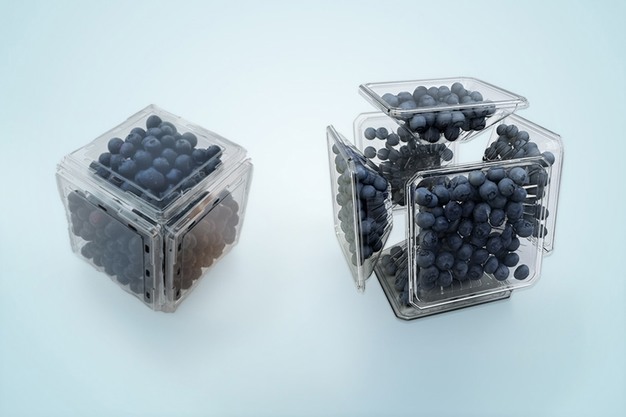
Sethi explique en outre que cette configuration leur permet de doubler le nombre de barquettes expédiées par chargement. « Q-Bic est une barquette pour petits fruits développée par AVI en collaboration avec la société norvégienne Smart Packaging Industries AS et désormais fabriquée en Inde sous licence. Chaque barquette a une forme pyramidale avec des parois latérales à 45 degrés, de sorte que six barquettes s’assemblent pour former un seul cube. Cette géométrie permet d’expédier deux fois plus de barquettes par chargement et offre une visibilité des fruits supérieure de 100 % par rapport à une barquette classique. 36 barquettes classiques occupent 34,8 litres, tandis que 36 barquettes Q-Bic n’occupent que 17,1 L. Moins d’espace perdu par expédition signifie moins de trajets de camions frigorifiques et de conteneurs par volume exporté. »

AVI a également mis au point une barquette monobloc pour avocats dotée d’un design breveté. « Cette barquette a été spécialement conçue pour les besoins d’emballage des avocats, plutôt que d’adapter une barquette générique. Elle reflète la même tendance sous un angle différent : un emballage spécifique au fruit, conçu pour un produit unique, et non un format universel, et elle offre aux exportateurs l’accès à un design exclusif que les concurrents ne peuvent pas simplement reproduire. »

C’est sur les marchés d’exportation que la pression s’intensifie le plus rapidement, souligne Sethi. « Les réglementations européennes telles que l’ESPR et la taxe sur le plastique imposent des exigences en matière de contenu recyclé conformes aux normes de l’EFSA, que la plupart des fabricants d’emballages indiens ne sont pas en mesure de certifier, et les importateurs rejettent ou retardent de plus en plus les expéditions qui ne peuvent pas fournir ces documents à l’arrivée. L’Inde ajoute sa propre exigence : les règles de responsabilité élargie du producteur (REP) prévoient une augmentation de la teneur en matériaux recyclés, passant de 30 % en 2025-2026 à 40 % en 2026-2027, 50 % en 2027-2028 et 60 % d’ici 2028-2029, le tout suivi via le portail centralisé de la responsabilité élargie des producteurs (REP) du CPCB. Tout manquement à cet objectif oblige le propriétaire de la marque à acheter des certificats de quantité équivalente pour couvrir le déficit. Nous anticipons ces deux évolutions en proposant des grades à teneur en matériaux recyclés qui répondent d’ores et déjà aux exigences futures, tout en garantissant la conformité aux normes de l’EFSA grâce à la gamme Starlinger deCON. Ainsi, les exportateurs de fruits et légumes ne sont pas contraints de faire valider un nouveau fournisseur à chaque fois que la réglementation se renforce sur l’un ou l’autre de ces marchés. »

« L’innovation couvre aussi bien la technologie des matériaux grâce à Starlinger deCON, la précision de fabrication qui réduit progressivement la quantité de matériau par emballage sans compromettre la résistance barrière nécessaire aux produits frais, que la conception des formats grâce à des initiatives telles que Q-Bic et la barquette brevetée pour avocats. La qualité constante se traduit par des performances répétées dans des conditions réelles d’exportation, comme en témoigne le prix d’excellence décerné à AVI par Sahyadri Farms, le plus grand exportateur de raisins d’Inde, pour la performance de ses emballages d’exportation. Notre rigueur en matière de certification signifie que tous nos certificats sont maintenus en permanence plutôt que renouvelés de manière réactive, ce qui est primordial pour les expéditions de fruits et légumes transfrontalières. »

Pour plus d’informations :
Sukhdeep Sethi
AVI Global Plast
sethi@avigloplast.com
https://avigloplast.com

La production française de fraises perturbée par les fortes chaleurs par Agreste et FreshPlaza

La production française de fraises perturbée par les fortes chaleurs

Selon les prévisions d’Agreste arrêtées au 1er juillet 2026, la production française de fraises, hors DROM, est estimée à 74 100 tonnes pour la campagne 2026, un niveau proche de celui de l’an dernier. Les conditions climatiques ont toutefois réduit le potentiel de production, tandis que le Sud-Ouest, principal bassin français, a été perturbé par l’alternance de fraîcheurs et de fortes chaleurs à partir de mai. Côté marché, les prix de juin se sont établis au même niveau qu’en juin 2025, tout en restant supérieurs de 15 % à la moyenne 2021-2025.

Une récolte en léger recul dans le Sud-Ouest
Les surfaces nationales implantées en fraise sont estimées à 3 668 hectares pour la campagne 2026. Elles restent comparables à celles de la campagne précédente, mais reculent de 2 % par rapport à la moyenne 2021-2025.

La production nationale est, quant à elle, attendue à 74 100 tonnes. Les bassins Centre-Ouest et Sud-Est affichent des hausses respectives de 6 % et 2 % sur un an. À l’échelle nationale, la récolte resterait néanmoins proche de celle de 2025, dans un contexte climatique moins favorable dans le Sud-Ouest, principal bassin français de production.

À partir de mai, l’alternance de périodes fraîches et de fortes chaleurs y a perturbé la production. La situation s’est accentuée au cours de la deuxième quinzaine de juin : « Les fortes chaleurs en deuxième quinzaine de juin ont fragilisé les fruits. Le tri a été accru pour maintenir une qualité du produit commercialisé », indique Agreste dans sa note de conjoncture.

Au 1er juillet, 89 % de la production nationale était estimée réalisée.

Des prix toujours supérieurs à la moyenne quinquennale
Sur le plan commercial, la première quinzaine de mai a été marquée par une offre limitée face à une demande soutenue. Cette configuration a favorisé la tenue des cours. En mai, les prix ont ainsi dépassé de 6 % leur niveau de 2025 et de 14 % la moyenne 2021-2025.

La situation a évolué en juin. Malgré une production en baisse, la demande a nettement ralenti, les consommateurs se tournant davantage vers les autres fruits de saison, notamment la cerise, l’abricot ainsi que les premières pêches et nectarines. « L’activité commerciale reste néanmoins présente et les prix sont supérieurs à la moyenne quinquennale », indique Agreste dans sa note de conjoncture.

En juin 2026, les prix des fraises se sont ainsi situés au même niveau qu’en juin 2025, mais 15 % au-dessus de la moyenne 2021-2025.

Importations et exportations en baisse
Les échanges extérieurs se sont contractés sur les cinq premiers mois de l’année. Entre janvier et mai 2026, les exportations françaises de fraises ont atteint 6 300 tonnes, un volume comprenant une part significative de réexportations. Elles ont reculé de 19 % par rapport à la même période de la campagne précédente.

Les importations ont, de leur côté, diminué de 4 % sur un an pour atteindre 41 100 tonnes. Le déficit des échanges extérieurs en volume s’est établi à 34 800 tonnes sur la période, en baisse de 1 % par rapport à l’année précédente.

Source : agreste.agriculture.gouv.fr

Photo de la première page: © 0meerk | Dreamstime Date de publication: mer. 12 août 2026