
AsperCut : l’innovation de rupture qui redonnera de l’autonomie au producteur d’asperge?
Une approche low-tech pour plus de fiabilité
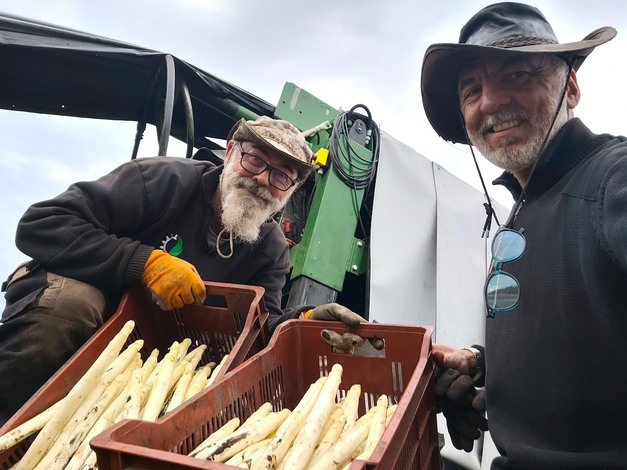
« Nous ne sommes pas issus du milieu agricole mais de l’industrie et nous sommes convaincus que les solutions de robotique déjà existantes dans le secteur industriel peuvent servir le secteur agricole. Nous avons donc lancé le projet en 2020 et en sommes aujourd’hui à la troisième version du prototype AsperCut. Nous commençons désormais à aboutir sur quelque chose de très opérationnel et productif », précise Wilfried Guarrigue.
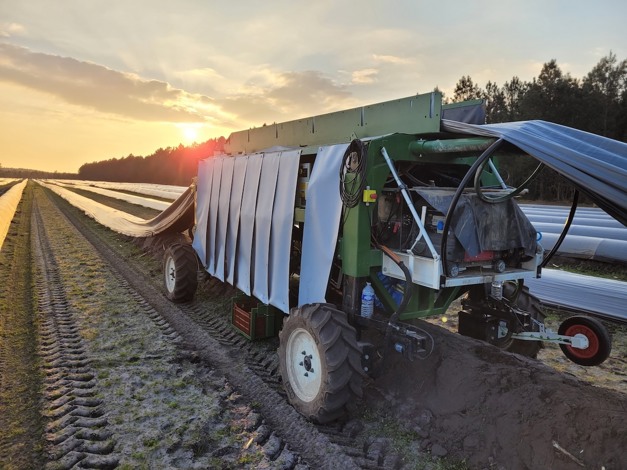
Si AsperCut n’est pas le premier robot sur le marché à avoir été conçu dans l’objectif de récolter les asperges mécaniquement, il incarne une véritable rupture technologique avec les différents modèles déjà existants. « Plutôt que de tout inventer, nous avons souhaité utiliser au maximum les technologies largement déployées dans le secteur industriel et agricole et qui ont déjà fait leurs preuves. La machine est donc constituée de trois parties : l’enjambeur porte-outil, que nous avons nous-même mis au point, le robot qui récolte et la partie IA qui permet de détecter les asperges. Cette approche « low-tech » et pragmatique a l’avantage de proposer une machine à des coûts beaucoup plus abordables pour les producteurs. Elle permet également de s’appuyer sur une technologie fiable et beaucoup plus simple ».
Une ambition de ne pas récolter vite, mais bien
C’est sur cette simplicité d’utilisation et cette robustesse que les deux fondateurs ont souhaité miser pour convaincre les producteurs. « Il y a un certain scepticisme de la part des agriculteurs envers la robotique qui peut leur paraître parfois trop sophistiquée, peu fiable, difficile à manipuler et à entretenir.
Plutôt que de « robot », nous préférons parler de « machine de récolte ». Contrairement aux machines qui sont déjà sorties sur le marché, nous avons souhaité proposer un outil plus petit qui soit donc moins cher et privilégiant la qualité à la vitesse. Notre machine fait 4m de long, 2,5m de large, 2,5m de haut et pèse 3,5T. On assume pleinement cette volonté de préférer s’arrêter pour récolter l’asperge, car le cas contraire nécessite une robotique beaucoup plus complexe et donc forcément moins fiable. C’est aussi une façon de garantir une récolte de qualité. En s’arrêtant, l’outil est capable de récolter les asperges en un seul coup, ce qui n’est généralement pas possible à la main. Il permet également de récolter l’asperge sans la pincer ni toucher le turion, ce qui permet là encore de garantir la qualité du produit récolté. Par ailleurs, nous avons développé et breveté un outil qui est capable de récolter toutes les asperges, même celles qui sont un peu tordues. Ce qui engendre beaucoup moins d’écart de production à la récolte ».
La machine est adaptée à des surfaces de production plus modérées allant de 2 à 4ha. Nous préférons par ailleurs vendre plusieurs petites machines plutôt qu’une seule, ce qui a l’avantage de s’adapter à toutes les surfaces de production et au producteur de ne pas se retrouver coincé si l’une des machines tombe en panne ».
Un outil autonome basé sur une détection précise grâce à l’IA
L’AsperCut, autonome sur la butte d’asperges à récolter, repère les asperges grâce à un système de détection en 3D basé sur l’intelligence artificielle et qui permet un positionnement de précision de l’outil : « Nous sommes à un croisement où les techniques ont beaucoup évolué. Avant, les caméras et ordinateurs étaient inaccessibles, les tarifs aujourd’hui ont beaucoup diminué ce qui nous a permis d’intégrer cette technologie à notre machine. Pour ce qui est de son autonomie, le tout électrique aurait représenté une trop grosse rupture. Or, nous ne voulons pas être trop disruptifs et apporter en priorité une solution pour la récolte. La machine avance toute seule, elle détecte les asperges, s’arrête pour les récolter et les met en caisse. Lorsqu’elle a fini un rang, elle s’arrête pour qu’un opérateur prenne les caisses et la positionne sur un nouveau rang d’asperge pour relancer le cycle de récolte, ce qui permet de ne pas laisser les asperges trop longtemps dans les caisses une fois récoltées. Il s’agit d’une machine hybride basée sur une alimentation électrique à laquelle nous avons ajouté un groupe électrogène qui permet de garantir son autonomie à 100 % ».
Un outil qui s’adapte à la récolte d’asperges blanches et de vertes
Si Sylektis s’est d’abord attelé à développer une machine de récolte d’asperges blanches, l’entreprise a souhaité aller plus loin encore avec la création d’un robot de récolte d’asperge verte : « L’idée est d’avoir une plateforme de récolte robotique sur laquelle on peut positionner jusqu’à deux robots de récolte. Un robot d’asperges blanches à l’avant de la machine et un de vertes à l’arrière, ou même deux de blanches ou deux de vertes pour ceux qui souhaitent augmenter la capacité de récolte. Concernant la mise au point du robot de récolte d’asperges vertes, nous nous travaillons avec notre partenaire japonais Fanuc, leader mondial des robots industriels ».
Apporter une solution compétitive à la pénurie de main d’œuvre
« Aujourd’hui, la vraie problématique que rencontre le monde agricole est celle de la main d’œuvre. La récolte est le seul acte dans les champs qui se fait encore manuellement, contrairement au désherbage et au travail du sol par exemple. Mais le problème, c’est que nous n’avons plus de bras. Ce sont des métiers difficiles et ingrats, dont les gens se détournent de plus en plus. La récolte étant aussi l’étape qui apporte le plus de valeur ajoutée, l’AsperCut a un argument solide en termes de retour sur investissement. En termes de prix de vente, la machine permet de récolter à 1 euro/kilo. Avec Maxime Pallin, agriculteur dans le Médoc en France chez qui nous testons notre prototype depuis 3 ans, nous avons défini les objectifs à atteindre pour avoir une solution répondant aux enjeux techniques et économiques. Cette saison 2025 nous permet de valider l’atteinte de ces objectifs et le démarrage de la commercialisation de l’AsperCut ».
Une solution autonome pour augmenter la capacité de production locale et limiter les importations
Bien que le coût de la récolte soit un sujet important, il n’en demeure pas pour autant le sujet principal : « L’objectif premier n’est pas de proposer une solution moins onéreuse qu’en faisant appel à des saisonniers. Mais d’être compétitif et d’apporter une solution à la pénurie de main d’œuvre, de fournir aux agriculteurs la possibilité de récolter. Avec 50 % d’asperges importées beaucoup nous disent qu’ils veulent récolter plus et augmenter les capacités de production, mais qu’ils n’ont pas les moyens humains de le faire. Avec l’AsperCut, nous voulons offrir aux producteurs la capacité d’être autonome sur une production locale. Une démarche en somme plus vertueuse en termes d’autonomie, qui minimise les importations, aboutit à un meilleur impact environnemental et donne une visibilité pérenne de l’investissement sur la culture. Avec l’AsperCut, on ne se posera plus la question de savoir si on arrivera à trouver de la main-d’œuvre sur 10 ans, longévité d’une aspergeraie. C’est aussi en ce sens que nous voyons à travers l’AsperCut une innovation de rupture ».
L’ambition d’accompagner les agriculteurs français et au-delà des frontières dans cette transition
A l’aube de l’industrialisation de l’AsperCut, Wilfried Garrigue et Stéphane Abraham abordent la suite de l’aventure avec confiance et beaucoup d’ambition : « Nous sommes les premiers à avoir développé une machine de récolte conçue et fabriquée en France et nous en sommes fiers. Nous bénéficions de France Relance 2030 qui nous aide depuis le début du projet et sommes dans une phase de levée de fonds pour avoir les ressources suffisantes pour se lancer dans l’industrialisation des machines, que nous aimerions commencer à vendre cette année afin d’être en mesure de livrer la première présérie en 2026. Nos machines seront vendues par des distributeurs de tracteurs locaux pour faciliter leur maintenance et assurer leur longévité. Les problématiques de main d’œuvre ne concernant pas uniquement la France, nous avons l’ambition de proposer notre machine en Europe et même au-delà de ses frontières. Nous pensons même à l’adapter à d’autres filières qui font face aux mêmes problématiques comme la récolte de raisins. La filière agricole est en danger, si on ne peut plus récolter, on va tuer notre agriculture au profit d’importation de produits étrangers. Nous sommes convaincus que l’AsperCut est une réponse pertinente au problème et sommes très déterminés à accompagner les agriculteurs dans cette transition ».
Pour plus d’informations :
Wilfried Garrigue
Sylektis
wilfried.garrigue@sylektis.com


 For more information: