Archive

« Les fraises égyptiennes au chocolat sont le snack favoris sur les marchés de Noël allemands » avec Lucien de Wit, deLuBa Fresh (Pays-Bas) par FreshPlaza:

« Les fraises égyptiennes au chocolat sont le snack favoris sur les marchés de Noël allemands »

La saison des fraises égyptiennes bat son plein chez LuBa Fresh. « Nous avons démarré deux semaines plus tôt que d’habitude. Normalement, la saison commence avec des prix élevés, mais ce n’était pas le cas cette année. Entre-temps, ils ont heureusement augmenté. La semaine dernière, ils étaient même très élevés, puis ont de nouveau baissé », explique Lucien de Wit.

« Comme les autres années, le grand défi de cette année est la disponibilité du fret aérien. Dès qu’il y a une opportunité, la vente est assurée, mais c’est vraiment un facteur limitant. Une grande partie du fret aérien se concentre sur l’Asie alors que la capacité vers l’Europe est minime. Cette année, davantage de fraises ont été plantées en Égypte, mais en raison de la réalité logistique, de nombreuses fraises se retrouvent sur le marché intérieur ou dans l’industrie. »


Luuk de Wit

« De nos jours, les fraises sont aussi transportées par camion depuis l’Égypte, mais cela prend plus d’une semaine. Nous n’y participons pas, pourtant nous voyons ces fraises arriver sur le marché et des importateurs les vendre comme fraises de fret aérien. Nous continuons à nous spécialiser dans un produit qualitatif, avec des arrivées quotidiennes aux aéroports de Francfort, Cologne, Maastricht et Amsterdam. »

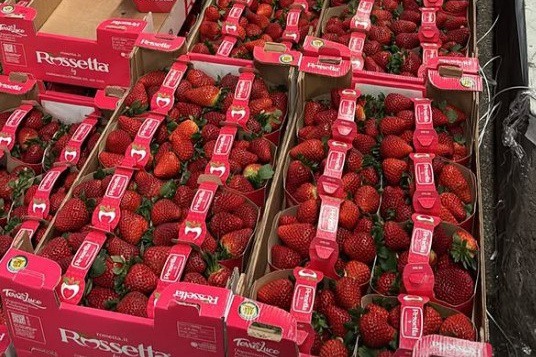
Les fraises égyptiennes sont surtout livrées aux marché de Noël allemands, où elles sont trempées dans du chocolat. « Les variétés un peu plus dures comme Fortuna, Festival et Sensation s’y prêtent bien. Le produit néerlandais est trop mou pour cette application. Traditionnellement, la saison égyptienne est de courte durée : à la nouvelle année, il n’y a plus de demande. En ce sens, cette fraise reste un produit très spécial ! »

Pour plus d’informations :
Luciën de Wit
LuBa Fresh
Tél. : +31 777777715 / +31 641273443
l.deWit@lubafresh.com
www.lubafresh.com

Photo de la première page: © Luba Fresh Date de publication: mar. 9 déc. 2025

© FreshPlaza.fr / Izak Heijboer

Patras port clear of blockades. Strawberries depart smoothly for European markets by FreshPlaza and Taktikos SA

December sees more Greek strawberries thanks to increased early plantings and favorable weather

The harvest of the first Greek strawberries in the Ilia region is currently proceeding exceptionally well, while exports are not being hindered by the tractor blockades that have spread across Greece or at the customs on the country’s northern borders, as shipments are, as always, departing from other points.

“We have no issues with distribution. Not yet, at least. Strawberry shipments to Germany and the rest of Europe do not pass through the roads currently blocked by tractors, nor through the customs at the northern borders. They leave, as always, by ship from the port of Patras and reach various markets via Italy,” notes Dimitris Taktikos, owner of Taktikos SA.

Regarding production, he adds: “We are in a good phase; the plants are in really excellent condition because the ‘incubator’, as we call the conditions of the location and the weather at the time of planting, was ideal. Last year, it was very hot, which caused the plants to burn. This year, the rainfall during that period was extremely favorable.”

“These conditions have caused the early ripening of all varieties. The appearance and growth of the plants we see now would have only been visible in February last year. This development, combined with the significant increase in potted plantings, perhaps 100% more than last year, has already brought an early start to our harvest. However, we cannot yet estimate the exact difference in current productivity compared to last year. We are talking about Fortuna, Arwen, and other varieties. Producers have paid great attention to their early varieties,” Taktikos adds.

Early ripening is also expected for Victory, which continues to be the predominant variety in Greek strawberry greenhouses: “As for Victory, it will start giving us very small quantities around Christmas, slightly before or after. Going forward, if there are no complications from very cold weather in January and February, we can expect good quantities of this variety from February 15–20, whereas last year, we received them from March 15–20.”

Finally, the rosy picture is somewhat clouded by competition from Egypt. “We see Egypt ahead, which increases its strawberry cultivation every year, but we are talking about outdoor crops, and their products reach the markets in poor quality. Nevertheless, they put pressure on us and our prices. The prices we are receiving in the first ten days of December are 15–20% lower compared to the same period last year,” notes the Greek exporter.

For more information:
Dimitris Taktikos
Taktikos SA
Tel: +30 262 307 3124
Email: info@taktikos.com.gr
https://taktikos.com.gr/

Patras port clear of blockades. Strawberries depart smoothly for European markets

December sees more Greek strawberries thanks to increased early plantings and favorable weather

The harvest of the first Greek strawberries in the Ilia region is currently proceeding exceptionally well, while exports are not being hindered by the tractor blockades that have spread across Greece or at the customs on the country’s northern borders, as shipments are, as always, departing from other points.

“We have no issues with distribution. Not yet, at least. Strawberry shipments to Germany and the rest of Europe do not pass through the roads currently blocked by tractors, nor through the customs at the northern borders. They leave, as always, by ship from the port of Patras and reach various markets via Italy,” notes Dimitris Taktikos, owner of Taktikos SA.

Regarding production, he adds: “We are in a good phase; the plants are in really excellent condition because the ‘incubator’, as we call the conditions of the location and the weather at the time of planting, was ideal. Last year, it was very hot, which caused the plants to burn. This year, the rainfall during that period was extremely favorable.”

“These conditions have caused the early ripening of all varieties. The appearance and growth of the plants we see now would have only been visible in February last year. This development, combined with the significant increase in potted plantings, perhaps 100% more than last year, has already brought an early start to our harvest. However, we cannot yet estimate the exact difference in current productivity compared to last year. We are talking about Fortuna, Arwen, and other varieties. Producers have paid great attention to their early varieties,” Taktikos adds.

Early ripening is also expected for Victory, which continues to be the predominant variety in Greek strawberry greenhouses: “As for Victory, it will start giving us very small quantities around Christmas, slightly before or after. Going forward, if there are no complications from very cold weather in January and February, we can expect good quantities of this variety from February 15–20, whereas last year, we received them from March 15–20.”

Finally, the rosy picture is somewhat clouded by competition from Egypt. “We see Egypt ahead, which increases its strawberry cultivation every year, but we are talking about outdoor crops, and their products reach the markets in poor quality. Nevertheless, they put pressure on us and our prices. The prices we are receiving in the first ten days of December are 15–20% lower compared to the same period last year,” notes the Greek exporter.

For more information:
Dimitris Taktikos
Taktikos SA
Tel: +30 262 307 3124
Email: info@taktikos.com.gr
https://taktikos.com.gr/

Health benefits of berries: antioxidants, brain and heart protection, metabolism and gut health by ItalianBerry
Berries offer powerful antioxidant, metabolic and neuroprotective properties for heart, brain and gut wellness, proven by scientific research.
https://italianberry.it/en/news/health-benefits-berries-antioxidants-brain-heart-metabolism-gut

Supply window is Argentina’s competitive advantage in global blueberry landscape with Citromax by FreshPlaza

Supply window is Argentina’s competitive advantage in global blueberry landscape

Harvest of Argentina’s 2025 fresh blueberry season started in August and wrapped up early October. However, the commercial window was centered in September. “We moved about 90 percent of our fresh blueberry volume by air during the month of September,” says Bernabé Padilla, Fresh Division Commercial Manager at Citromax. “We were able to benefit from a favorable window as we reached key northern hemisphere markets early.” During the month of September, demand in Europe was very strong and Citromax’s early positioning helped in serving key programs effectively. This early window is one of Argentina’s competitive advantages in the global blueberry landscape.

Europe leads demand
With a share of 60 percent in export volume, Citromax’s fresh blueberries were primarily destined for Europe, followed by the U.S. and Canada. “The U.S purchased about 30 percent of our volume and the remaining 10 percent went to Canada.” Strong demand from the European market in September supported a dynamic pricing environment throughout the month.

Also driving exports this season were strong quality indicators for fresh blueberries. “Stable weather conditions and the absence of significant rainfall during the export period were critical,” commented Padilla. This really helped in securing good fruit firmness, size, and taste – key attributes for air-shipped blueberries.

IQF is largest category
In addition to the fresh category, the company is also reporting solid results in IQF with harvest for the processing segment expected to continue through the end of December. Out of an estimated total production volume of 1,700 tons, about 1,450 tons are channeled into IQF, which makes up the majority of Citromax’s blueberry program. The remaining 250 tons were allocated to the fresh segment. “Together, the fresh and IQF categories reaffirm our role as a leading supplier of organic blueberries from Argentina,” said Padilla.

While total output was robust, it was slightly below expectations due to a late August frost. On a positive note, the impact was contained and did not disrupt the company’s commercial commitments.

Competition from Peru
Despite a favorable supply window, Argentina continues to face intense competition from Peru. “Peru is the dominant exporter during this window and suppliers from South Africa and Zimbabwe are also becoming increasingly relevant, especially in Europe.” Their presence adds new layers of competition for early-season fruit.

Overall, it is Citromax’s goal to continuously deliver high-quality fruit with excellent flavor profiles to premium northern hemisphere markets at the very start of the season. “We attribute our differentiation to a combination of early supply, organic certification, and flavor-driven varieties that are well suited for air transport.”

For more information:
Estefania Scuka
Citromax
escuka@citromax.com.ar
www.citrom

Florida growers increasingly shift to Ember and Encore varieties of strawberry by FreshPlaza

Florida growers increasingly shift to Ember and Encore varieties

Florida’s winter strawberry harvest is underway, with growers in Hillsborough, Manatee, and Polk counties producing fruit across roughly 16,000 acres (6,475 hectares) from December through March. The crop represents about US$500 million in annual statewide production.

Planting took place between late September and late October, and harvesting has now begun, said Vance Whitaker, strawberry breeder and professor of horticultural sciences at the University of Florida Institute of Food and Agricultural Sciences (UF/IFAS). Whitaker noted that about 88 per cent of strawberry varieties grown in Florida originate from UF/IFAS breeding programs.

Vance Whitaker

Two recently commercialized UF/IFAS varieties, Ember and Encore, have expanded rapidly. Last season, the two accounted for about 13 per cent of planted acreage. This season, Ember represents 35 per cent and Encore 18 per cent, totaling approximately 53 per cent of Florida’s strawberry acreage. According to Whitaker, these varieties produce strong early yields and show improved flavor, shelf life, and disease resistance compared with older cultivars.

Florida Brilliance is the next most widely planted cultivar, representing about 27 per cent of acreage.

The UF/IFAS strawberry breeding program, established in 1948, has released dozens of cultivars now grown globally. Whitaker said breeders focus on meeting grower and consumer expectations for appearance, texture, and flavor.

Encore variety.

Whitaker also developed a specialty variety known as the pineberry, which is pale in color and has an aroma reminiscent of pineapple. Pineberries are grown on about 325 acres, a level that has remained steady in recent seasons. They are expected to appear again in retail markets carrying Florida strawberries, though volumes remain limited.

Strawberries in retail outlets are generally not marketed by cultivar name, but consumers can identify Florida-grown product through store labeling or by consulting produce managers.

For more information:
University of Florida
Tel: +1 352 392 1365
www.blogs.ifas.ufl.edu Publication date: Thu 4 Dec 2025

New Ruralim asparagus variety launched for growers with Limgroup by FreshPlaza

New Ruralim asparagus variety launched for growers

Limgroup presented its new asparagus variety Ruralim during its annual customer day on 23 October in Horst. German and Dutch asparagus plant growers attended the event, which included updates on market developments and seed-technology innovations. Dr. Ludger Aldenhoff also delivered a lecture on new approaches in plant nutrition.

The company introduced Ruralim through a sand-art presentation by artist Gert van der Vijver. Ruralim follows Mosalim, a variety known for reliability, structure, tip closure, and quality. Limgroup stated that the new variety draws its name from the river Roer and is intended to reflect themes of growth and connection.

Key characteristics of Ruralim include that it produces strong and vigorous foliage. It shows uniform and stable grading. It has a high yield potential.

The company described Ruralim as part of its ongoing breeding work focused on varieties suited for future production needs.

For more information:
Stefan Pohl
Limgroup BV
Tel: +31 77 397 99 00
Email: pgphermans@limgroup.eu
www.en.limgroup.eu Publication date: Fri 5 Dec 2025

Dried strawberries are a feature of the current Egyptian season by FreshPlaza

Dried strawberries are a feature of the current Egyptian season

The Egyptian strawberry season started early this year, with a significant increase in acreage and supply, while quality issues reduced the proportion of exportable strawberries. According to several exporters, the start of the season was also marked by a drop in prices compared to last season.

El Sayed El Gohary, Egyptian strawberry grower, explains that many producers had a difficult planting period due to the quality of seedlings, which required vast replantings. He adds: “This problem mainly affected early production and involved plants imported into Egypt last year, and was accompanied by widespread presence of pests. We were able to remedy this through replanting and authorized biological and chemical treatments.”

The producer explains the low prices at the start of the season by the poor quality of certain harvests and assures us that these prices will not dictate the rest of the season. He explains: “The strawberry harvest started earlier than usual this year, in October, while exports to Europe did not begin until mid-November. This led to an abundance of strawberries on the local market and a drop in prices. It should also be noted that the first exports to the Gulf countries were not of the best quality, which explains the low prices. Prices may be slightly lower than last season, but not as low as at the start of the season.”

“Growers who have excellent quality, with good MRL results, will get good prices. For their part, buyers need to pay closer attention to the source of their strawberries this season,” El Gohary continues.

The grower anticipates strong demand for fresh and frozen strawberries during the export season. “We are seeing strong demand. The fresh strawberry season will continue until January in Europe and until March in the Gulf countries, and the frozen strawberry season will start in February. At this pace, Egypt will certainly exceed 500,000 tons of strawberries exported this season.”

In addition to fresh and frozen strawberries, a new export process is emerging in Egypt this season. El Gohary explains: “We are seeing the emergence of drying chambers this season. This is a high-demand sector, as dried strawberries are used in cooking and the food industry in many parts of the world. This process produces very sweet fruit and requires the use of high-quality strawberries with a high Brix level. Usually, Egyptian strawberries are sent to China to be dried and then re-exported, but this industry is being brought to Egypt starting this season. More than 30 drying chambers will be operational starting in January.”

“We anticipate that drying will contribute significantly to sustained demand, as it absorbs large volumes, with 100 tons of dried strawberries requiring 1,000 tons of fresh strawberries,” he concludes.

For more information:
El Sayed El Gohary
Marvel Farm
Tel: +201002496633
Email: azomite2015@gmail.com Publication date: Thu 4 Dec 2025

© FreshPlaza.com / Youness Bensaid

Johan Mostert – DiPAR Systems

Inside the architecture driving real-time fruit supply chain decisions By FreshPlaza

Johan Mostert – DiPAR Systems

Inside the architecture driving real-time fruit supply chain decisions

“Over the last ten to fifteen years, exporters focused mainly on how quickly they could move pallets to market,” says Johan Mostert, managing director of DiPAR Systems. “But that’s changed: with oversupply becoming more common, the real advantage now lies in ensuring that the right carton lands on the right pallet for the right client.”

The recent mandarin season, with its higher-than-normal incidence of peel disorders, illustrates this shift. Producers increasingly need to know which clients tend to claim against a specific defect, what the financial impact has been historically, and whether higher-risk fruit can be identified and rerouted before export.

“This is a deep part of the industry,” he says. “It’s incredibly difficult to systematize, and very few have attempted it at the scale we’re working at.”

For DiPAR Systems, it has taken the form of an extensive, multi-year rewrite of all their agricultural software modules, a project now more than 300,000 logged hours deep, expected to reach roughly half a million hours once every module is completed. He explains that the rewrite began in earnest in 2018 to consolidate legacy systems, eliminate duplication, and bring the entire platform up to modern architectural standards.

Six33 Produce has been running five farms and a pack house for seven years on a single, integrated DataGear® database

DiPAR has been supplying software to packhouses since 2004 and exporters since 1998, later adding quality control, variety evaluation, labour, and wage-tracking components at the industry’s request. They estimate that in some form or other, 20% to 25% of South Africa’s fruit goes through DiPAR’s products; the exact market share is hard to measure.

The new unified platform is called DataGear®, and alongside the major structural modules, it includes new additions such as a forex management component. To support training, Johan and the DiPAR team used modern AI tools to create an internal training assistant, helping DiPAR’s Client Success Team to master and then teach the module efficiently.

“When all modules are complete, this will rank among the largest privately funded Agri-ERP rebuilds in South Africa,” he says. Each module is released first to select early-adopter clients for user acceptance testing. Commercialisation then begins with a small group to allow rapid feedback during stabilisation. Once the module is fully stable, broader client onboarding begins as part of a phased migration.

Exporters at Core Fruit using the latest Stock Planning and Allocations module in DataGear®

From complexity to intelligence
A growing trend in the fruit sector is the use of deep technical data to reduce risk and improve decision-making. DiPAR is leaning into this movement.

One example is cross-referencing specific defects with the historical claims of particular clients, giving exporters a clearer view of risk profiles before they pack a single pallet. For growers, the system can quantify how much a specific defect has cost the farm over multiple seasons, insight previously nearly impossible to extract quickly or consistently.

Food-safety risks can be modelled similarly, and several clients have already used the platform to run mock recalls.

“Our systems collect and track data from pre-commercial variety trials right through to export,” Mostert says. “Once DataGear® has been completed, this end-to-end integration will be available in a single, modular system. For inspection agencies, DataGear® feels like a dedicated inspection tool, yet quality control represents only a small portion of the full platform.”

As vertically integrated producers and exporters adopt more modules, the depth of benchmarking becomes significant. “The system can measure operational aspects previously difficult to quantify, for instance pruning efficiencies, labour performance, varietal behaviour, scouting intelligence and a range of encompassing metrics that influence decisions and therefore the final packouts and grower returns.”

Built in Africa, designed for the world
The expansion of blueberries in Zimbabwe gave DiPAR a foothold in the broader Southern Africa, where large farms are being established at a pace. Due to exchange rate differences, DiPAR’s offering is often substantially more affordable than competing systems, and crucially, the mobile apps are designed to operate fully offline.

Right: The Pest Monitoring module in DataGear® in use at Six33 Produce’s LeArc Farm, Western Cape

“Six33 Produce is in the process of finishing off their seventh season running five farms and a pack house on a single, integrated DataGear® database,” he notes. “They have generated up to 100,000 lines of data in a single day on the app.”

Where connectivity is limited, a daily reality on many farms, DataGear® continues to function without interruption. Some clients also make use of optional offline biometric validation to confirm worker attendance. The system allocates duties, integrates directly with harvesting scales, and feeds the resulting data into labour and wage modules in near real-time.

Despite touching several points of the payroll workflow, DiPAR intentionally avoids the accounting-software space. “We’ve seen farms running three different payroll systems. Our goal isn’t to replace them, but to provide the overarching system that connects everything.”

Safety, audits and future vision
Audits across the value chain, covering farm, packhouse, export, food safety, and more, are increasingly intertwined. This creates a strong need for cross-modular integration so that compliance, traceability, and risk information aren’t trapped in separate systems.

The long-term vision for DataGear® includes additional safety features, such as enforcing post-spray re-entry intervals to prevent accidental exposure for workers, a real challenge in certain crop environments. Similarly, DataGear® aims to integrate receiver requirements, market specifications, consumer preferences, and grower exposure into every allocation decision, with the long-term goal of maximising grower returns while reducing risk.

Among the largest releases, currently in the initial commercialisation phase, is the Stock Planning & Allocations module which is running live at Core Fruit and the Estimates & Planning module which is running live at EXSA and Core Fruit. “Both of these modules represent comprehensive coverage and client configurability, whilst addressing some of the most technically demanding areas of export operations.”

EXSA uses the Estimates & Planning module in their operations

For more information:
Johan Mostert
DiPAR Systems
Tel: +27 82 940 9820
Email: jmostert@dipar.co.za | info@dipar.co.za
www.dipar.co.za

David Vélez, directeur technique de Plus Berries :

« Nous démarrons la récolte des fraises avec de bonnes prévisions commerciales » par FreshPlaza

David Vélez, directeur technique de Plus Berries :

« Nous démarrons la récolte des fraises avec de bonnes prévisions commerciales »

Les premières fraises de la saison 2025/2026 apparaissent dans les champs de Lepe, à Huelva, après avoir surmonté les défis posés par les conditions météorologiques jusqu’à présent.

« Le début de la saison a été marqué par des exigences techniques élevées en raison de facteurs climatiques défavorables, en particulier les températures élevées enregistrées pendant la phase de semis et le récent passage de la tempête Claudia », explique David Vélez, directeur technique agricole de Plus Berries, qui démarre officiellement sa nouvelle saison de fraises avec une augmentation de 10 hectares de sa zone de culture.

« Malgré ces difficultés initiales, le bilan est positif. Bien que la tempête ait causé des dégâts, ceux-ci ont été entièrement réparés et la gestion des cultures a été efficace. »

Néanmoins, M. Vélez souligne objectivement que « la plante est un peu plus tardive que l’année dernière, une situation qui découle de la nécessité de maintenir une irrigation constante pour protéger la culture de la chaleur initiale. » Malgré le retard phénologique, la récolte a déjà commencé et les prévisions de vente restent optimistes, les premiers fruits ayant déjà commencé à être récoltés. »

Pour Plus Berries, la stratégie de la saison s’articule autour de sa propre variété, Candela. « Il s’agit d’une variété précoce dont les fruits sont très homogènes et d’un rouge intense. De plus, elle se distingue par une plante beaucoup plus résistante aux parasites et aux maladies, ce qui est essentiel pour atteindre l’objectif « zéro résidu. » Pour le consommateur, cela se traduit par une saveur et une bonne qualité. Parallèlement, nous maintenons la disponibilité des variétés Marisma et Cleopatra, qui complètent l’offre. »

Selon le directeur technique de l’entreprise, le début de la saison est le moment le plus important et le plus crucial, où il est essentiel de soigner chaque étape, et il souligne les qualités uniques du produit Lepe, « en raison d’une intensité qui se remarque à la dégustation. » En ce qui concerne la commercialisation, les attentes sont positives. « La demande est bonne et nous espérons continuer à couvrir tous les marchés possibles. »

« Nous sommes engagés dans un modèle de culture durable et de zéro résidu, ce qui implique un effort quotidien de surveillance des parasites et des maladies. L’objectif est clair : offrir au consommateur une fraise aussi naturelle que possible. Cet engagement est étayé par un investissement important dans la recherche et le développement. Nous disposons d’un centre de développement de l’innovation qui étudie l’utilisation de la lutte biologique, des micro-organismes et des outils de précision tels que les sondes d’irrigation, les dosimètres et les pluviomètres pour optimiser les ressources. Cette recherche nous permet de développer des variétés plus adaptées au sol, plus rustiques et plus adaptées à une production écologique et sans résidus. »

Pour plus d’informations :
Grupo Plus Berries
Tél. : +34 959504454comunicacion@plusberries.com
plusberries.com Date de publication: jeu. 4 déc. 2025

© FreshPlaza.fr / Joel Pitarch

Articles connexes → See More