New blueberry and Rubus varieties expand berry genetics portfolio
Fall Creek® will showcase its newest blueberry genetics, expanding berry portfolio, and grower-focused developments at Fruit Attraction 2026 in Madrid.
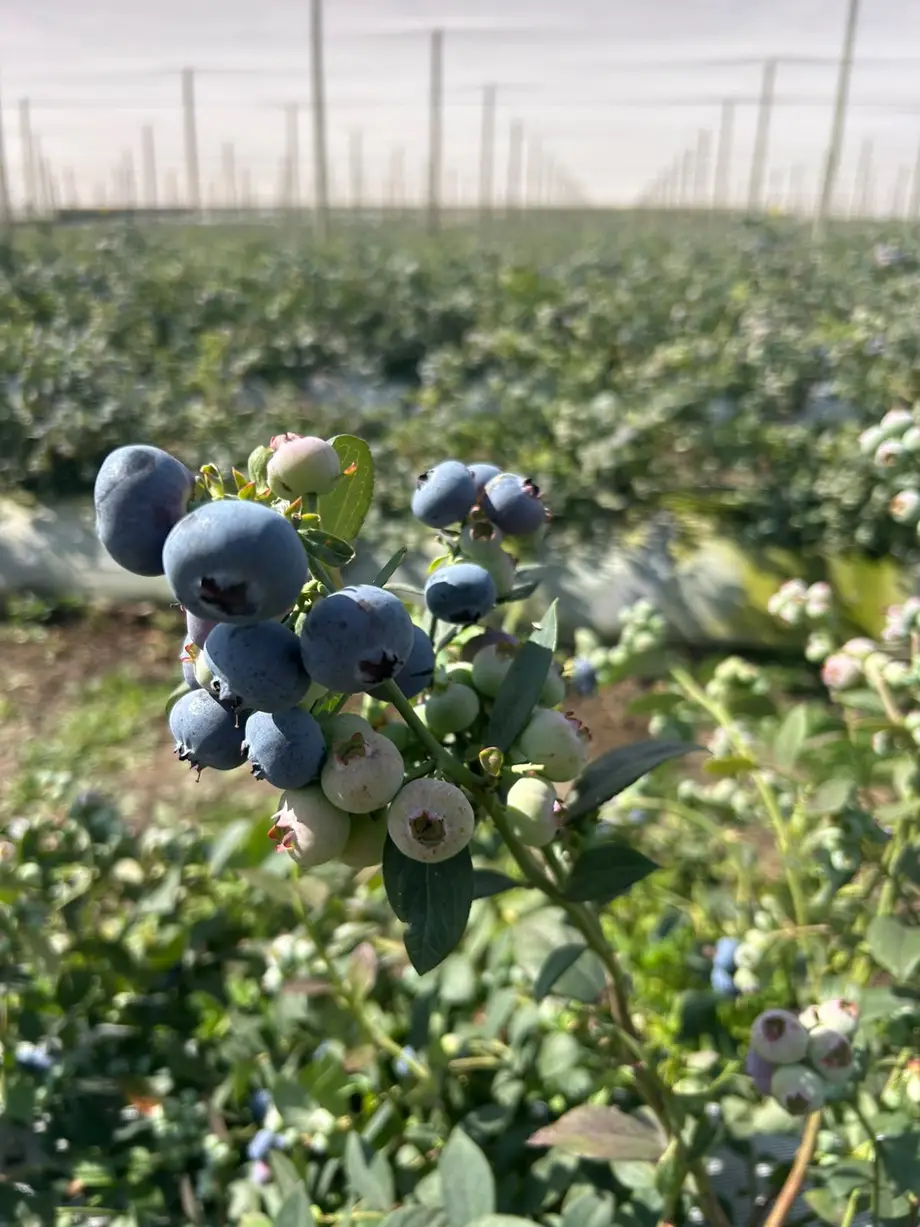
At Hall 9, Stand F08, from Oct. 6–8, Fall Creek will showcase the newly released Everlast™ ‘FC11-164’ and Sekoya® Nova ‘FC15-173’, alongside its expansion into raspberries and blackberries. The company will also highlight how its Breed. Grow. Serve. approach connects genetics, growers, and the marketplace.
Innovation starts with genetics Everlast ‘FC11-164’, joining the Fall Creek Collection, and Sekoya Nova ‘FC15-173’, joining Sekoya, represent the latest genetics from Fall Creek’s two commercial platforms. The company will also feature low-chill varieties from the Fall Creek Collection and Sekoya Pop ‘FCM14-052’, a low-chill variety from Sekoya, while sharing progress from its genetics pipeline and trial network.
In a recent Fall Creek consumer survey across seven blueberry-consuming regions, respondents consistently cited fruit condition as a barrier to satisfaction, identifying mushy fruit and early spoilage as common sources of disappointment, while also highlighting taste as a foundational expectation.
“What consumers are telling us is pretty straightforward: if the fruit disappoints them, they may not come back,” said Paul Nselel, Chief Commercial Officer. “The better we can address condition, shelf life and flavour at the genetics level, the stronger the opportunity is for growers, retailers and consumers.”
Taking genetics to market Visitors to the Fall Creek stand will also see how the Fall Creek Collection and Sekoya platforms serve distinct but complementary roles in bringing Fall Creek genetics to market.
The Fall Creek Collection provides professional growers with access to genetics across chill levels, supported by Fall Creek’s horticultural and technical expertise. Sekoya brings together members across multiple growing regions, with a focus on fruit quality and year-round supply.
“Growers consistently tell us they need varieties that perform in their environment, fit their harvest strategy and ultimately earn their place in the market,” said Teun Leenders, EMEA Commercial Manager. “Our role is to connect the right genetics with the right growing conditions, technical support and market opportunity.”
Fall Creek will also preview Berry Business Week 2027, including a Global Field + Forum focused on low-chill cultivation in Seville, Spain, on March 18, 2027.
Expansion beyond blueberries Fall Creek will also use Fruit Attraction to showcase its expansion into raspberries and blackberries, building on nearly five decades of experience in blueberry genetics and nursery cultivation.
The expansion brings together more than three decades of Rubus breeding experience and an established portfolio, expanding Fall Creek’s offering to growers. Among the genetics now available through Fall Creek are Amalia Rossa ‘BTRASFOUR’ and Easy Rose ‘ALEL101’, recently added to Fall Creek’s raspberry portfolio.
Blueberry sales support breast cancer screening in South Africa
Checkers, BerryWorld, and Discovery Vitality have partnered to bring Booberries™ to South African shoppers, using blueberry sales to support breast cancer awareness and access to screening services.
During Breast Cancer Awareness Month in October, limited-edition Booberries cups of locally grown blueberries will be available exclusively at Checkers stores nationwide.
For every cup sold, BerryWorld and Checkers will each donate R1, contributing a combined R2 per cup to PinkDrive, a non-profit organisation providing breast-health education and screening services to people who are medically uninsured or face barriers to accessing healthcare. Its mobile health units provide clinical breast examinations, mammograms, and health education. Discovery Vitality will also make a donation to PinkDrive.
The cups include a QR code linking shoppers to breast-health resources and information about screening and early detection.
Breast cancer is the most commonly diagnosed invasive cancer among South African women. National Cancer Registry data recorded 11,262 cases of female breast cancer in 2024, with a lifetime risk of 1 in 28. The Council for Medical Schemes reports that male breast cancer accounts for approximately 1.8% of breast cancer cases in South Africa, compared with less than 1% globally.
Through the partnership with PinkDrive, more than 150 women across two BerryWorld grower farms in the Western Cape recently received breast-health education and clinical breast examinations.
Booberries builds on a BerryWorld breast cancer awareness campaign launched in the UK in 2024 and subsequently expanded into European markets including France and Norway.
Discovery Vitality also encourages eligible members to complete preventive screenings. Female Vitality members aged 40 and older can earn 2,500 Vitality points for completing a mammogram.
Through the Vitality HealthyFood benefit, members can earn up to 25% back in Discovery Miles when buying blueberries at Checkers, increasing to up to 75% back when paying with a qualifying Discovery Bank card. The HealthyFood range includes more than 2,500 products, including Booberries.
« L’accent mis sur une génétique de haut de gamme déterminera la place future de la Géorgie sur le marché international de la myrtille »
Le secteur de la myrtille en Géorgie entre dans une nouvelle phase de développement, alors que la production augmente et que les exportateurs se tournent vers de nouvelles destinations, au-delà des marchés traditionnels, notamment vers le Golfe, l’Europe et l’Asie. Pour Ekaterine Vepkhvadze, fondatrice d’Agritouch, le prochain défi ne consiste pas simplement à augmenter les volumes d’exportation, mais à développer des marchés fiables pour ces fruits géorgiens d’une qualité constante.
« Pour les myrtilles, la qualité prime sur la quantité. Lorsque les acheteurs bénéficient d’une qualité constante d’une saison à l’autre, la relation se renforce. Ils commencent à reconnaître le fournisseur, à faire confiance au produit et reviennent l’année suivante. »
Agritouch est présente sur le marché international depuis 2018, où elle se consacre à l’exportation de myrtilles et au conseil agricole. « J’avais déjà une expérience du commerce international avant de créer l’entreprise. En 2015, j’ai organisé une livraison aérienne précoce de myrtilles géorgiennes au Qatar pour le compte de Lulu Hypermarket. Depuis lors, nous avons noué des relations avec certains des plus grands producteurs. Nos prestations de conseil ont contribué à la création de plus de 500 ha de plantations. Côté exportation, nous nous approvisionnons en fruits auprès de différentes exploitations géorgiennes, nous effectuons des contrôles qualité, nous les reconditionnons et nous regroupons les volumes destinés aux acheteurs étrangers. »
Dans le cadre de ses activités de R&D, Agritouch collabore avec Planasa pour introduire pour la première fois en Géorgie les variétés Blue Madeira et Blue Masirah. « Nous allons tester ces cultivars dans les conditions de culture géorgiennes afin d’évaluer leur adaptation, leurs performances et leur potentiel commercial. »
Parallèlement à la R&D, l’entreprise propose des services de conseil agricole et de gestion technique. « Nous accompagnons les producteurs tout au long du processus, depuis le développement du projet et la sélection des variétés jusqu’à la production, la gestion de la qualité et les opérations post-récolte. La diversification des exportations constitue un autre axe stratégique majeur. Nous souhaitons élargir l’accès des produits géorgiens à de nouveaux marchés internationaux, renforcer nos relations avec les acheteurs et développer des filières d’exportation plus diversifiées et plus fiables. »
Agritouch approvisionne actuellement des marchés tels que le Qatar, l’Arabie saoudite, les Émirats arabes unis et Oman. « En 2026, nous nous sommes implantés en Inde et en Israël, ce qui élargit encore notre zone géographique d’exportation. Rien que pendant la saison 2026, nous avons exporté plus de 50 t de myrtilles par fret aérien. »
Le projet en cours de l’entreprise couvre environ 30 ha et compte quelque 98 000 plants. « Nous prévoyons des rendements de 5 à 6 kg par plant, ce qui représente environ 500 t/an. À plus long terme, notre objectif est d’étendre la production de myrtilles à 100 ha. »
Agritouch vise à se positionner entre les producteurs géorgiens et les acheteurs internationaux, en proposant des services d’approvisionnement, de contrôle qualité, de réfrigération, de conditionnement et d’exportation. L’entreprise exploite actuellement 600 m2 d’installations frigorifiques d’une capacité de plus de 200 t.
Alors que la production de myrtilles en Géorgie continue de se développer, la diversification revêt une importance croissante. « La compétitivité future du pays dépendra de sa capacité à offrir aux acheteurs non seulement des volumes plus importants, mais aussi des variétés présentant la fermeté, le goût, la taille et la durée de conservation requis pour les marchés éloignés. C’est ce qui nous a poussés à renforcer notre coopération avec des entreprises internationales spécialisées dans la sélection végétale et les fruits et légumes frais. »
L’ambition de Vepkhvadze à long terme est de faire d’Agritouch l’une des plus grandes plateformes géorgiennes spécialisées dans l’exportation de myrtilles, capable de regrouper la production de plusieurs producteurs et d’approvisionner des clients à travers l’Europe, le Moyen-Orient et l’Asie. « Les salons professionnels internationaux constituent un élément important de notre stratégie de développement commercial. »
Agritouch sera présent au salon Fruit Attraction du 6 au 8 octobre, stand 8D20.
Pour plus d’informations : Ekaterine Vepkhvadze Agritouch LLC Tél. : +995 599240246 eka@agritouch.ge
Pérou : la production de myrtilles progresse, mais les exportations reculent
Proarándanos a publié ses cinquièmes prévisions d’exportations, qui révisent à la baisse de 4,2 % les estimations de septembre. L’impact du phénomène El Niño s’avère plus sévère que prévu, bien que la superficie en production ait augmenté de 15 %.
Le Pérou devrait clôturer la campagne 2026-27 avec environ 366 000 tonnes de myrtilles fraîches exportées, selon les cinquièmes prévisions de Proarándanos. Ce chiffre est inférieur de 4,2 % à l’estimation de septembre (382 000 tonnes) et de 4,4 % aux exportations de la campagne précédente (383 000 tonnes).
« D’après les informations que nous ont transmises les producteurs et les exportateurs, nous constatons que les dernières semaines confirment une tendance à la baisse, avec une chute importante des volumes exportés », explique Luis Miguel, de Proarándanos. « Cela se produit malgré une augmentation d’environ 15 % de la superficie en production. »
Jusqu’à la semaine 38, le Pérou a exporté 136 000 tonnes, soit 18,7 % de plus qu’au cours de la même période de la campagne précédente (115 000 tonnes). Toutefois, Luis Miguel met en garde contre une interprétation erronée de ce chiffre : « Le bilan cumulé est positif, mais il ne reflète pas le changement de tendance marqué qui s’est produit ces dernières semaines. »
De la semaine 39 jusqu’à la fin de la campagne, 229 000 tonnes devraient être exportées, soit 14,2 % de moins qu’au cours de la même période de la campagne 2025-2026 (268 000 tonnes).
La baisse est plus marquée au cours des huit prochaines semaines, pour lesquelles 108 000 tonnes sont prévues. Cela représente 48 000 tonnes de moins que lors de la campagne précédente (156 000 tonnes), soit une baisse de 31,2 %.
« Plutôt qu’un pic, nous nous attendons à une stabilisation sur cette période, avec une moyenne d’environ 13 500 tonnes par semaine », précise le porte-parole. Cela contraste avec les campagnes précédentes, au cours desquelles les volumes hebdomadaires avaient clairement atteint des niveaux plus élevés pendant les semaines centrales.
Les prévisions de clôture pour le segment bio s’établissent à 24 900 tonnes. Le pic devrait être atteint lors de la semaine 47, avec 1 100 tonnes, un chiffre inférieur à celui de la campagne précédente, qui avait été enregistré lors de la semaine 40 avec 1 900 tonnes.
Luis Miguel souligne que cette mise à jour confirme que l’impact du phénomène est plus grave que prévu et qu’il contraste avec le bon rythme observé en début de campagne. « Notre objectif est de tenir le secteur informé de manière opportune et rigoureuse », affirme-t-il.
Frutivar : Grupo Hijuelas et Les Domaines Agricoles présentent une nouvelle plateforme pour le développement de plants au Maroc
L’alliance entre le groupe chilien, expert de la multiplication, de la génétique et de la production de plants depuis six décennies, et l’un des principaux acteurs agricoles du Maroc depuis 1960, dont le laboratoire El Bassatine pratique la culture in vitro depuis 1984, donne naissance à Frutivar. Le projet avance déjà dans ses infrastructures et sa production locale, et ses premiers plants de fruits rouges sont établis chez des producteurs marocains.
Grupo Hijuelas et Les Domaines Agricoles unissent leurs forces pour développer Frutivar, une nouvelle plateforme dédiée à la multiplication, à la production et au développement de plants au Maroc, en associant l’expertise technologique et pépiniériste du groupe chilien aux capacités de production in vitro, agricoles et commerciales du groupe marocain.
L’initiative vise à consolider au Maroc une capacité nationale de production de plants, afin de mettre de nouvelles alternatives génétiques et une expertise technique à la portée des producteurs du Royaume. Elle s’appuie sur l’application de modèles de production éprouvés, pour accompagner le développement d’une filière fruitière marocaine qui pèse toujours davantage sur les marchés internationaux.
Deux sources d’expertise Grupo Hijuelas apporte son expérience de la multiplication et de la production de plants, ainsi qu’une plateforme internationale en croissance, qui relie génétique, technologie et développement productif sur différents marchés, parmi lesquels le Chili, le Pérou, le Mexique, le Brésil, les États-Unis et la France.
Les Domaines Agricoles est pour sa part l’un des principaux groupes agricoles du Maroc, avec un modèle intégré couvrant différentes activités de production et une forte présence à l’international. Son activité export commercialise fruits et légumes dans plus de 40 pays. Le groupe est également l’un des premiers producteurs de plants fruitiers au Maroc, à travers ses pépinières et son laboratoire El Bassatine.
Créé en 1984 pour contribuer au repeuplement de la palmeraie marocaine affectée par le Bayoud, le laboratoire El Bassatine est l’un des plus anciens laboratoires de culture in vitro du Royaume. Il maîtrise la micropropagation du palmier dattier, du bananier, des rosacées et du cactus, et accompagne à ce titre les grands programmes de plantation du pays. C’est cette expertise que Les Domaines Agricoles apportent à Frutivar, aux côtés des programmes génétiques et de l’échelle industrielle de Grupo Hijuelas.
Portée par l’expérience de ses deux actionnaires, la nouvelle société ambitionne de compter dans un secteur particulièrement dynamique.
Les premiers plants de fruits rouges sont déjà au Maroc La première production de Frutivar concerne les fruits rouges. Le développement productif n’a pas attendu la mise en service complète du site. Au cours de cette première étape, du matériel végétal a été expédié depuis le Chili puis enraciné chez Frutivar. Les premiers plants ont déjà été livrés et sont établis chez des producteurs marocains : ils constituent la première génération du projet dans le pays.
Pour Remo Nasi, responsable de Grupo Hijuelas pour la région EMEA, cette étape marque un jalon dans la croissance et l’implantation mondiale du groupe chilien. « La capacité de développement et de partenariat de Grupo Hijuelas témoigne de la valeur reconnue à l’échelle mondiale à son expérience et aux résultats qu’il a démontrés au fil des années », déclare-t-il.
« La culture in vitro est un métier que nous exerçons depuis quarante ans sur les filières stratégiques du Royaume. Frutivar l’ouvre à de nouvelles espèces, avec un partenaire qui apporte l’accès aux programmes génétiques internationaux et une échelle industrielle éprouvée », ajoute Badr Bennis, directeur général adjoint des Domaines Agricoles.
Les premiers partenariats internationaux sont signés Les premiers groupes internationaux ont déjà accordé leur confiance à la nouvelle société. MBO, OZblu et Hortifrut ont signé un partenariat avec Frutivar, qui ouvre aux producteurs marocains l’accès à leurs programmes variétaux.
Frutivar intègre en parallèle de nouvelles génétiques à son portefeuille, afin d’élargir progressivement les alternatives disponibles pour les producteurs et de contribuer à la croissance et à la diversification de l’arboriculture fruitière locale. Les équipes des deux partenaires conduisent un programme continu de formation et d’échange technique.
Avec ce projet, Grupo Hijuelas et Les Domaines Agricoles entendent bâtir une structure de long terme, qui rapproche des producteurs de nouvelles alternatives végétales et des capacités de multiplication, avec le Maroc comme base de développement régional.
Des représentants de Grupo Hijuelas et des Domaines Agricoles seront présents à Fruit Attraction, du 6 au 8 octobre à Madrid. Ils se tiendront à la disposition des producteurs, exportateurs et acteurs de la filière souhaitant échanger sur Frutivar.
Pour plus d’informations : Les Domaines Agricoles Kenza Ouali, Directeur Marketing kouali@domaines.co.ma
New berry plant propagation project begins in Morocco
The partnership between Chilean Grupo Hijuelas, active in plant propagation, genetics, and plant production for six decades, and Morocco’s Les Domaines Agricoles, whose El Bassatine laboratory has conducted in vitro culture since 1984, has resulted in Frutivar. The project is developing infrastructure and local production, and its first berry plants have been established with Moroccan growers.
Frutivar combines Grupo Hijuelas’ nursery and technology expertise with Les Domaines Agricoles’ in vitro production, agricultural, and commercial capabilities.
The initiative aims to establish plant production capacity in Morocco, providing growers with access to new genetics and technical expertise through production models intended to support the country’s fruit industry.
Two sources of expertise Grupo Hijuelas has experience in plant propagation and production, with operations connecting genetics, technology, and crop development in markets including Chile, Peru, Mexico, Brazil, the United States, and France.
Les Domaines Agricoles operates across several agricultural sectors and exports fruit and vegetables to more than 40 countries. The group also produces fruit plants through its nurseries and El Bassatine laboratory.
Founded in 1984 to help restore Moroccan palm groves affected by Bayoud disease, El Bassatine works with the micropropagation of date palm, banana, rosaceae, and cactus. This expertise is being combined with Grupo Hijuelas’ genetic programs and propagation activities through Frutivar.
Frutivar’s first berry plants are already in Morocco Frutivar’s initial activities focus on berries. Plant material has been shipped from Chile and subsequently rooted at Frutivar. The first plants have already been delivered to and established with Moroccan growers.
According to Remo Nasi, Head of Grupo Hijuelas for the EMEA region, “Grupo Hijuelas’ capacity for development and partnership demonstrates the value placed globally on its experience and the proven results it has delivered over the years.”
“In vitro culture is a business we have been running for forty years on the Kingdom’s strategic crops. Frutivar opens it to new species, with a partner that brings access to international genetic programmes and proven industrial scale,” added Badr Bennis, Deputy CEO of Les Domaines Agricoles.
The first international partnerships are signed MBO, OZblu, and Hortifrut have signed partnerships with Frutivar, giving Moroccan growers access to their variety programs.
Frutivar is also adding genetics to its portfolio to expand the alternatives available to growers and support diversification of Morocco’s fruit industry. Teams from both partners are conducting an ongoing training and technical exchange program.
Grupo Hijuelas and Les Domaines Agricoles intend to use Morocco as a base for the project’s development across the region.
Representatives of both groups will attend Fruit Attraction in Madrid from 6 to 8 October to discuss Frutivar with growers, exporters, and other industry stakeholders.
Mexican asparagus supplies tighten as California strawberry prices fall
North American produce markets are seeing mixed movement, with Mexican asparagus supplies affected by rain, Peruvian blueberry arrivals increasing, and California strawberry prices declining.
Asparagus Asparagus movement from Mexico through Arizona, California, and Texas is expected to decrease. Supplies are limited, with many shipments tied to previous commitments. Rain from Hurricane Polo halted harvesting, which is expected to resume on Friday, October 2, once fields dry.
Peruvian asparagus movement through South Florida is expected to remain stable, with light supplies and active trading. Prices are generally unchanged. Eleven-pound cartons of bunched green jumbo asparagus are mostly US$60.75-62.75, large US$54.75, and standard US$48.75.
Avocados Mexican avocado movement through Texas is expected to remain stable, with fairly slow trading. Hass 2-layer cartons range from US$21.25-40.25 depending on size. California movement is decreasing as growers finish the season, while Peruvian imports through Philadelphia and New York are also declining seasonally.
Blueberries Peruvian blueberry imports through Miami, Philadelphia, and New York are expected to increase seasonally. Conventional trading is fairly active at slightly lower prices. Flats containing 12 1-pint cups are mostly US$40.00-42.00, while organic fruit is mostly US$62.00-64.00. Chilean imports are also expected to increase seasonally.
Cucumbers Mexican cucumber movement through Texas is expected to decrease slightly, with prices slightly higher. Medium 1 1/9-bushel cartons are US$19.95-21.95. Supplies through Otay Mesa remain light, with most prices higher. South Georgia supplies are fairly heavy, while arrivals through Nogales are expected to increase seasonally.
Green bell peppers California San Joaquin Valley movement is decreasing seasonally, with higher prices. Extra-large 1 1/9-bushel cartons are mostly US$19.95-20.95. Michigan movement is stable, while South Georgia volumes are expected to increase.
Strawberries California strawberry trading remains slow, with prices much lower. Salinas-Watsonville flats of eight 1-pound containers are mostly US$6.00-8.00, while Santa Maria fruit is mostly US$8.00. Some berries are being diverted to freezers or processors.
Tomatoes Mexican tomato movement through Texas is expected to increase slightly. California Central District movement is decreasing slightly, with active trading at lower prices. Mature Green 25-pound cartons range from US$9.35-13.35 depending on size. Supplies through Otay Mesa remain light but are expected to increase in early October.
The hidden postharvest technology that protects fruit across oceans — and why a delayed shipment can change both the quality in a punnet and the balance of a season.
A grower can produce an excellent blueberry and still never deliver an excellent blueberry to the consumer. Between those two achievements lies another part of the industry: cooling, grading, protective packaging, treatments, monitoring and the management of a journey that may last several weeks.
During my September visit to South Africa, this less visible part of the business became the most important conversation. We discussed the European market, but also what must happen after harvest for a consignment to fulfil its commercial promise.
Questions about SO₂ sheets, temperature histories, handling instructions and customer acceptance showed how much responsibility sits between the plantation and the supermarket.
Consumers should not need to understand that machinery to enjoy their favourite berries. Nevertheless, the industry should explain it more clearly.
Year-round availability does not depend only on growers in different countries taking turns. It also depends on preserving their fruit during the handover between seasons.
Harvest is not the finish line. It is the start of a second, technically demanding phase.
The season on the shelf is an arrival calendar
Around the middle of July this season, I was already noticing Peruvian blueberries in the European market, earlier than I normally associate with the transition towards overseas supply.
Italian Berry’s Piacenza survey on 22 July 2026 recorded Peruvian fruit alongside Polish, Romanian and late Spanish blueberries. This confirms their presence in that market, not Europe’s first arrival date or a permanent change in seasonality (Italian Berry, 2026).
As attention turns to South African arrivals, the commercial task is to complement existing supply, maintain agreed volumes and support retail programmes.
My starting point would be the intended week of sale, working backwards through distribution, port handling, sailing and harvest. A production calendar alone cannot describe what consumers will find on the shelf.
Europe’s imports also include blackberries from Mexico and Guatemala, making this relevant beyond blueberries (Centre for the Promotion of Imports from Developing Countries [CBI], 2025). The principle is shared; the acceptable journey and protective technologies are not necessarily the same.
What happens while the fruit is travelling?
A harvested berry remains biologically active. Respiration, water loss and decay continue, although refrigeration slows them. Botrytis cinerea, the fungus responsible for grey mould, can grow slowly even near 0 °C. Cooling therefore buys time; it does not stop the biological clock (Mitcham et al., 1998).
The fruit also enters the chain with a history. For an export decision, I want to know its variety, maturity, harvest conditions, handling and initial quality.
The pressures discussed in my presentation — labour shortages, rain, heat and compressed picking windows — matter here because postharvest operators cannot start from the assumption that every lot has the same potential.
Consider an illustrative journey: four days from harvest through packing, inland transport and departure; 21 days at sea; three days for arrival handling and distribution; and two days before purchase.
The consumer buys fruit that is already 30 days beyond harvest. Time at home comes afterwards. These are planning assumptions, not a standard transit time or a shelf-life recommendation.
For air freight, I would similarly count road collection, terminal handling, connections, clearance and delivery, not just the scheduled flight. A shorter line-haul journey does not remove the need to control the stages around it.
Now add a seven-day delay. The transport booking can be revised, but the fruit’s elapsed time cannot. Whether the lot remains suitable depends on its condition, temperature history and validated storage programme, not simply its revised arrival date.
This is why I would assess a route against the full harvest-to-consumption period, including a realistic disruption. The question is not only whether the fruit can reach the destination. It is whether enough quality will remain for distribution, sale and enjoyment.
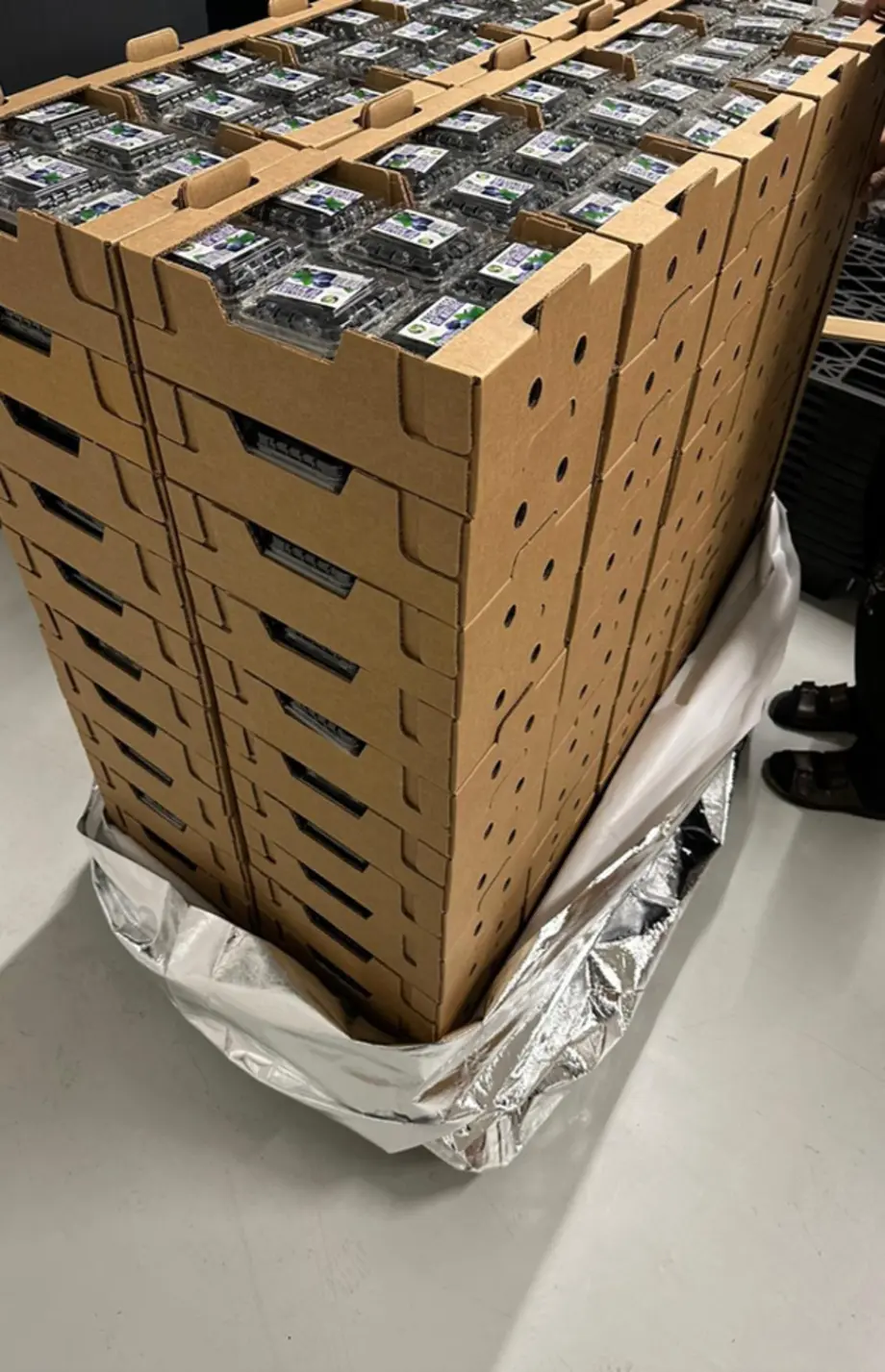
The first technology is effective heat removal
A cold room and a properly cooled pallet are not the same thing. Forced-air cooling creates a pressure difference that draws refrigerated air through the packages and around the produce. Its effectiveness depends on airflow, refrigeration capacity and the arrangement of the load (Boyette et al., 2025).
A reading beside the pallet cannot establish the temperature at its centre. My requirement would be representative fruit-temperature measurements, including positions known to cool slowly, supported by a cooling curve and a dispatch criterion. A target such as 90 minutes can be meaningful for a tested installation but should not become a universal rule for every box, liner and pallet.
Hapag-Lloyd’s handling guidance requires produce to be at transport temperature before loading and emphasises unobstructed air circulation. A refrigerated truck should therefore not be treated as a substitute for pre-cooling. Loading geometry, packaging and ventilation belong in the transport specification, not merely the warehouse instructions (Hapag-Lloyd, n.d.-b).
Humidity has a different role from temperature: suitable relative humidity limits water loss, whereas low temperature slows respiration and deterioration. High humidity should not be confused with uncontrolled condensation (Mitcham et al., 1998).
For the exporter, the important handover is consequently not “the cooling room was cold”. It is “this lot met the required fruit-temperature criterion, in this packing configuration, before dispatch”.
Managing the atmosphere around the berries
Refrigeration can be supplemented by controlling the gases surrounding the fruit. Controlled-atmosphere systems regulate oxygen and carbon dioxide in a storage or transport environment.
Modified-atmosphere packaging creates a different atmosphere within a package, through its design and, in some systems, initial gas flushing (Hapag-Lloyd, n.d.-a; Islam & Mitcham, 2024).
Appropriate conditions can help suppress decay and slow deterioration. However, too little oxygen or excessive carbon dioxide can produce off-flavours and physiological injury. The response depends on cultivar, temperature and exposure time (Mitcham et al., 1998).
For that reason, I would not approve an atmosphere from a gas percentage alone. The trial must represent the actual fruit, package, load and journey. A sealed liner, a ventilated liner and an uncovered pallet are different systems. Combining them with an antifungal treatment requires evidence for the combination.
The technical objective is not to remove as much oxygen or retain as much gas as possible. It is to maintain conditions that protect the fruit without compromising its eating quality.
SO₂ sheets: active packaging, not ordinary paper
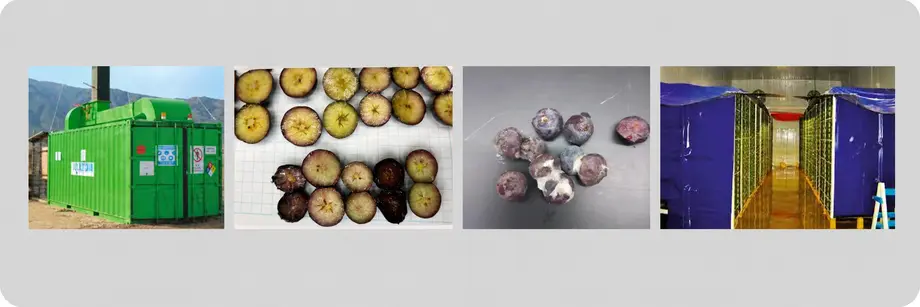
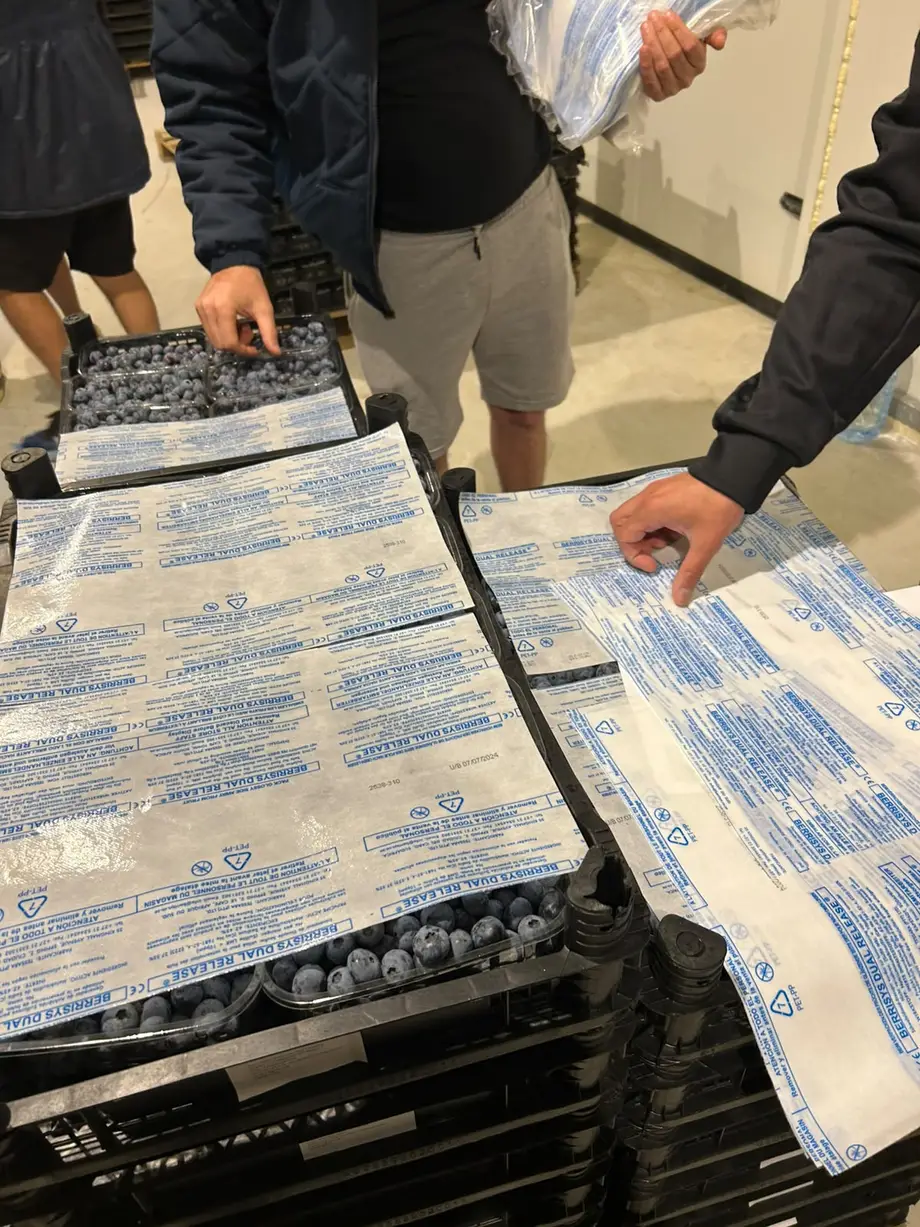
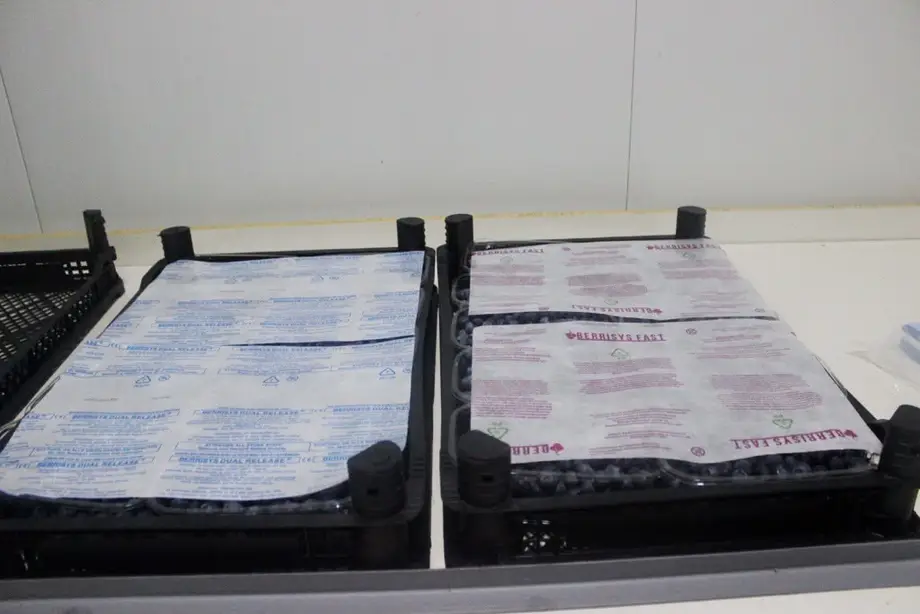
Sulphur dioxide-generating sheets illustrate why the postharvest process requires specialist knowledge. They are not simply liners placed between boxes. In systems such as Berrisys®, sodium metabisulphite is incorporated between membranes; moisture activates SO₂ release. Different constructions provide faster release, slower release or a combination of both (AgroFresh, n.d.-a, n.d.-b).
The purpose is to expose the fruit to an antifungal gas, particularly to limit grey mould and its spread. A faster phase and sustained low-level release perform different functions. They must be matched to the intended packing system rather than selected only by sheet size or purchase price (AgroFresh, n.d.-a).
Independent research shows the potential and the limits. Saito and Xiao (2017) obtained strong grey-mould control with a dual-release pad during five weeks at 1 °C, but more than 20% of berries in that treatment developed bleaching and the fruit softened.
Their slow-release-pad and modified-atmosphere combination offered a more promising balance under those conditions. This is not a verdict against all dual-release products; it demonstrates that fungal control alone is an incomplete measure of success.
Saito et al. (2020) subsequently evaluated SO₂-emitting liners across five cultivars over two years. The liners reduced decay, while packaging ventilation influenced water loss and treatment performance. Bleaching was not observed in those trials. The relevant unit of validation was the fruit-and-packaging system, not SO₂ in isolation.
For an exporter, that means specifying the correct product, fruit quantity, liner or any other protection, ventilation and intended duration together. The supplier’s claimed period of activity must not be read as a guarantee that every lot will retain acceptable quality for that long. A sheet can remain active while another quality attribute becomes unacceptable.
Preventing mould is essential. Delivering fruit that still tastes and feels right is the wider objective.
Gas treatment and in-pack release are different operations
SO₂ can also be applied as a controlled postharvest gas treatment. Research coordinated through the IR-4 Project examined compressed-gas application in fumigation chambers and metabisulphite pads in fruit containers, separately and in combination. These are different delivery methods, each requiring its own validation (Ross, 2023).
Rivera et al. (2013) demonstrated the importance of gas concentration and exposure time in blueberry grey-mould control, including pallet-scale trials. They measured exposure at different positions, recognising that the treatment delivered to the fruit matters more than the amount nominally introduced into an enclosure.
A chamber treatment provides a defined exposure before the next stage of handling. In-pack release can continue during storage and transport. Combining them is not automatically better: the complete exposure pattern, quality response and residues must be assessed together. A result obtained on table grapes is not sufficient validation for blueberries.
This is also worker protection, not just fruit protection. SO₂ is hazardous by inhalation and can irritate the eyes and respiratory system (National Institute for Occupational Safety and Health [NIOSH], 2019). There is no justification for improvising a treatment because a shipment is urgent.
South Africa: the instructions are part of the technology
The discussions during my visit made these distinctions practical. Operators wanted to understand storage of unused sheets, resealing opened packs, expiry control and whether the correct instructions had reached the packhouse through the distributor. These were not secondary questions: they concerned how the purchased technology was being used.
The lesson I take from this is that a product specification must become an operating procedure. Staff need to know the approved configuration, how materials are stored, when a batch cannot be used and what to do after a deviation.
Any extension beyond a labelled expiry date should require documented, batch-specific justification from the responsible supplier.
A packaging substitution, an added liner or a different absorbent layer should be assessed before implementation. A small purchasing decision can change a system that was previously validated. The supplier, distributor and operator all have a role in preventing that gap.
Exposure, residues and contamination must not be confused
Monitoring must answer distinct questions. A gas sensor measures SO₂ in the atmosphere. A passive dosimeter can indicate exposure accumulated over time. A laboratory residue test measures the relevant substances remaining in the fruit. These measurements are related, but they are not interchangeable (Rivera et al., 2013; Ross, 2023).
For example, ppm measured in a gas environment is not the same measurement as mg/kg in fruit. A gas reading cannot establish compliance with a residue specification. Nor can one reading near a door, establish exposure throughout a load.
The idea of simple colour-changing indicators is developing, proving they are calibrated for the application. Detector instructions themselves specify limits for temperature, humidity, exposure duration and interfering gases (Gastec Corporation, n.d.). An indicator designed for hours cannot simply be assumed to validate a multiweek voyage. It should complement, not replace, fruit testing and process records.
For EU-bound fruit, pesticide maximum residue levels must be met. An MRL is a legal limit linked to the correct use of a pesticide, not a declaration that every possible hazard has been excluded. Buyers can impose additional specifications, so exporters must establish both the legal requirements and the intended customer’s conditions before treatment and dispatch (European Commission, n.d.-b; CBI, 2025).
Active food-contact materials introduce further obligations under Regulation (EC) No 450/2009. An antifungal effect does not, on its own, establish that a particular product, released substance or use is authorised for the intended market (European Commission, 2009).
Sulphites use deserve clarity. EU food-information rules include sulphur dioxide and sulphites above 10 mg/kg or 10 mg/litre, expressed as total SO₂ in the ready-to-consume product, within mandatory allergen-information requirements.
This is not a universal pesticide MRL or blanket permission to use SO₂ below that concentration (European Parliament & Council of the European Union, 2011).
As so, unexplained deposits on berries is a separate issue requiring identification and assessment. Likewise, a treatment validated against Botrytis is not automatically validated against human pathogens.
The FDA’s berry prevention strategy addresses hepatitis A and norovirus and stresses consistent preventive practices across the chain (U.S. Food and Drug Administration, 2025). Sound hygiene, suitable water and clean handling cannot be replaced by an antifungal sheet.
A delay changes the protection requirement
Additional days extend the time during which the lot must retain acceptable quality. A delay under stable, validated conditions is not equivalent to one involving warming, repeated handling and a disrupted atmosphere.
The expected quality at destination must be reassessed from the actual history, not from the original booking.
Extra time can increase water loss and shrivelling even when fungal growth is suppressed. SO₂-liner research evaluated decay control and moisture retention as different outcomes (Saito et al., 2020).
A lot may therefore remain free of obvious mould without retaining the appearance or texture required by the customer.
That reassessment should include the treatment system. Does the remaining journey still fall within the validated programme? Has an active pack been opened or replaced? Is its gas environment still appropriate?
It is unsafe to assume that a longer journey can be corrected by simply adding another sheet or repeating a gas treatment.
There is also a difference between arriving sound and remaining sound. My validation would include the intended transport period followed by a defined distribution and retail simulation. It would measure decay, firmness, shrivelling, leakage, treatment injury and eating quality, with appropriate residue testing. A cold-store photograph is not an adequate commercial endpoint.
Retained reference samples can help, but their storage history must be recorded: fruit kept continuously in an ideal cold room is not proof of how the shipped lot performed. The destination inspection and subsequent retail-life assessment remain necessary.
When delayed shipments arrive together
A delay does more than age one consignment. It can disrupt the balance between origins and selling weeks.
Consider a hypothetical programme expecting 100 tonnes each week for three weeks. If the first two consignments are delayed and all three become available in the third week, receiving capacity faces 300 tonnes instead of 100. Seasonal volume has not increased, but two weeks of shortage have been followed by a concentrated arrival.
Assuming unchanged demand and no alternative outlet, the importer now has more fruit to sell quickly, while the earlier lots have already spent longer in transit. This can create pressure for markdowns, additional grading and accelerated distribution. It is a commercial scenario, not a prediction that every delayed season will produce the same price movement.
The complication becomes greater when delayed fruit from one origin meets an on-time programme from another, or cargo diverted from a different destination. What was intended as seasonal complementarity can become competition within the same week. Physical arrivals may be abundant while fruit suitable for a premium programme is scarce.
Redirection also needs a compliance check, not just a buyer. Great Britain and the EU can apply different pesticide MRLs, while EU MRLs apply in Northern Ireland (Health and Safety Executive, n.d.). The fruit’s treatment history, packaging and customer specifications must remain compatible with the new destination.
Shipping cut-offs consequently belong in commercial planning. Maersk distinguishes container gate-in, shipping instructions and verified-gross-mass deadlines; missing one can undermine an otherwise well-prepared programme (Maersk, n.d.).
My recommendation is to manage expected arrival date, condition, remaining validated life and committed sales together. A promotion should be based on fruit likely to be available and acceptable, not simply tonnes already loaded overseas.
When delays emerge, early adjustments to allocation and marketing are more useful than discovering the mismatch after unloading.
The same principle, different berries
Blueberries provide the main example, but preservation must remain fruit specific. In blackberries, transport-like vibration can induce red drupelet reversion, with differing cultivar susceptibility. An antifungal treatment cannot be assumed to prevent this appearance defect; handling and packaging need their own assessment (Flores-Sosa et al., 2022).
For raspberries, leakage, loss of structure and decay sharply constrain the commercial period. Islam and Mitcham (2024) found that elevated-CO₂ atmospheres maintained good quality for up to ten days under their experimental conditions, compared with marked deterioration after about five days in air. That result supports a tested raspberry programme, not a universal ten-day allowance.
In strawberries, prompt cooling, injury prevention and suitable CO₂-enriched shipment conditions remain important foundations (Mitcham et al., 1996). Their acceptance test must also include flavour, colour and texture. A successful blueberry protocol is not automatically a strawberry protocol.
Other technologies, including UV-C, aqueous ozone and cold plasma, have shown potential in blueberry research (Zhou et al., 2019). Their commercial value still needs demonstration at realistic throughput, under the intended route and regulatory conditions. The useful question is which problem a technology solves, not how many technologies can be added to the line.
The final destination is the consumer, not the port
The grower creates the fruit’s potential, but the packhouse, technology supplier, carrier, importer and retailer must preserve it. Recognising that work means recognising shared responsibility, not making the grower answer for every event after dispatch.
A practical programme should connect harvest identity, cooling records, treatment and packaging batches, transport history and destination checks.
It should also define who acts when a deviation occurs. A temperature alarm has limited value when nobody is authorised to change the plan.
At destination, I would prioritise lots according to condition and remaining validated life, rather than arrival order alone. Any repacking or change of atmosphere belongs in the assessment.
A safe lot with a shorter quality window may need faster sale; a lot that fails safety or legal requirements cannot simply be diverted to a less demanding customer (European Commission, n.d.-a).
Consumers do not need a technical lecture beside the shelf. They should expect safe berries, good flavour and reasonable value. But a clearer account of the journey would show that a punnet arriving from the other side of the world represents more than successful farming. It represents a sequence of controlled operations, trained people and decisions taken against deadlines.
That is the less visible industry I encountered in South Africa: not a single sheet or treatment, but the knowledge required to use protection correctly and keep it connected to logistics and the market.
The objective is not to keep berries travelling for as long as possible. It is to deliver them while they still have enough quality left to be enjoyed.
European Commission. (2009). Commission Regulation (EC) No 450/2009 of 29 May 2009 on active and intelligent materials and articles intended to come into contact with food. Official Journal of the European Union, L 135, 3–11. https://eur-lex.europa.eu/eli/reg/2009/450/oj/eng
European Parliament & Council of the European Union. (2011). Regulation (EU) No 1169/2011 of 25 October 2011 on the provision of food information to consumers. Official Journal of the European Union, L 304, 18–63. https://eur-lex.europa.eu/eli/reg/2011/1169/2025-04-01/eng
Flores-Sosa, A. R., Fabela-Gallegos, M. J., Cruz-Acevedo, M. E., Rivera-Pastrana, D. M., Nava, G. M., & Mercado-Silva, E. M. (2022). A portable vibration system to induce and evaluate susceptibility to red drupelet reversion in blackberry cultivars. Horticulturae, 8(7), Article 631. https://doi.org/10.3390/horticulturae8070631
Islam, M. R., & Mitcham, E. (2024). Extending raspberry shelf life and maintaining postharvest quality with CO₂ atmospheres. Horticulturae, 10(10), Article 1092. https://doi.org/10.3390/horticulturae10101092
National Institute for Occupational Safety and Health. (2019, October 30). NIOSH pocket guide to chemical hazards: Sulfur dioxide. Centers for Disease Control and Prevention. https://www.cdc.gov/niosh/npg/npgd0575.html
Rivera, S. A., Zoffoli, J. P., & Latorre, B. A. (2013). Determination of optimal sulfur dioxide time and concentration product for postharvest control of gray mold of blueberry fruit. Postharvest Biology and Technology, 83, 40–46. https://doi.org/10.1016/j.postharvbio.2013.03.007
Saito, S., Obenland, D., & Xiao, C.-L. (2020). Influence of sulfur dioxide-emitting polyethylene packaging on blueberry decay and quality during extended storage. Postharvest Biology and Technology, 160, Article 111045. https://doi.org/10.1016/j.postharvbio.2019.111045
Saito, S., & Xiao, C.-L. (2017). Evaluation of sulfur dioxide-generating pads and modified atmosphere packaging for control of postharvest diseases in blueberries. Acta Horticulturae, 1180, 123–128. https://doi.org/10.17660/ActaHortic.2017.1180.17
Zhou, D., Wang, Z., Tu, S., Chen, S., Peng, J., & Tu, K. (2019). Effects of cold plasma, UV-C or aqueous ozone treatment on Botrytis cinerea and their potential application in preserving blueberry. Journal of Applied Microbiology, 127(1), 175–185. https://doi.org/10.1111/jam.14280
California Giant Berry Farms announced a multi-region expansion of its strawberry and blackberry programs. With new harvesting windows beginning across key growing regions in California and Mexico, the company is delivering on its commitment to consistent, reliable year-round supply supported by strategic investments in growing regions, grower partnerships, and production capacity.
The multi-district expansion strengthens supply and scales production across core growing regions:
Central Mexico: Increased acreage across both conventional and organic strawberry programs.
Florida: Expanded conventional strawberry acreage to meet winter and early spring demand.
Oxnard, CA: New conventional strawberry production, bolstering late-fall and spring volume.
Baja, Mexico: New organic strawberry production to expand winter and early spring organic availability.
San Diego, CA: New organic blackberry acreage to expand fall, winter and early spring organic availability.
California Giant’s Tom Smith.
By scaling production across these primary growing regions, the company enhances its 52-week supply capabilities, giving retail and foodservice partners the confidence to build long-term, high-volume berry programs. The expansion increases flexibility across production regions, helping it maintain a more consistent supply position and provide customers with greater confidence throughout the year.
“Our growth strategy centers on building surety of supply through thoughtful region selection, geographic expansion, and strong grower relationships,” said Tom Smith, vice president of sales and marketing at California Giant Berry Farms. “This expansion is not a short-term reaction to market conditions, but a disciplined investment in the people, growing regions, and infrastructure needed to be the most dependable year-round berry partner in the industry.”
By balancing supply curves across multiple growing regions, the company is able to support high-capacity customer commitments while promoting long-term grower success and economic sustainability. These investments strengthen a more resilient supply network and reflect its ongoing commitment to customer service, operational excellence, transparent communication, and long-term partnership.
Industry partners attending the IFPA Global Produce & Floral Show are invited to connect with the company’s team at booth #2743 to discuss 52-week supply programs across strawberries, blueberries, raspberries, and blackberries.
New Zealand legislation prioritises domestic vegetable growing
The NZ Vegetable Council (NZVeg) is welcoming the passing of the Natural Environment and Planning Bills, which herald a new era in resource management in New Zealand.
‘We’re exceptionally pleased that the new legislation – to be specific, the Natural Environment Act – recognises the importance of and prioritises the growing of food in New Zealand,’ says NZVeg CEO Mike Brown.
‘For more than a decade, vegetable growers have struggled with the inconsistent application of resource management legislation, particularly across the key growing areas of Pukekohe, the Horowhenua and Canterbury.
‘Millions of dollars have been wasted in hearings, tribunals and courts, to say nothing of the missed opportunities resulting from all the uncertainty.
‘No wonder around half of the country’s vegetable growers are currently not certain if they will be in business in ten years’ time. This is a sobering statistic for an industry worth $1.1 billion in farmgate returns a year.’
Mike says the Natural Environment Act should pave the way for a national and consistent approach to vegetable production in New Zealand.
‘The new Act sets the scene and gets the basics right by prioritising the production of food and fibre. This should ensure a national approach to vegetable growing, which is what NZVeg and other vegetable sector groups have been advocating for, for more than a decade.
‘A national approach is important to ensuring New Zealand can produce fresh, healthy vegetables, at reasonable prices, now and in the future. For the past year, vegetables have been great value for money. According to Statistics NZ, fruit and vegetable prices fell by 1.6% between August 2025 and August 2026. This drop is pretty incredible, especially when you consider how much inputs such as fuel and electricity have gone up.
‘These comparatively low vegetable prices have been driven by the fact that growing conditions for the past year have been good, so supply has been plentiful. However, a major weather event like a cyclone or flood in one of the country’s key vegetable growing areas could see supply severely affected, which would create shortages and raise prices.
‘That’s why being able to grow vegetables across New Zealand is very important to ensuring consistent supply and value for money prices for consumers.’
To provide the best experiences, we use technologies such as cookies to store and/or access device information. Consenting to these technologies will allow us to process data such as browsing behavior or unique IDs on this site. Failure to consent or withdrawing consent may adversely affect certain features and functions.
Functional
Always active
Technical access or storage is strictly necessary for the legitimate interest purpose of enabling the use of a specific service explicitly requested by the subscriber or user, or for the sole purpose of carrying out the transmission of a communication over an electronic communications network.
Preferences
Technical access or storage is necessary for the legitimate interest purpose of storing preferences that are not requested by the subscriber or Internet user.
Statistics
Technical storage or access that is used exclusively for statistical purposes.Technical storage or access that is used exclusively for anonymous statistical purposes. Absent a subpoena, voluntary compliance from your internet service provider, or additional records from a third party, information stored or retrieved for this sole purpose generally cannot be used to identify you.
Marketing
Technical access or storage is necessary to create user profiles in order to send advertisements, or to track the user on a website or across websites with similar marketing purposes.



 For more information:


 For more information:


 For more information:
 California Giant’s Tom Smith.
 For more information:

 For more information:
