Archive

« Les formats 300 g rencontrent un très bon accueil dans le commerce alimentaire de détail » par Ewelina Dittmeyer et FreshPlaza

Ewelina Dittmeyer à propos de la saison des myrtilles en France cette année :

« Les formats 300 g rencontrent un très bon accueil dans le commerce alimentaire de détail »

La saison française des myrtilles approche désormais de son pic. « En raison des conditions météorologiques, la récolte a commencé cette année dès la dernière semaine de mai, soit environ une semaine plus tôt que l’année précédente. En revanche, l’Espagne a accusé un retard d’environ deux semaines, ce qui a entraîné au début un afflux important de marchandises sur le marché. Le commerce alimentaire de détail français privilégie toutefois les myrtilles d’origine nationale, d’autant plus que la qualité des fruits espagnols s’est quelque peu dégradée en fin de campagne. Dans ce contexte, le début de saison a été plutôt satisfaisant », explique Ewelina Dittmeyer, de l’entreprise portant son nom, qui exploite ses propres cultures dans le Sud-Ouest de la France.

À l’heure actuelle, en pleine période de récolte, l’offre et la demande sont globalement équilibrées. « La demande est particulièrement dynamique et les volumes disponibles sont satisfaisants. À partir des semaines 27/28, les quantités récoltées devraient toutefois légèrement diminuer en raison de la vague de chaleur persistante. Au cours de la semaine 26, nous avons de nouveau enregistré dans le Sud-Ouest des températures dépassant parfois les 40 °C, ce qui représente un véritable défi pour la production. Malgré cela, la qualité des fruits a jusqu’à présent été bonne et le calibre des baies correspond dans la majorité des cas au standard recherché de 12+. » Malgré ces conditions chaudes, l’équipe commerciale de Dittmeyer estime pouvoir continuer à approvisionner le marché français en petites myrtilles jusqu’à la mi-juillet.

Une hausse mesurée des coûts et des prix
Les ventes peuvent également être qualifiées de stables, poursuit Ewelina Dittmeyer. Jusqu’au début du mois de juillet, le commerce alimentaire de détail met régulièrement en place des actions promotionnelles tout au long de la saison, ce qui contribue considérablement à assurer une bonne régularité des écoulements et à maintenir les niveaux de prix. « Par rapport à l’année dernière, les prix ont progressé de manière raisonnable et nous prévoyons des niveaux stables, voire légèrement supérieurs, même en fin de saison. Nous sommes également confrontés à une hausse continue des coûts de production, notamment en raison de l’augmentation des charges salariales. Contrairement à l’Allemagne, les salaires minimums en France ne connaissent toutefois pas de fortes revalorisations ponctuelles, mais progressent d’environ 2 % par an, ce qui permet au marché de mieux absorber ces évolutions. »

Environ un tiers de la surface totale est consacré à la production sous tunnel

L’importance croissante des myrtilles françaises
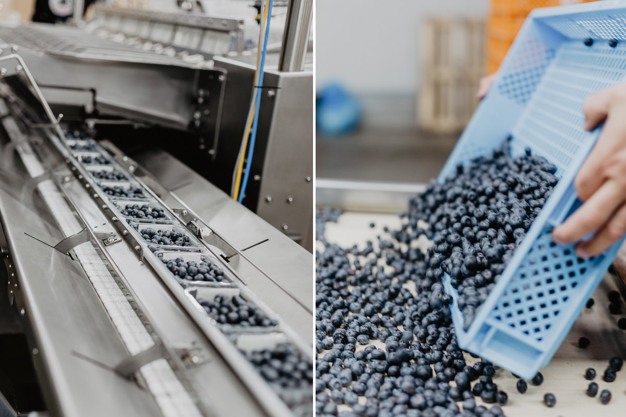
La plantation moderne de myrtilles située au sud-ouest de Bordeaux couvre aujourd’hui environ 80 hectares et constitue l’un des trois sites de production du groupe familial Dittmeyer, originaire de Hambourg. Depuis 2017, des myrtilles destinées au commerce alimentaire de détail français y sont cultivées. Alors qu’à l’origine la majorité de la production était exportée vers les pays voisins, plus de 90 % des volumes récoltés sont désormais commercialisés auprès des consommateurs français via la grande distribution. « La myrtille française a connu un développement remarquable au cours des cinq à six dernières années. Outre les fruits frais, de nombreux produits transformés sont désormais également présents dans les rayons des grandes enseignes. Nous constatons aussi que les nouveaux formats de barquettes et de coupelles de 300 g (photo ci-dessous) sont très bien accueillis comme alternative aux conditionnements de 125 g. Selon nous, il s’agit d’un excellent compromis et probablement du format d’avenir », explique Wout Verledens, directeur commercial de l’entreprise depuis cette année.

Des investissements qui commencent à porter leurs fruits
Face à la demande croissante pour les myrtilles françaises, de nombreuses exploitations agricoles, principalement des structures petites et moyennes, se sont lancées dans cette culture, entraînant une augmentation de la production nationale. Wout Verledens précise : « Nous ne prévoyons donc pas, pour le moment, d’augmenter davantage nos surfaces. Nous nous concentrons plutôt sur l’optimisation de notre gamme variétale et de nos méthodes de production. Pour lutter contre le gel, nous utilisons différentes techniques, comme l’aspersion antigel, les bougies et les systèmes de chauffage antigel, auxquels s’ajoute depuis cette année une machine à brouillard pour nos cultures de plein champ. Nous adaptons également en permanence notre gamme variétale aux nouvelles conditions de production. Nous recherchons encore actuellement une variété performante pour la fin de saison, en complément de Liberty. » Par ailleurs, les équipements de refroidissement ont également été modernisés l’année dernière.

De bonnes perspectives pour la récolte bio en Allemagne
En plus de ses productions conventionnelles en Espagne et en France, Dittmeyer développe depuis plusieurs années une importante activité de myrtilles biologiques en Basse-Saxe. Les perspectives y sont également encourageantes. « Nous devrions commencer la nouvelle récolte au cours de la semaine 29 et le développement des cultures est particulièrement satisfaisant jusqu’à présent. Si les conditions météorologiques restent favorables, les volumes devraient dépasser ceux de l’année dernière, avec une proportion importante de fruits de gros calibre ».

Pour plus d’informations :
Ewelina Dittmeyer & Wout Verledens
SCEA Dittmeyer Agricola
Domaine des Myrtilles
3346 Route de Sanguinet
F-40160 Parentis-en-Born
Tél. : +49 1627719176
frucht@dittmeyer.com
www.dittmeyer.com Date de publication: ven. 26 juin 2026

« Nous tablons sur des recettes nettes supérieures à celles de l’année dernière » par Exploitation fruitière Knöbl et FreshPlaza

Début de la récolte des groseilles précoces dans le sud du Burgenland :

Exploitation fruitière Knöbl

Comme les années précédentes, la récolte des groseilles dans le sud du Burgenland a débuté au cours de la semaine 24. « Après un mois de mars et un mois d’avril particulièrement secs, le mois de mai a été chaud et relativement bien arrosé. Sans irrigation, nous aurions toutefois enregistré des pertes considérables, car la variété Marlena, que nous cultivons exclusivement, fleurit précisément à cette période, en mars », explique David Knöbl, de l’exploitation fruitière éponyme située à Neudauberg, dans le sud du Burgenland.

En plus de la production de pommes, M. Knöbl cultive depuis maintenant cinq ans des groseilles précoces sur une surface d’environ 1,3 hectare. Les fruits sont commercialisés exclusivement auprès du commerce de détail alimentaire régional par l’intermédiaire de son partenaire styrien Lammer Fruchtlogistik GmbH. La récolte s’étale sur les semaines 24 et 25, avant que l’intégralité des volumes récoltés ne soit écoulée en moins de deux semaines. « Nous prévoyons un volume total d’environ 15 à 16 tonnes, soit un niveau comparable à celui de l’année dernière. Toutefois, la récolte précédente comptait proportionnellement davantage de petits fruits, principalement en raison de la présence de bois de deux ans. Cette année, nous avons presque exclusivement du bois d’un an, ce qui devrait se traduire par des fruits plus gros, de meilleurs rendements et, par conséquent, des recettes nettes plus élevées. »

La variété précoce Marlena permet une commercialisation anticipée des groseilles produites localement. Elle arrive à maturité nettement plus tôt que les variétés traditionnellement cultivées en Autriche, comme Haronia et Rovada

Le producteur reste encore prudent concernant les perspectives commerciales précises. « Il faut toutefois tenir compte du fait que la demande pourrait être légèrement inférieure cette année en raison de la prudence persistante des consommateurs en matière d’achats », explique M. Knöbl. Les prix devraient néanmoins rester globalement comparables à ceux de l’année dernière. En magasin, les groseilles issues de la production locale sont proposées soit en barquettes de 250 g (groupe Rewe), soit en barquettes de 500 g (Hofer).

Un enrichissement de l’assortiment
Cinq ans après la première récolte, l’exploitation fruitière familiale tire un bilan particulièrement positif de cette production. « Grâce à cette entrée en saison précoce, notre partenaire commercial consolide sa présence sur le marché et complète son assortiment existant, principalement basé sur les variétés Haronia et Rovada. Pour nous, en tant que producteurs, la groseille représente désormais une véritable gamme à part entière qui, notamment grâce à son calendrier de récolte, s’intègre parfaitement à côté de la culture des pommes. » En période de pointe, l’exploitation emploie jusqu’à 18 cueilleurs, principalement originaires d’Ukraine.

La Pinova poursuit son développement
Le verger de pommiers de l’exploitation comprend un large éventail de variétés, parmi lesquelles Golden Delicious, Pinova, Supernova (un mutant de Pinova), Granny Smith, Idared, Braeburn et Fuji. La surface totale cultivée atteint environ 16 hectares. « Nous devrions très probablement enregistrer une récolte moyenne cette année. En raison du mois de mai chaud et humide qui a suivi directement la floraison, nous aurons probablement une proportion légèrement plus élevée de fruits tombés, comme cela a également été le cas pour les groseilles. »

À l’exception de quelques pertes limitées dans les zones situées en altitude, l’exploitation a été largement épargnée par les dégâts liés au gel. La récolte des pommes commence généralement à partir de la mi-septembre, après quoi les fruits sont commercialisés exclusivement sur le marché libre. « Ces dernières années, nous avons ajusté nos surfaces par variété en fonction de l’évolution de la demande. Nous avons ainsi progressivement augmenté les volumes de Pinova, tandis que nous avons légèrement réduit ceux de Fuji. Dans les prochaines années, nous poursuivrons cette orientation et remplacerons progressivement les variétés plus anciennes, comme l’Idared, par la Pinova », conclut-il.

Pour plus d’informations :
David Knöbl
Exploitation fruitière Knöbl
Gemeindestraße 9
7574 Neudauberg
Tél. : +43 664 8685730

Drainage analysis and AI-supported nutrient management in soilless production by Hortidaily

Drainage analysis and AI-supported nutrient management in soilless production

“The most important question in soilless production is not what we apply to the crop, but what is actually happening in the root zone,” says Birgül Albayrak, Agricultural Engineer and Soilless Strawberry R&D Specialist.

As soilless production systems become increasingly data-driven, drainage analysis is evolving from a routine monitoring activity into a critical decision-making tool.

While EC, pH, and irrigation volumes remain the foundation of nutrient management, the challenge for modern growers is interpreting these parameters in real time and translating them into precise production strategies.

“The focus today is not only on what is supplied to the crop, but on understanding what is happening within the root zone and responding before imbalances affect performance,” she explains.

Drainage as an indicator of root-zone dynamics
Drainage measurements provide one of the clearest indicators of nutrient movement and accumulation within the substrate. Comparing input and drainage EC values allows growers to identify trends in nutrient uptake, irrigation effectiveness, and salt accumulation before visible crop symptoms develop.

“High root-zone EC is often interpreted as excess fertiliser, but in practice it can indicate a broader range of issues, including osmotic stress, restricted water uptake, and nutrient antagonisms,” says Samet Albayrak, Agricultural Engineer and Consultant for Soilless Strawberry Production.

He adds that when EC remains elevated over extended periods, nutrient interactions can become increasingly significant. “Excess concentrations of certain ions may reduce the availability of calcium, magnesium, iron, and other essential elements, even when these nutrients are present in adequate quantities within the solution.”

As a result, flushing decisions should be based on measured root-zone conditions rather than fixed schedules. Drainage EC, irrigation volumes, climatic conditions, and crop stage all contribute to determining whether corrective action is required.

Irrigation uniformity remains critical
Accurate volume-based irrigation management continues to be fundamental in high-performance production systems. “Although irrigation scheduling technologies have advanced significantly, uneven water distribution can still occur due to pressure variations, emitter performance, or system design limitations,” he says. “Professional irrigation management requires verification of actual delivery volumes throughout the system. Even small variations in emitter output can influence root-zone conditions and ultimately affect crop uniformity.”

The two argue that regular validation of flow rates and delivered volumes remains essential to ensure irrigation strategies perform as intended. “Insufficient irrigation can increase root-zone EC and salt accumulation, while excessive irrigation may reduce oxygen availability and contribute to nutrient losses.”

The growing role of AI and sensor technologies
Birgül says that the next stage of precision horticulture is increasingly centred on continuous monitoring and predictive analysis. “Modern sensor platforms now extend well beyond EC and pH measurements, incorporating moisture, oxygen, nitrate, temperature, climate data, and a growing range of nutrient-specific measurements. The value of sensor technology lies not only in data collection, but in its ability to reveal trends that would otherwise remain unnoticed until crop performance declines.”

She notes that artificial intelligence is further enhancing this capability by analysing historical production data alongside real-time sensor inputs. “Artificial intelligence enables growers to transform large volumes of sensor data into practical production decisions,” Samet adds. “By analysing historical and real-time information together, irrigation timing, nutrient formulations, and resource use can be optimised more precisely.”

“For growers operating high-value greenhouse crops, the ability to understand and respond to root-zone dynamics in real time is becoming an increasingly important component of maintaining productivity, resource efficiency, and crop quality,” he concludes.

For more information:
Birgül Albayrak, Agricultural Engineer / Soilless Strawberry R&D Specialist
sagincbirgul@gmail.com
linkedin.com/birgul-albayrak

Samet Albayrak
Agricultural Engineer / Consultant for soilless strawberry production
sametalbayrak.agro@gmail.com
linkedin.com/samet-albayrak Publication date: Wed 24 Jun 2026

© HortiDaily.com / Tinneke Hattingh

Strawberry tip production in Morocco supports Northern European propagation needs by Planasa with FreshPlaza

Strawberry tip production in Morocco supports Northern European propagation needs

During a recent visit to Planasa’s nursery in Kenitra, Morocco, Ronnie Kersten, Business Development Director Northern Europe at Planasa, joined customers, propagators and partners to evaluate strawberry tip and microplug production and assess its potential for Northern European markets.

“The objective was to look at the strawberry tip and microplug production, and to understand the opportunities and possibilities for our customers in Northern Europe,” he shares.

He adds that the visit provided valuable insight into how Moroccan propagation can support European growers and propagators facing increasing operational challenges. “Many propagators are short in capacity, labour availability is an issue, and increased labour and energy costs have made the search for alternative production locations more important.”

Advantages of Moroccan tip production
One of the highlights for him from the visit was the role Morocco can play in supplying certified propagation material to Northern Europe.

“Producing tips in Morocco for Northern European propagators offers significant advantages in terms of timing, quality and cost reduction.” He notes that Moroccan authorities recognise the European certification system, enabling certified plant material to move efficiently through the supply chain.

The Kenitra nursery produces strawberry tips from a wide range of varieties originating from different breeding companies, providing flexibility for propagators working with diverse genetics and market requirements.

Plant health as a foundation
A strong emphasis on plant health leads the propagation programme. Certified mother plants free from pests and pathogens are used as the starting point, while monitoring and testing continue throughout the propagation process.

“High-quality propagation starts with certified plant material and consistent phytosanitary control at every stage,” Douglas Rodriguez, Global Plant Health Director at Planasa, says.

The operation follows a global propagation material certification programme covering mother plants, tissue culture multiplication, pre-basic, basic and commercial nursery stages. Plant material transferred between countries is also subject to internal certification procedures designed to minimise phytosanitary risks.

Supporting these activities is a dedicated plant health laboratory, which increases testing capacity and enables rapid diagnosis of target pathogens.

Digital monitoring and integrated crop health management
Another area highlighted during the visit was the use of digital monitoring systems. Pest and disease observations are recorded digitally, providing real-time access to information and supporting faster decision-making.

“Early detection is critical. Digital monitoring allows teams to respond quickly and prevent issues from spreading through the propagation chain.”

The nursery also combines conventional crop protection with biological and biorational solutions. Staff receive ongoing training in pest and disease identification, integrated pest management and responsible pesticide use, while application equipment is regularly calibrated to ensure accurate treatments.

Impact on grower performance
Propagation quality has direct implications for crop performance after planting. Even asymptomatic infections can affect establishment, plant development, yield and fruit quality.

“Healthy propagation material is one of the most important factors influencing crop performance later in the growing cycle. The benefits of strong phytosanitary management are seen throughout the production process,” Douglas says.

Reflecting on the visit, Ronnie praised the local operation in Kenitra. “We were very impressed by the team, the organisation, the professionalism and the quality of the plants.”

For more information:
Planasa
Ronnie Kersten
rkersten@planasa.com
www.planasa.com

Study finds strawberry colour can mislead harvesting robots by Lisa HortonUniversity of East Anglia and FreshPlaza

Study finds strawberry colour can mislead harvesting robots

Researchers at the University of East Anglia (UEA), working with agri-tech firm Antobot, have found that the colour of strawberries captured by cameras may not always provide an accurate indication of ripeness, raising questions about the reliability of vision-based agricultural robotics.

As automation becomes more common in crop monitoring and harvesting, cameras are increasingly used to assess fruit ripeness, detect disease, estimate yields, and support quality control. For strawberries, ripeness is largely judged by colour.

Prof Graham Finlayson, from UEA’s School of Computing Sciences, said: “In the race to modernise agriculture, farmers are increasingly relying on technology to monitor plant health or predict crop yield.

“Cameras have taken on jobs once done by the human eye – for example, they may be monitoring crop health, detecting disease, estimating yields, deciding when fruit is ready to harvest or determining what ends up on supermarket shelves.”

To investigate the accuracy of camera-based assessments, researchers photographed strawberries under field conditions while the fruit remained on the plant. They then compared the images with berries selected for harvest by experienced pickers.

Postgraduate researcher James Bennett said: “When we processed images using standard camera settings, the strawberries showed noticeable differences in colour – even when they were equally ripe.

“But after applying a simple calibration technique using a colour checker placed in each image, much of that variation disappeared.”

According to the researchers, uncorrected images showed ripe strawberries ranging from deep magenta to bright orange-red depending on lighting conditions, while calibrated images produced more consistent colour measurements.

The calibration method reduced variation in strawberry colour measurements by 48 per cent, indicating that much of the inconsistency originated from the imaging process rather than the fruit itself.

The findings suggest that some colour differences detected by automated systems may be caused by image capture and processing conditions rather than actual variation in ripeness.

Prof Finlayson said: “As automation becomes more widespread, ensuring the fidelity of visual data will be crucial for reliable decision-making – from yield predictions to quality control.”

Marc Jones of Antobot added: “Autonomous robots are only as good as the information they receive. Improving the consistency and reliability of crop data is fundamental to making better decisions in the field, whether that’s monitoring crop health, identifying harvest readiness or improving yields.

“This research is an important step towards building more intelligent, more trusted and ultimately more productive autonomous farming systems.”

For more information:
Lisa Horton
University of East Anglia
Email: l.horton@uea.ac.uk

Jim Mellon invests in UK’s berry-picking robots by Fieldwork Robotics Ltd. and FreshPlaza

Jim Mellon invests in UK’s berry-picking robots

Fieldwork Robotics has announced an investment from SEED Innovations Ltd, the AIM-quoted investing company chaired by prominent British businessman Jim Mellon. The investment forms part of a £2.5 million Seed+ fundraise and combined investment and grant funding announced in April 2026.

Jim Mellon is one of the UK’s most prominent early-stage investors, with a long track record of identifying and backing transformative technology businesses. Through SEED Innovations, which is focused on high-growth robotics and AI ventures, Mellon has been vocal about the opportunity for autonomous systems to address real-world labour and productivity challenges, an ethos that sits at the heart of Fieldwork’s mission.

Berry growers worldwide face rising labour costs, a shortage of available fruit pickers, and supply chain pressures that drive up harvesting wages. These challenges increase food waste, push up consumer prices, and contribute to higher climate emissions. Large volumes of soft fruit are lost due to a shortage of pickers. Fieldwork’s autonomous harvesting robots address these issues directly, reducing reliance on seasonal labour, boosting productivity, and operating efficiently across entire farms, helping growers protect margins and scale production sustainably.

The Seed+ fundraise enables Fieldwork to accelerate farm adoption of its autonomous harvesting technology and transition from the technology validation stage to commercial trials. The Company is currently deploying production robots in a two-year IUK ADOPT programme with Place UK in Norfolk and Littywood Farm in Stafford. Subject to these trials, Fieldwork expects multi-robot fleets to be operating on farms from 2027, with planned international trials in Australia as part of its global expansion strategy.

David Fulton, Fieldwork Robotics CEO commented: “SEED’s support at this stage is vital as we move into this important next chapter for Fieldwork. This fundraise supports the demand for our robotic harvesting capabilities from our grower customers and builds on the significant commercial progress we are making and gives us the platform to accelerate farm adoption of our technology at scale. We are now focused on delivering results, expanding our commercial trials and progressing our international expansion, and we are well positioned to do so with the right investors alongside us.”

Jim Mellon, Non-Executive Chair of SEED, commented: “Fieldwork is a UK company which epitomises how AI and robots can solve a very real-life problem. Up to 30% of soft fruit is lost due to a shortage of pickers, which affects not only growers’ profitability, but also the costs passed on to consumers. Fieldwork’s berry picking robot offers an innovative and scalable solution to this problem. We are delighted to be supporting Fieldwork at this stage of its development and look forward to following its progress as it continues to commercialise and expand internationally.”

For more information:
Fieldwork Robotics Ltd.
Cambridge Innovation Park
Cambridge, CB25 9PB
United Kingdom
Tel.: +44 (0) 1223 210 376
info@fieldworkrobotics.com

“The asparagus season has just passed its lowest point” by Christian Befve and FreshPlaza

“The asparagus season has just passed its lowest point”

The 2026 asparagus season got off to a good start, according to Christian Befve, an international expert in the asparagus sector. Despite delays initially reported in several French regions following heavy rainfall, the start of the season ultimately proved positive. “We had an excellent start to the season, although the inability to access the fields to carry out earthing-up operations ahead of the season caused some concern and led to a delay in the start of the season.” But once these difficulties were overcome, production quickly found its pace, giving an overall sense of a successful start to the season. Unfortunately, this situation did not last, as the market is now suffering from an imbalance in favor of supply.

A widespread heatwave that caused a surge in volumes
Everything changed with the arrival of the intense heat in recent weeks. “All regions of France started producing at the same time,” explains Christian Befve. “Usually, yields hover around 150 kg/ha/day, but they have shot up to 200-300 kg/ha/day.” This simultaneous surge in production across all growing areas has led to a massive influx of asparagus onto the market, resulting in supply far outstripping demand, which has not kept pace with the same growth.

Consumption lagging behind a saturated supply
“While production has suddenly doubled, consumption has obviously not been able to keep pace.” This phenomenon was exacerbated by several factors. “School holidays may well have acted as a brake, of course, but above all, asparagus was not the only crop to arrive in huge quantities on the market following this major heatwave. Strawberry production also rose sharply. With strawberries in such abundance and on offer at attractive prices, I think this supply led consumers to make trade-offs.”

Price pressure and increased European competition
The oversupply has, unsurprisingly, led to a fall in market prices. But the situation has been exacerbated by foreign competition. Greece has exported heavily to Germany, which has in turn redirected part of its volumes to France. “Germany, with production in full swing, is sending significant quantities onto the French market at prices as low as 2.20 euros [2.51 USD] per kilo, completely disregarding any notion of profitability,” explains the expert. This phenomenon has increased the pressure on French operators, particularly in the wholesale sector, which is considered to be hit the hardest. “Producers who sell directly to consumers, at markets or to the catering sector, are less affected by this drastic fall in prices. Those supplying supermarkets, even with promotional campaigns planned well in advance, are also less affected. Those suffering most from the situation are the operators who supply their produce to wholesalers. It is in this sector that foreign competition is strongest and prices have fallen the lowest.”

Impact on quality and labor shortages
This overproduction has also had an impact on quality. With harvests that were too large, farms have at times been overwhelmed. “Some growers have even halted production in their asparagus fields due to a lack of labor. Because, faced with this overproduction, more than 1 person per hectare would have been needed to ensure optimal quality. However, labor is not that easy to come by.” The result is a drop in the proportion of top-grade produce and a rise in second-grade produce, exacerbated by the fact that ridging could not always be carried out properly due to the wet spring conditions.

Is the market gradually recovering?
At the start of this week, however, the market seems to be rebalancing itself. “It is clear that in recent weeks, some asparagus has been sold below cost price, but the situation seems to be improving very slightly since the start of the week. Volumes are starting to fall due to some asparagus farms halting production and cooler temperatures. Prices are not really changing at the moment, but at least stocks seem to be gradually clearing up, which is a rather good sign.”

For more information:
Christian Befve
Christian Befve & Co
christian@befve.com
www.befve.com

Fresh Mode to be introduced in Monterey by Berry Fresh and FreshPlaza

Fresh Mode to be introduced in Monterey

Berry Fresh will return to the Organic Produce Summit (OPS) in Monterey this July, where the company will highlight its organic berry offerings and introduce attendees to Fresh Mode™, its new lifestyle-driven brand platform built around the connection between fresh nutrition and active living.

The company is focused on creating an engaging experience that highlights the role fresh berries play in supporting healthy, everyday habits. Fresh Mode reflects the company’s belief that simple choices—like reaching for fresh, nutritious foods—can help fuel energy, movement, and overall well-being.

“OPS continues to be an important event for connecting with retailers, industry partners, and organic produce leaders,” said Laudan Chaffin, marketing director for Berry Fresh. “Fresh Mode is about celebrating the connection between fresh nutrition and active living, and OPS provides the perfect opportunity to bring that story to life.”

Visitors to the company’s booth will have the opportunity to learn about its organic offerings while taking a moment to refresh themselves with the company. The Fresh Mode Refresh Station will give attendees a quick moment to recharge during the busy event. The activation reinforces the brand’s focus on helping consumers—and in this case, industry professionals—feel refreshed, energized, and ready to keep moving.

As consumer interest in wellness, nutrition, and fresh foods continues to grow, the company sees Fresh Mode as a long-term platform that strengthens the connection between produce and everyday wellbeing.

The company invites attendees to stop by booth #417 during OPS to learn more.

For more information:
Berry Fresh
press@berryfresh.com
www.berryfresh.com Publication date: Tue 23 Jun 2026