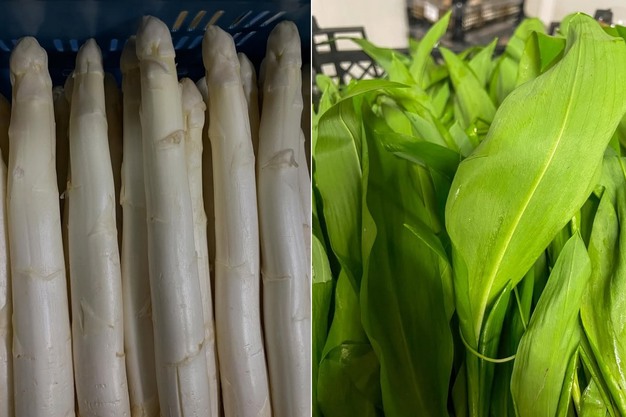
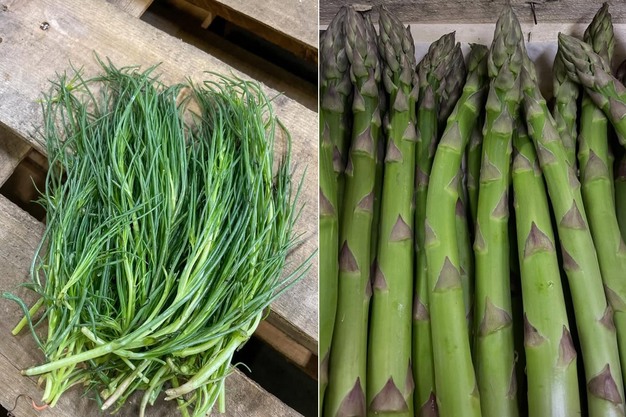
« Je suis plutôt confiant pour cette campagne d’asperges 2026 »
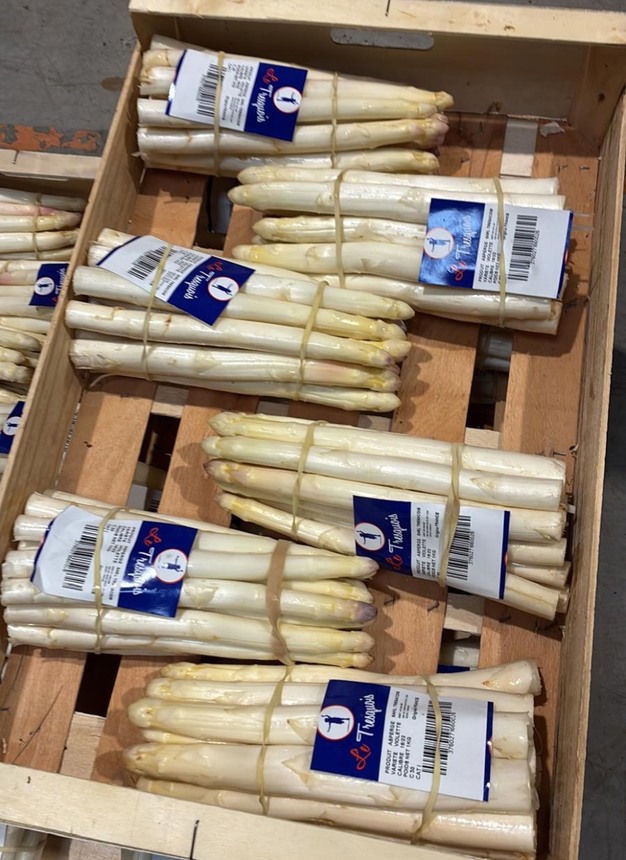
Si les intempéries du début d’année ont fortement perturbé le lancement de la campagne pour de nombreux asparagiculteurs, certains tirent néanmoins un bilan positif de ce début de saison. C’est notamment le cas de Maxime Gervasoni, producteur au sein de l’entreprise familiale Le Tresquois, qui a su préserver une précocité stratégique lui permettant aujourd’hui de bénéficier d’une position avantageuse sur le marché.
Une anticipation décisive face aux intempéries Pour rappel, il y a quelques semaines, les fortes pluies et le vent ont rendu La plupart des parcelles impraticables, empêchant bon nombre de producteurs de butter. Maxime Gervasoni fit parti des rares à avoir pu effectuer cette opération capitale en amont, lui permettant aujourd’hui d’avoir une longueur d’avance sur le marché : « Nous avons réussi à trouver un créneau pour butter dès le mois de janvier. Cette anticipation nous a permis de démarrer sans retard. La réactivité est vraiment – et aujourd’hui plus encore – le maître-mot dans notre métier ». Résultat, la production a pu conserver sa précocité, arrivant même dans un marché déficitaire : « Nos premières asperges ont été bien valorisées. Aujourd’hui, les prix se maintiennent à un bon niveau, même si les promotions s’intensifient. Quant à la qualité, nos clients sont satisfaits, nous avons de bons retours. En somme, c’est un meilleur début de campagne que l’an dernier ».
Des volumes justes pour Pâques Depuis une quinzaine de jours que la campagne a démarré, la montée en puissance de la production s’est vue impactée par les températures froides de la semaine dernière : « Le froid a ralenti la production, ce qui fait que les volumes seront justes pour Pâques. Cela va se jouer à quelques jours près, mais l’approvisionnement devrait dans l’ensemble être assuré », précise le producteur, qui reste tout de même positif : « Avec le retour des températures plus douces, la saison est désormais pleinement lancée et devrait rapidement gagner en intensité. Après Pâques, il nous reste tout le mois d’avril qui est souvent dynamique en termes de consommation. Je suis plutôt confiant pour cette campagne 2026 ».
Pour plus d’informations : Maxime Gervasoni Le Tresquois Tél. : 06 48 81 85 00 commerce@letresquois.com Date de publication: mar. 31 mars 2026
Les premières du printemps donnent le ton à Pâques à Sebrechts
« Forte demande de fruits rouges en raison des problèmes de qualité cet hiver en Espagne, au Portugal et au Maroc »
Le début de la saison printanière est traditionnellement synonyme d’effervescence chez Sebrechts Groenten en Fruit. Avec l’arrivée des légumes de serre et l’approche de Pâques, le grossiste d’Anvers tourne actuellement à plein régime. « La journée d’hier a été un peu plus calme, mais c’est surtout dû au mauvais temps de ces derniers jours », explique Ellen Sebrechts. « On le remarque immédiatement dans les ventes, surtout au printemps : c’est le temps qui détermine la demande. »
Selon elle, l’ambiance commerciale peut varier rapidement. « La semaine dernière a été très bonne, mais un week-end moins favorable sur le plan météorologique a un impact immédiat. Heureusement, les perspectives sont meilleures. Le temps devrait s’améliorer à partir de demain et nous nous attendons à ce que les ventes reprennent vers la fin de la semaine. Avec les vacances qui suivent, on observe traditionnellement un pic vers Pâques, suivi d’une brève baisse avant que la saison estivale ne démarre vraiment. »
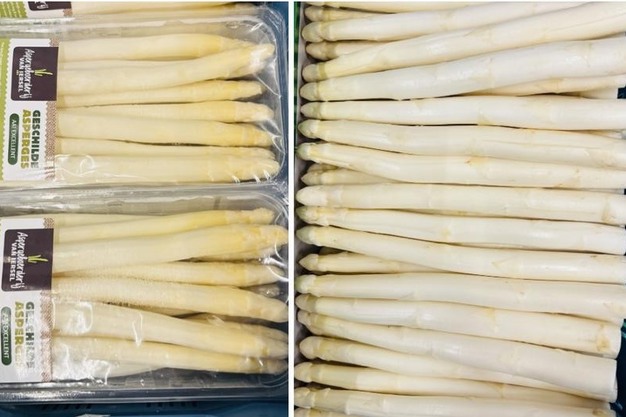
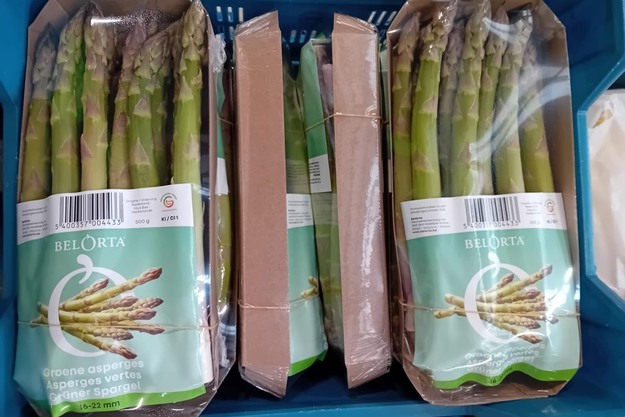
Produits de printemps Au cours de cette période, ce sont principalement les produits saisonniers typiques qui donnent le ton. « La demande tire le prix vers le haut. Le prix des asperges a de nouveau augmenté, tout comme celui des fraises. Ce sont vraiment les produits phares du moment. En outre, nous vendons aussi beaucoup d’asperges vertes et des endives, parmi d’autres produits de printemps. »
« En même temps, avec des prix si élevés, les clients restent un peu plus prudents, au lieu de 10 barquettes, ils n’en prennent quie 5. Le problème est que tout ce qui vient d’Espagne a souffert du mauvais temps. Le chou-fleur par exemple, était pratiquement introuvable, ce qui a immédiatement fait grimper les prix en flèche. Tout est en transition vers de nouvelles cultures et les premiers volumes sont toujours très attendus et un peu plus chers. »
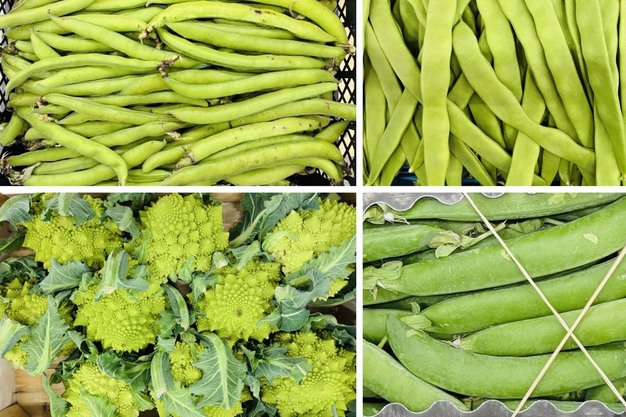
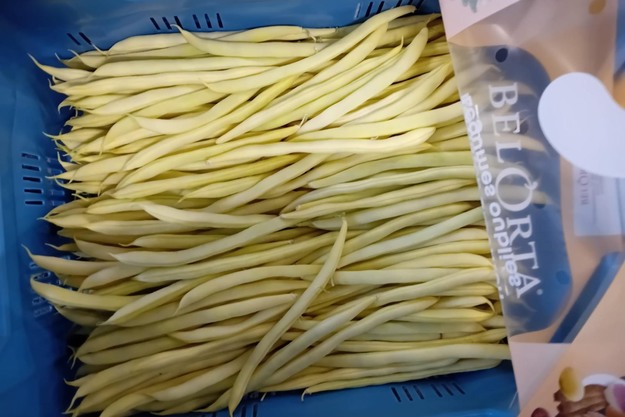
Les ventes sont donc très dynamiques. « Des produits comme les haricots beurre, asperges vertes, haricots plats, navets et navettes d’été sont très recherchés en ce moment. Après l’hiver, les consommateurs veulent de la nouveauté dans leur assiette. »
« Nous avons aussi toutes ces tomates colorées en provenance de Belgique et de France. Cela permet d’avoir un étal très coloré, presqu’estival. Et nous suivons aussi l’actualité culinaire ! La semaine dernière, un chef belge a cuisiné avec des pousses de houblon et nous avons eu une énorme demande ! Un tel produit peut soudainement devenir encore plus populaire. Les pousses de houblon sont assez chères, mais elles se vendent quand même très bien. Il s’agit vraiment d’un produit de saison, qui n’est disponible qu’un mois et demi et maintenant plus que pour quinze jours, du coup on se l’arrache ! Il en va de même pour les restaurants qui les mettent au menu avant Pâques. »
Petits fruits et météo Malgré la plus grande variété de produits disponibles, les fraises et les asperges restent les vedettes absolues de cette période. Toutefois, l’offre reste fortement tributaire des conditions météorologiques. « Les asperges commencent tout juste à reprendre un peu de volume, mais le temps change soudainement. Il en va de même pour les fraises : le beau temps d’il y a quinze jours a stimulé les volumes, mais après un retournement de la météo, l’offre est immédiatement divisée par deux. »
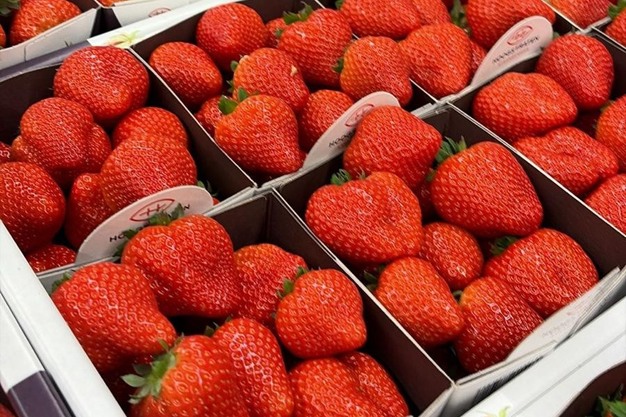
« C’est assez frustrant à l’approche de Pâques, mais aujourd’hui, il y a eu plus de fraises sur le marché et le prix a rebaissé. Certains produits fluctuent constamment. C’est là tout le défi et, en fin de compte, il faut connaître ses clients et acheter ce que l’on sait vendre. Le goût joue également un rôle majeur : si le produit est bon alors il se vend. Pour les fraises, Sebrechts travaille exclusivement avec des produits locaux. « Nous n’avons que des fraises de Coöperatie Hoogstraten. En outre, les premières variétés spéciales arrivent, comme les fraises à l’ananas et à la pêche. Les premières framboises et mûres néerlandaises sont également arrivées. »
« La demande pour les fruits rouges locaux est forte parce qu’il y a eu beaucoup de problèmes de qualité ces derniers mois en Espagne, au Portugal et au Maroc, et que tout le monde attendait avec impatience le début de la saison ici. Il en va de même pour les poivrons, qui commencent à bien arriver. Hier, on a eu les premiers poivrons orange. Tout cela coûte de l’argent, mais l’Espagne n’a pas non plus été bon marché cette année. Ça a aussi été le cas pour de nombreux produits d’importation, comme au Kenya avec des inondations dans les haricots. Nous ne sommes pas habitués à ce que tout soit si cher et si rare. Les consommateurs pensent et s’attendent toujours à ce que tout soit disponible, mais ce n’est plus le cas à l’heure actuelle. »
Contradictoire Expliquer cette situation reste un défi. « Pour ce qui des framboises, par exemple, la qualité n’est pas constante depuis décembre. C’est délicat, car les prix augmentent en raison de la pénurie, alors que la qualité ne fait que diminuer. C’est très contradictoire. Nous le comprenons, mais le message est parfois difficile à faire passer. Nous pouvons arrêter de les acheter, mais ça veut dire décevoir certains clients. Un pâtissier a besoin de framboises pour sa tarte. Payer plus cher pour une qualité moindre, ça paraît illogique, pourtant, c’est le cas et il faut pouvoir l’entendre. »
« D’une manière plus générale, tout devient plus cher. Cela crée de la frustration chez les clients. Non seulement les denrées alimentaires, mais aussi d’autres coûts tels que l’énergie et le transport augmentent. Il est donc plus difficile pour certaines personnes de continuer à tout payer. Nous distribuons également nos excédents à des personnes moins fortunées. Chaque petit geste compte, car tout le monde ne peut pas se le permettre. »
Sebregts prévoit que la saison estivale démarrera réellement après les vacances de Pâques. « C’est alors que l’offre s’élargit et que les prix baissent un peu. Cela donne généralement un nouvel élan aux ventes. Avec la perspective d’un temps plus clément et d’une offre croissante, la saison semble évoluer positivement. La combinaison d’un plus grand nombre de produits et de conditions plus favorables offre des opportunités pour une période de ventes importantes dans les mois à venir. »
Pour plus d’informations : Ellen Sebrechts Sebrechts Groenten & Fruit Tél. : +32 32374192 info@sebrechtsfruit.be www.sebrechtsfruit.be Date de publication: mer. 1 avr. 2026
« Le marché est fluide, mais il ne faudrait pas que les prix baissent »
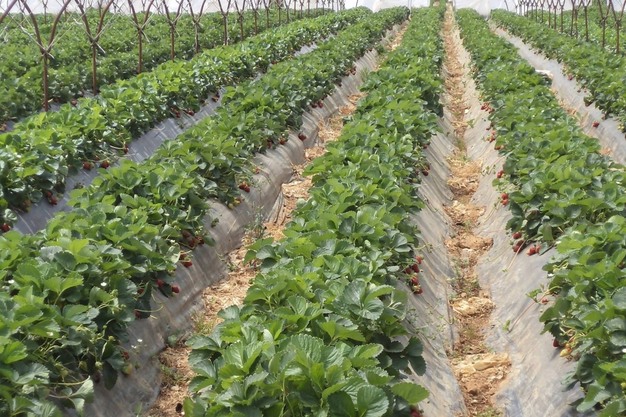
Cinq semaines après la récolte de ses premières fraises, Vincent Chaban – producteur de fraises sur 17 ha au sein de l’exploitation Fruits Rouges du Confluent dans le Lot-et-Garonne –, dresse un état des lieux de la campagne en cours.
Une montée en volume légèrement freinée par le récent coup de froid « Nous avons commencé à un jour près au même moment que l’an dernier avec les premières Gariguette et Dream », rapporte Vincent Chaban. Après une montée en puissance progressive des volumes, un récent épisode de froid est venu ralentir la production. « Nous avons connu un petit coup d’accélération en fin de semaine dernière, puis la chute des températures est venue freiner la maturité ». Un changement de météo qui n’aurait en rien impacté la qualité : « Ce n’est jamais en début de campagne que nous obtenons les meilleurs fruits en termes de tenue, mais depuis une dizaine de jours, nous sommes très satisfaits du produit. Les fraises sont belles et bonnes, avec une bonne tenue dans le temps ». Un pic de production est attendu deuxième quinzaine d’avril, notamment avec la montée en production de la fraise ronde qui vient de démarrer sa campagne.
Un marché globalement fluide mais des prix sous surveillance Sur le plan commercial, la campagne évolue de manière globalement favorable : « Nous serions contents de garder la même dynamique toute la campagne. Car jusqu’ici nous sommes plutôt satisfaits, même si certains jours ont été un peu moins favorables. En début de semaine dernière par exemple, le marché était plus tendu, mais en fin de semaine nous avons manqué de fraises ». Malgré ces légères fluctuations, le marché reste globalement fluide, avec des débouchés présents. La question des prix demeure toutefois centrale. « On sent que les prix sont discutés, et il ne faudrait pas qu’ils baissent davantage. On ressent déjà une tension au niveau des coûts de production, avec une hausse notamment de l’énergie, des engrais et du carburant.
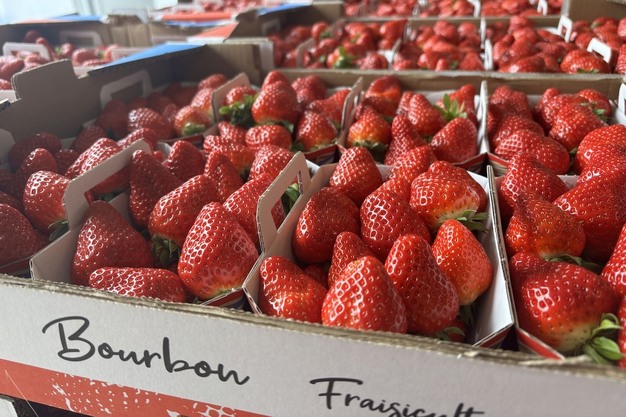
Une offre premium portée par la Dream et la Gariguette Parmi la gamme variétale qu’offre Fruits Rouges du Confluent, l’exploitation revendique un positionnement qualitatif affirmé notamment à travers ses variétés phares. « La Dream Bourbon fait clairement partie de nos produits premium. Reconnue pour ses qualités gustatives, elle s’adresse à une clientèle en quête de saveur et de différenciation, à l’instar de la Gariguette qui s’inscrit également dans cette logique. En termes de goût, on est largement au-dessus du standard, et c’est ce qui justifie le prix ». Ce travail de valorisation passe aussi par un soin particulier apporté au packaging, en adéquation avec le positionnement haut de gamme. « Le client voit la différence, et même si le prix est plus élevé, on garde cette cohérence en termes de rapport qualité/prix, ce qui fait que le consommateur y trouve son compte ».
Pour plus d’informations : Vincent Chaban Fruits Rouges du Confluent vincent@fruitsrougesduconfluent.com Date de publication: lun. 30 mars 2026
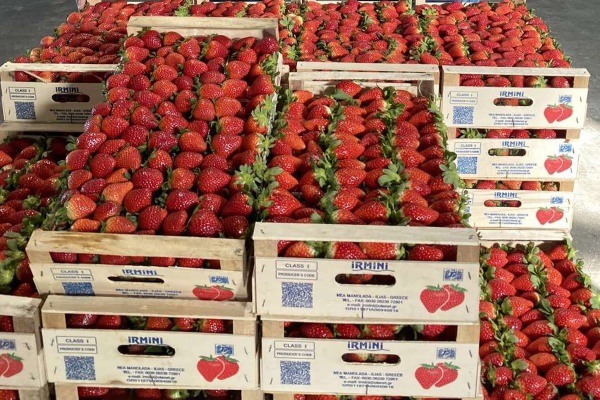
Le rythme de production dans les serres de fraises de la région d’Ilia est désormais revenu à des niveaux saisonniers normaux, malgré un léger retard en début de campagne. En revanche, la situation du marché reste peu favorable.
« Depuis le 10 mars, notre récolte a retrouvé des niveaux normaux. Nous enregistrons des volumes élevés et cela devrait se maintenir pendant encore un mois », indique Fotis Kyriazis, président de la coopérative agricole Irmini.
« À cette période, les palettes de fraises grecques sont principalement composées de la variété Victory. Les serres de la variété Arwen continuent également de produire des volumes importants, et ces deux variétés devraient rester présentes jusqu’à la fin de la saison. Globalement, les fruits sont de bonne qualité et nécessitent peu de tri. Nous ne constatons pas de pertes significatives », précise Fotis Kyriazis.
Sur le plan commercial, la situation est plus tendue. Les faibles niveaux de production en début de saison, jusqu’en février, ont limité les performances à l’export. Selon les données du ministère grec du Développement rural et de l’Alimentation, sur les 17 premières semaines de campagne — depuis le 21 novembre, date de début de l’enregistrement des exportations — seuls 35 387 217 kg ont été expédiés. L’Allemagne et la Pologne arrivent en tête, avec chacune un peu plus de 10 millions de kilos. Parmi les autres destinations, au nombre de 29, la Roumanie se distingue avec 3 856 153 kg.
« Nous travaillons beaucoup avec les enseignes de la grande distribution allemande », souligne Fotis Kyriazis. Il se montre toutefois préoccupé par l’évolution du marché : « Le commerce n’évolue pas de manière satisfaisante. Il y a une pression importante. En Espagne, selon nos informations, les prix sont passés sous les 2 €/kg cette semaine. En conséquence, en Grèce, le prix producteur pour la variété Victory se situe désormais entre 2 et 2,50 €/kg. »
La concurrence internationale pèse également. « D’importants volumes en provenance de Turquie sont présents sur le marché, tandis que les fournisseurs égyptiens restent actifs au Royaume-Uni et en Allemagne », ajoute Fotis Kyriazis.
Dans les prochains jours, la pression pourrait encore s’accentuer. « D’un point de vue commercial, je pense que les prix vont continuer à baisser. La production va rester élevée, mais la demande est insuffisante, et les conditions météorologiques froides ne favorisent pas la consommation », conclut Fotis Kyriazis.
Pour plus d’informations : Fotis Kyriazis Irmini Tél. : +30 262 307 3712 Date de publication: mar. 31 mars 2026
« Je suis plutôt confiant pour cette campagne d’asperges 2026 »
Si les intempéries du début d’année ont fortement perturbé le lancement de la campagne pour de nombreux asparagiculteurs, certains tirent néanmoins un bilan positif de ce début de saison. C’est notamment le cas de Maxime Gervasoni, producteur au sein de l’entreprise familiale Le Tresquois, qui a su préserver une précocité stratégique lui permettant aujourd’hui de bénéficier d’une position avantageuse sur le marché.
Une anticipation décisive face aux intempéries Pour rappel, il y a quelques semaines, les fortes pluies et le vent ont rendu La plupart des parcelles impraticables, empêchant bon nombre de producteurs de butter. Maxime Gervasoni fit parti des rares à avoir pu effectuer cette opération capitale en amont, lui permettant aujourd’hui d’avoir une longueur d’avance sur le marché : « Nous avons réussi à trouver un créneau pour butter dès le mois de janvier. Cette anticipation nous a permis de démarrer sans retard. La réactivité est vraiment – et aujourd’hui plus encore – le maître-mot dans notre métier ». Résultat, la production a pu conserver sa précocité, arrivant même dans un marché déficitaire : « Nos premières asperges ont été bien valorisées. Aujourd’hui, les prix se maintiennent à un bon niveau, même si les promotions s’intensifient. Quant à la qualité, nos clients sont satisfaits, nous avons de bons retours. En somme, c’est un meilleur début de campagne que l’an dernier ».
Des volumes justes pour Pâques Depuis une quinzaine de jours que la campagne a démarré, la montée en puissance de la production s’est vue impactée par les températures froides de la semaine dernière : « Le froid a ralenti la production, ce qui fait que les volumes seront justes pour Pâques. Cela va se jouer à quelques jours près, mais l’approvisionnement devrait dans l’ensemble être assuré », précise le producteur, qui reste tout de même positif : « Avec le retour des températures plus douces, la saison est désormais pleinement lancée et devrait rapidement gagner en intensité. Après Pâques, il nous reste tout le mois d’avril qui est souvent dynamique en termes de consommation. Je suis plutôt confiant pour cette campagne 2026 ».
Pour plus d’informations : Maxime Gervasoni Le Tresquois Tél. : 06 48 81 85 00 commerce@letresquois.com Date de publication: mar. 31 mars 2026
“Asparagus, strawberries, and wild garlic: Easter has overtaken Christmas in demand for us”
Easter is approaching once again, and for hotel and catering wholesalers, it marks a peak period. The same applies at Square Melon, where Easter has now overtaken Christmas in terms of activity, says Pasquino De Vuyst of the wholesaler near Ghent. “This is also linked to the traditional start of Belgian asparagus, which every restaurant wants on the menu at Easter.”
At Square Melon, the asparagus season is now in full swing, although it started slightly later than usual this year. “At the end of February and the beginning of March, I noticed that demand had not really taken off yet. Of course, volumes were still very limited, and prices were high. That is not necessarily a bad thing. It is better to have a shorter, more intense season than one that drags on slowly.”
According to Pasquino, this is also a deliberate choice by growers. “We used to have three major growers who started very early. Now we only have one, and he also decided to start a bit later this year. We communicated this to our customers, indicating we would begin one to two weeks later, and that is exactly how it turned out.”
Asparagus only more expensive towards Easter Once the season began, supply increased rapidly. “When we first started loading, we had about 30 crates, but by the end of the week, we were easily loading 200 crates per day. Everything is running smoothly,” he explains.
On the sales side, Pasquino expects demand to remain strong. “Just a few days of good weather immediately gave a boost in shops. If temperatures drop again, supply will decline, and I expect prices to rise further. The lowest prices before Easter have already passed.” The hospitality sector plays a key role in this. “Around Easter, almost every restaurant features asparagus on the menu. They are willing to pay regardless of the price. After the holiday period, prices will ease again, as they do every year.”
Strawberries, wild garlic, and morels Not only asparagus, but strawberries are also arriving slightly later this year. “We only loaded the first high-quality strawberries from BelOrta last week. But here too, it is better to start strong than to have a slow beginning. Larger volumes are still to come, but the outlook is positive. From next week onwards, we expect steady availability and gradually easing prices.”
In addition to asparagus and strawberries, Pasquino notes a clear seasonal transition in the product range. “Lamb’s ears and wild garlic are currently strong sellers. We are also handling French Gariguette strawberries from the Lille market. The mushroom segment is also performing very well. We sold chanterelles and Pied de Mouton for a long time, and now morels are in demand as well. We are still waiting for wild asparagus, which should arrive within two to three weeks.”
These wild products come directly from France. “Our wild asparagus and wild garlic come from the Vosges, where they are harvested over the weekend. We place orders on Monday, they are available at the Lille market on Tuesday, and delivered to customers by Wednesday. It cannot get any fresher. It is enjoyable work. Overall, we have had a very good spring so far. Normally, there is a dip in January and February, but we have not experienced that this year.”
Summer season The trader also observes a shift in demand patterns. “The Christmas period is less intense than it used to be,” he explains. “More hospitality businesses are closing during that time, which reduces peak demand. What used to be an extremely busy period now allows some of our drivers to take holidays. There is a clear trend toward staff working fewer hours, shorter days, and fewer public holidays. Hospitality should operate when others are off, but we see customers adapting their approach, and we have to adapt as well.”
“It is what it is,” Pasquino concludes. “It certainly does not mean we are less busy. The winter period and the first months of 2026 have been particularly strong for us, just at different times compared to a few years ago.” Looking ahead, he expects supply to continue increasing. “As we move toward summer, volumes will gradually rise, and we will be fully busy again.”
For more information: Pasquino De Vuyst Square Melon Bij Sint-Jacobs 20/23 9000 Ghent, Belgium Tel: +32 (0) 9 223 34 16 info@square-melon.be www.square-melon.be
Manage consent
To provide the best experiences, we use technologies such as cookies to store and/or access device information. Consenting to these technologies will allow us to process data such as browsing behavior or unique IDs on this site. Failure to consent or withdrawing consent may adversely affect certain features and functions.
Functional
Always active
Technical access or storage is strictly necessary for the legitimate interest purpose of enabling the use of a specific service explicitly requested by the subscriber or user, or for the sole purpose of carrying out the transmission of a communication over an electronic communications network.
Preferences
Technical access or storage is necessary for the legitimate interest purpose of storing preferences that are not requested by the subscriber or Internet user.
Statistics
Technical storage or access that is used exclusively for statistical purposes.Technical storage or access that is used exclusively for anonymous statistical purposes. Absent a subpoena, voluntary compliance from your internet service provider, or additional records from a third party, information stored or retrieved for this sole purpose generally cannot be used to identify you.
Marketing
Technical access or storage is necessary to create user profiles in order to send advertisements, or to track the user on a website or across websites with similar marketing purposes.

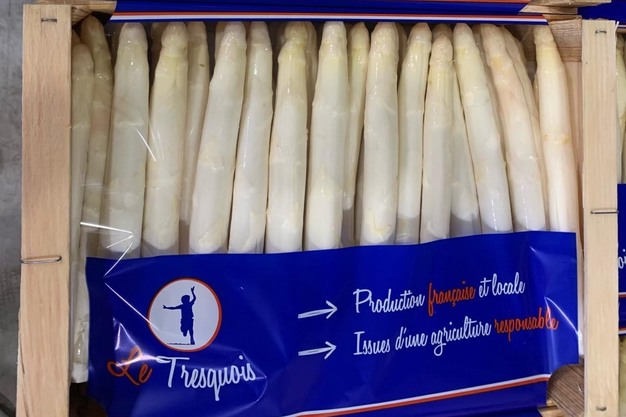
 Depuis une quinzaine de jours que la campagne a démarré, la montée en puissance de la production s’est vue impactée par les températures froides de la semaine dernière : « Le froid a ralenti la production, ce qui fait que les volumes seront justes pour Pâques. Cela va se jouer à quelques jours près, mais l’approvisionnement devrait dans l’ensemble être assuré », précise le producteur, qui reste tout de même positif : « Avec le retour des températures plus douces, la saison est désormais pleinement lancée et devrait rapidement gagner en intensité. Après Pâques, il nous reste tout le mois d’avril qui est souvent dynamique en termes de consommation. Je suis plutôt confiant pour cette campagne 2026 ».