Archive

Spécial Pérou – Valle y Pampa

« La région d’Ica ne connaît pas le chômage grâce à la culture de myrtilles » par FreshPlaza

Spécial Pérou – Valle y Pampa

« La région d’Ica ne connaît pas le chômage grâce à la culture de myrtilles »

Dans les terres sablonneuses de Pisco, à quelque 250 km au sud de Lima, la saison des myrtilles péruviennes touche à sa fin. Valle y Pampa y cultive depuis 15 ans ce fruit qui, grâce à un portefeuille de variétés sélectionnées, garantit du travail à des milliers de personnes pendant plusieurs mois. Selon son directeur général, Miguel Bentín, « l’agriculture favorise l’emploi formel, constitue un outil de réduction de la pauvreté et rend la vie rurale plus digne. »

« Valle y Pampa est un opérateur de la filière doté d’une structure particulière. » La société gère les entreprises de production Agrícola San Gallán, qui se consacre aux grenades, et Family Farms Peru, un partenariat avec l’entreprise américaine Family Tree Farms, qui se concentre sur les myrtilles.

40 % des myrtilles ont une taille supérieure à 20 mm

Les deux exploitations sont situées à Pisco, une région au climat aride et aux sols sablonneux, où l’entreprise gère 700 hectares : quelque 600 hectares de myrtilles et 54 hectares de grenades, avec l’intention de doubler ces derniers.

Des myrtilles sur un sol désertique
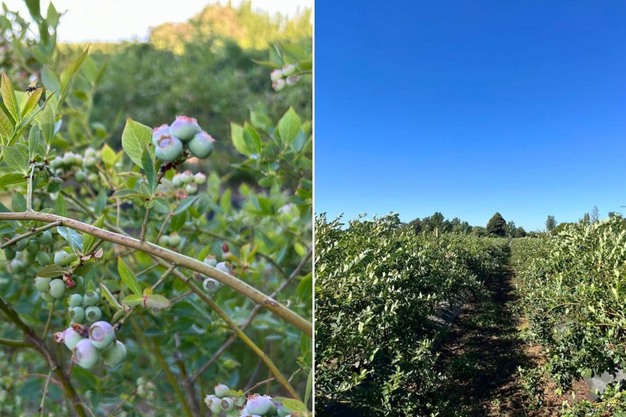
Contrairement à de nombreuses autres exploitations du secteur, Valle y Pampa cultive les myrtilles en terre et non en pots. « Notre sol est un sable fin et inerte, typique du désert. Mais nous avons mis au point un système où nous incorporons le substrat en ligne continue, comme on le ferait dans un conteneur. »

Culture de myrtilles en pleine terre

Cette approche est le fruit d’un savoir-faire accumulé pendant plus de 15 ans, lorsque l’entreprise était pionnière dans la culture des myrtilles sur la côte méridionale du Pérou. Le substrat est entretenu avec du compost fabriqué à partir de leurs propres déchets de taille. « À maturité, les rendements sont similaires à ceux en pots. La culture en conteneurs est plus précoce, mais pas forcément plus productive. Les plantes, si la variété n’est pas changée, peuvent donner pendant au moins 15 ans. »

Génétique premium et récoltes prolongées
Toute la production de myrtilles de Family Farms Peru provient de variétés du portefeuille Mountain Blue Orchards (MBO), d’origine australienne, dont le licencié exclusif au Pérou est Family Tree Farms, actionnaire de l’entreprise. Les principales variétés sont Eureka, Eureka Gold, Eureka Sunset et Eureka Sunrise.

« Ce sont toutes des variétés de qualité supérieure : bonne saveur, croquant et gros calibre. 40 % des fruits ont une taille supérieure à 20 mm et dans certains cas, ce pourcentage atteint 80 %. » La saison de récolte du Pisco s’étend de juin à décembre, ce qui permet une activité constante pendant la moitié de l’année. Les variétés sont distribuées en fenêtres précoces, moyennes et tardives, ce qui permet d’échelonner la production et de tirer parti des différents marchés.


Cette année, Family Farms Peru prévoit une production de 11 000 tonnes de myrtilles. « Nous avons des champs de différents âges entre un et cinq ans. Nous prévoyons 35 % supplémentaires en 2026, pour une production estimée à 18 000 tonnes en 2027, lorsque l’exploitation atteindra sa maturité. »

Plus de 60 % de la production de myrtilles est destinée aux États-Unis, grâce à la force commerciale de Family Tree Farms. 10 % sont destinés à l’Asie, en particulier à la Chine, 25 % sont répartis entre le Royaume-Uni et l’Europe continentale, et le reste est destiné à d’autres marchés.

Pour l’Asie (en particulier la Chine), Bentín procède à un conditionnement sur le terrain, en tirant parti de l’uniformité de leurs variétés. En revanche, pour l’Europe et les autres marchés, ils utilisent des lignes de calibrage automatisées.


La grenade : un complément stratégique
Bien que la grenade soit un marché plus petit et plus mature, elle occupe une place importante dans la stratégie de Valle y Pampa. L’entreprise, par l’intermédiaire de sa filiale Agrícola San Gallán, produit 2 000 tonnes par an, principalement de la variété Wonderful, qui s’est avérée la plus fiable. « Au total, le Pérou produit environ 40 000 tonnes. S’il en produisait beaucoup plus, le marché aurait du mal à absorber tous les volumes. »

« Nous commençons à récolter les grenades en mars, ce qui nous permet de faire passer du personnel d’une culture à l’autre. Nous prolongeons ainsi le calendrier de travail. La saison des grenades s’étend de fin mars à début juin, une période très intéressante. Les principales destinations sont le Royaume-Uni et l’Europe continentale. »

Pour accéder à des marchés exigeants, Valle y Pampa dispose de multiples certifications couvrant les bonnes pratiques agricoles, la gestion de l’eau, la responsabilité sociale et la durabilité environnementale. « Smeta est la plus exigeante en matière sociale. D’autres sont plus axés sur l’environnement. Elles sont toutes nécessaires. »


Un travail décent sur le terrain
Pendant la haute saison, l’entreprise emploie jusqu’à 4 200 personnes, en commençant par environ 400 en mars et en augmentant jusqu’en décembre. La main-d’œuvre est un défi permanent, mais Bentín y voit une opportunité : « C’est une concurrence saine. Elle nous oblige à être de meilleurs employeurs. Plus il y a de services, plus les revenus sont élevés. Cela améliore la vie des communautés rurales. »

À Ica, grâce à ce dynamisme agricole, le chômage est nul. Pour Bentín, c’est une source de fierté : « L’agriculture emploie un travailleur sur cinq au Pérou. C’est le principal générateur d’emplois. Elle crée du bien-être, favorise la mobilité sociale et génère du développement. »

Obstacles structurels : eau et logistique
Tout n’est pas positif. La croissance se heurte à des limites, notamment en ce qui concerne les infrastructures et les ressources en eau. Dans le domaine de la logistique, Bentín souligne les problèmes des ports et des lignes maritimes : manque de fréquence, d’équipement et de services adéquats. En ce qui concerne l’eau, la situation est plus critique.

« Le sud du Pérou n’a aucun projet d’irrigation. Toute l’eau de Pisco est souterraine. Et la rivière perd chaque année entre 500 et 600 millions de m3 d’eau douce au profit d’eau salée pendant les mois de pluie. C’est une tragédie. »

Après des années d’expansion accélérée, Valle y Pampa donne désormais la priorité à la consolidation. « Nous voulons optimiser les opérations existantes et maximiser l’efficacité et la qualité, en garantissant la durabilité et la traçabilité. Notre objectif de croissance n’est pas quy’économique, il poursuit aussi d’autres valeurs. » Le directeur général n’exclut pas de s’étendre à d’autres régions, voire à l’étranger, si l’occasion se présente.

Pour plus d’informations :
Miguel Bentín – directeur général
Valle y Pampa
miguel@valleypampa.com
www.vallypampa.com Date de publication: mer. 3 déc. 2025

© FreshPlaza.fr / Peter De Craemer

Dormancy management for maintaining productivity in winter crop production by Hortidaily and American Floral Endowment and osu educ

Dormancy management for maintaining productivity in winter crop production

Photoperiodic lighting can make a huge difference in strawberry production. This article is timely in the season you need to consider extension lighting or night interruption lighting to improve the productivity of your strawberry plants.

Off-season greenhouse strawberry plants are often planted in late summer to start producing fruits in October or November. However, sometimes after the first flush of production, plants may go into a slow growing phase, not producing as many flowers and fruits and not extending leaves. Overall morphology is rosette-like with dark green leaves with short petioles. This is because plants are getting in the dormancy phase as a response to the light environment.

Figure 1. ‘Tochiotome’ strawberry plants showing dormancy symptoms in early January (left). The same plants recovering from the symptoms after three weeks under night interruption lighting (right).

Dormancy in strawberry is induced under short-day conditions when average temperature is greater than 15 °C (Sønsteby and Heide, 2021). Many growers and researchers may have misunderstood that low temperature is part of the stimuli for entering plants into dormancy. In fact, while short-day conditions are considered as the primary factor inducing dormancy in many species, some species such as apple and pear require low temperature for entering dormancy regardless of photoperiod (Heide and Prestrud, 2005). Strawberry plants do not exhibit ‘absolute dormancy’ as their growth is not completely ceased: the reason why the status in strawberry is called ‘semi-dormancy’. The state of semi-dormancy is characterized by reduced growth while still retaining the capacity of growth when transferred to long days. In contrast, plants in the state of absolute dormancy cannot be overcome by photoperiod alone.

When plants start showing low productivity associated with the typical morphology of dormancy status, long-day lighting has been shown as an effective way to overcome the dormancy symptoms. As good news, this photoperiodic response requires only a small amount of light (a minimum of 2 µmol m⁻² s⁻¹) to apply as extension lighting or night interruption lighting. In the Netherlands and Belgium, intermittent cyclic lighting may also be common. This practice in Europe typically follows the winter-resting period of the traditional “double-cropping” system in greenhouses. Specific application methods of dormancy control lighting are shown in Table 1.

Most greenhouse strawberry growers in North America grow cultivars typically considered as facultative long-day plants. Because supplemental photosynthetic lighting is commonly provided for winter strawberry production in greenhouses, creating long-day conditions is common, and therefore dormancy would rarely become an issue. However, when greenhouse production occurs in areas where supplemental photosynthetic lighting is not necessary in winter (e.g., Southwestern U.S., Mexico), strawberries may be exposed to dormancy-inducing short-day conditions. In addition, some growers may wish to grow short-day cultivars for specific traits, such as unique flavor and fruit color, and may apply short-day conditions to assure continuous flower induction. Sensitivity to dormancy-inducing short-day conditions seems to be cultivar-specific (Lin et al., 2025b). Therefore, photoperiodic lighting needs to be carefully applied over short-day cultivars so that it would not inhibit flowering. If cultivars of interest are known to be sensitive to dormancy-inducing short-day conditions, it is recommended to start photoperiodic lighting in late October, as indicated by a compendium of strawberry cultivation in Japan (Nobunkyo, 2008).

Aside from the traditional approach of lighting up strawberry, some research has been conducted to develop alternative means to manage dormancy in strawberry production under short-day conditions. At Ohio State University, it was demonstrated that supplemental far-red
light could prevent dormancy under short-day conditions (Lin et al., 2025a). To implement, more research is needed to optimize the far-red intensity and application methods. Gibberellic acid (GA) application has been also practiced in other countries as alternative approach; however, GA-based growth regulators have not been registered for strawberry fruit production in North America.

For more information:
Chieri Kubota
Email: kubota.10@osu.edu
Yiyun Lin
Email: lin.2266@osu.edu
Pooja Tripathi
Email: Tripathi.78@osu.edu

American Floral Endowment
Tel.: +1 (703) 838-5211
afe@endowment.org
www.endowment.org Publication date: Mon 1 Dec 2025

“Imported blueberry demand grows nearly 50% over last year in India” by FreshPlaza

Madeira variety showcasing consistent quality this season

“Imported blueberry demand grows nearly 50% over last year in India”

Fresh blueberry availability in India is currently tight, with air shipments from Peru dropping from 70 tonnes per week in September to just 30 tonnes in November, says Sharath Loganathan of Ninjacart Global. “Peru is the only active origin supplying the market right now, but production there is around 25 percent below early projections.”

According to Loganathan, “Many Peruvian farms are also grappling with size issues in the later part of the season, producing more berries below the 14 mm size preferred by Indian buyers.” He notes that most imports are coming via the Netherlands’ wholesale ecosystem, which has kept supply reasonable so far. “However, we expect these Holland-routed volumes to gradually reduce in the coming weeks as the Peruvian season progresses.”

Quality this season has been mixed, with over 95 percent of imported blueberries originating from Peru. “While Madeira has performed consistently well, certain dominant varieties showed unexpected variability early on. The market has required more active selection compared to last year,” Loganathan explains. Prices reflect the tighter supply. “Pricing is currently at USD 15 to 17 CIF in the Netherlands, up from USD 12 to 13 CIF during the same period last year. This firming comes from lower volumes and stricter quality picks at origin.”

Loganathan notes how Chile stepped up meaningfully last season during January-February and should do so again, offering a supply bridge as Peruvian fruit tapers. “Although less firm than what Indian consumers favor, Chilean berries provide reliable volumes. Demand for imported blueberries remains strong regardless, up nearly 50 percent year-over-year, especially from organized retail and e-commerce. Tier 2 cities are showing strong double-digit growth, and consistent brands are gaining higher recall in wholesale.”

Domestic production typically enters the market from February to May, coinciding with the end of the Peru season. The two supply windows work well together, Loganathan shares. “This year, domestic supply is expected to arrive earlier, around mid-January. But despite Indian berries gaining visibility, there is still a strong preference for imported berries in premium channels due to their consistency and well-established quality benchmarks.” He adds, “Newer origins like Poland and Georgia have entered the market, but their quality and volumes don’t yet rival Peru. South Africa looks promising for the future as import protocols open.”

Looking ahead, supply and quality are expected to hold steady through mid-December. Loganathan predicts that from late December to early February, things may tighten as Peruvian volumes drop before Chile scales up. “The focus will be on managing quality and supply continuity during that window,” he concludes.

For more information:
Sharath Loganathan
NinjaGlobal
Tel: +91 80 50 064 652
Email: sharath@ninjacart.com
www.ninjacart.com Publication date: Fri 28 Nov 2025

© FreshPlaza.com / Alysha Fernandes

Ukrainian demand rises for sweet potatoes and asparagus by FreshPlaza

Ukrainian demand rises for sweet potatoes and asparagus

Demand for niche vegetable crops in Ukraine is rising, particularly for sweet potatoes and asparagus, according to a market review published in “Gardening in Ukrainian” by Ksenia Guseva, fruit and vegetable market analyst at APK-Inform IA.

Guseva notes that sweet potatoes, once available only in premium supermarket formats such as Le Silpo or Delmar, are now stocked in mainstream retail, including the Varus chain. “While sweet potatoes used to be sold only in premium supermarkets, like Le Silpo or Delmar, now they can be found even in regular retail chains, in particular Varus. The price has become quite affordable,” she says.

She reports that production of salads and leafy greens is also increasing. Supermarkets now offer a wider selection of mixes, packaged salads, green onions, parsley, and dill. “I won’t say that prices are high, but the choice is much wider now than a few years ago. Conditions for growing greens are now favorable, so production is gradually increasing,” Guseva notes.

Despite wider availability, she emphasizes that sweet potatoes and greens remain niche crops grown largely under contract-based supply programs for supermarkets and restaurants. “This is not a mass product: you need to know exactly who you are selling to before you plant it. If ten farms nearby grow onions and only one grows potatoes, then the potatoes will be more expensive,” she says.

The current trend reflects increased consumer interest in alternative vegetable crops and a shift in retail assortment, though production remains limited and targeted toward specific buyers rather than broad distribution.

Source: PotatoPro

Frontpage photo: © Jianghongyan | Dreamstime

Camposol in Peru reports 35% volume growth in Q3 update by FreshPlaza

Camposol reports 35% volume growth in Q3 update

Camposol Holding PLC has released its preliminary financial results for the third quarter of 2025, covering the period ending September 30. The figures, prepared under International Financial Reporting Standards, remain subject to adjustment following the completion of audited financial statements.

For the first nine months of 2025, the company reported sales of USD 367 million, a 21 per cent increase compared with the same period of 2024. Volumes sold reached 99,737 metric tons, up 35 per cent year-on-year. EBITDA stood at USD 101.2 million, down 1 per cent from the previous year, with a margin of 28 per cent. Net profit was USD 19.2 million, a 41 per cent decline. The company’s net debt to EBITDA ratio was 2.81x.

During the third quarter, Fitch Ratings upgraded the company’s long-term credit ratings to B+. The company also inaugurated a new biofactory in Virú, northern Peru. The 2,000-square-metre facility integrates in-vitro and ex-vitro production and has a stated annual capacity of up to five million blueberry plants. The facility is intended to support the company’s varietal development programme and long-term planting plans.

Camposol took part in several industry events throughout the quarter, including meetings focused on avocado and blueberry production. The company also received recognition from Peruvian export and regional trade organisations and obtained ISO 37001 certification for its anti-bribery management system.

In a statement, CEO Ricardo Naranjo said, “The third quarter demonstrated the continued strength of our strategy and disciplined execution. We delivered another solid financial performance, maintaining our Net Debt-to-EBITDA ratio well below the 3.5x threshold for the fifth consecutive quarter, reinforcing the progress of our deleveraging trajectory and the resilience of our financial profile.” He added that the inauguration of the Virú biofactory enhances the company’s development capacity and supports its replanting and new planting programs.

Blueberry volumes in the first nine months grew 62.8 per cent year-on-year to 36,500 metric tons. Sales reached USD 242.2 million, up 34.1 per cent, while gross profit rose 38.7 per cent. Cost per kilogram decreased 19.9 per cent, supported by pruning strategies applied in 2024 and an earlier start to the 2025–2026 season. Avocado volumes rose 14 per cent, and the company reported a 20 per cent gross profit margin for this crop despite lower market prices.

Tangerines experienced lower volumes and quality due to adverse weather in Uruguay and Peru. Mangoes and grapes performed in line with expectations following the close of the 2024–2025 season. Capital investments continued during the period, including funding for the new biofactory and nursery.

Short-term debt represented less than 27 per cent of total debt, and the company expects working capital levels to ease as blueberry collections take place in late 2025 and early 2026.

To view the full report, click here.

For more information:
Jossue Yesquen Lihim
Camposol
Email: jyesquen@camposol.com
www.investors.camposol.com Publication date: Thu 27 Nov 2025

Le Benelux élargit l’accès aux emballages sans plastique pour les produits frais avec Quality Pack par FreshPlaza

Le Benelux élargit l’accès aux emballages sans plastique pour les produits frais

Les fournisseurs de produits frais du Benelux doivent se conformer aux nouvelles réglementations européennes en matière d’emballage tout en conservant des formats d’emballage efficaces et protecteurs. Une nouvelle collaboration entre Quality Pack et SoFruPak vise à répondre à ce problème en mettant la gamme d’emballages sans plastique de SoFruPak à la disposition des entreprises de la région.

La ligne d’emballage SoFruPak utilise du carton combiné à un film de cellulose. Ces matériaux ne contiennent pas de plastique et sont conçus pour préserver la fraîcheur des produits. L’emballage est recyclable et biodégradable en 24 semaines. Comme le carton et la pellicule de cellulose peuvent être traités ensemble, le système offre une alternative aux emballages en PET à un moment où les exigences réglementaires deviennent plus strictes.

Adam Sikorski, directeur commercial de SoFruPak, a déclaré : “Notre partenariat avec Quality Pack nous permet d’apporter des solutions d’emballage véritablement durables au marché du Benelux. Ensemble, nous permettons aux entreprises de répondre facilement aux exigences réglementaires et à la demande des consommateurs pour des emballages respectueux de l’environnement, sans compromettre la commodité ou la qualité du produit.”

Le partenariat s’aligne sur la législation européenne en cours qui devrait exiger une adoption plus large de matériaux respectueux de l’environnement dans les emballages de fruits et légumes. SoFruPak est actif dans le secteur des produits frais depuis plusieurs années et a été récompensé pour ses concepts d’emballage entre 2016 et 2023.

Cette collaboration permet aux producteurs, emballeurs et criées du Benelux d’avoir accès à des emballages conçus pour répondre aux attentes réglementaires en constante évolution, tout en offrant une option aux entreprises qui souhaitent réduire l’utilisation du plastique dans leurs chaînes d’approvisionnement.

Pour plus d’informations :
Marnix van der Caaij
Quality Pack
Tél : +31 6 53 57 27 74
mvandercaaij@qualitypack.nl
www.qualitypack.nl

When automation supports blueberry and asparagus growers with Berryway and Optisort by Maf Roda and FreshPlaza

Berryway and Optisort by Maf Roda

When automation supports blueberry and asparagus growers

At the IAD-IBD trade fair held last month in the Bordeaux region, the Maf-Roda Group – platinum sponsor of the event – presented its sorting and grading solutions for red fruit and asparagus. The two installations did not go unnoticed.

Berryway and Berryscan: Cutting-edge technology for high-precision sorting while respecting the fruit
The Berryway grading machine attracted the attention of visitors, as it offers a complete solution for post-harvest blueberries, combining delicate handling with high-precision sorting. “The Berryway is designed to handle blueberries with the utmost delicacy. Each line takes care of the berries to limit shocks and guarantee the integrity of the fruit,” explains Fabrice Blanc, managing director of Maf Roda. Modular from two to eighteen lines, processing 160 to 200 kg of blueberries/hour/line at an average weight of 2g per fruit, Berryscan is equally suited to small-scale producers and industrial structures.

The Berryscan module enhances this performance with particularly accurate multispectral optical sorting. Taking 360° photos of each berry, it analyzes color, shape, and external quality, while detecting defects such as soft, dehydrated, or damaged fruit. “Thanks to Insight technology, we can measure sugar levels to guarantee a consistent, tasty product,” explains Fabrice Blanc. Based on artificial intelligence, the software makes it possible to fine-tune the sorting criteria (shape, firmness, size, Brix) and automate the entire process right through to packaging.

Already widely deployed internationally – from the United States to South Africa, via Eastern Europe – the solution is now attracting considerable interest in France. “Demand for high-performance, automated sorting lines is growing strongly,” observes Fabrice Blanc. By reducing dependence on manual sorting while maximizing final quality, Berryway and Berryscan are positioning themselves as essential tools for growers looking to improve precision, productivity, and added value.

An asparagus grading machine for high-precision associativity
Since acquiring the German company Strauss, Maf-Roda has also been offering a complete range of solutions for asparagus, from harvesting to packaging, including grading and weighing. At the IAD-IBD trade fair, it was the grading machine for white and green asparagus that was presented. “In this sector too, we can offer turnkey solutions that can be adapted to any type of structure,” explains Fabrice Blanc.

These solutions are all the more appreciated in this particularly labor-intensive sector, since no human intervention is required, apart from receiving the packaged product. “We were the first to automate bundling. Our grading machine enables us to achieve high associativity accuracy, to +/- 4g on the bundle. The capacity of our machines ranges from 800kg/1.2T to 2T/h.” Another special feature of the Strauss-Maf-Roda grading machines is their high-pressure washing system. This is a definite advantage for products that come straight out of the ground, such as asparagus, which is contaminated by the sand that slips into its scales.

The asparagus grading machine presented at the show can also be adapted to leeks, zucchinis, and rhubarb.

For more information:
Christophe Nivet
Maf-Roda
Phone: +33 5 63 63 27 70 Publication date: Wed 26 Nov 2025

“We began a major expansion that will bring us to nearly 50 hectares”Raspberries and blackberries production grown in hydroponic tunnels at BigRed berry farm by FreshPlaza

Raspberries and blackberries production grown in hydroponic tunnels

“We began a major expansion that will bring us to nearly 50 hectares”

A major expansion is underway for a Polish soft fruit producer, as the company is increasing acreage for both raspberries and blackberries, says Oleh Naumenko, CEO and co-owner of Polish soft fruit producer BigRed berry farm: “Our raspberry and blackberry projects have grown very dynamically. In 2023, we started with a pilot project in Poland, about 7.5 hectares of fully hydroponic tunnels near the German border. We tested different varieties of raspberries and blackberries and saw strong market demand. By 2025, we began a major expansion that will eventually bring us to nearly 50 hectares of hydroponic tunnels. We’re adding around 45 hectares of raspberries and 5 hectares of blackberries, bringing us to nearly 60 hectares total.”

In recent years, overall demand for soft fruit has been in the lift according to Naumenko, which has also resulted in better prices for the produce. “We’ve seen steadily growing demand and gradually rising prices. During the summer season in Poland, there are weeks when berries are scarce on the market and competition is low, allowing us to operate profitably.”

Naumenko emphasizes that their high-tech way of growing the raspberries and blackberries is the future for growing premium berries: “Hydroponic systems are easy to manage and very efficient in terms of yield and quality. They let us control climate and irrigation automatically, which is the future of premium berry production. In 2025, we built the core infrastructure and added 12 hectares of tunnels. In 2026, we’ll add another 15 to 20 hectares, and in 2027, another 15 to 20 hectares. We’re also launching a separate project for our own long canes.”

BigRed berry farm isn’t just growing the soft fruit, they’re also growing in the post-harvest process, working together with a well-known player in the industry: “We’re also expanding in terms of logistics, packaging, and sales. We’re working closely with Berry Group, which ensures smooth distribution and good pricing. Together, we’re ready to handle about 1,500 tons of berries for the European market and local sales in Poland,” Naumenko concludes.

For more information:
Oleh Naumenko
BigRed berry farm
Tel: +48 573 490 247 (🇵🇱)
Tel: +38 067 673 22 99 (🇺🇦)
bigredfarmpl@gmail.com
www.bigredfarm.net

The rush to grow strawberries in Egypt results in falling prices by FreshPlaza and Fruit.Farm

The rush to grow strawberries in Egypt results in falling prices

The first Egyptian strawberries of the season are hitting the market. The industry is emerging from a difficult planting period, marked by issues with seedling quality, only to face a decline in value. However, according to several growers, export volumes this season are expected to reach record highs.

Amr Kadah, export manager at Fruit.Farm, sums up the situation: “The strawberry acreage in Egypt has increased dramatically this year. Growers rushed to cultivate strawberries, and the total area increased by 35% to reach more than 100,000 feddans (1 feddan = 0.43 ha). This has been accompanied by widespread problems with the supply of good-quality seedlings, necessitating extensive replanting. We are now seeing huge volumes and very low prices at the start of the season.”

This craze for strawberries has naturally led to fierce competition among Egyptian exporters themselves. Kadah says, “Despite increased production and transportation costs, prices for fresh strawberries are now lower than last season.”

“Strange strawberry season. We are barely two weeks in, and already we are witnessing a masquerade in the markets. I do not understand how a box of strawberries can be exported at half its cost to Gulf countries,” an Egyptian exporter rants on LinkedIn.

Kadah comments, “This is the inevitable result of the large expansion in acreage and the big jump in volumes. We expect to exceed 550,000 tons exported in a single season, in both fresh and frozen strawberries.”

According to the exporter, strong demand and greater market diversification will help sustain the export campaign. He explains, “We expect a large increase in exports to China, which has exempted Egyptian exports from customs duties. China will join markets that import Egyptian strawberries in large quantities, such as Arab countries, Europe, and Russia.”

“Egypt is therefore set to remain at the top of the podium as the leading exporter of strawberries for the fourth consecutive year, despite strong competition, surpassing all other sources such as China, the United States, Mexico, Chile, Turkey, Morocco, and Spain, thanks to unbeatable prices,” the exporter continues.

According to Kadah, this season’s Egyptian production is dominated by the Florida, Sweet Sensation, Fortuna, and Festival varieties. He concludes: “We strive to offer our partners in all regions of the world the variety they want, at competitive prices and with impeccable quality.”

For more information:
Amr Kadah
Fruit.Farm
Tel: +201009288377
Email: amr.kadah@mail.ru