Archive

New premium blackberry label introduced by Hailey ClarkSun Belle LLC and FreshPlaza

New premium blackberry label introduced

Sun Belle has launched Craveabelles™, its new premium blackberry label.

With peak availability now through May, the Craveabelles blackberry program will debut with varieties from the company’s breeding program in Mexico, packed in 6 and 10oz clamshells. The company’s vertical integration under Frutura ensures consistent supply, strong quality control, and dependable deliveries.

Craveabelles have a sweet eating experience with higher-than-usual brix levels, glossy appearance, and 360- degree color. This premium crop reflects the company’s continued investment in varietal innovation with Black Venture Farms – another member of the Frutura family – leading varietal development, breeding, propagation and trialing.

“After extensive field trials, performance monitoring, and refinement, we’re confident that we can reliably deliver this program with exceptional flavor, bold color, firm texture and dependable shelf life,” said Sun Belle’s VP of business development, Ken Hopps. “From farm to shelf, we’ve implemented our tightest quality control practices at every step to ensure shoppers experience a truly premium, Craveabelle berry every time.”

The line was curated as a sub-brand of Sun Belle to reflect berries that are craveable by the consumer and by Sun Belle’s standards. The branding features an elevated and modern aesthetic designed to signal an indulgent berry experience to shoppers.

“This launch gives retailers a blackberry option that differentiates on the shelf,” said Hailey Clark, director of marketing at Sun Belle. “The Craveabelles brand communicates a premium eating experience through intentional design while nodding to Sun Belle’s name. It begins on the shelf with a deep purple and gold modern label that signals something elevated and indulgent. When the consumer opens the package, they’re met with a beautiful, uniform presentation of hand-selected berries and a back-label that reads, ‘Specially selected with the flavor you crave,’ building anticipation with purpose.”

The new label even offers long-time retail customers a sneak peek at the branding to come in 2026.

With increasing market traction and demand, the company plans to expand its premium berry offerings while strengthening partnerships with retailers seeking flavor, dependable supply, and compelling branding.

“Today’s consumers are actively seeking exceptional eating experiences. When you pair that with compelling branding that clearly signals premium quality, it doesn’t just drive trial — it builds repeat purchases,” said Sun Belle’s VP of sales, Taylor Hazelwood. “Our goal is to give retailers a differentiated premium program that keeps shoppers coming back for that experience again and again.”

The company will display its new premium blackberry line at SEPC Southern Exposure in Orlando at booth #711.

For more information:
Hailey Clark
Sun Belle LLC
hclark@sun-belle.com
https://www.sun-belle.com/

What impact will storms, cold, and unworkable fields have on the asparagus campaign? by FreshPlaza

What impact will storms, cold, and unworkable fields have on the asparagus campaign?

Many producers in France have been affected by storm Nils, violent gusts of wind, heavy rain, and flooding. While the extent of the damage varies from one sector and region to another, one thing is certain: the calendar has been disrupted for many crops. These include asparagus, which is particularly sensitive to soil conditions at the start of the season.

With the exception of the North, the last French region to go into production, the situation is widespread. Fields are impassable, making ridging impossible and delaying the start of the season by 2 to 3 weeks, depending on the terroir. This situation is all the more complicated for growers who are counting on the earliness of their crop, and it is a source of concern for the rest of the season, which could result in a clash between regional productions.

South-East: “We do not have any production to offer”
In the South-East, Maxime Gervasoni is one of the few farmers to have already ridged the soil. “We were able to prepare the ridges in January thanks to a favorable window of opportunity. But I think that around a quarter of the growers in the region have been able to do so,” he explains. Unfortunately, the cold and rain that followed put the brakes on the momentum. “We do not have any production to offer today, and I think we will have a 10 to 15 day delay in production.”

Each year, the farm produces around 200 tons of asparagus, making early production a strength. However, even with the land ready, the weather is still the deciding factor. “We are all in the same boat. Clients are coming, but unfortunately, they will have to wait a little longer.”

South-West: A region hit by the storm
In Gironde and Landes, Thibaut Lebourg managed to ridge around 80% of his surfaces by anticipating the bad weather. “We started very early,” he explains. But the storm wiped out some of our efforts. “We placed tarps, but with the gusts of wind that swept through the region, the tarps could not hold and blew away. We lost all the degrees we had gained to warm the soil.”

As a result, it will be “very complicated to have asparagus before the end of the month.” Although some volumes have emerged in the south of the Landes, Thibaut Lebourg estimates a delay of two to three weeks. However, he puts this into perspective. “Perhaps it is a blessing in disguise, as the market is not particularly buoyant at the moment with the school holidays. It is true that the first asparagus are selling at a good price, but they are just as expensive to produce.”

Center: Impassable fields make ridging impossible
In the Anjou region, the situation is no better. Frédéric Poupard, an asparagus grower in Longué Jumelles, has not been able to start ridging. “The fields are impassable.” Although production has not yet started, the delay is already a fact. “Usually, the harvest starts around March 1st outdoors. But this year, I do not think we can start before March 15th. After that, it all depends on the weather. Drier conditions are forecast over the next few days, so work on the plots should be able to resume more quickly.”

Brittany: Asparagus is already arriving, even without the ridging
The same applies in Brittany. “We have to wait for the soil to dry out some before ridging. In these conditions, the soil would clump together when it dries, forming hard masses that prevent the asparagus from growing straight. The quality of the asparagus will be affected, with the result being twisted asparagus. Unfortunately, a lot of rain is forecast for next week, which will cause further delays. In these conditions, I do not think that the first asparagus will arrive before March 10th,” explains Karel Kaptein, asparagus producer at La Torche.

This situation is forcing the asparagus grower to review his technical itinerary. “What is annoying is that the first asparagus is starting to come out before we have had a chance to ridge, so we will probably use them for green asparagus.”

A “winter like any other” in the north
In all production areas, the sector seems to be facing a delayed start to the season. Only the North seems to have been spared for the time being. “We are used to this kind of weather in the region. For us, it is a winter like any other,” explains Olivier Thomas of Ferme du Pont d’Achelles. “In any case, we never go into the fields to ridge before the end of March/beginning of April. And I think that by the end of March, we will be able to start work. The main cause for concern is the fact that regional production is overlapping. But if everyone is behind schedule, the impact will be less. The situation is not ideal, but it is not catastrophic either, so we remain positive.”

Frontpage photo: © Bernd Juergens | Dreamstime Publication date: Thu 19 Feb 2026

« Nous devons veiller à ce qu’il nous reste suffisamment d’asperges pour servir les supermarchés » par Goertz Asperges BV et FreshPlaza

Franc Goertz, de Groetz Asperges (Pays-Bas) :

« Nous devons veiller à ce qu’il nous reste suffisamment d’asperges pour servir les supermarchés »

Chez Goertz Asperges à Maria Hoop, les préparatifs pour la saison des asperges battent leur plein. « Les deux tiers de notre superficie sont sous un film noir. Nous prévoyons de récolter les premières asperges vers le 20 mars. Le reste de la récolte se fera en avril », explique Franc Goertz, qui cultive des asperges sur les sols sablonneux du Limbourg depuis 1987.

Nouveau site de triage en cours de construction

À contre-courant de la tendance, il a choisi d’étendre la superficie consacrée aux asperges cette année encore. « L’année dernière, nous ne l’avons pas fait, mais nous allons rattraper notre retard. Nous devons veiller à ce qu’il reste suffisamment de produits pour les supermarchés et les autres clients ! » Goertz s’attend à une assez bonne récolte cette saison. « L’année dernière, les productions ont été faibles, mais l’été dernier a été clément. Nous constatons cependant que de nombreuses parcelles ne se sont pas encore remises des inondations d’il y a deux ans. »

« Il n’est pas facile de maintenir une superficie suffisante aux Pays-Bas. De nombreux petits producteurs abandonnent et les plus grands ne se développent plus aussi rapidement, de sorte que la superficie totale continue de diminuer. Une des raisons est qu’un certain nombre de producteurs n’a pas accès à de nouvelles terres. En outre, il n’est pas facile pour tous d’avoir suffisamment de personnel et il y a une catégorie de producteurs plus âgés qui n’ont pas de successeur. »

Patates douces
Cette année de nouveau, Goertz cultive la patate douce. « Nous fournissons actuellement les derniers tubercules de la saison, mais nous aimerions à terme passer à une production tout au long de l’année. La demande des supermarchés, tout comme celle des détaillants et des magasins à la ferme est suffisante. Elle augmente légèrement chaque année. La saison prochaine, nous espérons pouvoir livrer jusqu’en juillet. »

Alors que Goertz cultivait initialement les patates douces en deux rangées sur un lit, les plants sont aujourd’hui cultivés en butte. « Nous pensons que les plantes se réchauffent plus vite et donnent un meilleur rendement. Chaque année, la qualité du produit néerlandais s’améliore. Il le faut, car je veux pouvoir comparer le produit avec les patates douces américaines ; après tout, ce sont les meilleures que l’on trouve sur le marché. »

Franc avec sa famille

Pour les myrtilles, troisième culture de l’exploitation, aucun projet d’expansion n’est prévu : « Nous conservons notre plantation, mais nous ne l’agrandissons pas. L’année dernière, la récolte et le prix des myrtilles ont été bons, mais c’est et cela reste une culture difficile parce qu’elle est très facilement délocalisable. En effet, les myrtilles peuvent être transportées sur de longues distances et à moindre coût depuis l’étranger. Notre produit de base reste donc l’asperge, alors que les patates douces sont porteuses et que les myrtilles restent stables. »

Pour plus d’informations :
Franc Goertz
Goertz Asperges BV
info@goertzasperges.nl
www.goertzasperges.nl

« L’hiver devient un véritable défi pour le maraîchage local » par Olivier Thomas et Françoise Thomas de La Ferme du Pont d’Achelles et FreshPlaza

Olivier Thomas, la Ferme du Pont d’Achelles :

« L’hiver devient un véritable défi pour le maraîchage local »

Le commerce en direct de légumes de saison pour les maraîchers l’hiver n’a jamais représenté la période la plus dynamique. Néanmoins, il semblerait cette année que le constat soit plus marqué encore : la fréquentation ralentit, les habitudes évoluent, et le maraîchage hivernal doit redoubler d’ingéniosité pour maintenir le lien avec le consommateur. Une situation qui contraste de plus en plus avec celle des produits printaniers tant attendus.

Appoline et Olivier

Une gamme complète, mais des consommateurs moins présents
Poireaux, pommes de terre, salades, navets, céleris… La Ferme du Pont d’Achelles a depuis longtemps décidé de proposer la gamme la plus étendue possible de légumes de saison : « Nous proposons une grande diversité de produits, dans les variétés, les couleurs, les références… chaque consommateur peut y trouver son bonheur ! », précise Olivier Thomas, gérant de l’exploitation. Malgré une offre très étendue et abondante, la clientèle se fait plus rare. « Les habitués sont toujours là, de janvier à décembre. Mais ce noyau vieillit et se renouvelle peu. » Le passage sur les marchés baisse également : « En été, les gens se promènent, il y a beaucoup de passage. En hiver, ils viennent moins spontanément. »

Un trio gagnant : fraise/asperge/tomate
Fort est de constater que tous les légumes de saison ne sont pas logés à la même enseigne. Si en plein hiver, malgré la qualité et la fraîcheur des produits locaux, l’élan est plus timide ; la donne change du tout au tout dès l’arrivée des légumes printaniers : « Le trio gagnant, c’est la fraise/asperge/tomate. On sent que les clients attendent ces produits-là avec impatience. Dès que les premières fraises arrivent, les gens accourent. La demande est telle les premières semaines qu’il est même parfois difficile de satisfaire tout le monde ». Ces références printanières et estivales attirent le consommateur, qui complète ensuite son panier avec d’autres légumes. Elles agissent donc comme un véritable moteur de la consommation.

Innover pour maintenir le lien
Pour s’adapter à cette demande fluctuante et capter la plus large clientèle possible, l’exploitation a multiplié les initiatives. « Nous avons été parmi les premiers à installer des distributeurs automatiques il y a quinze ans. Nous proposons également de la vente en ligne afin de diversifier au maximum les canaux de distribution. Nos serres modernes permettent de gagner légèrement en précocité, mais dans la limite du raisonnable. Tout est mis en œuvre pour rester accessible et attractif, mais le rythme des saisons reste une réalité incontournable ». Si l’hiver est devenu un des véritables tests de résilience du maraîchage local, l’enjeu reste de taille : comment susciter un engouement plus fort pour les légumes d’hiver et atténuer ainsi le contraste d’attractivité avec les incontournables du printemps ?

Pour plus d’informations :
Olivier Thomas et Françoise Thomas
La Ferme du Pont d’AchellesTél. : 03 20 48 60 43
Laferme-dupontdachelles@orange.fr
https://www.lafermedupontdachelles.fr Date de publication: ven. 20 févr. 2026

© FreshPlaza.fr / Aurélie Pintat

“Questo clima ci fa disperare, non sappiamo quando avremo fragole a sufficienza”Aelia Berries & FreshPlaza

Giorgos Drakopoulos – Aelia Berries

“Questo clima ci fa disperare, non sappiamo quando avremo fragole a sufficienza”

Il tornado e le forti piogge della scorsa settimana nella principale regione produttrice di fragole della Grecia, Ilia, non hanno causato danni significativi alla produzione complessiva, nonostante alcune serre siano state completamente distrutte. Il problema principale per i coltivatori e i confezionatori locali è la scarsa esposizione al sole.

Come sottolinea Giorgos Drakopoulos, vicepresidente della cooperativa locale Aelia Berries, la produzione non può effettivamente aumentare. “Non ci sono danni significativi alla produzione, né la consegna dei nostri prodotti è stata ritardata o influenzata in alcun modo dai danni alle varie strade. Il vero problema è che non c’è abbastanza sole per incrementare i nostri volumi di raccolta”.

“Questo tempo ci fa disperare. La produzione rimane costantemente bassa, anche se in questo periodo dell’anno dovremmo avvicinarci al picco della stagione. Semplicemente non sappiamo quando avremo abbastanza fragole. La produzione effettiva delle tenute migliori è di 100-150 kg ogni 5-7 giorni. L’aspetto delle piantagioni sotto il cielo nuvoloso è deludente, ma cambia immediatamente quando esce il sole. Cerchiamo di garantire la massima produzione possibile durante le due o tre ore di sole che abbiamo”, sottolinea Drakopoulos.

Il dirigente della cooperativa greca aggiunge inoltre: “La maggior parte della produzione è costituita dalla varietà Arwen. Anche la varietà Victory sta incrementando i suoi volumi in questi giorni, mentre ci sono alcuni ritardi nella varietà Fortuna a causa di problemi durante la semina. Tuttavia, la produzione complessiva è bassa e, invece di concentrarci semplicemente sulla raccolta, dobbiamo anche dedicarci ad altre attività, come la rimozione delle foglie, lo scarto dei frutti danneggiati e la lotta alla botrite. Queste attività hanno un impatto diretto sull’aumento dei costi di produzione”.

“Il prezzo medio al produttore è di circa 4,00-4,50 euro/kg. I centri di confezionamento vendono il loro prodotto da 5,00 a 6,20 euro/kg, a seconda dei costi di selezione e confezionamento per ogni lotto. Nessuno è in grado di soddisfare la domanda e ci sono richieste che rimangono insoddisfatte. I prezzi sono più alti, ma il profitto dipende anche dai chili, che sono insufficienti. Non sappiamo quando questa situazione cambierà; è tutta una questione di condizioni meteorologiche”, conclude Drakopoulos.

Per maggiori informazioni:
Giorgos Drakopoulos
Aelia Berries
+30 262 307 2072
info@aeliaberries.com Data di pubblicazione: mer 18 feb 2026

© FreshPlaza.it / Fotis Karabetsos

“Al momento, la domanda estera di fragole supera quella interna” Cooperativa Sole & FreshPlaza

Coop Sole superficie produttiva incrementata del 12%

“Al momento, la domanda estera di fragole supera quella interna”

“La campagna fragole di quest’anno sta procedendo bene, contraddistinta da un mercato molto attivo e una domanda superiore all’offerta”. Così afferma Pietro Paolo Ciardiello, direttore di Coop Sole di Parete (Caserta), in riferimento alla stagione 2026 delle fragole, cominciata già dai primi di novembre, con piccoli volumi per ora costanti.

“Nonostante l’offerta ridotta, dovuta a un andamento climatico piovoso e caratterizzato da poche ore di luce, che ha contenuto i volumi disponibili, siamo molto soddisfatti della richiesta, soprattutto di quella estera, che va ben oltre il 50%, risultando maggiore di quella interna”.

“Rispetto allo scorso anno, la nostra cooperativa cresce anche in termini di investimenti produttivi – fa sapere Ciardiello – Siamo a un +12% di superfici, superando i 14 milioni di piante di fragole. Il nostro impegno è continuare a migliorare la qualità del prodotto”.

Nessuna novità in termini di packaging: per quest’anno Coop Sole continuerà a lavorare con quelli sviluppati nel 2025; dopo il successo della confezione dedicata da 400 grammi di SiBon per San Valentino, l’azienda si prepara per l’8 marzo. Tra gli obiettivi di questa campagna, c’è quello di puntare sulle linee premium.

In merito invece alla questione del ragnetto rosso, sulla quale si sono sollevati recenti allarmi, Ciardiello dice: “Non è il primo anno che questa problematica colpisce le coltivazioni di fragole. Anzi, possiamo tranquillamente affermare che, in questa annata, l’incidenza del ragnetto rosso sia minore rispetto allo scorso anno. L’acaro in questione non è una problematica locale, ma è più generale e interessa i Paesi del bacino mediterraneo (Francia, Spagna, Portogallo e Italia), motivo per il quale, essendo venute meno alcune molecole per poter effettuare una lotta efficace, già lo scorso anno durante il Gruppo di Contatto Fragola e Piccoli Frutti avevamo convenuto circa l’urgenza di armonizzare i principi attivi consentiti in Europa e di semplificarne il processo di registrazione. Tale necessità è stata ribadita anche quest’anno. Infine, sicuramente i cambiamenti climatici e i relativi innalzamenti delle temperature hanno contribuito all’aumento di parassiti e altre criticità fitosanitarie”.

Per maggiori informazioni:
Cooperativa Sole
Via della Repubblica, 70
81030 Parete (CE) – Italy
+39 081 5036887
info@coopsole.it
www.coopsole.it

“We still need to ensure sufficient asparagus for supermarkets and other customers” by Goertz Asperges BV

Franc Goertz expands asparagus cultivation against the trend:

“We still need to ensure sufficient asparagus for supermarkets and other customers”

At Goertz Asperges in Maria Hoop, preparations for the asparagus season are in full swing. “We now have two-thirds of our acreage under black foil. Around 20 March, we expect to harvest the first asparagus. The rest of the acreage will follow later in the season, for harvest in April,” says Franc Goertz, who has been growing asparagus on the sandy soils of Limburg since 1987.

New sorting location for asparagus under construction

Against the trend, he has chosen to expand his asparagus acreage again this year. “We didn’t do it last year, but we are going to make up for it now. We still have to ensure that we have enough product left for the supermarkets and other customers,” the grower states. He expects a reasonably good harvest this season. “Last year, production was low, but last summer was reasonably good. However, we do see that many plots have not yet recovered from the flooding two years ago.”

“We see that it is not easy to maintain sufficient acreage in the Netherlands. Many small growers are stopping, and larger growers are no longer expanding as quickly, so the total area continues to decline slightly. There are several reasons for this. A number of growers do not have access to enough fresh land. In addition, it is not easy for everyone to secure sufficient staff, and there is a group of older growers who do not have a successor,” Franc continues.

Sweet potatoes
Goertz is also expanding sweet potato cultivation again this year. “We are now supplying the last sweet potatoes of the season, but we would eventually like to move towards year-round production. We see enough demand from supermarkets, as well as from retail and farm shops. Demand increases slightly every year. Next year, we hope to deliver through until July.”

While Goertz initially grew sweet potatoes in two rows per bed, the plants are now grown on a small potato ridge. “We believe the plants warm up faster and deliver a higher yield,” says Franc. “Every year, the quality of Dutch sweet potatoes improves. It has to, because I want to be able to compare the product with the American ones; after all, these are the very best available on the market.”

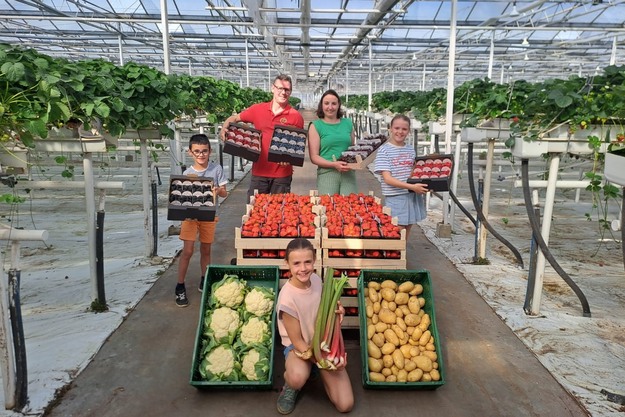
Franc with his family

For Goertz’s third crop, blueberries, he has no plans to expand. “We are maintaining our plantation, but not increasing it. Last year, the harvest and price of blueberries were good, but it is and remains a difficult crop because it is so easy to transport. You can ship blueberries over long distances, and they can be supplied more cheaply from abroad. Our main crop remains asparagus, sweet potatoes are a product on the rise alongside it, and we are keeping blueberries stable.”

For more information:
Franc Goertz
Goertz Asperges BV
Veestraat 20
6105 AB Maria Hoop
info@goertzasperges.nl
www.goertzasperges.nl