Archive

China expands blueberry production and market reach by FreshPlaza

China expands blueberry production and market reach

In less than a decade, China has evolved from an emerging player into the world’s main hub for blueberry production. This development was driven by large-scale investment, genetic research, growing domestic demand, and a vertically integrated production model that connects genetics, cultivation, and marketing.

In 2010, China had only a few experimental hectares of blueberries. Today, more than 90,000 hectares are planted, with output increasing at double-digit rates. Production spans from Yunnan and Shandong to modern greenhouse systems in Liaoning. Blueberries have become a preferred fruit among the middle class, associated with health and convenience, which has expanded local consumption alongside export capacity.

Until recently, China depended on imports from Peru, Chile, and Mexico during off-season periods. That balance has shifted as major companies such as Joy Wing Mau, Dalian Yidu, and Haisheng Group invested in a variety of licenses, genetics, and post-harvest infrastructure. Government programs promoting fruit with high nutritional value supported this expansion. Imports from Peru and Chile continue during the winter, but local production now covers nearly 80 percent of total consumption, with quality levels matching those from southern hemisphere suppliers.

One driver of this growth has been the rapid adoption of patented varieties through collaborations with Fall Creek, Ozblu, and Mountain Blue Orchards. Regional breeding centers and universities, including Zhejiang University and the Chinese Academy of Agricultural Sciences, are developing varieties adapted to local climates and using gene-editing programs to improve resilience and post-harvest quality. Greenhouse and hydroponic systems have expanded across multiple regions, allowing growers to manage temperature, light, and nutrients year-round.

Domestic consumption continues to rise. Online platforms such as Tmall and JD.com report annual berry sales growth above 30 percent, concentrated in major cities like Shanghai, Beijing, and Guangzhou. Imported blueberries, particularly from Peru and Chile, remain popular, but the gap in size and firmness is narrowing each season.

China’s logistics network supports this integrated model. Cold-chain facilities, rail corridors, and traceability platforms enable fruit harvested in Yunnan to reach Shanghai within 36 hours. Precision agriculture, artificial intelligence, and sensor-based management systems are now standard practice. The result is a digital production chain linking nurseries, farms, and retailers, allowing continuous monitoring and forecasting.

While the United States historically led the global blueberry industry, China has now surpassed it in planted area and is approaching similar consumption levels. Growth in the U.S. has slowed, while China’s combination of private innovation and policy support continues to expand domestic capacity.

Industry analysts expect China’s consumption to double by 2030. Southern Hemisphere exporters, including Peru, Chile, and Mexico, remain essential suppliers during China’s low-production months, while Morocco’s early window aligns well with southern China’s demand. Chinese companies are also investing in foreign farms, and Latin American growers are studying China’s model of digital integration and supply chain coordination.

Source: Blueberries Consulting

Frontpage photo: © Mitch Hutchinson | Dreamstime Publication date: Mon 10 Nov 2025

U.S. blueberry imports rise to meet year-round demand by Produce Business and FreshPlaza

U.S. blueberry imports rise to meet year-round demand

Blueberry imports to the United States have reached record levels as year-round demand continues to expand. According to the U.S. Highbush Blueberry Council (USHBC), headquartered in Folsom, California, consumption has risen sharply over the past two decades. Per capita consumption increased from 0.26 pounds in 2000 to 2.54 pounds in 2021.

In 2024, U.S. imports of fresh blueberries reached 684 million pounds, up 22% from the previous year and valued at US$2.18 billion. The USDA’s Economic Research Service (ERS) reported that blueberries ranked as the fourth most valuable fresh fruit import after avocados, bananas, and grapes.

“Consumers want blueberries year-round now,” said Marc Goldman, produce director at Morton Williams Supermarkets in New York. “During the fall, winter, and spring, the imported fruit has proven to be a strong and reliable source for national promotions, with consistency in the supply chain, quality, and flavor profile,” added Tom Linaris of Katzman, a berry buyer at Hunts Point Terminal Market.

Peru, Mexico, and Chile account for nearly 90% of U.S. blueberry imports, complementing domestic production from 38 states, led by Washington, Oregon, and Georgia. Peru’s harvest peaks between October and December, Mexico supplies from September to May, and Chile ships from December to February. Canada, Argentina, Uruguay, and Colombia also supply fruit during shorter seasonal windows.

“Roughly two-thirds of fresh blueberries sold in the U.S. now come from imports, so these windows are critical for us,” said Stevie Shandler of Shapiro-Gilman-Shandler Co. in Los Angeles. Peru and Chile remain subject to a 10% reciprocal tariff, while Mexico and Canada are exempt.

Brian Bocock, vice president of product management at Naturipe Farms, said both Chile and Mexico are “re-inventing themselves through improved genetics that are focused on firmness and flavor.” Colombia is also expanding its presence in the early-season window from February to April.

Retailers have diversified their blueberry offerings by size, packaging, and production type. “Jumbo-size blueberries jump out on the shelf and have been a game-changer that drives dollars in the category,” said Jason Kazmirski of Charlie’s Produce in Seattle. Organic blueberries now represent about 15% of total U.S. imports.

Kasey Cronquist, president of the USHBC, said imported fruit allows a continuous supply throughout the year. “These imports complement domestic production, keeping blueberries in front of consumers in the produce department.” The council’s ongoing strategy focuses on maintaining a steady supply while promoting blueberries as a year-round, flavor-forward product for global consumers.

Source: Produce Business

Frontpage photo: © Nina Osintseva | Dreamstime Publication date: Wed 5 Nov 2025

Les robots au service des agriculteurs : des pilotes à la pratique par FreshPlaza

Penser et développer de nouvelles techniques n’est une réussite que si les producteurs parviennent à les mettre en œuvre. L’ouverture d’Hortivec, un centre de démonstration, de rencontre et d’expérience pour la technologie agricole et horticole à Wavre-Sainte-Catherine, a mis l’accent sur la mise en pratique des nouvelles techniques. Frits van Evert, de l’université et de la recherche de Wageningen, s’est également attardé sur cette question lors de son discours d’inauguration intitulé ‘From Idea to Practice: Agricultural Robots in Action’.


Frits van Evert lors de l’ouverture de l’Hortivec

Van Everts a présenté les résultats du projet Rob4Crops. Le chercheur en agriculture de précision estime que les nouvelles technologies ont un rôle important à jouer pour relever les défis dans des domaines tels que le climat et la protection des cultures. « Car si les défis sont nombreux, les robots sur le terrain ne le sont pas encore. » Il y a quelques années, il a été décidé de lancer le projet Rob4Crops, qui a permis d’identifier les obstacles à la progression des robots dans la pratique.

Capteurs et logiciels
Dans le cadre du projet, quatre pilotes à grande échelle ont été réalisés. Ils ont mis en évidence les difficultés liées à la mise en pratique des robots. Entre autres, le rôle de bons capteurs pour aider le robot à naviguer s’est avéré important. « Un robot seul ne suffit pas. Outre les capteurs, un bon logiciel de contrôle s’est également avéré crucial. »

Des projets pilotes ont été menés en France et en Grèce pour le raisin de table, en Espagne pour les pommes et aux Pays-Bas pour la betterave sucrière. Dans tous les cas, la robotique a été utilisée pour résoudre des problèmes de protection des cultures.

Tirer des leçons de la pratique
C’est en France que le projet pilote a eu le plus de succès, dans la mesure où des désherbeurs mécaniques sont désormais utilisés dans les champs, ce qui permet d’éviter ou de limiter l’utilisation d’herbicides. Van Everts s’attend à une application pratique en Espagne, où un tracteur équipé d’un pulvérisateur de précision a été utilisé, après que la conduite avec un signal GPS défaillant ait été résolu par l’ajout de techniques supplémentaires telles que Lidar.

En Grèce, la combinaison d’un tracteur et d’un pulvérisateur ne s’est pas avérée idéale pour la situation locale, car le pulvérisateur était trop lourd. L’accent a alors été mis sur la conduite autonome du tracteur.

Aux Pays-Bas, Smart Agri Technology a participé au projet pilote. L’objectif était de désherber dans la culture de la betterave à sucre, mais les producteurs se sont montrés trop sceptiques. et n’en sont pas arrivés à l’application pratique. Cependant, l’équipe de Smart Agri Technology a réussi à les faire passer à la protection des cultures de précision, avec un pulvérisateur zonal.

« Je ne vends pas de recettes », a reconnu van Everts après 3/4 d’heure d’exemples pratiques. La meilleure façon de commercialiser une nouvelle technique reste toujours un défi. Lors d’une visite des serres et des champs à Wavre-Sainte-Catherinent dans le cadre de l’ouverture d’Hortivec, les participants ont pu rencontrer diverses entreprises qui mettent également en pratique de nouvelles techniques.

https://www.youtube.com/embed/l7krcg4ZvWY?si=e11YQqdECNrEFfQ0Plusieurs vidéos sont disponibles à propos du projet Rob4Crops

Photo de la première page: © Rob4Crops Date de publication: mar. 28 oct. 2025

© FreshPlaza.fr / Thijmen Tiersma

« Le développement durable, c’est aussi oser faire des choix difficiles » chez Teboza par FreshPlaza

Teboza (Pays-Bas)

« Le développement durable, c’est aussi oser faire des choix difficiles »

Teboza va fortement diminuer ses activités liées à la culture chauffée d’asperges blanches en plein air. Ce faisant, l’entreprise vise à réduire les émissions de CO2 générées. Teboza est le premier grand producteur et fournisseur d’asperges fraîches à prendre cette mesure. La décision d’accélérer la réduction a été motivée par l’ambition de l’entreprise de continuer à fournir à ses clients de manière responsable et à un coût raisonnable.

Chauffage au champ
La culture chauffée de l’asperge blanche fait appel à un système de tuyaux enterrés juste sous la plante afin de maintenir le sol à température. Ce chauffage au champ permet aux asperges de sortir plus tôt de leur dormance hivernale et au producteur de réduire sa dépendance à l’égard des conditions météorologiques.

Dans de nombreux cas, des combustibles fossiles sont utilisés. Bien que Teboza ait toujours cherché à minimiser son impact sur l’environnement, même avec ses cultures chauffées, une analyse d’impact récemment menée a décidé l’entreprise à abandonner cette méthode de culture plus tôt que prévu. Will Teeuwen : « Accroître la durabilité signifie également oser faire des choix difficiles. Dans le cas présent, nous disons donc adieu à une innovation dont nous avons nous-mêmes été à l’origine. Cependant, nous pensons que cette étape est nécessaire pour renforcer la position particulière de la culture néerlandaise de l’asperge. »

(Presque) dépassée par les innovations
« La période pendant laquelle la culture chauffée, relativement coûteuse, devance la culture traditionnelle est plus courte chaque année. Les innovations dans les variétés d’asperges, les nouvelles techniques de culture et les changements climatiques font que les asperges issues de la culture non chauffée sont disponibles de plus en plus tôt. En outre, au début de la saison, l’offre d’asperges savoureuses et cultivées de manière responsable en provenance du sud de l’Europe prend de l’importance. »

Pour plus d’informations :
Will Teeuwen
Teboza
Tél. : +31 773071444
w.teeuwen@teboza.nl
www.teboza.com

Photo de la première page: © Teboza Date de publication: lun. 3 nov. 2025

U.S. blueberry imports rise to meet year-round demand by FreshPlaza

U.S. blueberry imports rise to meet year-round demand

Blueberry imports to the United States have reached record levels as year-round demand continues to expand. According to the U.S. Highbush Blueberry Council (USHBC), headquartered in Folsom, California, consumption has risen sharply over the past two decades. Per capita consumption increased from 0.26 pounds in 2000 to 2.54 pounds in 2021.

In 2024, U.S. imports of fresh blueberries reached 684 million pounds, up 22% from the previous year and valued at US$2.18 billion. The USDA’s Economic Research Service (ERS) reported that blueberries ranked as the fourth most valuable fresh fruit import after avocados, bananas, and grapes.

“Consumers want blueberries year-round now,” said Marc Goldman, produce director at Morton Williams Supermarkets in New York. “During the fall, winter, and spring, the imported fruit has proven to be a strong and reliable source for national promotions, with consistency in the supply chain, quality, and flavor profile,” added Tom Linaris of Katzman, a berry buyer at Hunts Point Terminal Market.

Peru, Mexico, and Chile account for nearly 90% of U.S. blueberry imports, complementing domestic production from 38 states, led by Washington, Oregon, and Georgia. Peru’s harvest peaks between October and December, Mexico supplies from September to May, and Chile ships from December to February. Canada, Argentina, Uruguay, and Colombia also supply fruit during shorter seasonal windows.

“Roughly two-thirds of fresh blueberries sold in the U.S. now come from imports, so these windows are critical for us,” said Stevie Shandler of Shapiro-Gilman-Shandler Co. in Los Angeles. Peru and Chile remain subject to a 10% reciprocal tariff, while Mexico and Canada are exempt.

Brian Bocock, vice president of product management at Naturipe Farms, said both Chile and Mexico are “re-inventing themselves through improved genetics that are focused on firmness and flavor.” Colombia is also expanding its presence in the early-season window from February to April.

Retailers have diversified their blueberry offerings by size, packaging, and production type. “Jumbo-size blueberries jump out on the shelf and have been a game-changer that drives dollars in the category,” said Jason Kazmirski of Charlie’s Produce in Seattle. Organic blueberries now represent about 15% of total U.S. imports.

Kasey Cronquist, president of the USHBC, said imported fruit allows a continuous supply throughout the year. “These imports complement domestic production, keeping blueberries in front of consumers in the produce department.” The council’s ongoing strategy focuses on maintaining a steady supply while promoting blueberries as a year-round, flavor-forward product for global consumers.

Source: Produce Business

Frontpage photo: © Nina Osintseva | Dreamstime Publication date: Wed 5 Nov 2025

White asparagus peeler to increase consumption in France by FreshPlaza

Enya Vermuë, Agrivaloire

White asparagus peeler to increase consumption in France

Agrivaloire has been operating in the asparagus sector for 35 years, with expertise handed down from generation to generation. Founded by the parents of Enya Vermuë, who now runs the company, Agrivaloire initially built its reputation on the sale of asparagus plants before expanding its business in response to a growing problem: the lack of manpower in farms. “We gradually developed partnerships with European manufacturers that could provide machines to help growers,” explains Enya Vermuë. Thanks to her father’s Dutch origins and his many contacts in Belgium, the Netherlands, and Germany, Agrivaloire now plays an essential intermediary role between foreign suppliers and the French market and provides after-sales service.

Enya Vermuë at IAD 2025, presenting the Peelmaster Mini peeler from Tenrit Foodtec

A must-have machine in Germany, a novelty in France
Agrivaloire will be exhibiting a number of machines from its partners at the IAD-IBD, including various models of asparagus peelers. “This machine has been around for more than 25 years in Germany, but is still seen as an innovation in France,” explains Enya Vermuë. Coincidentally, the consumption of white asparagus in Germany is much higher than in France.

“At the time, a study highlighted the fact that in Germany, the time spent preparing meals was much shorter than in France: 25-30 minutes compared with 1h30. Using this machine saves precious preparation time. Today, the French have also reduced the time spent preparing meals to around 30 minutes. Habits have changed, and perhaps it is time to adapt our tools to this new lifestyle.”

According to a study published by CTIFL in 2025 on the perception of asparagus, 56% of non-consumers say it takes too long to prepare asparagus, and 45% say they do not know how to cook it. Peeling, in particular, is seen as an awkward, technical, discouraging stage for younger consumers. The asparagus peeler could therefore respond to a societal change in the French market, as it did in Germany, by simplifying preparation and making asparagus consumption more accessible. According to Enya Vermuë, this tool could even be “a lever for boosting consumption of white asparagus in France.”

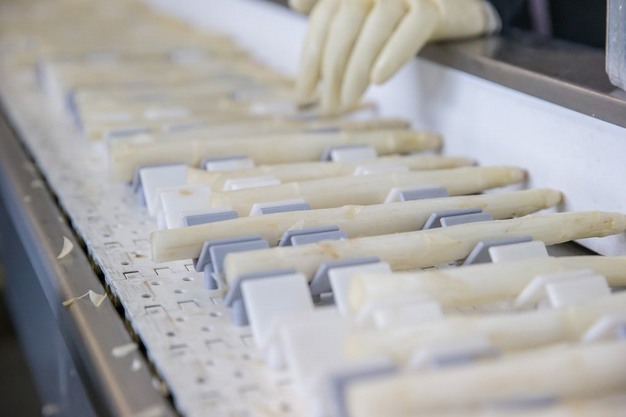
Asparagus peeler: the industrial model presented at the IAD show

Three models to suit all needs
At the show, Agrivaloire presented three models that meet very different needs. The first, an industrial model, is the historic version, with its many settings and options. The second, a self-service model designed to be installed directly next to the asparagus section in supermarkets, attracted a great deal of interest. “As well as being extremely practical, it is a fun way to liven up the aisle: it is the star of the display!”

Finally, Tenrit Foodtec’s Peelmaster Mini is a compact version, launched last year, aimed at small shops and convenience stores. “The Peelmaster Mini peels 1 kg of asparagus in 20 seconds. There are no buttons or settings. The asparagus is inserted on one side and comes out perfectly peeled on the other. It will be available on the French market for rent or purchase from 2026.” These last two versions stand out for their ease of use.

A good response from the French market
While the French market was still cautious two years ago, attitudes are changing. “Last year, we leased six machines and sold three models. For a launch, that is already very encouraging.” This year, the number of contacts and demonstrations at the show confirms the growing interest in this type of equipment.

By making it easier to prepare asparagus, Agrivaloire hopes to stimulate French consumption, which is still modest compared to that of its European neighbors. This approach is fully in line with the company’s mission: to support the asparagus sector by innovating and making life easier for producers and consumers alike.

For more information:
Enya Vermuë
Agrivaloire
enya.vermue@agrivaloire.fr

Les robots autonomes étendent les opérations culturales aux États-Unis et au Royaume-Uni avec Saga Robotics as Thorvald et par FreshPlaza

Saga Robotics a achevé sa plus grande saison opérationnelle à ce jour aux États-Unis et au Royaume-Uni, marquant une expansion de sa plateforme autonome Thorvald. L’entreprise a fait état d’un déploiement accru, d’un temps de fonctionnement plus élevé et d’une extension des services dans des cultures clés, notamment le raisin et les fraises.

Les robots autonomes étendent les opérations culturales aux États-Unis et au Royaume-Uni

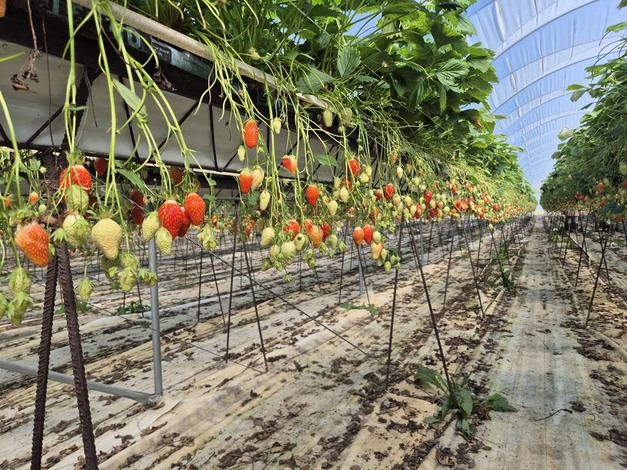
En Californie, les robots Thorvald ont couvert près de 1 300 acres de vignobles au cours de la saison 2025, tandis qu’au Royaume-Uni, ils ont opéré sur environ 20 % du secteur des fraises de table. Au total, plus de 150 robots ont atteint un taux de disponibilité de 97 %, enregistrant plus de 200 000 kilomètres autonomes, soit trois fois plus que la saison précédente.

Selon Saga Robotics, la technologie de la lumière UV-C utilisée dans les systèmes Thorvald est conçue pour cibler les pathogènes fongiques tels que l’oïdium en perturbant l’ADN. Le professeur Pål Johan From, fondateur et directeur général pour les États-Unis, a déclaré que les performances du système reposaient sur une application précise. “Si l’on en applique trop peu, la maladie fongique se rétablit, ce qui peut entraîner une épidémie. Une quantité trop importante appliquée de manière incorrecte risque de réduire les performances de la plante”, a-t-il déclaré.

Après la saison 2025, Saga Robotics a confirmé que tous les clients actuels prévoyaient de continuer à utiliser le service, et que plusieurs d’entre eux élargissaient leur zone d’activité. En Californie, l’entreprise a l’intention de tripler la couverture des vignobles et d’introduire un nouveau modèle Thorvald conçu pour la viticulture, doté d’une suspension améliorée, de roues plus grandes et d’une compensation automatique de l’inclinaison pour une utilisation sur des terrains irréguliers.

Saga Robotics lance également un service de collecte de données pour aider les exploitants de vignobles à estimer les récoltes et à planifier les vendanges. Le nouveau système utilise des caméras et des capteurs embarqués pour détecter et compter automatiquement les grappes de raisin, fournissant ainsi des données en temps réel sur la charge de la récolte.

Un service de données similaire a déjà été déployé dans la production de fraises au Royaume-Uni en partenariat avec Chambers Farm et Bitwise. Chaque robot aurait compté plus de trois millions de fruits et de fleurs par nuit, générant des données de production détaillées. Saga Robotics a déclaré qu’il prévoyait d’étendre ce service à une zone plus vaste au cours de la saison 2026.

Les améliorations opérationnelles au Royaume-Uni comprenaient l’utilisation de convois autonomes, une meilleure détection des objets et une surveillance à distance 24 heures sur 24 et 7 jours sur 7 à partir d’un centre d’opérations. Les producteurs ont désormais accès à des tableaux de bord en direct et à une assistance technique tout au long de la saison. La société a pour objectif d’augmenter sa part du secteur des fraises de table au Royaume-Uni à 30 % l’année prochaine.

Sacha de La Noë, directeur général, a déclaré que la stratégie de l’entreprise restait axée sur l’expansion tout en maintenant la qualité du service et l’efficacité des coûts. Selon Saga Robotics, les opérations UV-C de cette saison ont permis d’éliminer 133 tonnes de fongicides, d’éviter 4 450 tonnes d’émissions de CO₂ et de réduire l’exposition des travailleurs aux produits chimiques d’environ 85 200 heures.

L’entreprise a déclaré que les préparatifs pour la prochaine saison de croissance sont déjà en cours, avec des plans pour continuer à étendre les services de gestion des cultures à la fois robotisés et guidés par les données en 2026.

Pour plus d’informations :
Tale Hagelsteen
Saga Robotics as Thorvald
Tél. : +47 938 05615
thagelsteen@sagarobotics.com
www.sagarobotics.com